Saints with a Past, Witnesses of Grace

Homily: Solemnity of Saints Peter and Paul, Apostles

Readings: Acts 12:1–11; 2 Timothy 4:6–8, 17–18; Matthew 16:13–19

29 June 2025 

Fr. Ricky Cañet Montañez, AA

Today we celebrate two giants of our faith: Peter and Paul — pillars of the Church, apostles, martyrs, and saints. They were responsible for the spreading of the faith among the Jews and the Gentiles — essentially the whole world. 

These days that job rests mainly on the shoulders of priests. It is a tough job because we give up so much of regular life to care for the people of God and propagate the faith.  If you think that many of us are not skilled enough to be priests, many of us feel the same way about ourselves. We are very aware of our own limitations and shortcomings. We often wonder why God chose us. In times like these, what strengthens us is the knowledge that the pillars of the Church were not perfect either. Peter, impulsive and emotional, swore he would never abandon Jesus — only to deny Him three times on the night of His arrest.  Paul, brilliant and zealous, did not just reject Jesus — he actively persecuted Christians, dragging them from their homes and sanctioning their deaths.  Like Peter and Paul, we priests are not sinless men. We are all wounded men in the same way you are. Like you, we also need to examine our conscience and go to confession. As we have roles to play in building Christ’s Church, so do you. Yes, let us not allow our imperfections to cast doubts on our worthiness to serve God.  Let us always keep this in mind: Jesus chooses the imperfect to work wonders in His Church. 

In the Gospel today, Jesus asks: “Who do you say that I am?” (Matthew 16:15) Peter, inspired by the Father, answers: “You are the Christ, the Son of the Living God.” (Matthew 16:16) And Jesus declares: “You are Peter, and on this rock I will build my Church.” (Matthew 16:18) Christ is not referring to Peter the perfect disciple — but Peter, the forgiven one. The same Peter who, in today’s First Reading from the Acts of the Apostles, finds himself in prison, shackled, awaiting death — until an angel sets him free. Peter knew that the same God who forgave him was the same God who could deliver him.  Paul, in the Second Reading, looks back at his life: “I have fought the good fight, I have finished the race, I have kept the faith.” (2 Timothy 4:7) however, let us listen to what else he says: “The Lord stood by me and gave me strength… I was rescued from the lion’s mouth.” (2 Timothy 4:17) He never says, “I earned this.” He says, “God did it. God rescued me.”  That is the heart of today’s feast. Not that Peter and Paul were strong — but that God was stronger than their weakness. Not that they were holy from the start — but that they let grace change them. 

In the movie Green Bones, there is a scene where Domingo Zamora says, “Hindi ako mabuting tao.” (“I am not a good person.”) Grossly aware of his errors in life, he is not proud of the things he had done. He is very much convinced that his past disqualifies him from experiencing good.  “I have made too many mistakes.” “I am not worthy to serve.” “God cannot use someone like me.” Maybe sometimes we say these to ourselves, too. 

However, please pay attention to what Prison Chief Inspector Jorge de los Santos tells him: “Kung bibigyan mo ang sarili mo ng pagkakataon, puwede kang lumaya.” (“If you give yourself the chance, you can earn your freedom.”) That is the same grace Peter and Paul received. God did not erase their past, but He granted them freedom from the stigma of their mistakes. God does not pretend our wounds do not exist; He transforms them into signs of hope.  As Paul once wrote: “By the grace of God, I am what I am.” (1 Cor 15:10) And as St. John Paul II echoed centuries later: “We are not the sum of our weaknesses and failures, but the sum of the Father’s love for us.” 

Thus today, let us stop hiding our wounds. Let us stop saying, “I’m not good enough.” Moreover, let us start saying, “God is good enough to use even me.” Peter and Paul did not just tell people about Jesus. They told people what Jesus had done in them. Let us do the same. Our story — yes, even the messy parts — might be exactly what someone else needs to hear.  May we have the humility and courage of Peter and Paul — not just to preach the Gospel, but to live it through the story of what God has done in our lives!
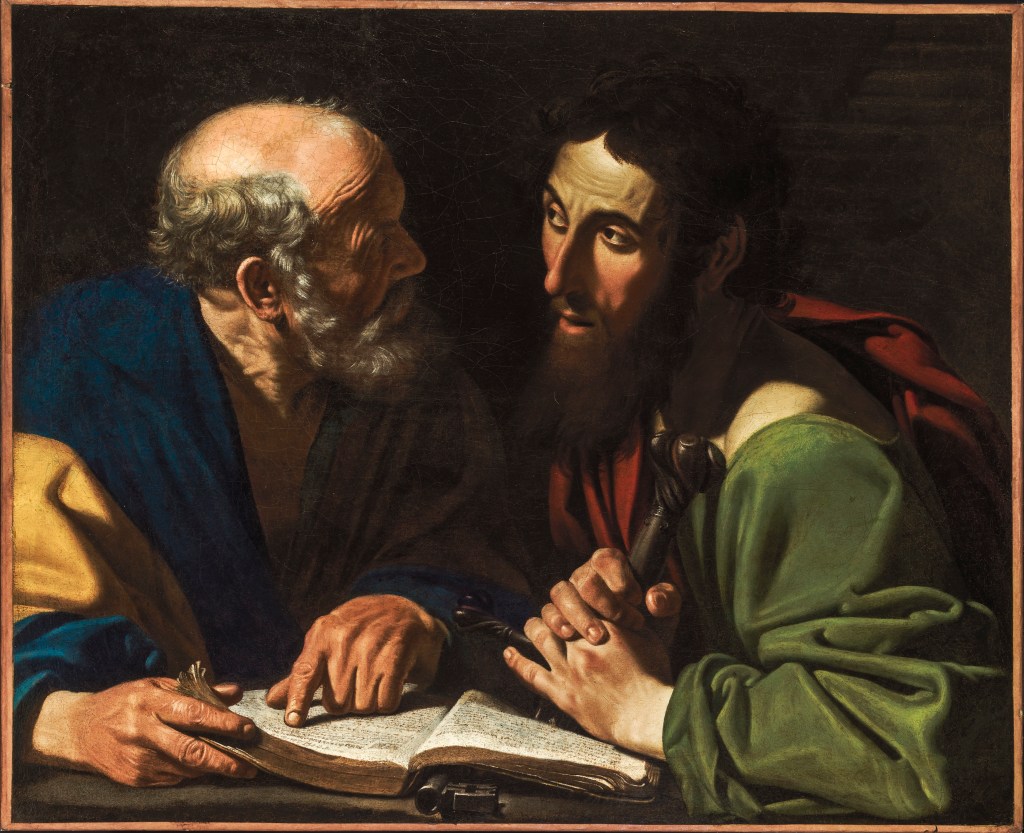
Attributed to Pietro Antonio Novelli (Kress Foundation)

Taken, Blessed, Broken, Given

Homily: The Solemnity of the Most Holy Body and Blood of Christ (C)

Luke 9:11-17

22 June 2025 

Fr. Ricky Cañet Montañez, AA

Today, we celebrate Corpus Christi Sunday.  We honour the Body of Christ which we experience through the Blessed Sacrament or Consecrated Hosts during Communion and the Eucharistic Adoration. 

Later, during the Liturgy of the Eucharist let us listen closely to the prayers over the bread and wine.  I will mention that Jesus took the bread, blessed it, broke it, and gave it to His disciples.  “TAKEN”, “BLESSED”, “BROKEN”, “GIVEN” — these are not just words uttered in a ritual.  They are the heart of the Eucharist, and they reveal what Jesus wants to do with us.  Like the bread in the Gospel, Jesus takes us, just as we are, even when we feel small, tired, or unworthy.  He blesses us, reminding us that we are loved and chosen. He breaks us, not to hurt, but to open our hearts in love.  Moreover, He gives us to be a blessing to others. 

Allow me to share an experience which happened mere months after my ordination.  I had been sent to an apostolate area to celebrate masses but one mass made such an impact on me. During communion, I suddenly felt a weight settle in my chest as I said the words, “The Body of Christ” over and over again. I had distributed communion many times before but never before had I felt a quiet awareness, almost like a whisper in the soul. I felt like bursting into tears. It was neither stress nor pressure but rather the deep realisation that it was Jesus I was holding in my hands!  I was vividly aware of the immense responsibility — the sacred trust, the calling which I was asked to carry in my life. 

“Lord, who am I to be doing this?” I knew I did not earn nor deserve the opportunity. I felt anxious and fearful that I would fail and be disappointing to God and to those who believed in me.  By God’s grace, I remembered that Jesus took me, just as I was, with all my flaws, fears, and wounds. He took me, not because I was the best nor the most worthy, but because He loved me. Despite all my limitations as a person, He entrusted me with this ministry anyway.  Not only did He take me from where I was, but He gave to me the people I now serve. He gave me this calling. He gave me to this very moment of grace — and still gives me, every day, to others in ways I never imagined. 

The miracle of the Eucharist is foremost that Christ becomes food for us but it does not end with Him giving us His Body — He makes us part of His Body! He takes us, blesses us, breaks us open in love, and then sends us to become nourishment for others. Jesus does not come to us because we are perfect and deserving. He comes to us because He loves us and He knows we need Him. In return, at the very least, we must prepare our hearts to receive Him by avoiding sin, and receiving the Sacrament of Reconciliation regularly. 

Today and on the Sundays to come, I encourage you to be more mindful whenever you line up for communion. Receive the Body of Christ with grateful hearts and pray that we become what we receive: blessed, broken, and shared — for the life of the world.

Created, Redeemed, Empowered: The Work of the Trinity

Homily: Solemnity of the Most Holy Trinity (C)

John 16:12-15

15 June 2025

Fr. Ricky Cañet Montañez, AA

When I was very young, I would like to believe that I did quite well in Math. Arithmetic was simple for me. 5-5 is zero; 5+ 5 is 10; 1+1 is 2. That is what is nice about Math. Even, complex mathematical equations are solvable. It is absolute. If you persevere, you will get the answer.  When I was coming into an understanding of our faith and especially the Holy Trinity, I got so confused because suddenly, 1+1+1 equals ONE. 

Today, we celebrate the Solemnity of the Most Holy Trinity.  It is a mystery at the heart of our faith. One God in three Persons: Father, Son, and Holy Spirit. They are distinct in characteristics and functions, but integral to one whole. It is very difficult to explain more precisely and I will not attempt it today. I will however tell you what the Holy Trinity is NOT and how we can prove the existence of all three persons by simply going over today’s readings. 

The persons of the Trinity are not simply costumes worn by one person or various roles played by one actor. They are neither distinct parts of one body like the Frankenstein Monster nor are they Japanese robots that have separate vehicles that volt in to form a super robot. In the Creed, we mention that they are consubstantial. They are of the same substance, essence, and power but different in their function and how they manifest to humanity. 

In the First Reading from the Book of Proverbs, we hear about God the Father who is the Creator.  Wisdom is at God’s side during creation — delighting in the world, and especially in us. This details the Father’s joy in creating us and sharing His life with us. Throughout the Old Testament we hear about the relationship between God and humanity in its early stages, where God reveals Himself through the prophets and establishes a covenant with His people. 

We know that the covenant is broken many times and attempts to re-establish this fail constantly due to the weaknesses and infidelity of humanity. This creates a divide between God and His people. However, God remains merciful and promises a Messiah who will liberate His people once and for all.   In the Second Reading, St. Paul tells us that we finally have peace with God through His own Son, Jesus. Through the Son, we are no longer outsiders — we have been welcomed back into God’s family. The gospels detail the life of Jesus who lived among us, bridging and reconciling humanity with the God who created all things. 

Last week, we celebrated the Solemnity of Pentecost — the descent of the Holy Spirit who empowers us and pours God’s love into our hearts, making divine love real and personal.  In today’s gospel passage from St. John, Jesus speaks of the Spirit who will guide us into truth, taking what belongs to the Father and the Son and declaring it to us.  Jesus Himself reveals this truth — so how can we possibly dispute His words? This truth about the Holy Trinity is a profound expression of complete unity — a love shared by the Father, the Son, and the Holy Spirit — that now embraces us as well.

On this Solemnity of the Most Holy Trinity, let us be mindful of how the Father, the Son and the Holy Spirit remain present with us, especially during the Holy Mass.  It is a memorial of how Jesus bridges the gap created by humanity with God the Father. In the liturgy of the Eucharist, Jesus willingly offers Himself as a pleasing sacrifice to the Father to make amends for the grave offences of humankind against God. It is not a simple re-enactment. Without leaving the Church, we are brought into the very moment of the Last Supper and the Crucifixion — when these events truly take place — and we, who are present, become recipients of Christ’s saving act. At the final blessing, the priest calls on the Holy Spirit to descend upon those present to receive spiritual gifts. We bow our heads in reverence and humility to receive the gift of the Father through the Holy Spirit. 

Our whole life on earth is an experience of the Trinitarian God who loves us.  Our Triune God is love — a love that calls us into being, restores our brokenness, and guides our path. Therefore, every time we make the sign of the cross, let us vividly remember the FATHER who lovingly created us and delights in us, the SON who became fully human to redeem us, and the HOLY SPIRIT who lives within us and stirs our hearts. This is far more than mere doctrine — this is the very core of who we are as God’s people.

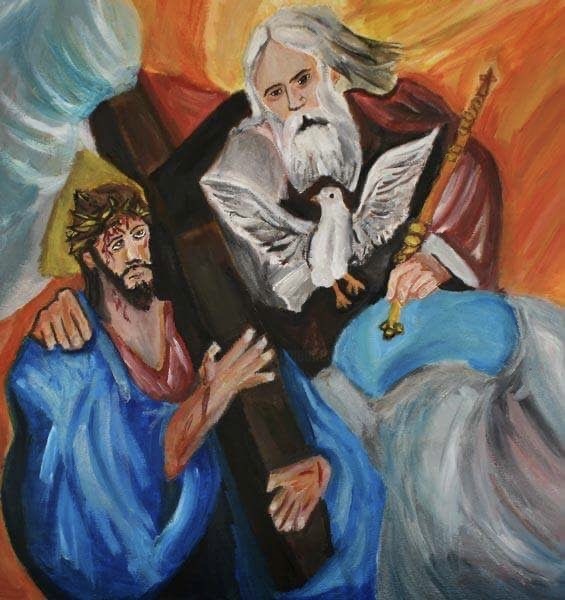
Painting by Shekells89/ArtMajeur

When Life Gives You Tangerines: A Pentecost Perspective

Homily: Solemnity of Pentecost (C)

John 20:19-23

8 June 2025 

Fr. Ricky Cañet Montañez, AA 

Have you heard the phrase: “When life gives you lemons, make lemonade.” Recently I watched a similarly titled Korean Drama called: “When Life Gives You Tangerines”. In the Philippines, we know them more as Ponkan oranges. They generally look sweet, right? However, sometimes, when we peel them open, they are sour, filled with seeds, or they are not what we expect them to be. 

I think that tangerines are a better image for life. We do not live expecting life to be as sour as lemons. Our life is not all sour — some moments are surprisingly sweet and grace-filled. Although we usually approach life with hopeful expectations, the reality of life can sometimes catch us off guard. We often embark on endeavours expecting things to go smoothly — but instead, we get challenges, confusion, delays, or disappointments. Maybe we were hoping for peace — but encounter anxiety. We expect joy — but found stress or pain. 

Today, we celebrate the gift of the Holy Spirit — the breath of God that gave life to the Church and continues to empower us every day. It is the same Spirit that helps us adapt and overcome the daunting things in life. In John 20, the disciples were so traumatised by Jesus’ crucifixion that they were hiding behind locked doors, afraid and unsure. Jesus comes and says, “Peace be with you.” (John 20:19) Then He breathes on them: “Receive the Holy Spirit.” (John 20:22) This act did not change their situation — Rome was still in power; the world was still uncertain. Nevertheless, this act of Jesus changed them. It gave them the courage to eventually go out, to speak boldly, to live fully — even with fear, even with setbacks. That is the miracle of the Pentecost account in Acts 2 as well. The Spirit came like wind and fire — and the disciples began to speak in new ways. They did not become great leaders and speakers overnight — but they were empowered to serve, to witness, to love. It took all their lives for them to hone their gifts but in the end, they achieved the task Jesus left for them. 

That is also what the Holy Spirit does for us. He may not remove the “tangerines” — the surprises, the sour parts of life — but He helps us taste them differently. He gives us strength in weakness, peace in chaos, and joy — even in sorrow. As St. Paul says, “There are different gifts, but the same Spirit… given for the common good.” (1 Corinthians 12:4-7) Each of us has been given something — a gift for our family, our Church, our world. Each of us has something to offer to make life better together. Thus, when the tangerines of life are less than sweet, let us avoid praying, “Lord, take this away,” but ask instead, “Lord, how can I grow through this?” 

This Pentecost, let us remind ourselves that we do not need everything in life to be perfect. The truth is, life never is. When we are under the impression that our life is, trust that it will not last. This is the nature of life.  What matters is, we receive Christ’s gift of the Holy Spirit and allow ourselves to be led and guided by Him. Hence, the next time life gives us “tangerines” — when things do not turn out how we planned, let us remember this: We do not need perfect circumstances to live a Spirit-filled life. We just need to open our heart and let the Spirit work — right where we are. The Holy Spirit knows exactly how to turn every piece of our life into something fruitful, so that it feeds, heals, and blesses others. 

This is the meaning of Pentecost for us. Let us live our lives in the knowledge that although Jesus has ascended to the Father, He did not leave us alone to deal with the challenges of life.  The Holy Spirit is ever present guiding us, sustaining us, empowering us, and working to consistently gather us all under the grace and protection of our loving Father.

By: Fernando Oramas (Saatchi Art)

Clothed with Power from on High

Homily: The Solemnity of the Ascension of the Lord (C)

Luke 24:46-53

1 June 2025

Fr. Ricky Cañet Montañez, AA

How many are retirees here? Please raise your hand? Normally the retirement age is sixty (60) or sixty-five (65) but there are some who opt for early retirement and still others can retire much later in life like doctors, authors, business owners, priests, etc. Do you remember what it was like on your last day at work? Was there a formal turnover? Were your colleagues sad to see you go or happy that you were finally leaving? (Just kidding.) Most often retirement demands from us a letting go of the role we once carried, the routine we followed, the busyness that filled our days. It is an end, but also a beginning. 

The Ascension of Jesus was sort of His last day of work on earth. In the First Reading from the Acts of the Apostles, we hear of that dramatic moment when Jesus is lifted up before the eyes of His disciples and taken into heaven. The disciples are left staring up at the sky, perhaps feeling what many of us feel after a major change in life — “What now?” Suddenly, there is quiet where there once was constant noise and movement. Now that their boss, their rabbi, their master has departed, there was a stillness that also felt like a loss. 

However, the Ascension was not just about Jesus leaving. We mentioned earlier that retirement is both an end and a beginning. In this case, Christ’s departure was making space for the Spirit to come and continue the work Jesus started by empowering His followers.  Jesus left but He did not abandon the Apostles. He told them to wait in Jerusalem where they would receive the Father’s promise and be baptized with the Holy Spirit. He assured them “you will receive power when the Holy Spirit comes upon you, and you will be my witnesses in Jerusalem, throughout Judea and Samaria, and to the ends of the earth.”  (Acts 1:8) We hear of this again in the Gospel from Luke where Jesus promises that the disciples will be “clothed with power from on high” (Luke 24:49) — a reference to the coming of the Holy Spirit. He then blesses them and is taken up to heaven.  

Jesus ascended to the Father but throughout His brief ministry He made sure that the Apostles were prepared and able to continue the mission.  On His last day, He promises them a parting gift. That gift is what enabled the Good News to reach us today.  In turn, this mission has been entrusted by the Apostles, through the ages, to all those who believe in Jesus.   It is by the power of the Holy Spirit that we have become an Apostolic Church, descended of the Apostles, founded on Jesus Christ.  Hence, the Ascension is not the absence of Christ — it is the expansion of Christ’s mission into every corner of the world through His followers. Today, that mission is in our hands.  It is our turn to step up. 

I asked you earlier about how your colleagues reacted to your retirement. Were they happy or sad to see you go? Did you notice that the reaction of the Apostles in our gospel to Christ’s Ascension was not one of sadness or depression.  It is said that they worshipped Him, returned to Jerusalem with great joy, and were continually in the temple praising God. (Luke 24: 52-53) They were joyful because they understood: this was not an ending, but a new beginning. They understood that they had to pick up from where Jesus had left off and although it was daunting, they could not contain the Good News that had overwhelmed them and was bursting from within them. 

Maybe if we find ourselves at the end of a job needing to shift roles at work or in life, let us remember that although we may initially ask ourselves “What now?”, we have to trust that God is not really retiring us — He is redirecting us. He opens new doors for us to serve others in a new environment or a new capacity. The Ascension invites us to stop looking up at what was, and to start perceiving what can be — empowered, sent, and ready for the path God is unfolding for us!

Belonging to God through Love

HOMILY: Sixth Sunday of Easter (C)

John 14:23-29

25 May 2025

Fr. Ricky Cañet Montañez, AA 

Who do you consider family? Does a family member always need to be a blood relative? Do they need to marry into your family?  Some families adopt children, others consider close friends part of their family. Others consider strangers who have helped them tremendously as honorary members of their family. Even pet lovers consider their pets part of their family. How do you decide if someone can be part of your family? 

In today’s Gospel, Jesus discloses the secret to becoming part of His family. He says “Whoever loves me will keep My word, and my Father will love him, and we will come [go] to him and make our home with him.” (John 14:23) Love is the mark of God’s family. It is what identifies us as Christians. This kind of love, Jesus cautions, is not just an emotion or a passing feeling — it’s a way of living. It’s the sign that we belong to Him. His teachings, His example, His works of mercy and healing are all manifestations of a life fuelled and motivated by love. This kind of love is what identifies us as Christians. 

This shouldn’t be new to us. From the earliest days of the Church, love was meant to be the defining mark of the Christian community. Initially there were issues and questions about who could belong to the Church. In our First Reading from the Acts of the Apostles, we hear about the argument whether non-Jews or Gentiles could be accepted. Did they have to follow Jewish law to be accepted? They struck at the heart of what it meant to be part of God’s people. 

Eventually, guided by the Holy Spirit, the Church made a bold, loving decision: to open its doors wide. To welcome people not based on background, ethnicity, nor strict-rule-keeping — but on faith in Jesus and the presence of His Spirit in their lives. It was a reminder that God’s love is always bigger than our boundaries. What is more important is to love Jesus and live by His word. 

Pope St. John XXIII captured this spirit beautifully when he said: “Let there be unity in what is necessary, freedom in what is doubtful, and charity in everything.”

We need unity — we need to hold fast to the essentials of our faith: love, mercy, the dignity of every person.

We need freedom — we give room to explore, to question, to grow, especially in matters that are not central to our faith.

Above all, we need charity — we have to love because even if we get everything else right but have no love, we have missed the heart of the Gospel.

Thus, what does this mean for us today?  It means we are called to be people who welcome, not exclude; who forgive, not judge; who build bridges, not walls. We are called to be known — not for our opinions or positions — but for our love. We must have love for God, love for neighbour, and love even for those we find difficult to love.  It is not how much theology we know, not how often we go to church, not how well we perform religious rituals — but how we love. Hence today, let us ask ourselves:  Am I living a life where people experience love through me? Do I make others feel that they belong?  Do my words, actions, and relationships reflect the presence of God?

Let us hold on to the promise Jesus gives: “We will come [go] to him/her and make our home with him/her.” (John 14:23) Let us remember that when we love, we make space for God to dwell with us. Love is where God feels at home.  Let us be the kind of people where others encounter Christ not through fear nor conditions, but through the open, generous, welcoming love that He showed us. Let us rejoice that we can be part of God’s family!

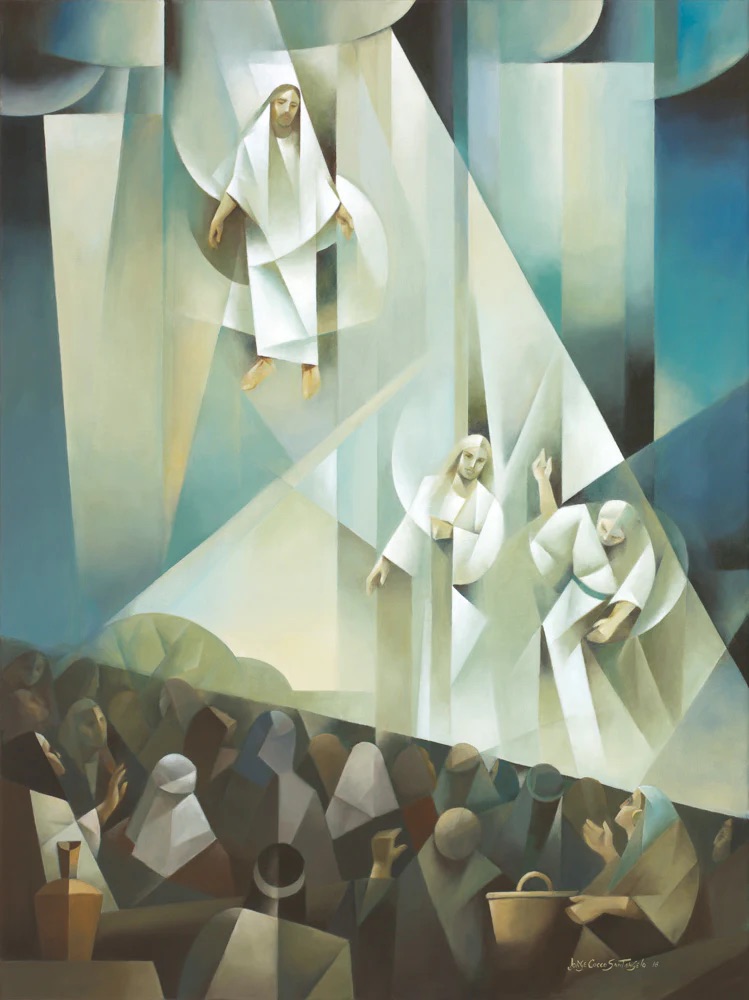
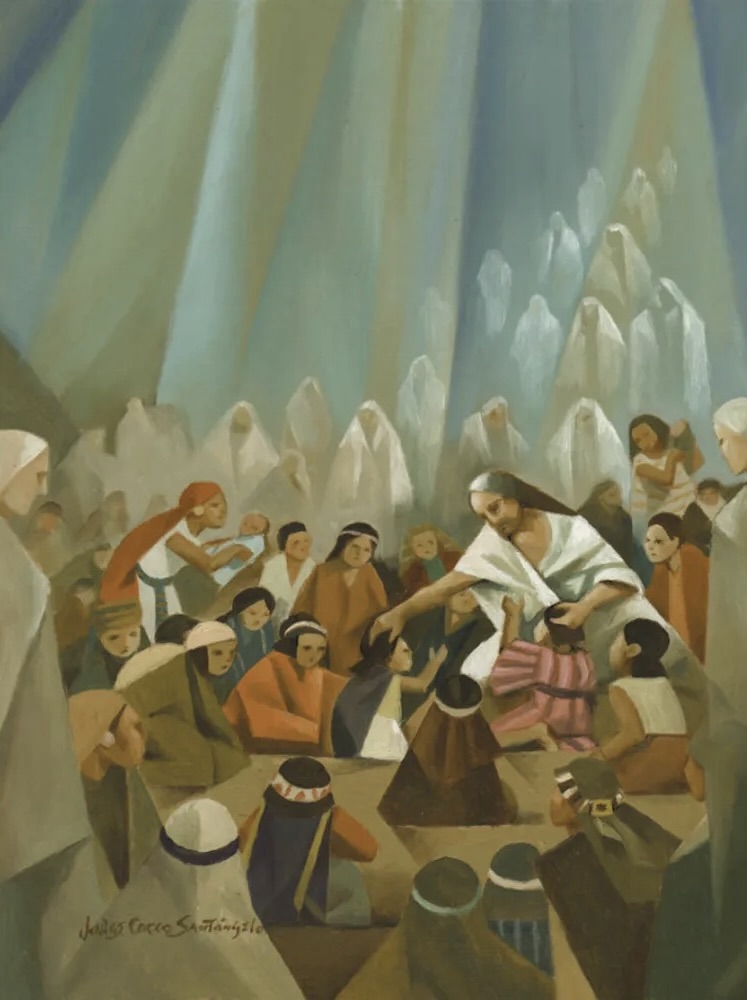
Christ by Jorge Cocco Santángelo

A Love that Glorifies God

Homily: Fifth Sunday of Easter (C)

John 13:31-33a; 34-35

18 May 2025 

Fr. Ricky Cañet Montañez, AA

It is that time of year again for graduation marches, moving up ceremonies, and recognition days. Students heave a sigh of relief for having made it through the many years of exams, projects and presentations. I know of a mom whose daughter is graduating salutatorian but she is not overjoyed because she wanted her kid to be the valedictorian. She wanted the whole school to hear her daughter deliver the valedictory address and she wanted to hear them applaud her daughter. Thankfully, her child has a nice disposition. She was happy and proud to even have made second place, considering most of her batchmates are just happy to be moving on to the next stage. 

As parents, are you the same way with your children? Did you push them to be honour students and to run for the highest honours?  There is nothing wrong with cheering on your children and wanting the best for them. We associate “GLORY” with winning, being the best, being admired, being looked up to.  We think of it as success, recognition, or praise. However, in today’s gospel passage from John, Jesus gives us a very different definition of “GLORY”. At the scene of the Last Supper, Judas leaves to betray Jesus; then, the Jesus addresses the Eleven (11) apostles and says, “Now is the Son of Man glorified…” (John 13:31) Jesus knows the Cross is coming and yet, He calls this moment His glory because for Him, glory does not come from being admired or exalted. Glory comes from loving completely. Jesus’ suffering, Jesus’ sacrifice — this is how He shows the depth of His love. And in that love, the glory of God is revealed. We see who God truly is: a God who gives Himself fully, even to the point of death. 

Then, Jesus turns to His disciples and says “Love one another as I have loved you, so you also should love one another.” (John 13:34) He explains further that “This is how all will know that you are my disciples, if you have love for one another.” (John 13:35) This new commandment encourages the apostles to mirror the life of self-giving love of their Lord and Master. To be associated with Christ is not just about being “nice” like Him. It is not about loving when it is easy or convenient. It is about loving like Jesus — with patience, humility, and sacrifice. That is what makes this commandment new: the measure of love is now the love of Christ. 

That commandment is also meant for us if we wish to live in obedience to Christ and in imitation of our Saviour.  In order for us to do this, we have to be ever mindful of how Jesus loves us, not just as a church but individually, personally and intimately.  Let us think of all the mistakes we have made in our life. Let us think of all the times we have committed sins — big or small. Let us think of all our imperfections as persons.  Still, Jesus loves us unconditionally! He welcomes us with love and compassion despite seeing all our faults and secret sins. He did not mind living a difficult life of public ministry for three years so He could make present for humanity the Kingdom through His teachings and miracles. He did not mind that He had to die so young at thirty-three (33) years of age.  He willingly gave His life on the cross for you and me that we may have a chance at eternity in Heaven. Can we love others as He loved us? We have to try if we want to follow Him and be identified with Him. 

Loving like Jesus is not always easy — but it is powerful. It transforms lives. It builds real communion. We need to realise that when we love one another this way, God is glorified.  It brings glory to God — not just in heaven, but here and now. Every time we forgive, show compassion, help carry someone’s burden, or choose kindness over pride — we reflect the glorified Jesus. We make God’s love visible to the world.  

Thus,  today, let us commit to live this commandment. Let us love in a way that reflects Jesus. Let us love in a way that glorifies God.

The Shepherd’s Mission to All Nations

Homily: Fourth Sunday of Easter (C) / Good Shepherd Sunday / World Day of Prayer for Vocations

John 10:27-30

11 May 2025

Fr. Ricky Cañet Montañez, AA

When I was a child, whenever my siblings and I were wandering out in public, we knew precisely when Mama was calling us to her side without her even mentioning our names. “Kahit maingay sa paligid, dinig na dinig namin pagsusutsutan kami ni Mama.” (Despite the noise, Mama’s “pssst” still came through us loud and clear.) We stop in our tracks and look her way awaiting the next instruction with the gesture of her hand. Now that I am grown up, and Mama gone, no one can call my attention that way anymore. It worked with Mama because we knew her voice. 

Today Jesus tells us: “My sheep hear my voice. I know them, and they follow me.” (John 10:27) This is a comforting promise to all those who acknowledge Jesus as their Shepherd and Master. If you ask a shepherd today, they will tell you that even if they tend to a large flock of sheep, they can identify each one and tell you the individual peculiarities of the animals. Jesus as the Good Shepherd also knows His sheep, and He knows each of us personally and intimately.  Yet, we must not forget that Christ is the Shepherd not just of some, but of all. His voice goes out to the ends of the earth. 

In Acts, we see evidence of this universality. Paul and Barnabas went to the synagogue, as they always did, to preach the Word. We are told the influential Jewish men stirred up the persecution of the two, even dissuading the prominent women who were believers.  Despite this, they did not retaliate nor speak against them, they simply turned to the Gentiles.  They “shook the dust from their feet” and went to Iconium. (Acts 13:51) They say, “We now turn to the Gentiles… for the Lord has commanded us: I have made you a light to the nations.” (Acts 13:47)

It was not an act of spite but rather of openness to other waiting opportunities. This shift is not abandonment — it is expansion. Recall that in Matthew 10, when Jesus sent out the Twelve (12) Apostles for the first time, He told them, to bring nothing with them, to avoid the Gentiles and Samaritans, and if they are not welcomed or listened to, they should leave and shake the dust off their feet. The reason for this being that the Jews were supposed to be the first recipients of the Gospel. After Jesus’ Resurrection and Ascension, the mission expanded to include the Gentiles. The Great Commission in Matthew 28:19 explicitly commands the disciples to “go and make disciples of all nations”.  This affirms how the Shepherd’s voice calls out not just to one group, but to the entire world — a growing flock that crossed borders, languages, and expectations. 

Something we must remember is that this sheep and shepherd relationship is not a one-way street. We have to remain close to Jesus to be sensitive to His voice. Sometimes, when we are overwhelmed by the noise of the world and the various voices calling our attention, they may drown out the voice of our Shepherd. He promises to care and protect us but we have to choose Him. We have to listen to Him and respond to Him.  Jesus promises that His flock shall never perish and that “No one can take them out of My hand.” (John 10:28) However, we tend to jump out of His hand of our own volition. When we sin and reject Christ and His teaching, we are choosing to leave the safety of the fold and the protection of our Shepherd. Despite this, Jesus never tires of seeking us out, sending His disciples, to bring us back to Him.  

In our own day, we are reminded of this universal mission especially in the election of a new pope. A few days ago, Robert Francis Cardinal Prevost, was elected as our 267th pope, taking the name Leo XIV.  He is an American and an Augustinian who spent many years ministering to the faithful in Peru. We have to bear in mind that whoever is chosen does not become a shepherd only of his country or his continent. He becomes a shepherd for the whole Church — East and West, young and old, rich and poor. He is a successor to Peter, responsible for feeding all the sheep, just as Christ commanded. In this age where a premium on individualism has led to alienation and division, the Church must always reflect the heart of the Good Shepherd — one who seeks out the lost, and gathers God’s children who have scattered. 

Let us be part of that mission. Let us listen to the voice of Jesus Christ, our true Shepherd — not just for ourselves, but so that we may help others hear it, too. And let us pray for our Holy Father — that he may, in imitation of our Lord, and guided by the Holy Spirit, shepherd the entire Church with wisdom, mercy, and courage.

Empty Nets, Full Hearts: Encountering Christ Again

Homily: Third Sunday of Easter (C)

John 21:1-19

4 May 2025

Fr. Ricky Cañet Montañez, AA 

Is there anyone here who believes he/she owes a deep debt of gratitude to someone else? (Meron ba kayong pinagkakautangan ng loob?) I am not talking about a monetary debt, but rather one that arises from another or others saving your life — be it because of their friendship, their compassion, their inspiration or their heroism. Would you take a bullet for them? Donate a kidney if they need it? Some people give their whole lives in humble service and staunchly defend their honour.  Others would stand in between them and danger. How far would we go to repay our debt to that person? 

Today’s readings highlight the response of Peter to the risen Christ. Remember that Peter was Jesus’ trusted right-hand man. He was among the intimate circle of friends Jesus chose to witness the raising of Jairus’ daughter and the miracle of the Transfiguration. Jesus even openly declared that He would build His church on the rock that was Peter. And yet Peter denied his friendship with Jesus at the onset of the Passion, when his friend needed Him the most. Peter owed his new life to Jesus and yet he betrayed His trust deeply. Imagine how he must have felt seeing his friend alive again yet in the back of his mind he knew they were still not properly reconciled. 

In our gospel we find the disciples back in Galilee and Peter decides to go fishing. In one sense, he is simply returning to what he knows. He is probably wondering what will become of his friendship with Jesus and if he still has a role to play in their mission. He is already considering giving up and going back to his old life.  It feels like a quiet kind of defeat — a slipping back into the old ways now that the high drama of Holy Week and Easter morning have passed. And isn’t that our experience, too? After Easter joy, after spiritual highs, how quickly we find ourselves drifting back into old habits, old fears, and familiar distractions. 

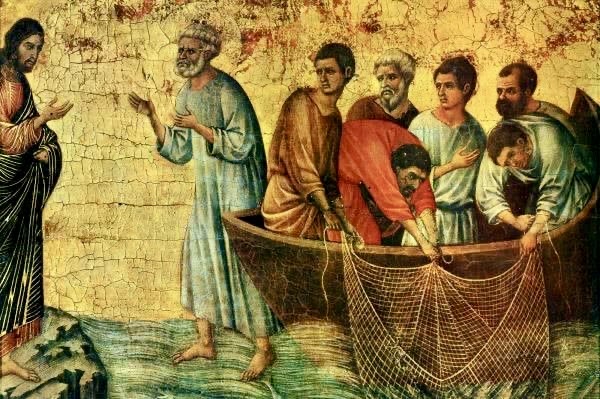
The other disciples fishing with him are equally discouraged when they catch nothing all night. These are seasoned fishermen and yet they take advice from a stranger on the shore. They seem to have lost confidence in themselves as is typical of a group that has lost their leader. They were sheep who have lost their shepherd. When they finally realise it was Jesus speaking to them, Peter jumps out of the boat and swims to shore to meet Him. He could not wait a minute longer. To his relief, he sees that Jesus has come to them not with judgment, but with breakfast. And more than that, He comes with mercy and memory. He re-calls Peter by repeating the very miracle that called him the first time. A night of empty nets. A simple command. An abundance that breaks the nets. 

It is this love — the love of the Risen Lord who comes looking for us, who renews our call when we have faltered — that gives Peter the courage we see in Acts (Acts 5:27–32, 40b–41). Peter and the apostles, having been arrested and humiliated, leave the council rejoicing. Not outraged. Not discouraged. But rejoicing — because they had been found worthy to suffer dishonour for the name of Jesus. The Peter who once denied Jesus three times now refuses to deny Him before the authorities. “We must obey God rather than human beings” (Acts 5:29), he says. That kind of response does not come from sheer determination or personality. It is the fruit of a life so rooted in the Risen Christ, so filled with the Holy Spirit, that even suffering becomes a sign of intimacy with the Lord. This is how Peter repays his debt to the Lord. He devotes his entire life to spreading the gospel of Jesus Christ and witnesses to the truth of God’s infinite love for us. 

What changed? Peter did not just believe in a Risen Christ — he had encountered the One who loved him even in failure, the One who filled his empty nets again, the One who said, “Follow me,” again. That is our hope, too. That the Risen Lord comes to us not just once, but again and again. He meets us in our return to “fishing,” in the places we feel stuck or lost — at times when we have failed and doubt ourselves, questioning if we still have a place in His church. And with gentle persistence, He fills our nets and renews our call.  I, too, find myself often praying that I might not grumble at the cost of my call to priesthood, but rejoice that even in my hardships I might serve His holy name. 

May we have eyes to recognise Him, hearts to receive Him, and courage to obey Him — no matter the cost. And may we, like the apostles, come to see every trial, every hardship, as a chance to walk more closely with the One who first called us and who never stops calling us to conversion, to mission, and His friendship.

No Sin Too Great, No Soul Too Lost

Homily: Second Sunday of Easter / Divine Mercy Sunday

John 20:19-31 

27 April 2025 

Fr. Ricky Cañet Montañez, AA

Do you find it easy to forgive someone who offended you? If your answer is “NO”,  ask yourself if it is easy for you to ask forgiveness when you are the offending party?  Some people only confess during Kumpisalang Bayan (Parish-wide Penance Service) thinking it is better to confess their habitual sins once and avoid going to confession frequently for the same sins. Others are so ashamed of their sins that they cannot bring themselves to speak of what they have done even in the confidentiality of the confessional. Either way, you are short-changing yourself by avoiding the mercy of God. Pope Francis once said “God never tires of forgiving us; we are the ones who tire of seeking his mercy.” 

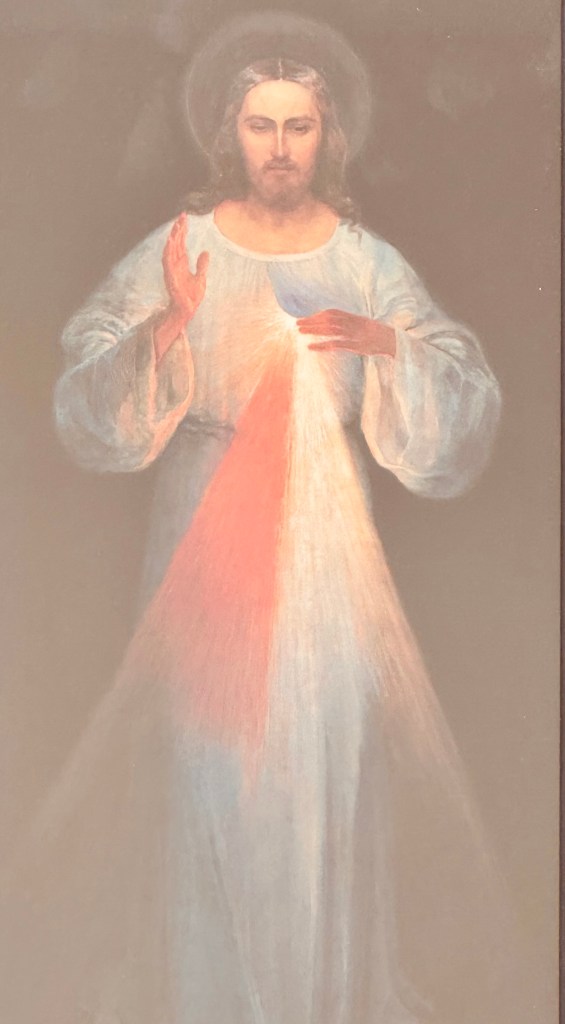
Today, on Divine Mercy Sunday, we reflect on the forgiveness that we can always expect from Jesus, most especially on this Feast. He says that those who go to confession and receive Holy Communion today will receive the complete forgiveness of their sins and the punishment resulting from them. Blood and water gush forth from the heart of Jesus as a fountain of mercy.  Even the most hardened sinner, once immersed in the ocean of His mercy will be forgiven.  This promise, anchored on the boundless mercy of God, is our ultimate hope. This is something we can count on. Jesus, the Divine Mercy will not fail us if we approach Him with full trust and confidence. He loves us so much that He does not want us to be separated from Him. God our Father encourages us to embrace His forgiveness that He may grant us the opportunity for a renewed life and a deeper connection with Him. 

On Holy Monday, I heard the confessions of Persons Deprived of Liberty (PDLs). In my thirteen (13) years as a priest, I have never heard confessions more powerful and heartbreaking than these. One conversation with a lady inmate had such a profound impact on me. The woman hesitantly stepped forward. She admitted she hadn’t really wanted to come for confession but her fellow inmates had urged her to. Avoiding my gaze, she said quietly, “Nagsasayang ka lang ng oras, Father. Hinding-hindi mamahalin ng Diyos ang taong tulad ko.”  (“You’re just wasting your time, Father. God will never love someone like me.”) I gently asked, “Bakit mo naman nasabi yan?”  (“Why would you say that?”) Her expression hardened as she revealed she had done contemptible things too terrible to mention. “Ang nakikita ko sa sarili ko ay isang taong wala nang kaligtasan. Ang tulad ko, wala nang pag-asa.”  (“I see myself as someone beyond salvation. There is no hope for someone like me.”) My heart sank. I felt such pity and compassion for her. I told her “With God, there is always hope. No one is worthless. No one is unredeemable. His mercy is unlike that of human beings because His mercy has no limits. There is no sin so dark and deep that is beyond the reach of His love. Ang Kanyang pagmamahal ay hindi batay sa anumang magagawa mo. “Mahal ka Niya dahil sadya ka Niyang nilikha at inangkin bilang anak.” (“His love is not based on anything you can do. He loves you because He intentionally created you and claimed you as His child.”) I pointed out to her Romans 5:8: “…God demonstrates his own love for us in this: While we were still sinners, Christ died for us.”  She looked at me for the first time and I saw tears in her eyes. In that moment, I knew grace had entered the room.

It may not seem sensible that God’s mercy should bypass the full force of His justice, but it does, because His love for us is simply so great!  This is the power of Divine Mercy. It does not excuse sin, but it heals it. It does not erase the past, but it gives us a future. And that future is rooted in hope — the hope that no life is beyond redemption, and no one is too far for God’s embrace. By God’s grace, we are freed from the burden of guilt and we receive the Lord’s peace. We are equally encouraged to extend the same mercy to others, reflecting God’s compassion for all. 

So today, on this Feast of the Divine Mercy, let us carry this message in our hearts: God’s mercy is bigger than our greatest failure. No matter where we are — in prison, in pain, or in doubt — there is hope.  If God can transform the heart of a prisoner, imagine what He can do in our life — if we let Him.

Jesus, we trust in You.