The Quiet Strength of the Meek

HOMILY: Fourth Sunday in Ordinary Time (A)

Zephaniah 2:3; 3:12–13 | 1 Corinthians 1:26–31 | Matthew 5:1–12a

1 February 2026

Fr. Ricky Cañet Montañez, AA 

Once, I had a conversation with a newly turned senior citizen (he had just turned 60). He said, “Father, I noticed something changed in me when I turned 60.” He said that before, he could not sit still whenever he was accused of something based on a wrong assumption. He felt he had to explain and correct every rumour just to clear his name. Now, he says, “Father, now, sometimes I just let it be.” He laughed a little and added, “Not because they are right — but because I am already tired.” We both laughed because we both understood. 

You reach a certain point in life — usually in your 60’s — when you realise everything not all battles need to be fought. Not because you are a coward, but because you already know what truly matters, and which things should simply be let go. We learn to choose our battles! We begin to realise: proving ourselves is tiring. It is exhausting to keep defending yourself at every opportunity. It is exhausting to keep showing that you are right, good, worthy — especially when you know that no matter how much you explain, there are people who simply refuse to understand. That, brothers and sisters, is not a moment of weakness, but rather the beginning of wisdom. 

This is exactly the kind of wisdom we hear in today’s readings. Zephaniah speaks of a people who are lowly and humble. They do not hurt others. They are not deceitful. They simply trust in the name of the Lord. Despite the many hardships they have gone through, they will not go home weeping. God Himself will lift them up from where they have fallen. He will elevate them by His own power and rebuild what was lost. 

St. Paul, in our Second Reading, is very direct — almost blunt. “Consider your calling,” (1 Corinthians 1:26) he says. You were not chosen because you are talented, famous, or impressive. God chose what is weak, what is ordinary, what the world easily ignores. In other words: God is not impressed by resumes. God looks for hearts that are free. 

St. Paul ends by saying “Whoever boasts, should boast in the Lord.” (1 Corinthians 1:31) Apart from God, we are nothing and have nothing. In life, we can lose everything — health, wealth, power, fame, and even loved ones, but God is the only one with the power to restore all those things to us, just as He did with His servant Job. It is our connection with Christ, our relationship with God, that is our true treasure and pride — the only thing worth preserving and fighting for. 

The Gospel only emphasises this theme of humility before God when we hear the Beatitudes. Jesus does not say:

Blessed are the achievers.

Blessed are the winners.

Blessed are those with all the answers. 

Rather He says:

Blessed are the poor in spirit.

Blessed are the meek.

Blessed are the merciful. 

These are not the words of someone glorifying weakness. These are the words of someone describing inner strength. You see, God’s favour and blessings are not a reward for “winning” at life. It is a comfort for those who recognise they are incomplete without Him. 

The person who turned 60 and shared his story with me — did not become oblivious or “deadma” to the world. He did not stop caring. He simply stopped proving himself. He no longer needed to win every argument, correct every accusation, or explain himself to everyone. That kind of freedom is rare because the strongest people are not those who shout the loudest but instead, they are those who know who they are in God’s eyes — even when misunderstood. They can walk away, keep their peace, and sleep well at night. By learning to let go of grudges, of irritations, and of many things that spark anger, hatred and discord, they make room in his life to better receive the graces from heaven. That confidence in God’s providence for all their needs is enough. This assurance is what floods him with peace. 

Today, at this mass, Jesus is blessing many people here — those who are tired, those who have lived long enough to know what really matters, those who no longer need to prove they are good. If we feel these words are describing us, then let us hear this clearly: we may not look impressive to the world, we may feel like we are losers according to the standards of the world — but because we are here, keeping close to God, we are most blessed in His eyes. We will receive all that we need, in God’s time.

When the Light Quietly Returns

HOMILY: Third Sunday in Ordinary Time (A)

Sunday of the Word of God / National Bible Sunday

Isaiah 8:23–9:3 | 1 Corinthians 1:10–13, 17 | Matthew 4:12–23

25 January 2026

Fr. Ricky Cañet Montañez, AA 

Have you ever experienced feeling like a robot? Do you wake up in the morning and run through the motions of your day — doing all that is expected of you, fulfilling all your responsibilities like a machine carrying out everything it is programmed to do—no error, no complaint, fully charged… at least on the outside? 

On the surface, everything functions as it should. beneath it, something feels quietly disconnected. 

Sometimes, the hardest part of life is not failing — it is succeeding while feeling completely empty. In these moments, we do not need a lecture, advice, nor explanation. Those things feel irrelevant because we are not doing anything wrong. In fact, we are doing everything right. One may be a devoted spouse, a hands-on parent, a loyal child… A capable and reliable employee — a neighbour, a student, a friend whom everyone counts on. Yes, we are not lost. We are walking the same familiar paths we have walked for years. The scenery has not changed. The people have not changed. Our commitment has not wavered. The only difference is that the light has gone dark. We are not looking for an exit—we are simply waiting for the colour to return to a world that has slowly turned grey; waiting for the light to come back on. 

In our First Reading, we hear Isaiah’s prophecy: “The people who walked in darkness have seen a great light” (Isaiah 9:2). Notice the words — “walked in darkness.” These were not people who rebelled against God nor ran away from Him. They were people who kept walking. Faithful people. Responsible people. Good people who simply woke up tired. This sounds very familiar, doesn’t it? Many of us are working so hard just to be good and responsible. And this can be exhausting. Tired from work. Tired from problems that never seem to end. Tired of being strong for everyone who depends on us. Sometimes, even tired of serving in the Church—or tired of trying to be holy. 

A few years ago, someone told me, “Father, I still come to Mass every Sunday. But honestly… I do not feel anything anymore.” He said, “I pray, but my mind is elsewhere. I read the Bible, but the words do not move me anymore.” One night, while cleaning his house, he found an old Bible on a shelf — dusty, with notes written years ago. Out of boredom, he opened it. And the first words he saw were: “Come to me, all you who labour and are burdened” (Matthew 11:28). He told me, “Father, I was not even looking for a miracle. However, it felt like those words were meant for me.” Then he added, “For the first time in a long while, I cried — not because my problems were solved, but because I realised God had never stopped looking for me.” This is how the Word of God works. It does not arrive with fireworks or loud announcements. It does not force itself. No pressure. No noise. Just quiet light. Gentle warmth. The kind that slowly brings feeling back into what has grown numb. 

Moreover, this is exactly how Jesus begins His mission in today’s Gospel. He does not go to Jerusalem, the centre of power. He does not seek influence or recognition. He goes to Galilee — ordinary, noisy, imperfect. There He finds fishermen — not praying, not reading Scripture, but working with their hands. Their clothes smell like fish, not incense. Their hands are rough from routine, their hearts perhaps tired from years of the same work. Jesus says only one sentence: “Come after me, and I will make you fishers of men” (Matthew 4:19). No explanations. No conditions. No promises of comfort or success. 

And yet, Scripture says Simon and Andrew left their nets at once, while James and John immediately left their boat—and even their father (Matthew 4:20–22). When the Word of God speaks, it reaches deeper than logic. It touches the part of us that has been waiting, even if we could not name what we were missing. Perhaps those fishermen, too, were among those “walking in darkness” — faithful, hardworking men simply doing what they had always done, until the light found them. 

In the Second Reading, St. Paul addresses a divided community: “I belong to Paul,” or “I belong to Apollos,” or “I belong to Cephas” (1 Corinthians 1:12). It sounds very modern, doesn’t it? Even today, we sometimes identify more with groups, personalities, or opinions than with Christ Himself. St. Paul on the other hand, reminds us: “Is Christ divided?” (1 Corinthians 1:13). The Word of God does not create camps. Our pride does. 

The Word gathers.

The Word heals.

The Word recentres our hearts. 

On this Sunday of the Word of God, we are reminded that Scripture is not just something to be read or studied. It is something that finds us — especially when we are tired, faithfully, and quietly walking in the dark. When we allow the Word to return to the centre, something stirs again. We stop merely functioning… and we begin living. And slowly, gently, the light turns back on.

Through Childlike Hearts

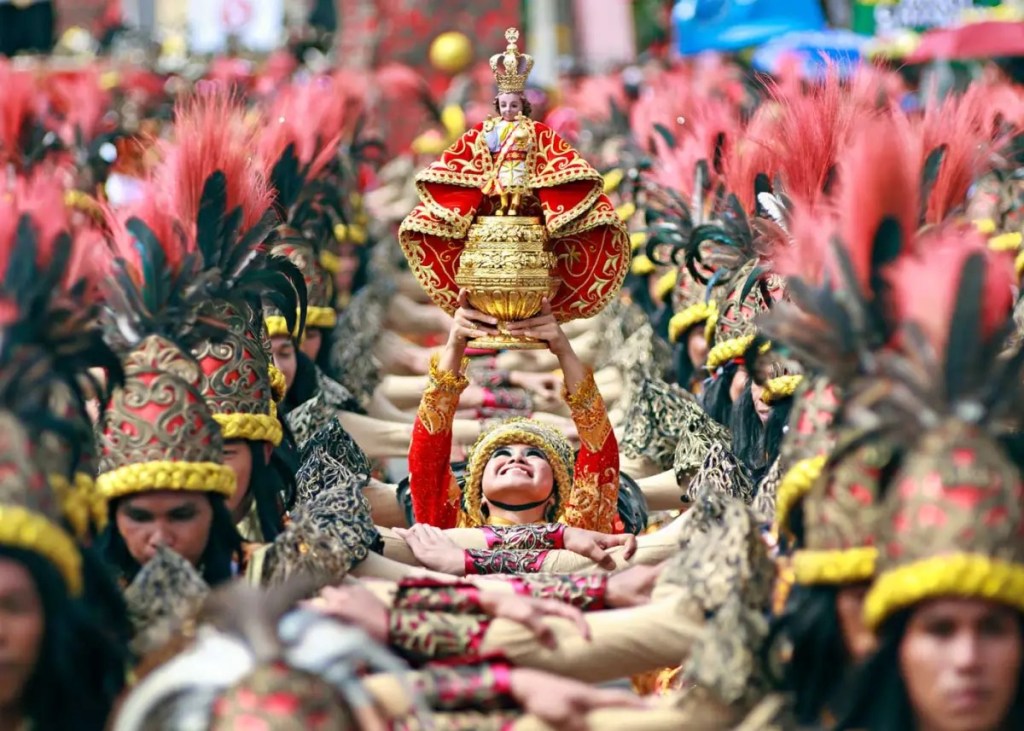
HOMILY: Feast of the Santo Niño (A)

Isaiah 9:1–6 | Ephesians 1:3–6, 15–18 | Matthew 18:1–5, 10

18 January 2026

Fr. Ricky Cañet Montañez, AA

When we were children, life seemed simpler. When we were young, our problems were things like: “Do I have ‘baon’ (pocket money)” or “Will we be allowed to play?” As we grow older, the problems change: bills, deadlines, family issues, health concerns—and sometimes even faith issues. As life becomes more complicated, we sometimes feel that our relationship with Christ becomes complicated as well. We begin to focus on rules and religious demands, and without realizing it, we get lost in them — until we slowly drift away from a living relationship with God Himself.

In today’s Gospel, Jesus offers a startling correction to our tendency to overthink and overcomplicate life. When the disciples press Him with the question, “Who is the greatest in the kingdom of heaven?” (Matthew 18:1) Jesus does not respond with a lecture, a formula, or a strategic roadmap for success. Instead, He performs a silent but radical act: He places a child in their midst. His words are as simple as they are challenging: “Unless you change and become like children, you will not enter the kingdom of heaven.” (Matthew 18:3)

He did not say, “Study harder.”

He did not say, “Just behave yourselves.”

And He certainly did not say, “Act childish.”

He said, “Become like children.”

What is so exemplary about a child in the eyes of God, when in practical terms a child knows very little and still has so much to learn? First, a child trusts easily. When a parent says, “Just hold on to me,” the child holds on — even without knowing where he or she is being led. We, adults are different. We ask questions. We doubt. “Are you sure? Is there a contract? Is there a backup plan?” Even with God, we say, “Lord, I will trust You — but please explain everything first.” And God smiles, because that is not how children love. Children love by trusting, not by demanding explanations.

Second, a child is honest. When children are hurt, they cry. When they are happy, it shows. When they are angry, they are direct. We adults, however, love to pretend. We pretend we are okay when we are not. We say things we do not really mean. We tell God, “We’re fine, Lord,” even when we are already breaking inside. We think this is what God wants to hear. We think we need to appear strong because our God is strong. But the Child Jesus reminds us: God does not want a perfect performance. He simply asks that we be real with Him.

Conversion, then, is not about growing up more, but about learning how to be a child before God again. St. Paul, in the Second Reading, reminds us that we were chosen and loved by God even before the foundation of the world — before we achieved anything, before we proved anything, before we succeeded or failed. Before all of that, we were already loved. Many of us forget this, while children understand love instinctively. Notice that children do not try to be great. They simply want to be held…to be loved! 

Jesus affirms this when He says, “Whoever humbles himself like this child is the greatest in the kingdom of heaven.” (Matthew 18:4) He also warns us, “Do not despise one of these little ones.”  (Matthew 18:10) Perhaps Jesus is reminding us that when we look down on weakness, simplicity, and vulnerability, we slowly lose our way back to God.

So today, on the Feast of the Santo Niño, the invitation may be very simple:

       •     To pray honestly again

       •     To trust without trying to control everything

       •     To come to God without pretending

There is no need to appear as experts or strong people before Him. In the end, heaven is not for those who have everything figured out. Heaven is for those who still know how to kneel, look up, and say with the heart of a child: “Father, I need You.”

From stunninganing posts

JUST LOVED!

HOMILY: Feast of the Baptism of the Lord (A)

Isaiah 42:1-4, 6-7, Acts 10:34-38 and Matthew 3:13-17.

11 January 2026

Fr. Ricky Cañet Montañez, AA

Let me begin with a simple yet difficult question: “When was the last time you felt truly loved for who you are — not because you were a big help, nor because you accomplished a feat, nor because you were useful?” — But simply because you are loved!

Many of us struggle to answer that — because from an early age, we have received more love and attention when we have done something praiseworthy, helpful or exceptional such as getting good grades or doing a great job. And slowly, we begin to believe that love equals approval and applause. Without realizing it, we start thinking: “If I stop doing or performing, I stop mattering.” This translates into all our relationships — even into our relationship with God.

Today’s Gospel is so powerful because it is a massive wake-up call. It shows us why it just is not true that we have to be productive or worthwhile to be loved.  We hear that Jesus goes to John to be baptised in the Jordan River.  He has not yet preached, healed anybody, or performed any miracles publicly but at that moment, heaven opens.  The voice of the Father says: “This is my beloved Son, with whom I am well pleased.” (Matthew 3:17) Jesus receives a very public affirmation simply because of who He is. Jesus is loved before He can fulfill the Father’s will!  

Let us also take note that Jesus does not stand apart. He does not claim a special place.  He waits for His turn, stepping in line — with sinners, with the broken, with people trying to begin again.  God does not look for a pedestal to look down on us; He looks for a place in the line to stand beside us. Heaven does not just open for the powerful; it opens in the ordinary river of our daily lives, shared with the people around us. This echoes the First Reading from Isaiah: “A bruised reed he shall not break.” (Isaiah 42:3) God is gentle with His people, especially with those the world sees as fragile or weak. He does not demand more from those who are already weary. Instead, He draws near, delighting in their presence and loving them as they are — because He is our Father, and we are His children.

Life today can be exhausting. It is so easy to feel tired today — not just tired in the body, but also tired in the soul. Young and old alike feel the weight of responsibility, the pressure of having to live up to standards, and the anxiety of waiting for acceptance and belonging. Many of us are tired of being strong, tired of being needed and tired of feeling guilty when we can no longer do as much as before. I know of elderly people or persons with disabilities who feel unloved because they have become weak and dependent. They believe they are no longer as productive or useful, thinking: “Wala na akong silbi.”  (I am useless!”) Let us stop listening to this voice in our head. This is definitely not God’s voice. God did not say, “This is my Son because he is productive.”  Rather, God says, “This is my beloved Son.”  God loves Jesus because He is His Son. God loves you and me because we are His children.

Sometimes, we act as though we can earn God’s love.  We treat God like a boss. Church workers and those who serve the church can be guilty of this. We work as though God were keeping tabs on us, keeping a checklist of duties and we panic when we fall behind.  The truth is this:  God loved us long before we ever served Him. He loved us as children before we could even speak. He loved us as young persons, making mistakes while learning our identity and discovering our talents and capabilities. The Acts of the Apostles tell us that Jesus was anointed by the Spirit — and then He went about doing good.  (Acts 10:38) Love came first.  Mission followed. Baptism, brothers and sisters, is not an assignment; it is our identity.  Before we are sent, we are embraced. Before we are called to do good, we are called beloved.

Today, as we remember the Baptism of the Lord, let us remember our own baptism when we officially became part of God’s family. God does not look at us and ask, “What can you do for me?”  God looks at you and me and says: “You are my beloved.” It is this love — and only this love — that fuels our mission. We do not do good to earn God’s favour; we do good because we are already loved by God. Driven by this love, we go forth to transform the world.

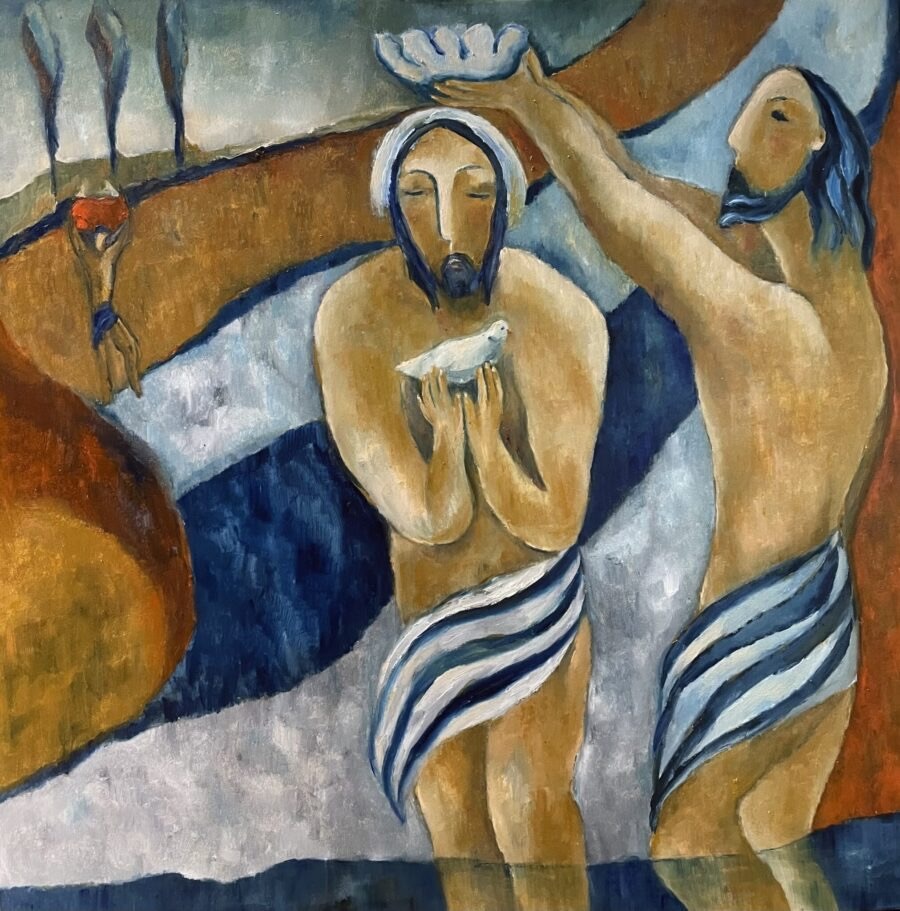
Baptism of Christ by Olga Bakhtina

God’s Quiet Light in the Dark

HOMILY: Solemnity of the Epiphany of the Lord (A)

Isaiah 60:1–6 | Ephesians 3:2–3a, 5–6 | Matthew 2:1–12

4 January 2026

Fr. Ricky Cañet Montañez, AA 

A few nights ago, while many of us were welcoming the New Year with fireworks, loud celebrations, and tables filled with food and drinks, a tragedy quietly entered the life of a family we know well.  A fire broke out in Pook Malinis and in an instant, everything changed for Jayson and his family.  His wife and child are now in the hospital, fighting for their lives. When something like this happens, words fail us. No explanation seems sufficient. No prayer seems strong enough. There is only silence… tears… and a question whispered deep within the heart: “Lord, where are You?” 

Today’s Solemnity of the Epiphany of the Lord reminds us that God chose to manifest Himself to His people; He shows up for us in the real world. At Christmas, God took on human form so we could truly see, hear, and touch Him. By welcoming the Magi from different eastern nations, He showed that His love is for everyone, everywhere.  The Gospel tells us that the Magi followed a star — not a bright road, not a clear map — just a small light in the darkness. They did not wait for everything to make sense. As stars only appear when the night is deep they began their journey in darkness.  They trusted that the light they had was enough for the next step. To this day, we still encounter God personally, usually not in grand gestures, but in the quiet, unassuming moments where our pain, anger, fear and confusion can cause us to miss His presence. 

Many of us are walking difficult roads today.   Some of us might be carrying a quiet grief, a lingering fear, or just the weight of being very, very tired and feeling a lack of direction. But even in the shadows, there is a hidden grace at work. There are people — some we love, and some we have never met — holding us in their thoughts and prayers. There are those who will step out of their own way just to offer us a hand. This is the true ‘star’ of the season: not a magic cure for our pain, but the steady, quiet light that reminds us we are not walking alone. 

The Magi did not know what they would find. In search of a future king, one might expect to find symbols of wealth, power and influence — a palatial home surrounded by guards and a multitude of servants probably preparing a huge celebration for the birth of a royal heir. lnstead they found a child — small, fragile and poor. God chose to be found not in strength, but in vulnerability, not in control, but in closeness.  Perhaps this is where God is today — in hospital rooms, in jail cells, in battlefields, on streets where we find the homeless.  God makes Himself real and present especially for tired hearts and for silent tears offered in faith.  

The Gospel ends with a simple but powerful line: “They went home by another way.” (Matthew 2:12) In the literal sense, it may seem that they simply wanted to protect the location of the Christ Child from Herod but on a deeper level, it could mean that they experienced a profound change after encountering the incarnate God. Life did not become easy because God had entered the world. In the past 2000 years we have seen darkness and affliction with the fall of nations, annihilations of a people, tragedy from calamity and inventions that have brought humanity more harm than good.  Undoubtedly, suffering changes us, but when God walks with us through moments of difficulty, instead of ending up with hardened and embittered hearts, we find that the experience softens us, deepens us, and teaches us how to love more truly.  

Faith does not mean having all the solutions to suffering; it means bravely taking the next step, even when the road is unclear, because we know God is with us. Jayson and his family are going through a very difficult time right now but God does not abandon them. He can manifest Himself to them through the support of family, friends parishioners and strangers. When we open our hearts to this suffering family, we let them know they are not alone — that their pain is held in our prayers and in the heart of God. 

On this Solemnity of the Epiphany of the Lord, may we rejoice in God’s choice to be closer to us by making Himself known. Let us rejoice that God continues to reveal His heart to the world through believers like you and me.  Our willingness to be small lights for one another — quiet, steady, and faithful — ensures that we can help each other find God present.  Darkness cannot overwhelm and overcome us because the light of the star will still shine, and it will shine through us.

Epiphany, a Crossroads Initiative

Walking into the New Year with Mary

HOMILY: Solemnity of Mary, the Mother of God (A)

Numbers 6:22–27 / Galatians 4:4–7 / Luke 2:16–21

1 January 2026 

Fr. Ricky Cañet Montañez, AA

Another year has come to a close. We look back on 2025 and see that it was filled with a mix of good things and bad. Some experienced financial success, others did not. Some people’s lives were ruined by calamities, others were saved. Babies were born into some families, while others experienced the loss of loved ones. This roller coaster of highs and lows can at times be exhausting. May nabuo at may nabuwag. May tumuloy at may nahinto. May saya at may lungkot. Nakakapagod kung iisipin. (Some were formed and some were broken. Some continued and some stopped. Some were happy and some were sad. It is tiring to think about.) The heart does get tired — tired of being strong, tired of holding everything together, tired of pretending that everything is okay. Moments like these, we do not really long for answers because explanations can feel forced or empty and advice can feel insulting and condescending. Rather, we yearn for the comfort and consolation of home — a place where we feel safe and loved. 

I once listened to a man who had just lost his mother. He was strong, composed and respectable — yet when he spoke of her, his voice broke.  He said, “Father, when she died, I realised something… all my life, when I was tired or afraid, I was always running home to her — even when I did not consciously intend to.”  On her final day, when she could no longer speak, he had held her hand. As long as he held her, he felt somewhat safe. When she was gone, he said he felt like “there was no shelter for him in the world anymore.”  Many of us know that feeling — be it because of a really good friend, a spouse, a close relative or a beloved, but mostly because of loving parents, most especially mothers. Unfortunately, some may never have had the experience at all, but still, deep within us lives that aching desire to be held without being judged, to be seen without having to explain, to rest without fear of being left alone. 

This is why today’s feast touches something so tender within each one of us.  Before Jesus healed the broken-hearted, before He carried the weight of the world, before He embraced the least, the last and the lost, someone else held Him tight and made Him feel loved and safe.  The God who saves us, chose to be carried in human arms, comforted by human hands, and loved by a human heart.  He could have saved us from His heavenly home but He did not. He chose to have a human mother. Mary was the first home God ever knew on this earth — not a luxurious palace fit for a King nor a place of learning that could provide all the answers. He chose a pure and simple heart that was willing to make space for Him.  She held God when He could not speak. She loved Him before He could give anything back. In her arms, the eternal God learned what it meant to be safe in this world. 

Maybe this is what some of us are longing for today — not solutions, not miracles, but the assurance that we are still held — that despite all our mistakes in life we are not despicable and unlovable, that despite all the bad things that happen to us we have a refuge where we can find comfort and safety. As we honour Mary, the Mother of God, we honour her as our own heavenly mother. At the cross, Jesus entrusted us to her as her children and through the ages she has been faithful to that trust. She is God’s gift to us because when life feels heavy, when we are tired of being strong, when parts of us feel broken or forgotten — it matters that we have an undeniable assurance that we are not alone. Mary is always there, praying for us and holding us in her heart, even when we feel there is no one around to hold us. If we have recourse to her, she cannot resist us, her children. 

Every Christmas, when we recount Mary and Joseph’s search for shelter, we are asked to make room in our hearts so that Jesus may be born in us. As we begin the new year, remember that the God who once rested in Mary’s arms still longs to rest in our hearts. Let Mary guide us to her Son, and let her be our comfort when times get rough. Let us allow Mary to show us how to be a “home” for one another too, especially for those who are weary and lost. May we learn, like Mary, to hold life gently, to love without fear, and to trust that even in our fragility, God chooses to dwell with us. 

Mary walks with us as we step into another 365 days of uncertainty, carrying both our hopes and our wounds. She gently leads us to her Son, Jesus, teaching us to trust Him and place our lives in His hands. And so we move forward with courage, knowing we are never alone, always held in His love, and forever at home in Him.

✨ A blessed 2026 to us all. ✨

Mary, Mother of God from paoline.org

Holiness in the Mess: Lessons from the Holy Family

HOMILY: Feast of the Holy Family of Jesus, Mary and Joseph (A)

Sirach 3:2–6, 12–14 / Colossians 3:12–21 / Matthew 2:13–15, 19–23 

Fr. Ricky Cañet Montañez, AA 

Every time we celebrate the Feast of the Holy Family, many of us come carrying mixed emotions because when we hear the word family, we do not always think of peace and harmony.  Sometimes we think of distance, of sacrifice, of unfinished conversations, and of love that is real — but also painful.  And in our hearts, some of us may believe that our own families are far from holy. 

Today’s Gospel is such a consolation for those of us who are keenly aware of the imperfections in our families. Actually, the Holy Family of Jesus, Mary and Joseph was not a picture-perfect family either.  They did not live in comfort.  They did not have financial stability or security. For a time, they lived as refugees in a foreign land — uncertain of what tomorrow would bring. Moreover, despite all these, it was the family where God chose to dwell. 

Let me share a simple story.  I once spoke with a mother who was going to send her son abroad. She tried to smile, but her eyes told a different story. She said to me, “Father, hindi ko na siya ihahatid sa gate. Baka hindi ko kayanin.” “Masakit,” she said, “pero kailangan… para sa kinabukasan niya.” (“Father, I won’t be taking him to the gate anymore. I might not be able to handle it.” “It hurts,” she said, “but it’s necessary… for his future.”) Thus, on the day of his flight, she prepared his favorite meal, helped pack his clothes, and double-checked that he would have everything he would need. When it was time to say goodbye, she stepped back — not because she loved him less, but because she loved him very deeply. Her love was a quiet, daily sacrifice — giving everything without demand and choosing her son’s needs over her own heartache. This is family!

This is the kind of love we see in the Holy Family. Joseph did not know where the road would lead when he had to bring Mary and the child Jesus to a foreign land, for their safety. We can imagine Mary, doting over Jesus, caring for him and protecting him not knowing the intensity of the suffering and humiliation that he would endure in the future.  Yet, they trusted God enough to move forward,  to leave what was familiar, and to bear that fearfulness and uncertainty without letting it paralyze them.  The Gospel gently reminds us today: holiness is not found in comfort and certitude but rather, it is found in courageously following God’s will in the face of the unknown. 

In our First Reading, Sirach calls us to honor our parents — not for their perfection, but for the unseen sacrifices behind their choices. Some memes remind us to refrain from always blaming our parents because often they simply do their best under the circumstances and with the knowledge available to them. St. Paul echoes this in the Second Reading, urging us to “clothe ourselves” in compassion, humility, and forgiveness. (Colossians 3:12) He reminds us that family love is not always an automatic feeling; it is a conscious, daily choice made especially during difficult moments. Perhaps the quiet truth we need today is this: holiness in the family is found in loving through the tension. It means caring for one another through every mood swing and disagreement, while remaining selfless enough to let go—trusting God to reach where our own hands no longer can. 

Some families today live with absence.  I know of a family where both parents live abroad and all their four children also live in different parts of the world for work. They cannot even be together yearly for Christmas. Some families are dealing with the pain of having lost a member — whether an elderly parent or tragically a young child. Some feel the absence of family members who withdraw due to misunderstandings and broken relationships. And still — God is there. The Holy Family teaches us that even when life feels unsettled, God does not walk away. He walks with families who are tired, uncertain, and simply trying to love as best they can. 

Today, as we honor the Holy Family, let us remember that their life together was far from perfect, they were displaced, they lived in fear for their lives.  Yet, God chose to make His home with them.  If our family feels incomplete, fragile, or still healing,  let us not be afraid. We are in good company!  This is often where God chooses to stay. After all, holiness is not having a perfect and pristine life where everything is in order. It is trusting God even when life feels unsettled and messy. If God could make a home with a poor family on the run, he can surely make a home in ours. 

Brothers and sisters, let us look past the issues, problems and uncertainties we perceive and experience in our own families. Let this not discourage us from giving the best love we can manage for our parents, siblings, and children. Let us remember that our family is not a museum of perfection, but a living sanctuary where God’s grace is constantly manifesting.

Why Christmas Matters

HOMILY: The Solemnity of the Nativity of the Lord (Christmas)

Isaiah 52:7-10 / Hebrews 1:1-6 / John 1:1-18

25 December 2025 

Fr. Ricky Cañet Montañez, AA

Every year, Christmas comes — and it surprises me that I always get asked: “Father, why do we have to celebrate Christmas?” “Can we not believe in Jesus without celebrating?” Some even say, “That is not important.” Tonight, brothers and sisters, the Gospel gives us a very simple answer — we celebrate Christmas because God did the unimaginable — He closed the gap between heaven and earth — between divinity and humanity.  Something happened. Someone came. Something has changed.

Let me share a short story.  There was a young doctor who volunteered to be assigned in a far-away village — secluded, quiet, far from big hospitals and the city. When he arrived, it was strange that people did not approach him right away. It turned out they were cautious and doubtful of his presence.  Why? First, they were afraid it would be expensive. “He is a doctor — we probably cannot afford to see him for consultation.” Second, they were afraid of what he might discover. “What if he finds something serious and fatal? It’s better if I do not know… I do not have money for treatment.” And third, they were afraid of being judged and shamed. “Maybe he would not understand our life. Maybe he will look down on us.” So, the doctor made a choice.  He stopped acting like a visitor from far away.  He removed his white coat.  He learned their names.  He ate what they ate.  He walked the same dusty roads and earned their trust and friendship. Only then did people slowly come to him.  It was then that their village experienced healing.  The doctor recounts, “I had to live like them so they would not be afraid.” 

That is precisely what Christmas is. “And the Word became flesh and made His dwelling among us…” (John 1:14) God wanted to heal our world that was so wounded by sin, fear, and darkness, but people feared Him because He was a powerful, frightening mystery. How could humanity be sure that God genuinely cared and understood people’s needs? We have so many doubts and fears. We are afraid He might ask too much. We are afraid He might show us something we do not want to face. We are afraid we might not be good enough. Thus, God did something unexpected.  He came to us, not as a frighteningly powerful ruler, but as a baby.  He came as a sweet defenceless baby — a cute, fragile, and innocent child that anyone would love to hold close; a child who would grow among the people and embrace them back with unconditional love. This is why Christmas matters. This is why we celebrate. 

If Jesus were only a teacher, we would not need to celebrate His birthday.  If He were only a prophet, Christmas would be optional — after all, the only other prophet whose birthday we celebrate is John the Baptist. No one else’s — not Elisha, not Amos, not Jeremiah, not even the great Elijah. Jesus is different. He is God, Himself, who chose to be close to His people by becoming one of us. This is a truth the Church repeats when it prays: “When our frailty was assumed by your Word, human mortality received unending honour.” God became human so that we might share in His divine life.  St. Irenaeus says: “God became what we are, so that we might become what He is.” Without Christmas, God would have remained distant. With Christmas, God has a face and a name, a heart that beats for us, and arms that embrace us. 

Brothers and sisters, when we gather with family and friends over a good meal or an exchange of gifts, remember that we do not celebrate Christmas simply out of habit.  We celebrate because we are endlessly grateful and humbled that the all-powerful God who created Heaven and Earth chose to be close to us. He sent His Son as the bridge that would make it possible for Him to sit with us, to walk with us, and to be known to us. He did not want us to fear Him but rather be drawn to Him so that that He could save us. 

As we celebrate the miracle that is Christmas, let us never take this gift for granted and bear in mind the depth of God’s love for us.  God showed up for us and drew Himself close. May we have the courage to see Him in others and draw close to the Christ in them — showing up with grace even when it is hard and to love when it is needed most.  

Maligayang Pasko sa ating lahat.🎄 (A Merry Christmas to us all!🎄)

THE NATIVITY by Wayne Pascall Art

Emmanuel Amidst our Unanswered Questions

HOMILY: Fourth Sunday of Advent (A)

Isaiah 7:10-14 / Romans 1:1-7 / Matthew 1:18-24 

21 December 2025

Fr. Ricky Cañet Montañez, AA 

A few years ago, someone came to see me late in the afternoon. He sat down, sighed deeply, and said, “Father, I did everything right. I followed the rules. I tried to be good. Pero bakit parang mas lalo pang gumulo ang buhay ko?” (But why does my life seem to be getting even more complicated?) He had avoided trouble and made responsible choices. He lived decently and yet, at that moment, his life was more complicated than ever. The deepest pain was not the problem itself, but the question that lingered in his heart: “If I was trying to do what was right, why did things turn out this way?” 

That question brings us very close to Joseph today because he had every right to ask that same question of God.   Joseph was a good man — righteous, the Gospel says. He did what was right. He lived quietly. He had plans. His life made sense. Then one day, he finds out that his fiancée Mary was with child. For Joseph, this was confusion, heartbreak, and public shame all at once. Being a reasonable person, Joseph found a solution that was lawful but still clean and quiet — he decided to walk away.  And then God intervened — not to simplify Joseph’s life, but to complicate it even more. In a dream, God asked Joseph to stay, take Mary into his home, and raise a child that was not biologically his.  For all his life he would have to live with questions, that would never be fully answered.  Why would God do that? 

Many of us know this experience. How many times have we thought that leaving a difficult situation was easier than staying? How many times did we wonder if we were justified in protecting ourselves and walking away? Those of us who are married know, that life together as a couple is not always smooth-sailing. Sometimes, family life can be so overwhelming, especially when we are burdened with responsibilities that were not of our choosing. We pray, “Lord, make this easier.”  However, God sometimes replies, “Stay. I am with you.” God does not always save us by removing the difficulty. Like Joseph, He saves us by calling us to remain faithful when obedience is costly and the road is unclear. 

Notice that God does not explain everything to Joseph. The angel does not give a long lecture. He simply says, “Do not be afraid.” (Matthew 1:20) That is often how God works. He gives us His PRESENCE, not explanations.  Saint Paul reminds us in the Second Reading (Romans 1:1-7) that we are called by grace — not because we are ready or because we understand everything. God simply chooses to work through our imperfect lives.  Joseph, himself, did not become holy because he understood God’s plan.  He became holy because he trusted in God’s abiding presence in his life.  Isaiah gives that presence a name: Emmanuel — God with us.  It does not translate to “God who removes all complications” or “God who fixes everything instantly”. 

Months later, I crossed paths again with the man who had spoken to me. And he said something simple and true: “Father, hindi pa rin malinaw ang lahat. Pero sa gitna ng kalituhan, doon ko nadama — hindi pala ako iniwan ng Diyos.” (Father, things are still unclear. But in the middle of it all, I felt that God had not abandoned me.) That is a clear example of Advent faith!  The Emmanuel did not wait for life to become neat and orderly.  He was born in the middle of confusion, uncertainty, and unfinished stories. 

On this Fourth Sunday of Advent, let us stop asking questions like: “Lord, bakit ganito?” (Lord, why did it turn out this way?)  but rather ask “Lord, nasaan Ka dito?” (Lord, where are You in this?) Sometimes, the complicated road we are walking is not a sign that God is absent. It may be the very place He has chosen to stay.  Like Joseph, may we choose to trust — not because everything makes sense, but because God (the Emmanuel) has chosen to stay with us!

Featured Image: Altarpiece of St Joseph the Worker. Pietro Annigoni (1910-1988). Chapel of the north aisle, Basilica of St Lawrence, Florence. Italy, 20th century.

Quiet Grace in Advent

HOMILY: Third Sunday of Advent (Gaudete Sunday)

Isaiah 35:1-6a, 10, James 5:7-10 and Matthew 11:2-11. 

14 December 2025 

Fr. Ricky Cañet Montañez, AA

A few years ago, I visited a woman grieving the loss of her husband. Every time I checked on her, she would say, “Father, I have been praying… pero wala naman nagbabago.” (I have been praying but nothing is happening.) One afternoon, I found her watering a small plant and she was still looking rather sad.  When she saw me, she pointed to a tiny leaf that had just sprouted: “Kahapon, wala ‘yan. (Yesterday it was not there.) Kaninang umaga, may umusbong. Hindi pa bulaklak… pero may buhay na.” (Today, something sprouted. It is not a flower yet but there is a sign of life.)  That little leaf made her smile because something had begun. A small, quiet grace. 

Gaudete Sunday is exactly like that — we have joy not because the desert has become a garden, but because the first green shoot has appeared.  Amidst our advent experience of expectant waiting, we are able to rejoice at small proofs of a promise to be fulfilled at the end.  We know that deserts cannot become lush and green overnight, but Isaiah does relay God’s promise that the desert will bloom! God’s work is real, but often slow, hidden, and easy to miss. That is why James, in our Second Reading tells us to be patient like a farmer who cannot rush the seed but trusts that life is growing beneath the soil. 

In our gospel, we see that John the Baptist is literally waiting in the darkness of a prison, wondering what will become of him. Upon hearing of the works of Christ, he sends his own disciples to ask Jesus, “Are You the One?” Jesus does not perform a dramatic miracle to convince them — He simply points to the slow, steady signs of the Kingdom: the blind beginning to see, the poor receiving hope. That is all John got — a verbal assurance, passed on by messengers, that although, not everything was finished, something had begun. That was enough for John. 

If we dig deeper into the experience of John, we can say that he missed out on a lot in his day. Poor John was beheaded at just about the time Jesus had begun His public ministry.  He never really got to witness first-hand the miracles of Jesus, listen to Jesus’ preaching, or see how crowds flocked to Him. He never got to be there at the crucifixion to comfort his Aunt Mary and his tortured cousin. He never got to be in awe of the resurrected Christ or to receive the Holy Spirit at Pentecost!  Perhaps, this is why Jesus said that although John was a great prophet, “the least in the Kingdom of Heaven is greater than he” (Matthew 11:11). Who are the least? That would be all of us who have come to know Jesus and have believed in Him and His teachings.  We are the “least” because by our merit, we will never measure up to the great virtue of John the Baptist. Our advantage over him is our experience of Jesus who is Lord and King! We now belong to the era that has had a taste of the Kingdom of Heaven in our lifetime. This is what we can celebrate! That is the small sign pointing to something greater that we can look forward to. 

My friends, maybe some of us feel like that grieving woman in my story earlier — still waiting, still praying, still hurting. Much of our lives is marked by pain, disappointment, anxiety, and uncertainty, for we live in a world that is not yet whole — world shaped by human imperfection and the lingering presence of sin. However, this is not the end of our story. We are still in the middle — waiting for the end Jesus promised — His return, His reign, and the establishment on earth of His Kingdom of mercy, justice, love and peace!  Gaudete Sunday invites us to look again at our situation. Is there a small leaf somewhere in our life? A softened heart? A quiet peace? A tiny step toward healing? That is a sign that the Kingdom of God is alive and slowly making manifest in our world. This is proof that one day, the earth will come to know the full glory and splendour of God’s Kingdom! 

Thus, let us open our eyes and our hearts because often, the signs seem small. Still, this is grace. This is enough reason to hope! This is God already at work. And this is enough for us to be joyful!