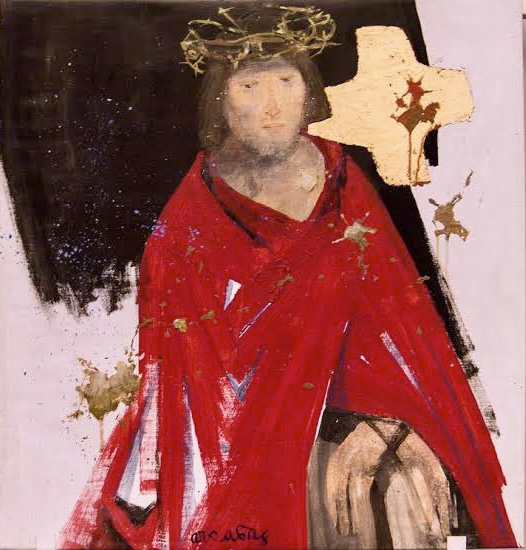
Touching the Wounds of Christ

HOMILY: Second Sunday of Easter (Divine Mercy Sunday)

John 20:19-31

24 April 2022

Fr. Ricky Cañet Montañez, AA

Over the past few years, I’ve grown to become a K-Drama fan. Madami na din akong napanood lalo na nung mga lock down.   May mga favorite na din akong artista — sina Song Ye Jin and Song Hye Kyo.  The two of them, like many Korean K-Drama stars, seemingly have perfect features. Anyone can readily describe them as “flawless, whiter than white actors/actresses”!  Pre-pandemic, dinarayo talaga ang South Korea para sa cosmetics and skin care products. It is dubbed as the epicentre of beauty.  

However, the pandemic changed the perspective of beauty in South Korea.  Beauty simply had a different face. Their medical frontliners started posting pictures of their faces with lesions, bruises, scars and other deep marks across their foreheads, cheeks and noses caused by wearing protective gears for many hours. When asked about how they felt about these marks, the medical frontliners in Keimyung University Daegu Dongsan Hospital responded that instead of being intimidated and embarrassed by such wounds, they wear them like badges of honour in the raging battle. 

In today’s gospel passage from John, we see the Risen Jesus appearing to the Apostles and showing His wounded hands and side to them. I recall Cardinal Chito Tagle in his homily during the mass at the Easter Recollection he gave in 2018 asking: “How come the Risen Lord, the triumphant Lord, did not erase the signs of His death? If I were Jesus, triumphant, I would remove all signs, all memories, of my defeat, my shame and humiliation. But that is not the way of Jesus.” The sacred wounds of Jesus as we refer to them are seen rather as “marks” of sacrificial love, of mercy and compassion, of healing and redemption. We recall Isaiah’s prophetic words: “But he was pierced for our transgressions, he was crushed for our iniquities; the punishment that brought us peace was on him, and by his wounds we are healed.” (Isaiah 53:5) 

Also in today’s Gospel, Jesus does not only show His wounded hands and side but He also invites Thomas to touch His wounds. Directly addressing Thomas, Jesus tells him: “Put your finger here and see my hands and bring your hand and put it into my side.”  (John 20:27) When Jesus asks Thomas to touch His side, He was allowing him to verify and ascertain that it was He — that He was who He said He was — the very same Jesus whom he lived and ate with, journeyed with and who loved them. As people, we always tend to look for something tangible and palpable. It is not enough to see or be told about something. To be able to touch and feel something with our own hands, guarantees something is REAL. It gives a better understanding.  Touch sometimes communicates what words can’t — a mother’s comforting embrace, a father’s reassuring pat on your back, a friend’s empathic squeeze of your hand/arm, or a caress on the cheek of a lover.  The invitation to touch His wounds is extended to all of us today. To feel the nail marks is for us to recognise the truth that He lived, suffered and died for us. 

If we look closely at the resurrection narrative, we see that it does not tell us whether Thomas actually touched the wounds of Jesus. What we find thereafter is Thomas’ faith exclamation: “My Lord and my God” (John 20:28) — which according to Bible commentators is a profession of faith that outshines all others in the four Gospels. Furthermore, it is to be noted that these are the very words used to refer to the true God in the Old Testament. What is clear is that Thomas is convinced of the presence of the Risen Christ in their midst and in turn is asked to be that presence of the Risen Christ to others. I think the story leaves a little to our imagination so that we are left to decide how we choose to respond to the invitation. 

This invitation to Thomas to touch His wounded hands and side is extended to all of us. How do we touch the wounds of Christ? As a community of believers, we, touch the wounds of Jesus when we are able to embrace our own suffering; when we come face to face with trials and difficulty; when we find ourselves in painful situations and when we touch the wounds of our brothers and sisters who are also suffering. We have been through a lot in the past few years. We have lived in fear of getting sick, we have lost loved ones to COVID, we have lost jobs, we have had mental health concerns, etc. These days we are worried of  the rising prices of commodities, the division we have as a people because of our political colours and leanings, the outcome of the elections, the future of our nation, and the effect of the current war in Russia and Ukraine.  These are situations wherein we desire healing — situations that leave us with emotional, and even physical scars. Is it not true that when we are most troubled and in need, this is when we call out to the Lord the most in prayer?  This is when we are likely to encounter Jesus.  Firstly, because we actively seek Him, and secondly, because Jesus is closest to us when we are suffering with Him. These moments in our life, are the moments that will allow us to say Jesus is real, and that He is truly with us. 

Jesus is no longer physically present with us, but we have to realise that all hope is not lost. Jesus Himself acknowledges, that to touch is not the be all and end all. He talks about believers beyond His time on earth — you and me, and those who will live after us — that those who have not touched nor seen Him yet believe, are blessed. And what is it that bridges the divide between believing something is real and not being able to touch? It is faith and the love we have in our hearts. We have that hope that someday we will be able to touch Jesus when we meet Him one day in the company of all our loved ones in Heaven.  For now, we look forward to a total end to this pandemic and a brighter future for the country, that we may freely and safely embrace our loved ones around us. 


We Race in Faith and Hope

HOMILY: Easter Sunday

John 20:1-9

17 April 2022

Fr. Ricky Cañet Montañez, AA

One of my favourite movies in the 90’s is the comedy-drama film, Forrest Gump based on the 1986 novel of the same title. “Run, Forrest, Run!” All throughout the story, the lead character Forrest Gump overcomes his life adversity by simply running. As a little boy he wore leg braces but at a pivotal moment of his young life, the braces came off and he learned, not just to walk without them, but to run! All throughout his life, people who influenced him and made an impact in his life motivated him to run. When he was bullied in school and stoned by his peers, his only friend in school — Jenny, prompted him to run. As an adult he was drafted into the Vietnam war and he saved people’s lives by carrying them and running to safety. In the course of the story, Forrest recounts what his Mama used to tell him… “My Mama always said, you’ve got to put the past behind, before you can move on.” 

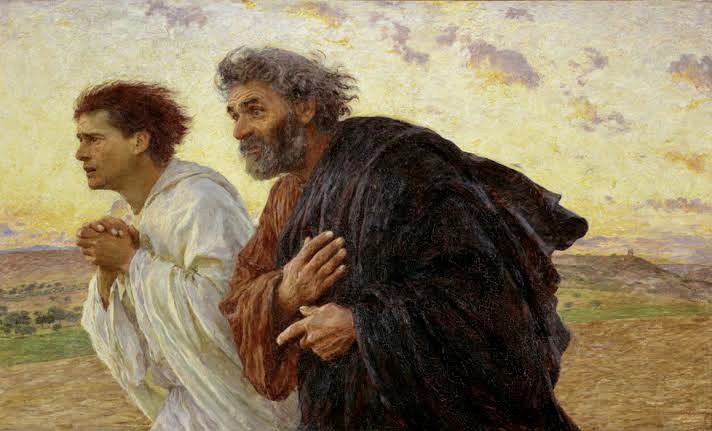
In the Easter narrative from John’s Gospel, there is also some running involved among the main characters of the Easter story. We are told that “Very early and still dark, Mary came to the tomb, upon seeing the tomb empty, she went running to Simon Peter and to the other disciples… Peter and the other disciple also ran together, the other ran faster…” (John 20:1-3) Three persons. All running, motivated differently.  Mary runs because she is fearful. She was afraid that someone had stolen the body of Jesus. We, too, tend to run when we are afraid. We run away from things that will cause us anxiety, grief, sadness, and negativity. Mahilig tayong umiwas. Nagpapakaduwag tayo. Magpapakalulon sa Netflix, sa video games, sa shopping, sa bisyo o kaya mangingibang bayan… lahat ng ito ay tanda ng pagtakas sa ating realidad ng buhay.  O minsan, gaya ni Mary, tumatakbo tayo sa taong agad na makakatulong o makapagbibigay ng kalutasan sa mga problema natin. 

The other disciple, who outruns Peter is unnamed but since he is referred to as “the one Jesus loved” we can safely assume this is John.  Why is he able to run faster?  Because unlike Peter, he did not have any guilt weighing him down. Throughout Jesus’ three-year ministry, Jesus has few disappointments in John. Sa katunayan, siya ay kinagiliwan ni Hesus. Sa pinakamasakit na kabanata ng buhay ni Kristo, hindi Siya iniwan ni Juan. John accompanied Jesus into the high priest’s chambers for his trial and even stood at the foot of the cross, in a show of loyalty, love, and support for his Master.  Panatag ang loob ng Panginoon kay Juan, kaya’t noong malapit na Siyang mamatay, inihabilin Niya kay Juan ang kanyang mahal na ina. I think that John, at his very core, did not doubt Jesus. He runs to see for himself the proof of Jesus’ declaration that He would rise from the dead. He runs in the hope that He will see his friend alive! He races and beats Peter to the tomb, and becomes the first believer in the resurrected Christ. Hindi ba, ganun naman tayo? We tend to run towards the persons we love so dearly whom we are excited to be with after not having seen them for a long time.

Conversely, we would not want to run towards people whom we have hurt or to whom we have done something wrong, am I right? Hindi ba’t pinagtataguan natin ang mga inutangan natin na di natin mabayaran? Ako, nung bata ako, nabasag ko yung vase ng terror teacher namin. Hindi talaga ako nagpakita sa kanya. I think this is why John was able to outrun Peter. Peter had some hesitation. Paano kung andun nga si Hesus na buhay? Paano niya ito mahaharap sa kabila ng kasalanan niya kay Kristo?  He was painfully aware that he had denied Jesus not once, not twice, but three times!  Ang masaklap, alam ni Hesus na ginawa niya iyon. Di na bale kung nagkakasala tayong walang nakakaalam, hindi ba? Pwede pa tayong magpatay malisya. Malas lang ni Pedro na bago pa nya nagawa ang pagtatatwa, alam na ni Hesus na mangyayari! Kaya doble pa ang kahihiyan niya kay Kristo. Throughout Jesus’ ordeal, Peter could only manage to go as far as the courtyard. And after he denied Jesus, he abandoned his friend and disappeared in shame. 

Ang maganda kay Pedro, tinuloy pa rin Niya ang pagtakbo papunta sa pinaglibingan kay Kristo. Inspite of himself, his embarassment, his fear and his hesitation, he ran to the tomb in the hope of finding Jesus. Alam naman natin na mabigat sa kalooban kung may daladala kang guilt, di ba? Kaya sa tingin ko, sabik na rin siyang mapagaan ang loob niya sa paghingi ng tawad kay Hesus.  Sana ganoon din tayo. Don’t let your sins and your mistakes keep you from moving forward in life. Sabi nga nung mama ni Forrest Gump, “Put the past behind…” The death and resurrection of Jesus are the very things that empower us to put our ugly, sinful past behind us. Jesus welcomes the penitent with open arms and gives us a future of renewed life in Him. We just have to find the courage to own up to our mistakes, run to Jesus and seek His forgiveness and allow the Risen Lord to lead us forward. 

One last thing, before we end. Did you notice that in the gospel, the three characters are not only running around but they are doing so in the dark? The setting of the story is that it was “very early and still dark” (John 20:1) Who runs in the dark?  Patatakbukhin mo ba ang anak mo sa dilim? Di ba kahit sino, takot madapa kasi di mo nakikita ang dinaraanan mo?  In his Easter sermon, a priest answered this question saying, “[Those who run in the dark are] people who have spent time with Jesus Christ. [These are] people with hope.” Ang taong umaasa kay Kristo ay may buong pagtitiwala sa Kanya. Hindi ba’t pagbuong- buo ang tiwala mo sa isang tao, susundin mo siya kasi alam mong di ka niya kailanman ipapahamak? These three characters had such a profound experience of Jesus that the faith Jesus sparked in their hearts was enough to light their way. 

This Easter, let us be like Peter. Despite all our failings and sinfulness, let us seek out the One who loves us unto our weakness. We are called to run towards the Truth who knows us through and through, and embraces us in our frailty. We race head on in faith and hope despite the darkness around us knowing that it is Jesus whom we will find at our destination. Trust in the Risen Lord, and run!

Peter and John Running to the Tomb by Eugène Burnand 

Aligning Expectations with God’s Purpose

HOMILY: Palm Sunday of the Passion of the Lord

Luke 23:1-49

10 April 2022

Fr. Ricky Cañet Montañez, AA

Sino ba sa atin ang mahilig mag-online shopping? Very convenient nga naman siya. We can even get some products cheaper online than if we buy them at the department store, after all, sometimes, they use the same supplier.  Kinakailangan lang mag-iingat tayo. Kilatisin ng husto ang produkto at tumingin sa reviews bago bumili sa isang seller. We might end up with something we do not want. There are buyers who end up with miniature or “doll size” items instead of full-size ones. Sometimes the colours appear different from what is in the pictures. Other times, we think we are buying the whole package but they were just selling a small part of it. It gets really frustrating and disappointing when we get what we were not expecting, di ba? 

Jesus was not the Messiah the Jewish people expected. It made it very difficult for them to accept the truth of His identity. When we look closely at Luke’s passion narrative, we sense that Jesus is trying to turn His accusers, His listeners and even His disciples away from their own expectations and notion of the Messiah. They had the wrong idea about who the Messiah ought to be. It kept them from seeing that Jesus was the Saviour and the Son of God. Recall the varying impressions provided by the people about the identity of Jesus — “Some say John the Baptist, others Elijah, still others Jeremiah or one of the prophets.” (Luke 9:18) Then Jesus poses this question to His disciples. “But who do you say that I am?” (Luke 9:20) Speaking on behalf of the others, Peter leads them all into a profession of faith. Peter confesses, “The Christ of God.” (Luke 9:20) Jesus acknowledges that it is God the Father who has revealed that to Peter.  On his own, Peter may not have realized it as well.  Nonetheless, Peter did not completely grasp the concept of Jesus’ mission as the Messiah. He was not able to accept the prospect of Jesus passion and death such that Jesus eventually reprimands him for it. We also take the example of Judas. What kind of Messiah was Judas expecting?  For Judas and the rest of the disciples, as Jews, they would have expected the Messiah to be a royal military figure who would wage a battle and save Israel from its oppressors to restore it to greatness. They were not expecting a spiritual figure who showed compassion, patiently taught crowds, and lived a life of humility.  We could surmise then that Jesus’ message of loving one’s enemies, concern for the poor and so forth was deemed nonsense to Judas and for those who see the Messiah differently. One commentary I have read even suggests that “Judas’ act of betrayal can even be deduced as an attempt to trigger Jesus. If He so wanted, Jesus could have saved Himself by rallying the people behind Him and so fulfill their expectations of the Messiah at the soonest possible time.” 

What Jesus was making them realise is that what they really want for themselves is upon them but perhaps in a different way from what they expected. He was the Messiah. He was in their midst. He was going to save them. Sadly, they did not see it.  Look at how Jesus further shatters their notion of the Messiah as He forgives while dying on the cross those who have caused Him great suffering and a painful death. As St. Paul points out in his Letter to the Philippians, “Christ Jesus, though he was in the form of God, did not regard equality with God something to be grasped. Rather, he emptied himself, taking the form of a slave, coming in human likeness; and found human in appearance, he humbled himself, becoming obedient to the point of death, even death on a cross.” (Philippians 2:6-8)

It is a terrible feeling to have one’s expectations raised only to be let down.  In the recent weeks, I have been following the interviews and speeches of the different candidates vying for the national posts. I pay close attention to how each one of them would respond to the questions randomly thrown at them by journalists. I could tell right away who are those who would be more collaborative (or not) in their approach of governance. I love those candidates who use the word “we” rather than “I”; those who say, “We will do this and that…” rather than “I would do this and that…” That, to me, is practical truth because no one person can do everything, especially run a country. No one person can force the entire nation to submit and conform to a plan. People have to want to support the plan. People have to see the benefit of cooperating such that they volunteer their efforts and skills. That is why I support leaders who inspire people to do good, to be helpful, to be active in society, to be compassionate, to think of the good of the nation and not just themselves. I do not believe in politicians who make promises they cannot keep. If you believe in empty promises, you will end up disappointed and frustrated. 

Jesus is very much a leader. He is Rabbi, Saviour, and King to us all. Just as He was misunderstood when He lived on earth, people today have their own misguided expectations of Jesus Christ that prevent them from seeing the truth about Him. Some of us expect Him to be a genie who grants wishes. Pray ka ng pray na yumaman ka pero pag hirap ka pa rin, sisisihin mo ang Diyos, kesyo walang malasakit sa iyo o di nakikinig sa dasal mo. Kung ganoon ang expectation mo, mabibigo ka talaga kasi hindi naman genie ang Diyos na sumusunod sa bawat utos mo at kahilingan. Meron naman umaasa na ang Diyos na lubos na nagmamahal ay hindi kailanman hahayaang may masamang mangyari kahit ano pa ang gawin nila. Mali din naman iyon. Kung ikaw ay magpakatamad, magpariwara, manghamak ng iba, hindi nalalayong mailagay mo ang iyong sarili sa kapahamakan. Hindi ka dapat magtampo sa Diyos. He never desired you to be in such terrible circumstances. Rather, it is by your own actions that you found yourself in a predicament. 

Sayang kung di natin lubos na kilalanin ang tunay na katauhan ni Kristo at ang kaugnayan nya sa buhay natin. Jesus is our Saviour and He loves us so much that He gave His life for us. This is the story we recount in today’s gospel narrative. In every age and season, Jesus desires to be in a close personal relationship with each member of humanity — with each of us. He helps and guides us in ways we may not understand or recognise because He wants what is best for us.  

This Palm Sunday, let us be reminded to place our trust in Jesus. No expectations. Just complete trust. Let us allow God to surprise us, resting assured that as our Father, He loves us unconditionally and as our Leader, He never makes a promise He does not keep.

By: Arcabas

Meeting Truth with Compassion

HOMILY: Fifth Sunday of Lent

John 8:1-11

3 April 2022

F. Ricky Cañet Montañez, AA

I know of this woman in her late fifties who got her first smart phone in the late 2019. Over the pandemic, she struggled to learn how to use it. She managed to join messenger chat groups and navigate her FB account on her phone browser. Dati, na-access lang niya ang FB niya pag nakikigamit siya ng computer ng kapatid niya. Ngayong madalas na siyang nakakapag-FB, namamangha sya sa mga posts na nababasa niya at pinaniniwalaan niya ang LAHAT ng ito. Hindi pa buo sa isip niya ang konsepto ng fake news. The worst part is she loves to SHARE and pass around what she finds interesting even if the information is not true. Dahil mas bata siya, tiwala ang mga lola friends niya na matalino siya at mulat sa mga kaganapan.  Kaya kahit anong ipasa nyang basura at kasinungalingan, pinaniniwalaan ito ng mga lola. Hangga’t walang nagpapatunay na mali siya, pinaninindigan pa niya at ipinaglalaban ang mga “shine-share”o “pino-post” niya. Nakakatawang, nakakaawang, nakakainis…

May kaibigan o kakilala ka bang ganyan? I’m sure. Naglipana ang Marites (Mare ito ang latest), Marietta (Mare, ito pa), Marisol (Mareng nanunulsol), Marissa (Mare, isa pa), Maricon (Mare, confirmed), Marichu (Mareng echusera), etc.  Pasintabi sa mga kapangalan ng mga ito. Hindi rin totoo na pawang babae lang ang ganyan. May mga lalaki din na nuknukan ng tsismoso. Yan ang realidad sa ating lipunan. Isn’t it true that we allow ourselves to be misled by gossip, lies and half-truths? We have to be very careful about what we believe in social media especially during this election period where trolls are paid to spread disinformation and to engage people into fighting and arguing online. They love to sensationalize things to suit their agenda. It is nothing new though, because as we hear in today’s gospel, it also happened in Jesus’ time!

In today’s Gospel passage, a group of scribes and Pharisees brought to Jesus a woman caught in the very act of adultery. Hoping to get Him to react in a way that would entrap him. They wanted Jesus to contradict His teachings and try to get Him to publicly disregard the Jewish laws. I recall one of my professors saying that “If she was caught in the very act of adultery, why did they not bring in her partner as well?” That’s a genuinely valid question. Both were guilty of the act and under the Jewish law both of them are supposed to be stoned. So, why was it only the woman who was brought in to be judged? Anyway, as the story progresses, we are told that instead of passing judgement on the woman, Jesus “bent down and wrote on the ground with His finger”. Many have speculated on this gesture of Jesus. Though it is not important what Jesus wrote on the ground, a Bible commentator sheds light on this well-known gesture. This very act of Jesus calls to mind Jeremiah’s denunciation of Israel’s infidelities and refusal to repent (Jer. 17:13). “O Lord, all who forsake You shall be put to shame; those who turn away from You shall be written in the earth, for they have forsaken the Lord, the fountain of living water.” In this sense, Jesus is trying to make them realise that nothing much had changed among them since Jeremiah’s time. They have been quick to pass judgment on others and yet they themselves have been unfaithful to God. Hence, Jesus challenges them: “Let the one among you who is without sin be the first to throw a stone at her.” (John 8:7)

In the Bible, Israel herself has been found to be in adulterous relationships with the foreign gods. Hosea is the prophet who speaks quite vividly of the covenant infidelity of the Israelites to the One True God. Despite Israel’s unfaithfulness, the prophet also highlights God’s faithful response to the covenant He had made with His people by showing them mercy. Similarly in the gospel account, instead of sending the adulterous woman to death, Jesus sends her to life. Jesus gives her a new lease on life. But take note also that although Jesus does not condemn her, neither does He exonerate her. Jesus exhorts her to sin no more. 

The Gospel passage teaches us to be most mindful in arriving at conclusions and in making judgments. Sometimes, we are given information that normally we consider “nakakasakit ng ulo” or “nakakataas ng BP”. Before we react, it is best to take a breath and take a step back to assess whether it is true and if we are looking at the complete picture. These days there is so much fake news, spliced videos and altered photos, that we can no longer accept things at face value. The woman I mentioned in the beginning used to believe every video on social media and Viber until someone taught her about deepfakes and video splicing. However, she has yet to learn the difference between a legitimate video from a credible source and the heavily biased “fan-made spliced or narrated videos”. Apps like Photoshop can manipulate photographs, while MyHeritage can animate a still photograph, Reface and Zao can create deepfakes wherein the user can make super believeable fake videos of anyone saying whatever the user wants them to say.   These can be dangerous especially at this time when some in the government has undertaken the malicious blacklisting of anti-administration individuals. Nakakatakot kung magawan ka ng fake video tapos na redtag ka. Sana, maging mapanuri din ang ilang mga awtoridad bago sila mag-redtag. 

Sometimes, we cannot help make rash judgments about people and situations. We tend to overreact or make hasty conclusions without making an effort to fact check or learn the whole story. For instance, I saw this post many years ago with a prompt not to be quick in judging others. Pinakita sa post ang larawan ng isang napakabatang buntis sa kalsada. Karamihan ng nakakita sa picture, naisip na maaga siyang lumandi pero kung mabasa mo ang kwento niya, masaklap ang kapalaran niya dahil ipinagbubuntis niya ang bunga ng panggagahasa sa kanya. Marami pang example kung saan tayo ay mabilis na nagiging mapanghusga gaya ng lalaking tinaguriang nating “baduy” na working student pala at walang pambili ng bagong damit, o yung estudyanteng pinagkakamalang “bulakbol” dahil laging absent, yun pala wala lang siyang pambaon at pamasahe. O kaya yung tindera sa palengke na binarat-barat mo para sa isang kilong gulay at sinabihan mong madamot, samantalang dose kilometro pala ang nilalakad papuntang palengke para makatipid sa pamasahe at may maiuwi pang kita sa panghapunan ng pamilya. 

We live in unusual times where we have access to a wealth of information online and the speed of communication has improved tremendously. If we are not careful, we can be agents of spreading lies and destroyers of innocent people’s reputations. Sometimes we arrogantly believe we know enough or that we are always right. The truth is, we have no right to judge others because most of the time we do not have the complete story. Let us learn to suspend our judgment before we can verify the circumstances surrounding the issue. We should be more like Christ who stands for the truth and who is welcoming and accepting of people regardless of their flaws and mistakes in life. He scrutinizes the heart, more than anything and reacts always with understanding and compassion.

From sel-compassion.org

Laying Ourselves at the Mercy of God

HOMILY: Fourth Sunday of Lent

Luke 15: 1-3, 11-32

27 March 2022

Fr. Ricky Cañet Montañez, AA

One of the first impressions I have of the British is that they tend to say ‘sorry’ quite a lot. They apologise for almost any given situation, such as accidentally bumping into you in the tube, asking a stranger for the time, sneezing, feeling sorry for being late, etc. A friend said that because they tend to use the word ’sorry’ so often, the word’s meaning has changed over time. It is easier to blurt out for trivial things but harder to say when we know we have deeply hurt someone — and that is when it really matters. 

In the gospel parable, which we normally refer to as “The Parable of the Prodigal Son”, the younger son’s redeeming factor for all his misgivings is his willingness to humble himself and acknowledge his sins. Great indeed were his sins by asking for his share of the father’s inheritance. I have read that in the Middle Eastern culture the distribution of the inheritance is traditionally done when the parents are on their deathbed. Hence, the request of the younger son for his inheritance while the father is still alive was tantamount to him saying, “Dad, I wish you were dead already.”  The Father must have been offended but he gives in to his son because He loves Him. He does not send him away in anger, but rather the son voluntarily leaves his home with an arrogance that he can make it on his own or do even better away from his father. In the foolishness of his youth, he spends his sudden fortune in living a life of total debauchery and self-centred indulgence. “Nagpakasasa siya sa kanyang mga luho.” Eventually, he spent everything and was left with nothing. He was reduced to something utterly detestable for the Jews — living with pigs and even eating their leftovers, a situation that is awful in any culture. Coming to his senses, he swallows his pride, returns home and throws himself at the mercy of his father. He was so desperate that he was even willing to relinquish any filial claims and be treated as one of his father’s hired workers. 

The younger son gives us an example of how we can make the first steps towards reconciliation. On his part, the younger son had to admit his wrongdoing, to accept (or even to suggest) the punishment he deserves, and then eventually to seek out his father’s forgiveness.  Admittedly one of the hardest things we may ever have to do in life is to apologise for the bad things we have done or to say sorry to the people we have hurt. Reconciliation always starts with admitting you were wrong. That is often not easy either because we tend to be too self-absorbed, proud, or fearful of the consequences. Sometimes it takes something drastic to shake us back into our senses.  On the part of the erring son, it was the experience of hunger and the realization that he was now living with filthy animals. In my experience as a priest, I have met people who were humbled by a life-threatening affliction, tremendous failure in business, devastating heartbreak, or the loss of loved ones. These moments become moments of conversion for many. These become the turning point of one’s contrition, where they realize their own failings and seek reconciliation with God and the people they have hurt.

One of the most important ways, we Catholics experience and exercise the act of saying sorry is through the Sacrament of Reconciliation and Penance — Confession.  This is very timely because it is Lenten Season and this is the time we are asked to look at ourselves and see where we have failed God and our neighbour in the spirit of humbling ourselves before Him, in Jesus, who took on the ultimate punishment for man’s selfishness — death. He undergoes the most painful and humiliating death so we need not go through it anymore as long as we abide in Him. You might say, my sins are minor and they do not merit death so I do not need to make amends. However, let us be reminded that all sins have an effect on our body and spirit. When we are not at peace, or when we suppress guilt feelings, this tends to manifest as health concerns that could progress into something serious if unaddressed and untreated. Forgiveness not only repairs relationships, it also grants healing — of both body and spirit.

In his homily for the Feast of the Annunciation, Pope Francis encourages those who hesitate to approach the Lord in the Sacrament of Reconciliation: “Dear sister, dear brother, if your sins frighten you, if your past worries you, if your wounds do not heal, if your constant failings dishearten you and you seem to have lost hope, do not be afraid. God knows your weaknesses and is greater than your mistakes. He asks of you only one thing: that you not hold your frailties and sufferings inside. Bring them to Him, lay them before Him and, from being reasons for despair, they will become opportunities for resurrection. Do not be afraid!”

Pope Francis also wants us to realize that Confession is how we experience the mercy of the Father. In the same way that the father in today’s gospel welcomes back his wayward son, God too waits patiently for us.  Notice that the father in the gospel runs out to meet his son even if he is still a distance away. And he throws his arms around his boy even before he is finished with his apology speech. The transgressions of the son become irrelevant because he is simply overjoyed that his son is back and he can keep him safe.  The father humbles himself for a second time by going out to speak to his elder son who refused to come in and join them in their feasting. Pope Francis further emphasized in his homily that in confession… “It is not so much that we go to the Lord, but that He comes to us, to fill us with His grace, to fill us with His joy. Our confession gives the Father the joy of raising us up once more. It is not so much about our sins as about His forgiveness.”

We must never underestimate the power of God’s love and mercy for us His children. If we, human beings in our own frailty and brokenness find it in our hearts to forgive those we love, how much more for God, Our Father? One very popular modern saying is that “God is bigger than [our] sins.” It is true! There are no sins God cannot forgive if we return to Him and ask His pardon. Let us think of our worst, most embarrassing sin and know that God will still run to us and embrace us when we come to the confessional.  When I hear confessions, I try to communicate the love and mercy of God to the penitent. Even if I am shocked or horrified by the sin confessed, I remind myself, it is not I who forgives but it is God who forgives through me and there is no sin greater than His love. I myself, as a priest, value this sacrament. I make sure, I too confess my sins to a brother priest at least once a year or as often as needed. Even though I am a minister of the sacrament to the lay faithful, I also seek the forgiveness of God, my Father and desire to be in His grace.  I hope you avail yourselves of this grace and seek the Father’s forgiveness this Lent. (Magkita kita tayo sa Kumpisalang Bayan. Wag na nating hintayin ang Holy Thursday para mangumpisal. May dalawang linggo pa naman.)

On this Laetare Sunday, we rejoice at our God whom Jesus came to reveal as a loving and merciful Father. God has lovingly shared His life with us in Christ. Having been reconciled to God through Christ, let us go out and spread the good news of reconciliation everywhere. Let us be agents of reconciliation that guarantees new life for all our brothers and sisters.

By Arcabas

Repentance: Turning to God, Living His Will

HOMILY: Third Sunday of Lent

Luke 13:1-9

20 March 2022

Fr. Ricky Cañet Montañez, AA

“Madapa ka sana.” Have you ever wished that on someone who slighted you or hurt you?  Pag nadapa nga, ano ang susunod na sasabihin? “Buti nga sa iyo.” Hindi ba? Natutuwa ka pa kasi tila ang mundo ang nagparusa sa taong naturingan mong masama.  Pagmalalang-malala ang kasalanan sa yo, minsan nasasabi mo pang “Mamatay ka sana.”  Should it happen, would you be satisfied? Would you feel vindicated? 

For the Buddhists, they call it karma. Tipong binabalikan ng pangyayaring masama ang gumagawa ng masama sa kapwa. It is quite common for people to believe that certain misfortunes that strike people, especially those whom they do not like are “well deserved!” (Sa Tagalog slang kadalasang sinasabi ng ilan… “dasurb na dasurb”).  For those who believe in God, they believe it to be Divine Justice wherein God metes out an appropriate punishment on evildoers. In the Exodus story, God punishes the oppressive Egyptians by having an angel slay all their first born and drowning the Egyptian army in the Red Sea. In the story of Noah, he sends a flood that destroys the world that has become evil, saving only what remained on the ark. In the story of Sodom and Gomorrah, God rained fire from the sky to destroy the two cities where He could not find even 10 righteous people. 

Ok na sana, di ba? But the truth is, bad things don’t just happen to bad people. They happen to good people too. When thousands of people are killed or are rendered homeless as the result of some terrible natural disaster are we to read it as an act of punishment for those people? For what crimes are innocent children paying for with their lives as casualties of war? Does that mean God is cruel?  Some people turn away from God because they cannot reconcile the loving nature of God with one who would not prevent such things from happening to good people. A high-ranking government official in the sixties developed Parkinson’s in his old age. The eldest of his two sons idolised his dad so much for his kindness and brilliance. He could not accept that God would allow his father to suffer the indignities brought by the disease. When his father passed away due to multiple complications, his son completely abandoned his faith. Some parents who lose their children at infancy, also turn away from God. They cannot fathom why He would allow bad things to happen to good people and innocent children. 

It is however incorrect to blame God for these misfortunes in life. God is all good and whatever God creates is good. It follows then those human beings are inherently good. However, when people make bad choices with the gift of free will, goodness is distorted, destroyed and corrupted. When people choose to be inconsiderate and selfish, they make victims of others.  We can victimise others deliberately and sometimes, unknowingly, we become the scourge of others. When people give in to jealousy, pride and ambition they become blind and indifferent to the plight of others. We also experience this in corrupt societies that breed criminals, and force the needy to kill and steal for survival. Moreover, it is the people’s abuse of the environment that intensifies natural calamities. Illegal logging and indiscriminate throwing of garbage causes the worst flooding in lowlands and cities. Smoke coming from factories wantonly destroy the atmosphere and contribute to climate change. All of these are influenced by man through the centuries. When people choose to do evil, misfortune becomes the way of the world. 

In today’s Gospel Jesus refers to two violent incidents primarily to point out the inevitability of these kind occurrences in life. The two tragedies — the murder of the Galileans by Pilate and the death of the eighteen people in the tower at Siloam made people think that such bad things happened because they must NOT have been good people after all.  And so, they concluded that those who died must have deserved what they got. Let us remember that people back then thought that any misfortune was a punishment for sin. However, Jesus uses these events to reverse this rather perverted thinking. “But I tell you, if you do not repent, you will all perish as they did!” (Luke 13:3) Jesus warns His listeners of the suddenness of these tragedies and the possible unpreparedness of the victims. Jesus exhorts His listeners to repent lest they suffer the same fate. In the same light, St. Paul also warns the Corinthians in the Second Reading: “Therefore, whoever thinks he is standing secure should take care not to fall.” (1 Corinthians 10:12)

This places a new perspective to the terrible events that are happening around us. We can accept them as a wake-up call that brings us to awareness that we are in need of salvation and are called to conversion. The second half of today’s gospel tells us of a landowner who planted a fig tree that did not produce fruit for three years.  Giving up on it, he tells the gardener to cut it down.  But the wise gardener knows that the tree simply needs cultivating and proper care.  He suggests, “I shall cultivate the ground around it and fertilise it; it may bear fruit in the future.” (Luke 13:8) Through the parable Jesus demonstrates the mercy of God for us. God is willing to give us time and means to repent. Jesus urges His listeners to be reconciled with God before any misfortune strikes so that divine judgment does not accompany it. Repentance is a call for all so that if all turn to God and live in accordance with His will no one hurts another, no one is punished by another (whether deserved or not). God’s will is always meant to breed and propagate justice, peace, goodness and love.

Every Lenten season is a chance for us to reflect on how we have contributed to the suffering of others and how we can make amends. Today, Jesus tells us not to give up hope that we can be better. There is still time to cultivate our life and ensure we bear much fruit. God offers us His love, His care and His help. Let us open our hearts to God’s merciful love and become the fig tree that bears fruits, as proof of our repentance.

From National Catholic Reporter

Transform for Jesus

HOMILY: Second Sunday of Lent

Luke 9: 28-36

13 March 2022

Fr. Ricky Cañet Montañez, AA 

I like coffee. When I eat a big meal, I always have a cup of coffee with some sugar. I can never drink pure black coffee. Others take their coffee in the morning and cannot seem to function without it. They are grumpy without their morning cup and if they skip it, become even more irritable throughout the day. Oddly enough, I don’t need coffee in the morning. I prefer hot chocolate or some tea. We all have our rituals and preferences because we are creatures of habit. We love to do the same things again and again. We eat the same food, watch the same TV shows. (The Broken Marriage Vow), etc. However, when we are content and satisfied with what is familiar, we tend to become quite resistant to change. Kung sanay ka nang magkape sa umaga, masisiyahan ka ba kung orange juice lang ang available? Change is often uncomfortable and change promises difficulties. We resist and refuse to succumb to it, but we know, change can be necessary for our growth and maturity. 

Today’s Gospel reading for the Second Sunday of Lent is the story of the Transfiguration wherein, Peter, James and John get a glimpse of the glory of Jesus. Peter is depicted in the reading as someone who was tempted to remain on the mountain and to stay put: “Lord, it is good that we are here. If you wish, I will make three tents here…” (Luke 9:33) Transfiguration comes from the words “trans” meaning “beyond” this world and “figures”. This suggests that what Peter, James and John witnessed was something otherworldly! Peter was overwhelmed and in awe of what he witnessed that he wanted to prolong it and remain in that beautiful moment. That glimpse into the glory of Jesus was proof that He was of divine and powerful nature. Peter was okay to live on that mountain forever, safe from the uncertainties, trials, and difficulties they faced on a day-to-day basis.  Jesus knew this and discouraged him. Jesus knew that if they remained, He could not fulfill His mission. 

While Peter is eager to stay and get settled, the message of Jesus’ Transfiguration suggests a contrasting challenge to those who follow Him. The disciples realise that they cannot simply stay where it is safe and comfortable — they must go back down the mountain and be integrated into their society as changed men — better men, braver men, with a certitude that all that must come to pass, though difficult all will end for the glory of God.  Yes, brothers and sisters, when we have the experience of Jesus, we cannot simply sit back, stay put and be content with the status quo. The one who truly listens to Jesus’ words, the one who takes heed of Jesus’ teachings cannot just stay and remain the same. We are all challenged to go down the mountain of complacency in order to witness to others what we have heard from Jesus. Not all of us are asked to be preachers. Not all of us will have the chance to lead and inspire multitudes but we must all, in our capacity, live out the demands of that Holy Voice that directs us where to go… and what Jesus wants us to do. 

As followers of Jesus, our journey to our own transformation inside and out will never be an easy one. At times we may have to lose ourselves in the process of this self-transformation. There are those who grew up wealthy and comfortable but upon knowing Jesus, opted for a life of poverty and simplicity that they may care better for the needy around them. Some of them have already been rewarded with sainthood, like St. Francis of Assisi. On a larger scale, we are bound to encounter difficulties for standing up and being outright vocal in setting right what is wrong in our midst. Servant leaders who battle the norm of corruption in government are often the target of gossips, criticisms and intrigues.  Their integrity is questioned so it takes a lot out of them to hold fast to their principles and pursue their efforts to stop corrupt practices.  Indeed, transformation journeys can be quite painful and costly.  

The story of the Transfiguration of Jesus is meant to encourage us to hope for our own transformation (including those whom we feel are beyond redemption). It is intended to embolden us to be steadfast through all the many challenges brought about by the process of spiritual growth and maturity. It is designed to make us hopeful for the glory for which we are all destined as followers of Jesus. We read from Genesis today about Abram who is invited to look up at the stars and seeing them all is asked to believe that his descendants will be more numerous than all the stars in the sky.  Abram is also promised a great land to possess for him and his descendants. Both of these are signs of God’s abundant blessings, but Abram and his wife are too old to have a child and the prospect of having land seems remote. But Abram believed in God’s promises and God did not fail him. God will certainly not fail us either. We just have to place our hope and trust in Him. 

My contemporaries have all turned golden this year. Turning 50 heralds a decade of transitions, many of them involving physical changes. Ibang-iba na rin ang mga pinag-uusapan namin sa mga pagtitipon. The conversations I hear among our circle of friends centres on receding hairlines, more grey hairs, weaker eyesight, growing larger sideways (nowhere to go but sideways), maintenance medicines, wrinkles and body aches all over. There are obviously physical changes and these changes are natural. Eventually, we will become forgetful as we age, maybe even makulit. Who knows? So, there is no need to feel stressed about them. However, through these changes, we still find purpose to life, and with more knowledge and experience behind us, we continue to live out the mission God has given us through our professions, vocations, and status in life — whether, married, single, or in the religious life. 

Today we are reminded that we must strive to be brave and work hard to overcome our propensity to remain in our comfort zones. It is through the conversion of our hearts… or changes for the better that we can ensure we are on the right path to Jesus. It is our hope that this path will lead us to an eternal glory that is our destiny as beloved sons and daughters of God!

Not ALONE in Battling Evil

HOMILY: First Sunday of Lent

Luke 4:1-13

6 March 2022 

Fr. Ricky Cañet Montañez, AA

Each of us has experienced the lure of evil at some point in our lives. We have all been invited to turn our backs on God. That is to say that temptation is a universal human experience. It happens to both young and old, when least expected. Sometimes, we, ourselves tempt each other. Two friends were talking. One said I am giving up NETFLIX as my Lenten Sacrifice. The other replied in disbelief, “Really? That’s great!” Then she proceeded to enumerate all the interesting shows recently added to the streaming service. Her friend laughed and said, “Baka next week, bumigay na ko. Temptation ka eh! Andaming magandang papanoorin.” 

In the Gospel, we hear the familiar account of the temptation of Jesus. Jesus subjected Himself to be tempted by the devil. We know that he was faced with temptations of power, possessions and preponderancy. (the three P’s) We also take note that the text suggests that these temptations occurred in three different places: the wilderness, on a high mountain and on the parapet of the Temple in Jerusalem. One Bible commentary suggested that rather than considering them as three consecutive experiences happening almost simultaneously at a particular moment, perhaps they have to be seen as temptations with which Jesus was beset with throughout his public life.

These recurring temptations happening in Jesus’ lifetime are recounted in various gospel accounts. “[The other Pharisees) to test Him, were demanding of Him a sign from heaven.”  (Luke 11:16). “One of the criminals who was hanged there was hurling abuse at Him, saying, “Are You not the Christ? Save Yourself and us!” (Luke 23:39). After feeding 5,000 hungry people with an abundance of food, “the people there said, ‘Surely this is the Prophet who was to come into the world!’ Jesus knew that they were about to come and seize him in order to make him king by force; so, he went off again to the hills by himself.” (John 6:14-15). These gospel accounts illustrate that the challenge to be faithful to the Father’s will was a continuing struggle for Jesus because being fully human, He, too, was tempted in every way. They would occur again and again at various stages in His life, right up to and especially at the most trying moments of His life on earth.  In His anguish in the Garden, Jesus cries out “Father, if You are willing, remove this cup from Me; yet not My will, but Yours be done.” (Luke 22:42) How did Jesus overcome such temptation? Prayer! Jesus prays intensely.  “And He withdrew from them about a stone’s throw, and He knelt down and began to pray…” (Luke 22:41) He even urges His disciples to pray… “Pray that you do not come into temptation.” (Luke 22:40) Furthermore, let us consider the final sentence of today’s Gospel, which says: “When the devil had finished every temptation, he departed from him for a time.” Luke 4:13) That strongly suggests that the battle against evil was not a one-time occurrence for Jesus. It took place over and over again at various stages in His life, right up to and especially at those last hours in the Garden of Gethsemane and as He was hanging on the Cross.   

If we look closely, the temptations of Jesus mirror those of the temptations of God’s Chosen People in the wilderness. They grumbled that they were left to die in the desert of hunger and thirst. What did they do? Israel made a golden calf and worshipped it. God’s people repeatedly tried and tested God and questioned the leaders God had appointed for them. Where God’s people failed in the wilderness, Jesus triumphed by remaining faithful to God. As one Bible commentator points out: “In His responses to the tempter, Jesus would constantly defer to the power of God: it is not by bread alone… worship God only… do not put God to the test.”  It was Jesus’ humility and confidence in God, His father, that helped Him resist the temptations.

In varying forms, we too are tempted, especially when we presume to be most in control of our own lives and believe to be strong enough to battle temptations without God. Those who have experienced the effects of the abuse of alcohol and other substances understand best the lure of temptation. They think they can control themselves and that they have the power to stay within their limits, only to end up endangering their lives by taking too much.  Sometimes, the immediate satisfaction of our whims makes us shun what is truly of value in our live — our good relationships, and the ideals of truth, honesty and integrity. At this election time, we are faced with all forms of temptations. Candidates are tempted to lie, cheat, and speak ill of their opponents. Voters are tempted to spread lies about candidates, sell their votes, and reject family and friends over differences in politics. One very subtle temptation is to believe that the devil is not going to tempt us. My friend jokingly said, “So pag hindi tayo kinukulit ni Taning, ibig sabihin ba ay napapasailalim na tayo sa kanyang kapangyarihan. O di kaya na discourage na siya kasi di siya pinapansin?” The devil, is relentless. He will continuously try to get us to turn our backs on God. He will try and deceive us into believing we can handle our lives without God. Our only defense is to draw closer to God in prayer and keep Him constantly at our side. 

Let us also be assured that we are not alone in this struggle. At the very beginning of the Gospel passage, we are assured that Jesus was not alone in the desert because He was filled with the Holy Spirit. Jesus gave us that same Spirit before He returned to the Father. Let us call on the Holy Spirit to strengthen us and guide us in our struggle against evil.

From the Works of George MacDonald

Allies of Truth; Followers of Jesus

HOMILY: Eighth Sunday in Ordinary Time

Luke 6:39-45 

27 February 2022

Fr. Ricky C. Montanez, AA 

Twitter has elevated the scale of opinion. Yung mga mahilig mag-comment at magbigay ng opinyon sa anumang bagay ay namamayagpag sa Twitter. Opinion is a statement of a person’s feelings towards something. Ideally, everyone should respect everyone else’s opinion because we cannot be judged for how we feel. Yet twitter erupts in a lot of heated arguments and fierce word wars that it can make the platform really toxic. Nakakasama lang ng araw. It happens when people try to change each other’s minds and then start attacking each other’s person/character. Yun ang masaklap. People are so focused on proving the other wrong that they fail to gauge whether they are the one in error or that they need to stop themselves from digressing from character assassinating another. 

This Sunday’s gospel passage picks up from where we have left off in the past two Sunday gospel readings on Jesus’ teaching about the blessed life. This time Jesus points out our all too human tendency of judging the actions of others. If we are honest enough with ourselves, we will realise that we are indeed very quick to point out the failings of those around us. We seem to have a special set of eyes and ears for other people’s faults while we are quite blind and oblivious to our own. Pero kung gaano katalas ang ating paningin o pandinig sa pagkakamali ng iba, ganun naman tayo ka-bulag at bingi sa sarili nating kakulangan at kamalian. Ang mas malala, ay kapag ipinagtatanggol pa natin ito kahit ito’y naturingang baluktot na pag-iisip at pananaw sa buhay. We become defensive and are quick to hide our own failings by calling even greater attention to the faults of others… “eh bakit si ganito hinahayaang maging ganyan? … eh si ganyan mas masahol pa nga sakin…” etc. Tila gusto nating iba muna ang magbago kaysa sa tayo ang magbago. Maaaring dahil alam nating mahirap, o di kaya’y hindi tayo kumbinsido na tayo ang nagkakamali. 

There are three things I wish to propose that I hope you will consider — first, although we should not judge other people’s opinions, an opinion does not change the truth about something. What is wrong will always be wrong. Hindi porke’t sa aking pananaw honest ang aking kandidatong ipinaglalaban, eh matataguriang katotohanan na iyon para sa lahat. Maaaring may ebidensyang nagpapatunay sya ay sangkot sa katiwalian. Yun na ang katotohanan at di yun mababago o mabubura ng paghanga ko sa kanya.  It is to Jesus whom we look for guidance of everything that is good, of what is righteous and of what is authentic. If we are too liberal and too accepting of everything, we end up muddling and diminishing the truth.  Secondly, we should accept that our differing perceptions are formed because each and everyone of us is unique. Yes, we are people of different backgrounds, circumstances and life experiences. Maaaring ang platorma ng isang kandidato ay mas naaayon sa paniniwala at pagpapahalaga ng isang pamilya kaya sinusuportahan nila, samatalang ang pamilyang may ibang pinahahalagahan ay susuporta sa kandidatong mas nababagay sa kanilang ideolohiya. We are all different, and all equally flawed. No one is perfect. Even if we differ in opinion, we have to be understanding of each other’s idiosyncrasies. Iba iba ang ating pinanggagalingan at pinagdadaanan. Thirdly, Jesus asks each of us to stand up for the truth. We are not to judge people but rather advocate truth. In this light, it is perfectly acceptable to call someone out when they are being inappropriate, hasty or naive about certain situations.   Kailangan pa rin nating panindigan kung ano ang tama at ano ang mali. What is wrong will always be wrong. As followers of Jesus, we cannot find ourselves allied with what is evil and dishonest. 

Jesus’ words in today’s Gospel passage truly hit home. “Why do you notice the splinter in your brother’s (sister’s) eye, but do not perceive the wooden beam in your own?” Jesus challenges us to stop faulting others. Instead, we are encouraged to try to do some self-examination and recognise our own shortcomings. From a practical perspective, we can only control how we think and act. We can’t always force our perception of propriety on others. We have a better chance of improving our own ways of behaving and treating others rather than bossing people around, getting them to comply with our idea of righteousness and basically telling them what they should do with their lives. Jesus wants us to honestly look at ourselves first.  Moreover, we should strive to do as we say. Twitter can give the speaker a sense of anonymity. So, they can say whatever they want without feeling pressured to manifest this in their life. They can hide behind their alias or Twitter handle and not put their personal reputations at stake. Taking after the model of Jesus, we Catholics should have integrity of speech. These days we struggle to take people at their word. In Hebrew they have the word DĀBĀR, which means both “word” and “deed”. It acknowledges that our words should match our actions. Syempre ayaw nating matawag na hipokrito kung saan iba ang sinasabi natin sa ginagawa natin. If we must call people out on what they are doing wrong, we can use constructive criticism, or points for improvement. This is usually done to help the other person improve on oneself. It is spoken in a kind, honest, and objective manner. Whereas, rash judgments of other people are usually spoken in their absence and are not meant to help them but rather to tear them down and discredit them in society. 

Remember, my three propositions to you — 1. opinion does not change truth. 2.  We have to respect people despite the differences in opinion. 3. We must always uphold the truth if we are true followers of Jesus. We pray therefore for God’s grace that we may discern what is true, that we will achieve a certain sense of our selves — an understanding of our individual brokenness — and how, as a people of faith, we can help each other heal and come into wholeness through Jesus. In so doing, we will not be rash at making judgements of other people and of their actions. We pray for the grace to be honest with ourselves, to recognise our failings, and to learn from the path of Jesus how we can be more like our one true Teacher. 

Love Your Frenemies

HOMILY: Seventh Sunday in Ordinary Time

Luke 6:27-38

20 February 2022 

Fr. Ricky Cañet Montañez, AA

A friend posted on her Facebook Wall that the Covid 19 pandemic is officially over. Comment ako agad “Says who?” Turns out she was reacting to pics of mammoth crowds participating in nationwide campaign rallies of the various candidates. Politics is the hot topic these days. It has even overtaken Covid-related discussions in chat groups, the news, and posts on different social media platforms such as Facebook, YouTube, Tiktok, Twitter and the like. Lahat ng uri ng propaganda, videos, ads tungkol sa mga kandidato ay makikita, mababasa at maririnig kung saan-saan. Usong-uso din ngayon ang bangayan sa social media at pagtatalo sa iba’t-ibang mga pag-uusap maski sa magkakaibigan o mga magkaka-anak. Sabi nga ng isang social media meme: “Want to convert friends into enemies these days? Try discussing politics…” 

Jesus’ teachings in today’s Gospel are among the most challenging to practice in our lives as Christians. Jesus challenges us that it is not enough to simply love those who love us nor is it enough to love even those who don’t love us. We are to go a step further by extending love to those who hate, curse and mistreat us! Jesus tells His disciples to love their enemies and to do good to those who hate them. He asks them to bless those who curse them, to turn the other cheek to those who strike them, and to let people take what belongs to them. Be merciful and forgiving, expect nothing, and “your reward will be great.” (Luke 6:27-31) This is a very difficult teaching indeed! This is one of the reasons Christianity is dismissed by so many. Is Jesus advocating passivity in the face of all manner of mistreatment? 

First of all, we need to underscore that Jesus’ words are addressed to those who have chosen to follow Him. Jesus begins His discourse with the following key words: “To you who hear, I say…”  It is not easy to adhere to what Jesus teaches. Madalas ito’y nababalutan ng hiwaga o misteryo. What Jesus asks His disciples usually goes against the ways of living that they have been used to. Only those who are willing to open their hearts and minds are able to tread His path of radical love. Jesus invites His disciples to love as God loves. This kind of loving mirrors God Himself “who is kind to both the ungrateful and the wicked.” (Luke 6:35) And Jesus further says… “Be merciful, just as your Father is merciful.” (Luke 6:36)

Secondly, we must ask, who are my enemies? If we are not quarrelsome, violent nor involved in any illegal activity, we would most likely have no enemies. Does this make us exempt from the teaching of Jesus? No!!! Most likely, some of us might not have been mistreated nor persecuted but there are some persons whom we would be in conflict with or would have had some misunderstanding. There is your mother who would point out to you your poor choices. There is your neighbour who always reports you to the Baranggay for the slightest violation of the Baranggay ordinances. Then what about those whom we consider as “frenemies” or those we have a love-hate relationship? Of course, we have those who are supporting  other candidates than our own. Gaya ng nabanggit sa simula, maraming nag-aaway ngayon dahil sa pulitika. Madaming na-unfriend at na-uunfollow sa social media dahil sa pagsuporta sa pulitikong di ka naman personal na kilala at pinagmamalasakitan. Yung social distancing nakakalimutan na ng publiko kasi kampante na silang nabakunahan. Pero ibang social distancing naman ang nabubuo sa social media pag may nilalayuan tayo dahil iba ang kandidato nila.  In these instances, we are still asked to respond with love. We can differ in opinions, have misunderstandings with people, or strongly disagree with them but we must not wish them harm but instead continue to show them respect and treat them with humility and love. Kahit di mo na maubos maisip kung bakit, ganoon sila mag-isip, hindi pa rin tamang manghamak ng iba. Respeto pa rin. Pero huwag naman yung galit agad pag tinatanong lang kung bakit siya iboboto mo. Nagtatanong lang naman.

David is a good example of one who practices restraint in the passage from the First Book of Samuel. Saul was out to kill David, and so humanly speaking David would have been justified in killing Saul, if he chose to. No one could blame him. Parang self-defense lang. Kung tutuusin, madami nang kasalanan si King Saul kay David. Ginagawan ng ng kwento, pinag-iisipan ng masama, niloloko, at ngayon ay pinapapatay na siya. Nagkataon at mapapasailalim na sana sa kamay ni David si Haring Saul. However, David chose not to take advantage of the situation and spared Saul’s life. He believed that judgement is in God’s hands. For David, Saul was God’s anointed and is thus answerable to God alone. David says: “The Lord will reward each man for his justice and faithfulness.” (1 Samuel 26:23)

Para kay Hesus, walang kakaiba sa hinihingi Niya sa atin. Ganoon na Siya magmahal kaya patunay lang ito na hindi imposible ang Kanyang hiling. Jesus does not ask from us something which He Himself did not practice in His life. Jesus exemplified this self-sacrificing love when He laid down His very life for all of us. We call to mind one of the Seven Last Words of Jesus while He was hanging on the cross. In Luke’s crucifixion account, we are told that Jesus prays to the Father for His persecutors: “Father, forgive them, they know not what they do” (Luke 23:34). In this prayer, Jesus is telling us that we should pray for that which our enemies lack: an awareness and recognition of their fault.  Kung sakali mang, mayroon kang tunay na katunggali o kaaway, sabi ni Hesus, patawarin na lang. May pinagdaanan sila sa buhay na nagtulak sa kanilang pagkabulag na nagiging balakid sa pagiging makatao. Their blindness and ignorance often make them do things that hurt others. Maaring sabihin nyo na “Naku, Padre alam niya ginagawa niya. Nagbubulagbulagan lang yan.” Maaari, pero kadalasan ang di magandang pakikitungo sa kapwa ay bunga ng insecurity, kakulangan sa pang-unawa o pagkapoot sa sarili. To love as Jesus does means genuinely wanting the good, the well-being of the other person. Yes, we denounce the evil done but we need to pray for the conversion and for the healing of the perpetrator. We have to pray that they will have an open mind and an open heart so they will realise their fault, their misgivings, their shortcomings; be sorry for them and make serious amends. 

As a people who are very much a work in progress in terms of loving and living the Christian way of love, let us pray for generous hearts so that we may learn to love as God loves. In the concluding verse of today’s Second Reading, St. Paul assures us that we can attain such perfection in loving through the power of the risen Lord, whose image we all bear as Christians. Through God’s grace, let us continue to strive to heed Jesus’ tough instructions on loving others and pray even more for the grace in order to discover and to fall in love with God so that we can respond out of love even when we are not treated lovingly.

From Players’ Aid