Becoming Persons of Integrity

HOMILY: Twenty-Sixth Sunday in Ordinary Time

Matthew 21:28-32

1 October 2023 

Fr. Ricky Cañet Montañez, AA

I have been learning to drive since 2019 but I have yet to graduate to driving on my own. Fr. Steve jokes that I already have a master’s degree in driving. I am not motivated to get behind the wheel because driving in the metro is incredibly frustrating and tiring. If I need to drive myself to mass, I would surely arrive stressed and exhausted. So, I opt to be a passenger so I can show up in the best condition possible. Someone said that Manila traffic can be so bad you could be cruising down a three-lane street with five cars side-by-side, and a horde of motorcycles zigzagging and squeezing in cars to get ahead!”  Sometimes I wonder why we bother to threaten people with fines for road rules violations. Drivers do what they want and try to wiggle their way out of a ticket when caught! Why can’t we simply do the right thing even when no one is watching? In times like these, I wonder if people no longer know the meaning of the word integrity.  

In our gospel passage this Sunday, Jesus presents a story of two sons and the manner by which both responded to their father’s command to work in the vineyard. One outrightly rejects what his father requires of him but afterwards repents and eventually does the task. On the other hand, the second son readily accedes to the father’s request, appearing respectful and obedient, but, in truth, fails to accomplish the task. Jesus then poses a question to the chief priests and elders: “What is your opinion?” (Matthew 21:28) This question is meant to challenge “the chief priests and elders” TO DO what they claim to believe. The story demonstrates how fidelity to God’s will is more than a question of words, but rather it is a matter of deeds. Believing is DOING God’s will. Hence, to profess faith in Jesus should not only remain in the level of words but by the quality of our lives and relationship with others. 

In the Gospels, people saw in Jesus someone with authority because He lived a life that manifested what He proclaimed. No one will believe us if we do not practice what we preach. Some parents have a bad habit of saying “Follow what I say, but not what I do”. It is difficult to teach a child not to lie if we lie ourselves. (Mahirap turuan ang bata na huwag magsinungaling kung tayo mismo ay nagsisinungaling.) How can they believe the value of what we teach if we cannot be models of these virtues? Spouses must follow through on their promise to love each other through thick and thin and to remain faithful until death. How can your children want to marry if you prove to them that the institution of marriage is of little value? We quickly learn to stop believing people who promise some things but then do not follow through. We Filipinos, are already overdosing on empty promises from politicians. We would not be where we are now, if politicians followed through on their promise to serve the people — no grandstanding, no PR stunts, just authentic service. It is the integrity of Jesus’ way of life that gave His words power, and which also drew many to Him and challenged them to live lives of the same integrity. The Scribes of their day were big on words and they memorised all the Jewish Laws and Scriptures but they did not know how to translate them into actions. What they claim to know about God does not penetrate the heart so they cannot persuade people to change their lives and return to God. (Hindi tumagos sa puso ang kaalaman kaya di nila mahikayat ang tao na magbagong buhay at bumalik sa Diyos.)

In the Second Reading from St. Paul’s Letter to the Philippians, we are urged to take heed of the example of Jesus’ self-emptying to inspire us to live a life of integrity as Christians. “Though He was in the form of God, He emptied Himself… becoming obedient to the point of death, even death on a cross.” (Philippians 2:8) Nothing was too much for Jesus who was faithful to the Father’s will even to the point of death. In our attempt to live our faith and do practice what we preach, we have to be ready to sacrifice. Our faith is not built on convenience. Our values are those of heaven and these normally contradict the values of the world. That tension often causes difficulty and pain. However, if we claim to be Jesus’ followers, we have to walk the path He walked. There is no other choice. To obey the Father, we must follow the example of His Son, Jesus. This is the kind of children we must be. 

Inasmuch as Jesus challenges these religious leaders to put their faith into action, we too are challenged to be Christians not only in name but more so in deed. In the passage from Ezekiel, the word of the Lord clearly calls the “House of Israel” to a conversion of life. Let us pray that God’s Word takes root in us deeply that all our thoughts and actions are motivated by it. Let us pray that God preserves us from fluctuating between saying “Yes” and “No” to Him. May we become persons of integrity patterned after Our Lord Jesus Christ who is  humble and obedient to the Father.

Kingdom-bound… Everyone?

HOMILY: Twenty-Fifth Sunday in Ordinary Time

Matthew 20:1-16 24

September 2023

Fr. Ricky Cañet Montañez, AA

Time flies so fast. Parents caring for their new-born are told to cherish each moment because before they know it, their kid is no longer a baby. Lovers, feel there just aren’t enough hours in a day to spend with each other.  We want to accomplish so much and squeeze in all we need and want to do because life is short! These are all echoed by the sayings — “Time is Gold!”, “The early bird catches the worm.”, “Daig ng maagap ang masipag.” All prove there is value in being first, in getting ahead. Yet there are those who still love to procrastinate. “I will do it tomorrow.” (“Bukas na lang.”) “I’ll do it later.” (“Saka na lang.”) As if, there is always time. My friend never likes to be the first to arrive at a party. You can’t rush her. She is suffering from DES or Dramatic Entrance Syndrome. She says, whether she’s first or last, she’ll still be fed and she’ll still be able to take home what was reserved for her as giveaway or party favour. The important thing is, she will come.

In the gospel this Sunday, Jesus tells His disciples a parable about a landowner and the workers he hires for his vineyard. He goes out at dawn, at 9 AM, at noon, at 3 PM and even at 5 PM to hire people to work for him. The only strange thing is that the compensation was the same for everyone. The first ones he hired complained because they had to work harder than those who came later. If we were those early hires, wouldn’t we feel the same way? It is unfair, right? It is just right that those who worked longer should be paid more.  If it happened now, the Union will surely dispute it or it will be reported to the National Labour Relations Commission (NLRC). 

If this is what we focus on, then we are missing the point of the parable entirely! In the text, Jesus’ first words are “The kingdom of heaven is like a landowner…” (Matthew 20:1) So the focus is on the Kingdom of Heaven. And what can we learn about the Kingdom? We can learn three things from the parable about the Kingdom. First, the Kingdom is bountiful; it is a kingdom of wealth. The fact that the landowner kept on hiring workers throughout the day means the land is vast and the harvest is bountiful. The harvest is even deemed too much for the most diligent worker to handle. Second, there is room for everybody. Everyone is welcome!  The workers who are called to work at different times of the day represent the different stages in life when we have responded to the call of Jesus to “Follow Him”. We can assume that the early birds are those who, in their youth, have already decided to follow Jesus and serve Him as their Lord and Saviour. Those hired at noon are likened to those who repent at mid-life, and perhaps the ones hired at 5 PM are those who are converted in their old age or when they are about to die. There is hope for all to belong to the Kingdom of God. The important thing is, we respond, when He calls. Third, we learn that God is an insane-Giver. His generosity does not make sense at all! He pays all the workers the same wage, regardless of the effort they put in. In the text the landowner declares: “Am I not free to do what I wish with my own money?” (Matthew 20:15) Isn’t this right? If we own a business, would we allow someone to interfere with how we run it? It’s just that God is so generous. Isaiah reminds us that God is not limited in His thinking as we are. “For my thoughts are not your thoughts, nor are your ways my ways,” says the Lord. “As high as the heavens are above the earth, so high are my ways above your ways and my thoughts above your thoughts.” (Isaiah 55:8-9)

Before the Ascension, Jesus tells His disciples: “In my Father’s house there are many dwelling places; if there were not, have I told you that I am going there to prepare a place for you? And if I go and prepare a place for you, I will come back and take you to be with me that you also may be where I am.” (John 14:2-3) The same promise is extended to us, who follow Him. Don’t we all feel lucky? Despite this promise, let’s remember that it is not enough that Someone is patiently waiting for us. We must be ready to respond to the Lord’s call. At the start of the homily, I mentioned that society puts a premium on those who work to be ahead of everyone else. It is good if we have that sense of urgency in responding to Christ’s invitation to live out the values of the Kingdom. Even if we fail at first, God still gives us many opportunities to repent of our sins and to choose Him. The problem is we don’t know the time of our passing. Some die young. Some die in midlife. Some die in their old age. We won’t know exactly when our time will end. We cannot assume that we can always put off for tomorrow what we can and must be doing today. What if we run out of time? How else will we repent or change to make amends? It’s a shame if we are left behind because of all the procrastinations.

The Kingdom of Heaven is too sweet a deal for us to pass up. God is such a generous and patient Father who is eager to embrace us and welcome us into an eternity in His Kingdom. He will never force us. He waits with anticipation when we will respond to His call.  The chances we have are not endless but we should not wait too long or else we could lose a golden opportunity. When the time comes, hopefully not anytime soon… “See you there.” My prayer is for everyone to be on board! (Ang dasal ko, sana all!) 😉

Entrusting Justice to God

HOMILY: Twenty-Fourth Sunday in Ordinary Time

Matthew 18:21-35

17 September 2023

Fr. Ricky Cañet Montañez, AA

Sometimes, when I do marriage counselling, I would ask couples if there was any marital problem that could completely destroy their marriage beyond repair. They say infidelity. It is after all, such a painful betrayal of trust. And yet, some women (or men) manage to forgive their spouses who had extra-marital affairs, even if they are repeat-offenders! Society is quick to brand them as martyrs, in a derisive, not admiring manner. There are children who have been neglected and abused all their life by either mother or father but when their parents are old and sickly, they still find it in their hearts to care for them and let them live out their final years comfortably and with dignity. When asked why they do it, they say with humility, “Of course, he’s still my father.” or “No matter what happens, she’s still my mother.” (“Siyempre, tatay ko pa rin siya.” or “Kahit anong mangyari, nanay ko pa din siya.”) If you were that spouse or that child, could you do the same? Could you find it in you to forgive such grave, repeated offenses? I myself, am not sure how I will react if I was in that situation. Our ego will tell us we are being foolish. Logic will tell us we have lost our mind. And yet, this is the kind of forgiveness asked of all of us God’s children. 

To forgive, truly forgive, from the heart is perhaps one of the hardest acts for us to do as Christians. Thus, Peter’s query comes from someone who has been hurt repeatedly: “Lord if my brother or sister sins against me, how often must I forgive…?” (Matthew 18:21) In the Gospel today, Jesus asks us to forgive those who sin against us, “not only seven times, but seventy-seven times.” (Matthew 18:22) To illustrate this point, Jesus relates the story of the man, whose debt is forgiven by the master. However, to those who owed him, he did not have the same leniency. He did not make allowances nor due considerations. Unlike the master, he did not open his heart to forgive them. Because of this, the master called him back and reversed his favourable decision. 

The king’s steward in today’s gospel certainly shows us the two-sided coin that is forgiveness. The steward was quick to ask for forgiveness but slow and pretty stingy to give the same to those who ask for it from him. Somehow, it is rather easier to ask for forgiveness but many of us find it difficult to forgive. But isn’t this what we explicitly pray for in the Lord’s Prayer? We ask God: “Forgive us our trespasses as we forgive those who trespass against us.” (Matthew 6:12) Similarly, St. Paul in the Second Reading hints at the reason why forgiveness should be an important aspect in the life of the Christian community. “None of us lives for oneself, and no one dies for oneself.” (Romans 14:7) Our relationship with each other is a mirror of our relationship with God.  

Going back to the story of the martyred wife  (or husband) and the abused and neglected children, few would think ill of them if the wife left her husband (or the husband left his wife) or if the children abandoned their abusive parent, right? Yet, what is noteworthy of their actions is the fact that they do not take justice into their own hands. They do not see themselves taking revenge or being the judge and the punisher. People who really have faith in God and are completely dependent on Him trust in His divine justice. “I will leave justice to God.”  (“Diyos na ang bahala sa kanila.”) It is an acknowledgment of our own sinfulness and imperfection. We each have our own sins against God to make amends for. Who are we to judge each other? Who are we to assume the gravity of the offence when we are not the offended party, but God? Jesus concludes His teaching in today’s gospel passage by emphasising the need to show mercy to others so we ourselves may be afforded mercy by our merciful God… “So shall the Heavenly Father do to you, unless each of you forgives your brother or sister from your heart.”  (Matthew 18:35) God is unquestionably generous in mercy to those who seek His forgiveness. Because we receive of this forgiveness, it is only right that we also dispense forgiveness to those who ask of it from us. 

Furthermore, in the First Reading (Sirach 27:30-28:7), we are told that there may be some situations in life where we may experience wrath and anger but we should not allow these harmful attitudes to be permanent dispositions of our minds and hearts. We have to be willing to let go of them for the sake of our inner peace. These negative sentiments can eat up the life away from us and can dampen our spirits. Life is too short for us to enjoy by harbouring resentfulness, vindictiveness and unresolved frustration. Let us forgive then so as not to be a prisoner of our anger, resentment and vindictiveness.   

Admittedly, forgiveness from the heart is not easy for us. This human condition puts into perspective Jesus’ response to Peter’s question on how often we must forgive our erring brother or sister. Sometimes, it may take time to forgive completely, but the first step towards healing is to be deliberate about wanting to forgive and to acknowledge our own flaws. We all have someone in our lives that we need to forgive or to ask forgiveness from. Let us be generous with our mercy and leave justice to God. Above all, let us be merciful because God has been merciful to us.

Correcting with Love

HOMILY: Twenty-Third Sunday in Ordinary Time

Matthew 18:15-20

10 September 2023 

Fr. Ricky Cañet Montañez, AA

I am sure you have all seen the video of the drag queen dressed as Jesus Christ head-banging to an adulteration of the Our Father. That video irritates me no end. They call it a drag performance. It is a display of exaggerated femininity or masculinity involving cross-dressing for purposes of entertainment. He claims his detractors are against drag performances and self-expression. He cannot seem to understand that it is not his craft, per se, but the theme of his performance that is offensive to the whole of Christianity since his intent was not to glorify the God, we consider sacred but rather to make Him a form of entertainment, a laughingstock. He continues to misconstrue the criticism. Personally, I think he is just exploiting the situation so he can gain popularity. If one thing is clear, he refuses to admit he offended anyone. 

The central theme of our Gospel today is all about fraternal correction. To call one’s attention to our brothers and sisters’ mistakes and wrongdoings with the purpose of correcting them, is never easy. Well, no one wants to be corrected. And most of us would choose to avoid the risk of offending others by pointing out and correcting their mistakes. Jesus offers us some practical advice on how to approach an erring member in the community. Jesus gives us three easy steps. One, do it in private. Two, do it in the presence of a few who matter. Three, if it cannot be helped, do it before the whole community. Jesus even suggests that if the one at fault refuses to submit to correction, this may lead to the person’s mandatory separation from the group. 

Does this sound pretty severe and drastic to you?  Actually, this is an expression of love. Fraternal correction creates an opportunity for the offender to rectify his/her error and make amends. Such is an exercise of tough loving on the part of the offended. We correct others because we care for them. At the heart of our correction is not so much to emphasise the idea “I am right!” and “You are wrong!” What should motivate us is love and concern for the other. As St. Paul says in the Second Reading: “Owe nothing to anyone, except to love one another.” (Romans 13:8) We call the attention of those who have wronged others to whatever wrong, disrespect, or shortcoming that they are guilty of because we want to better them, to correct them. We want them to become better disciples of our Lord Jesus Christ. Thus, a Christian cannot afford to be morally indifferent, to close one’s eyes, and to remain silent when a brother or sister chooses blindly to follow the path to destruction. 

We all have blind spots. We need people who truly care for us to confront us and to correct us whenever we make false moves in life.  Those who persist in their wrongdoing essentially separate themselves from the Church. By their actions, they claim that Jesus’ ways are wrong and that their ways are better. Reconciliation requires the admission of guilt from the offender. Only then can they truly be re-integrated into God’s Family. We all need people who can be honest with us and show us tough love. Sometimes we need people to help us repent and try to change for the better. 

Sometimes we think that keeping quiet is the best move… that it is part of expressing mutual love. But it is not. Sometimes, even those close to us choose to turn a blind eye because they think they are being kind or understanding. However, if we allow our loved ones to persist in error, we are not helping them become better people. In the First Reading (Ezekiel 33:7-9), the prophet is appointed to be a watchman for the entire House of Israel. He fulfils this mission only if he warns the people of their wicked ways. If the people remained adamant in walking in the ways of God, even with his warning, he can be rest assured that he has fulfilled his responsibility. Similarly, it would be a remiss on our part if we do not help someone by our fraternal correction. 

Maybe parents with young children nowadays have to evaluate their ways of effecting discipline. Modern thinking tells parents to be lenient with their children. They teach them to coddle their children and fear their potential to rebel or sink into depression. Do not be fooled into thinking your permissiveness will be offset by future life experiences that will teach them valuable lessons. If you wait that long, it will be too late. Children need the guidance of their parents at a young age. They need to be taught right from wrong during the formative years. To the parents, you need to be there for your children if they are to grow up morally upright and resilient. Keeping quiet will not do them any good.

These days, the trend is to be accepting of all kinds of opinions even if they are far from the truth. How many times have we encountered people who say: “Everyone’s opinion is right. Let us not be judgmental!” If we just accepted every opinion as right, how can we uphold and act according to the teachings of the Christian faith? Not everything conforms to the way of Jesus. Everything that does not conform to the way of the Lord Jesus is unacceptable for His true followers. What is wrong cannot be considered right no matter how we twist it and turn it and try to make it conform to the truth. I recall Bishop Robert Baron commenting on the topic of inclusivity saying that “although Jesus promoted inclusivity, it was unambiguously and consistently accompanied by His summons to conversion. Indeed, the first word out of Jesus’ mouth in his inaugural address in the Gospel of Mark is not ‘Welcome!’ but rather ‘Repent!’”  

Needless to say, we all desire to grow and mature as persons. This will only happen if we humbly recognise our imperfections, and receive and welcome corrections open-heartedly, open-mindedly. Ultimately, with God’s transforming grace, we will learn to conform our lives to the Truth who is Christ Jesus Himself.

photo from internet sources

Trusting in God’s Wisdom

HOMILY: Twenty-Second Sunday in Ordinary Time

Matthew 16:21-27

3 September 2023 

Fr. Ricky Cañet Montañez, AA

Had your house ever been on fire? Had you ever experienced being robbed? Had you ever had business failure, broken heart, loss of a loved one? These are just a few of the painful experiences of life. The effects of these events can be devastating to a person, not just physically, but mentally, emotionally and spiritually. More often than not, people who wish to sympathise with us would say: “Be strong! Don’t lose faith. Accept God’s will.” Sometimes you can just…(beep) “How can this be God’s will?” “Does He want us hurting and struggling?”

On this Sunday’s readings, we hear all about God’s will and how it may not conform to our own ideas of what is right and what is just. In Jeremiah, we hear how the prophet complains to God saying: “You have duped me!” (Jeremiah 20:7) He did not appreciate that after he followed God’s will, he was constantly subjected to mockery and ridicule. When he conveyed God’s message to people he was the subject of derision and reproach. He was mocked and detested. Jeremiah is so angry that he attempted to stop following the will of God. In the gospel, Peter is displeased by Jesus’ news of His impending suffering and death at the hands of the Jewish leaders. He rebukes Jesus saying: “God forbid, Lord! No such thing will happen to you.” (Matthew 16:22)

Both characters in our readings judge situations based on their limited understanding. Jeremiah only sees how others perceive him and their negative reactions to the message he has for them. He misses three (3) important details. First, God is always good. He cannot have bad intentions. There is no malice in any of His actions. Second, the message God asks him to convey is the Truth. Most likely people rejected it because it did not conform to their sinful ways of life. Truth is powerful and it cannot be hidden nor suppressed forever. The truth will eventually come out like light penetrating through the darkness. The prophet experiences the power of truth when he tries to stop preaching. He says: “it becomes like fire burning in my heart, imprisoned in my bones; I grow weary holding it in, I cannot endure it.” (Jeremiah 20:9) Third, God’s will may not always generate immediate effects. Sometimes, time needs to pass. People need to grow in order to realise their mistakes and learn to cooperate with the grand plan of God the Father. 

In the gospel, Peter is scolded by Jesus because once again he is thinking from a human perspective. He judges that the Father is being so harsh to Jesus if He allows Him to suffer and die. Hence, he says: “God forbid! No such thing shall happen to you.” (Matthew 16:22) Peter acts as though he knows better than God. If Jesus did not straighten him out, he would have gotten in the way of God’s plan for the salvation of humanity! Perhaps that is why Jesus calls Peter “Satan” in this instance because he was challenging God’s wisdom like the fallen angel Lucifer who thought He knew better than God. Jesus tells Peter something of importance that we, too, must always remember — God does not think as human beings do. In Isaiah 55:8-9, God, Himself reminds His people: “My thoughts are not your thoughts, neither are your ways my ways… For as the heavens are higher than the earth, so are my ways higher than your ways, and my thoughts than your thoughts.” 

My sisters and I lost our father when we were very young. He died in a motorcycle accident. It was very painful for all of us, especially his children. Our grandparents along with Mama took really good care of us and raised us to be God-fearing individuals. Being the eldest in the family, I had to step in after college and helped in sending my sisters to school. To some extent, my life situation contributed to my late decision to become a priest. I have been ministering to God’s people for the past twelve (12) years now. This may not have been my dream job but I believe this is what God really intended for me. I am humbled that God has used me in many instances to bring healing, hope, and peace to many people in my various assignments. 

In the latter half of the gospel, Jesus further emphasises the seeming irony in the wisdom of God’s plan — “Whoever wishes to save his life will lose it, but whoever loses his life for my sake will find it”. (Matthew 16:25) Perhaps it is not for us to always understand the will of God. We can never match His wisdom. God knows the past and the present and its effects on the future, not just for one life but how each interconnects with everyone else’s life. We however, have a choice whether to value God’s will in our life or not. The Second Reading from St. Paul enjoins us not to conform to this age but to “discern what is the will of God, what is good and pleasing and perfect.” (Romans 12:2)

In life, we can expect that we will experience difficulties. As the French always say: “C’est la vie!” God does not delight in our pain and suffering. That is not what He wants. Most of these misfortunes are borne of our wrong choices or others’ misuse of their free will. We cannot blame that on God. His will is always anchored on what is good, what is just, and what is true. Through the ages, His plan for the ultimate good of humanity never changes. We have to learn to trust in God’s wisdom and be confident in His love for us.

God’s Power at Work in Us

HOMILY: Twenty-First Sunday in Ordinary Time

Matthew 16:13-20

27 August 2023 

Fr. Ricky Cañet Montañez, AA

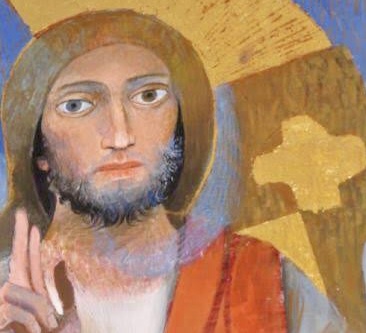
Who is Jesus for us? Who do we say Christ is for us? What kind of relationship do we have with Jesus? In the past, children were taught about God, by introducing to… “PAPA JESUS”. “Pray to Papa Jesus.” “Say, Thank you, Papa Jesus.” Is it still the same now? This is a bit confusing actually… Jesus is the Second Person of the Trinity. He is God the Son. God the Father is the First Person. They are not the same. He cannot be Father and Son at the same time.

I’m sure we relate with various images of Jesus at different stages of our life.  Children are more likely to be drawn to the Sto. Nino more than the image of the crucified Christ because they see themselves in the round cheeks, and chubby little arms and legs of the Christ Child. Those who are suffering major trials may identify with the Nazareno who is bent over by the weight of the Cross. Those who survive a life-threatening experience may be drawn towards the image of the Risen Christ. We can also associate Jesus with images of people we need. There are probably occasions where we perceive Christ as a reliable friend who is always there for us in good and bad times. Perhaps He is the image of an advocate for the disadvantaged when we struggle with being a victim of certain injustices in society. At other times, Christ is more of a peacemaker when we see the great need for reconciliation among people around us. These images of Christ reflect our various human experiences. When we see our humanity in Him, we feel He is closer to us; He understands us. 

In the gospel passage this Sunday, Jesus seemingly appears to be conducting an opinion survey about His identity. The disciples initially give a report of how they’ve heard other people identify Jesus. However, Jesus directs the question to them: “Who do YOU say that I am?” (Matthew 16:15). Jesus’ question is actually a test of faith. He wanted to know if His disciples’ close association with Him finally opened their eyes to His divine nature. Peter, naturally, steps up. He is Christ’s biggest fan. If Jesus were a member of the BTS, Peter would most likely be the leader of the Purple Army. He is also the one who seeks the limelight  among the group. Wasn’t he the one who challenged Jesus by saying, “Lord, if that’s you, ask me to walk on water.” (Matthew 14:28) In the Transfiguration, Peter said, “Lord it is good that we are here. Let us not go down!” (Matthew 17:4) And as he dissuades Jesus from the Passion he will be told: “Get behind me Satan.” (Matthew 16:23) There were many occasions he got things wrong. This time, however, he got it right! Jesus says, “Blessed are you for my Father has revealed this to you.” (Matthew 16:17)

The question Jesus poses reveals something deeper than the expected answers. Jesus is indirectly telling them that by being His followers they participate in His identity as children of God as well as in His saving mission. Hence, the question hints at who we need to be. Peter was far from perfect yet Jesus chose him as the foundation on which to build the Church; to him he gave the keys to His kingdom and the power to do things on earth that would be honored by heaven. To be identified with Jesus is always a challenge for us flawed and imperfect human beings. And so today, we see many among us, especially priests and consecrated persons who are severely criticised, accused of hypocrisy, and persecuted in many places and in different fronts.  Like Peter we all struggle with being true to our identity as Christians. We are consoled that when we look at Jesus’ selection of Peter and the other disciples, we see how God’s power works through our human imperfections. In the Second Reading (Romans 11:33-36), St. Paul tells us, no one knows the mind of God. His choices may not seem logical to our human understanding but in the end they bring about His greater glory. 

The other day, I was called to anoint a very sick lady whom the family thought was going to die soon. Just yesterday, the lady’s sister  came to the parish office to report that her sister got stronger and that she was walking again. I was surprised because I am not known as a ‘Healing Priest’. I was amazed and humbled how the power of God worked through a weak and flawed minister like me. Don’t be surprised if God seems to have chosen you for things you never imagined or for responsibilities you can’t seem to handle. God knows best. Trust and persevere. We are all works in progress and God is working great things through each and every one of us. 

Let us pray then that we may remain true to who we are as Christians! May we as a Church make manifest Our Lord Jesus as the Christ and the Son of the Living God among our brothers and sisters!

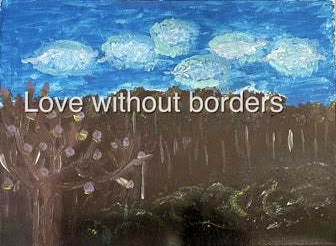
A Love without Borders

HOMILY: Twentieth Sunday in Ordinary Time

Matthew 15:21-28

August 20, 2023

Fr. Ricky Cañet Montañez, AA

One time a priest friend and I were travelling together to attend a meeting in Manila from Quezon City. The traffic was so bad since it was a Fright-Day, Flight-Day. On a street where traffic was almost at a standstill, a very tiny girl knocked on our car window to sell Sampaguita flowers to us. I advised my friend who is from the province to just “knock” on the car window as a signal for her to go leave us alone since we are in a hurry. To my irritation, my friend lowered the car’s window on his side and spoke with the little girl and asked her whether she goes to school or not, what school she went to, what was her favourite subject, etc. I was sure the girl was only making some things up but my friend did not mind at all. He eventually gave the girl money and water because he said: “Naawa siya sa bata”.  (He pitied the girl.) 

This incident reminded me of the contrast between the way the disciples and Jesus dealt with the Canaanite woman in the gospel. Notice the reaction of Jesus’ disciples: “Send her away, for she keeps calling out after us.” (Matthew 15:23) They were irritated with her because she was not a Jew and they felt she was different from them and so did not deserve the benefit of Jesus’ attention. With such a reaction, Jesus took this as a wonderful opportunity to teach His disciples a lesson. Jesus engages with the woman and is impressed by her faith and perseverance. She was not going to give up until He had cured her daughter. Here was a Gentile woman who exuded faith being judged by Jesus’ disciples who had just proved their lack of faith when they saw Him walking on the water. We recall that last Sunday’s gospel passage they feared the storm and the image of Jesus coming to them on the water. Jesus even tells Peter  as  He saves him from drowning “Oh you of little faith!” (Matthew 8:26).

When someone approaches us looking for help, do we take the time to engage even in a  brief conversation with the person in need? Do we even attempt to understand the circumstance of the person and what led them to seek help? Do we automatically reject people we don’t know or don’t like when they ask our help?  Do we think we are better than them? Like the disciples, our usual response is to immediately presume we know all the answers and write people off according to our assumptions.  On the other hand, when we know the person well enough and that person has repetitively approached us for help, do we put a limit on the number of times we extend assistance?  Jesus does not make distinctions and He does not count the number of times He shows mercy. 

Our readings this Sunday remind us that God’s love and mercy are universal – inclusive, all-encompassing, complete – for all peoples of all time. In the Second Reading, St. Paul speaks to the Gentiles acknowledging how God has extended His mercy to them because they now obey God. He compares them with the Jews who now reject God and he expresses his wish that one day Israel may once again be reconciled with God. The passage from the prophet Isaiah emphasises how God longs to be in relationship with ALL peoples. He is a God who desires that “my house shall be called a house of prayer for all peoples” (Isaiah 56:7). It doesn’t matter whether they are “locals” or “foreigners.” God’s justice and salvation are generously promised and given to all who sincerely seek the Lord, who minister to Him, who love Him, who serve Him, who keep Holy the Sabbath and who hold to His covenant in their hearts. 

Let us ask the Lord then that we be graced to have even just a tiny bit of this Canaanite woman’s faith to help us rise above life’s challenges. And as disciples of Jesus, let us allow Our Lord to teach us how to respond more compassionately with those who are in need among us. Let us make others feel that the love of God knows no bounds and is meant for everyone.

Artwork from LWBRefugeeArt

Stronger than Any Storm

HOMILY: Nineteenth Sunday in Ordinary Time

Matthew 14:22-33

13 August 2023

Fr. Ricky Cañet Montañez, AA

We recently had a painting workshop for the children in the parish. Over 100 children completed the two-week workshop that taught them the basics of painting. The first session had the theme: “The Church on a Journey” (Ang Simbahang Naglalakbay). The symbol chosen by the artist-facilitator was that of a boat navigating through the sea. Our attention was caught by the artwork of one of the children. The boat he drew was struggling through the raging waters of the sea. It was almost sinking as the waves were threatening to break his boat apart. The artist-facilitator casually told me that this child did not need to say anything but we could immediately tell he was going through overwhelming troubles in life.

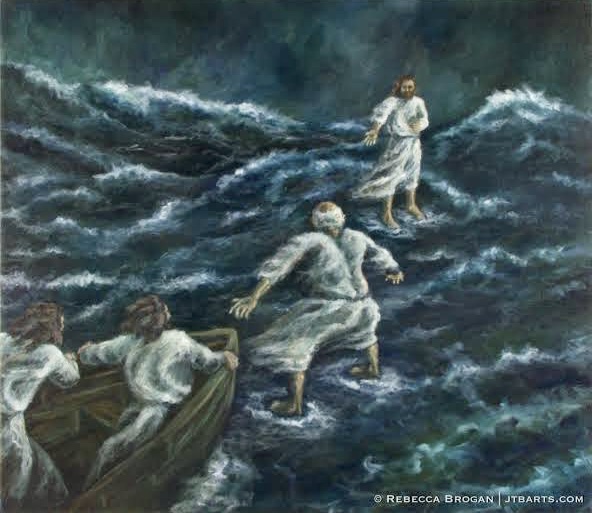
The disciples on this Sunday’s gospel passage found themselves in such a situation. It happened that their boat in the darkest hour of the night was also battling a turbulent sea and fighting a strong headwind. They became desperate as they struggled to stay afloat in the midst of strong winds and high waves. Then they saw a figure coming toward them, whom they thought at first was a ghost. Soon enough, they realised it was Jesus who was coming toward them as He assures them: “Take courage, it is I; do not be afraid!” (Matthew 14:27)

For the Jews, the sea can be perceived as a symbol of evil. It is a force of nature that they cannot control. It is a treacherous body of water where frightening storms suddenly appear and whose unexplored depth housed evil creatures. One could easily lose their life in the sea. The fact that Jesus is walking on the water shows that He has power over this evil. He is the only one who has full control over it. The fact that He does not sink and perish reveals how Jesus has power over death. It echoes the story of creation that shows the strength and might of God’s power. Before God puts order in the world, there is only chaos — a formless, desolate, ocean covered in absolute darkness. Imagine all around you the sound and feel of raging waters and waves violently crashing against each other and you cannot see a single thing! It is in this context that God’s spirit moves above the waters and brings order by creating light, day and night, the sky, and dry land filled with vegetation in the first three days. This is absolute proof that God can control chaos and put order in anything.

All the Evangelists except Luke record Jesus’ walking on the water, but it is only Matthew who goes further and narrates the incident of Peter attempting to walk on water. Why is it given importance in Matthew’s Gospel? The answer lies in the purpose of his version of the Gospel — promoting DISCIPLESHIP! In Matthew, we are told that Peter succeeds in walking on the water.  He says “Lord, if it really is You, command me to come to You on the water!” (Matthew 14:28) Can you imagine the audacity of Peter? He tests the Lord and presumes that he, too, has such power over this force of nature. However, Jesus is not angry. He calmly calls Peter to Himself. As long as Peter had his eyes on Jesus, he miraculously could also walk on the water — at least until he notices the strong wind and becomes frightened. Only then does he begin to sink.  He cried out, “Lord, save me!” (Matthew 14:30) Immediately Jesus stretched out his hand and caught him, and said to him, “O you of little faith, why did you doubt?” (Matthew 14:31)

Why did Peter sink?  Of the various reasons proposed by Bible scholars, I am most convinced that he focused too much on the strong winds and the raging water around him. The moment he took his eyes off Jesus, he was once again overwhelmed by the storm around him. Peter forgot that Jesus (walking on the raging waters and calming the storm) has total control over these hostile forces which are far beyond human strength and capacity. His faith in Jesus had been drowned out by the fear of the violent storm. His whole attention shifted from Jesus to the storm. 

We can be like Peter as we face the many challenges in life. Remember that the disciples were in the boat when the storm hit and normally, they were doing their best to navigate the vessel so they do not sink and drown. We can bet that they were all wondering “Where is our friend Jesus when we need Him? He asked us to get into this boat and now that there is a storm, He is nowhere to be found!” Isn’t that how we feel sometimes? When we are facing adversity, even small ones, we tend to focus too intently on what is scary, what is frightening, what is difficult. We say our prayers and wait impatiently for an immediate solution. We begin to doubt whether God actually has power over that situation, or if He cares enough to help us. We become so overwhelmed with fear and doubt and let the problem defeat us. We feel abandoned and get angry with the Lord. We don’t even notice when God is already helping us!  Let us in the First Reading, God did not manifest in the strong wind, the fire or the earthquake.  He came in a whisper! Fortunately, Elijah was very sensitive to God’s presence that He knew when the Lord had arrived. Can we say the same of ourselves?  Here is the truth: A lot of situations can really be too big or too scary indeed for us to handle, but nothing is too big for Jesus! Thus, we shouldn’t focus on the situation we are in. Rather, we must focus on the One who has power to overcome all adversity!

The battle over evil has been won when Jesus died on the cross and saved humanity. We are no longer destined for damnation. We have a future with God our Father and Creator in heaven. Of course, as we journey through life towards the Father, Satan will keep coming at us to weaken our resolve — to make us lose faith, to deceive us into believing God does not care and His promises are empty. This is actually why it is important for us to pray and receive the sacraments. These are the tools Jesus has left for us to strengthen us and keep us connected to Him always. Let us remember that evil and death no longer have power over us as long as we keep our eyes fixed on Jesus. 

Thereby, whatever storm we are going through, let us invite Jesus into our boat and entrust ourselves to Him. He will get us to safety. Let us remind ourselves and each other constantly to keep our gaze upon Jesus. At His command, the wind and waves will subside and there shall be calm in the midst of the turbulence. Brothers and sisters, let us be at peace. Let us trust that God loves us and He will not let us drown in the difficulties of life.

Divinity Breaking Through Humanity

HOMILY: Feast of the Transfiguration of the Lord

Matthew 17:1-9

6 August 2023 

Fr. Ricky Cañet Montañez, AA

Back in my early formation years as a religious, I was sent to Mexico for exposure and language learning. The Mexican priests of our community were assigned to say the morning mass every Wednesday at a nearby Carmelite convent. It was an opportunity to interact with these contemplative sisters after mass. What struck me about these sisters was how radiant most of them looked. They all looked so young. There was something noticeably aglow in each one of them. It made me wonder whether it could be likened to the Transfiguration of the Lord. 

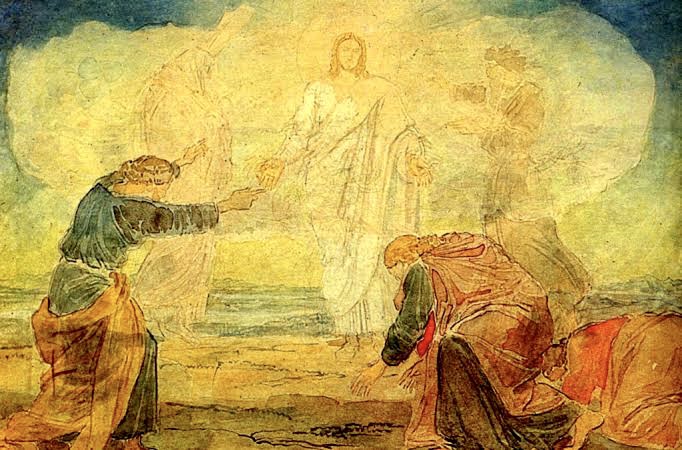
Today’s feast reminds us that Jesus was of divine nature. The transfiguration was a moment in time when His divinity broke through His humanity. This was manifested in how radiant He appeared to the disciples. “And He was transfigured before them; His face shone like the sun and His clothes became white as light.” (Matthew 17:2) He shone so brilliantly that it was almost blinding to Peter, James and John. His body changed somehow and His being was illumined. 

Like these eyewitnesses, we similarly experience some transfiguration moments in our life when we come in contact with the presence of God’s holiness in our midst. We may not shine the way the apostles saw Jesus; however others would still be able to perceive the light of Christ in our noble actions and in our good deeds. In the Second Reading, St. Peter urges us: “You will do well to be attentive to it, as to a lamp shining in a dark place, until day dawns and the morning star rises in your hearts.” (2 Peter 1:19)

There are many moments we do experience profoundly God’s presence. There are instances when we come in contact with the divine presence especially in moments of deep prayer. We may recall that there were strange events experienced by some visionaries at Mama Mary’s apparition sites. When they fall into a deep state of prayer and find themselves in the presence of the divine, they are described to be in the state of ecstasy! Their faces glow and they are not disturbed by any noise or commotion around them. We also encounter Jesus in various moments in the Eucharist, particularly during the Liturgy of the Word, as well as in the Breaking of the Bread. I chanced upon this video clip of a mass celebrated by Cardinal Chito Tagle becoming so emotional at saying the words: “Behold, the Lamb of God who takes away the sins….” as he presents the Body and Blood of Christ before Holy Communion. If we are truly conscious and sensitive to the presence of Jesus, we cannot help but be moved to tears in every mass.

This weekend, the World Youth Day will culminate in Portugal. In 1995, the World Youth Day took place here in the Philippines. At that time, it was St. John Paul II who was Pope. The ones who were blessed to see him in person even if only for a brief moment while he was passing by the pope mobile were moved to tears. There were many accounts of people who were moved to tears after just seeing the Pope on TV as they televised his activities here in the Philippines.  They could not explain why, except for the overwhelming feeling of peace and holiness that the man radiated. This is probably the result of his closeness to Christ and of being a good and faithful disciple of the Lord.

This divine presence is also sensed in the acts of service done to us or others in time of great need. In these moments, we recognise the holiness that is embedded in all of us when we were created, breaking through our human experiences both in small and profound ways. We may not see the effect on ourselves but others do see the mark of Christ on us. That’s why we say to those who have helped us in dire need: “You are God-sent!” (“Hulog ka ng langit!”) Hence, when we pursue lives of prayer and service, we participate in the work of making others experience the goodness of God, and we in turn are made more like God. When we serve others, we are transfigured into God’s radiance that illumines the darkness of this world. 

The nature of light is to illuminate. A small amount can already show us what we need to find or to show us where we need to go. Many things and events in our life are shrouded in darkness. When we ask the Lord for guidance, what we are actually asking for is clarity so that we may find a solution to our problems. Light is also not easy to conceal because it shines through the smallest cracks and can be visible even through opaque surfaces. At home, even if the door is closed, we can still tell whether the light is on or not because we see a glimmer of light in the tiny space at the bottom rail of the room’s door. In the same way, although we do not experience Jesus fully and completely as the apostles did when He walked the earth, we can still have an unmistakable experience of Jesus through the Eucharist or our encounters with others. One day, when we are called from this life, we hope to witness the Lord in His glory in heaven. It is our hope that one day, we shall find ourselves in the dazzling light of His presence.

Today, as we celebrate the Transfiguration of the Lord, may we strive to fill our lives with God’s radiant light and be a lamp lighting the way for all our brothers and sisters.

The Incomparable Treasure

HOMILY: Seventeenth Sunday in Ordinary Time

Matthew 13:44-52

30 July 2023

Fr. Ricky Cañet Montañez

I was amazed at what I found on Instagram recently.  Lee Wilkins posted a reel that declared: “You work 8 hours to live 4. You work 6 days to enjoy 1. You work 8 hours to eat in 15 minutes. You work 8 hours to sleep 5. You work all year just to take a week or two vacation. You work all your life to retire in old age, and contemplate only your last breaths. Eventually you realise that life is nothing but a parody of yourself practicing for your own oblivion. We become so accustomed to material and social slavery that we no longer see the chains. Life is a short journey. Live it! Collect memories! Not material things!” This post makes us take stock of how we spend our time and where our life is leading to.  What do we really value most in life?  There is so much wisdom in taking the time to discern what has true worth; to sort out what is lasting from what are simply passing things of this world. 

On this Sunday’s gospel, Jesus uses parables to teach us that the greatest priority His followers ought to pursue in life is the Kingdom of Heaven. Through very relatable scenarios, Jesus describes the heavenly Kingdom’s incomparable value. He likens it to a buried treasure, the pearl of great price or an abundant catch which one endeavours to have at all costs. What is it that we work hardest to acquire? What is it that we want more than anything else in the whole world? What are we willing to do and what lengths would we go so that we may acquire it?  Some people endanger their lives by scouring the depths of the seas to recover treasures from sunken ships.  Similarly, as followers of Jesus, we have to exhibit this same dedication to relentlessly search for this treasure of incomparable value. We must give our all to become part of the Kingdom of Heaven.

There are times that what has true value escapes our attention because we are easily fooled by the lure of the things of this world that promise to elevate our status or boost our worth.  Some people skip meals, and sleep little to gain fame or success only to end up so sick that they either die young or that they must live the rest of their lives limited by health problems. They work themselves close to death, oblivious of their loved ones, as they are thinking that it is more important to afford their dream car or build their dream house.

It was somewhat consoling to learn that some millionaires like Dolly Parton would rather write checks to put 150 million books on the hands of children. The example of King Solomon who requested wisdom and an understanding heart emphasizes that only those whose “hearts so wise and understanding” can sort through life’s distractions that we may distinguish and pursue the treasure Jesus speaks of. God’s gift of wisdom gives us a roadmap to guide our path forward and save us from taking false steps along life’s journey. Our pandemic experience, although difficult, opened our eyes to what is truly essential in life. We really ought not to forget. But human as we are, we have the tendency to do so and be distracted by the next big thing or whatever it is that fills our mind with thoughts of getting rich, becoming famous and pursuing our wants at any cost.

It is never easy to pursue what is just and true in life.  Possessing the buried treasure or the pearl of great price comes at a cost and we must be ready to pay for it. At times it will entail denying ourselves, delaying personal gratifications, and enduring some suffering. Non-believers will take us for fools for investing our whole being in something we can not see taste or touch nor determine when it will finally come into our possession.  However, as people of faith we trust in the promises of Jesus. As children of God destined for the heavenly Kingdom, we have all been promised God’s assistance and sustenance in our pilgrimage through this life. We have to strive to walk in the presence of the Lord and gain wisdom of heart so that we may attain our eternal reward!

St. Paul challenges us to look beyond the trials and difficulties of this world to the destiny promised by God to all of us whom He has called. As we are often told, “this world can only be a place of temporary refuge; a world of passage and not a world of permanence.” As Christians, our eyes are on a different prize than the world’s. We can’t be reminded of that too often. May we order our priorities correctly and fix our gaze on those things that last! May the Lord Jesus gift us with the courage to resist the superficial consolations of the world as we feed our deep hunger for the eternal— for what is of the Lord’s, and fulfill what is needed to be with Him.