Homily – Nineteenth Sunday in Ordinary Time (Year A)
1 Kings 19:9a, 11–13a • Romans 9:1–5 • Matthew 14:22–33
9 August 2026
Fr. Ricky Cañet Montañez, AA
A few years ago, a close friend’s mother went in for a routine check-up. When she was told, “We need to run a few more tests.”, fear immediately stepped in to fill the silence. She lost so much sleep obsessing over every minor ache, but worst of all, a late-night consultation with “Dr. Google” convinced her she had a life-threatening disease. After days of agonising suspense, her test results came back, and they were completely normal! She realised fear had forced her to suffer a tragedy that never actually existed—writing a dark story long before the real facts arrived.
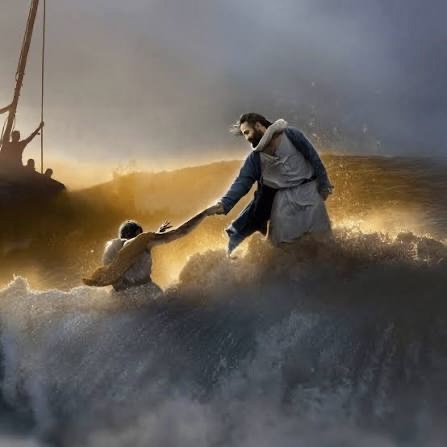
I think that is exactly what today’s Scriptures reveal. St. Matthew recounts that “the boat… was being tossed by the waves, for the wind was against it.” (Matthew 14:24) The disciples had spent hours battling the storm. They were tired, anxious, and afraid. Then, “Jesus came toward them walking on the sea.” (Matthew 14:25) But instead of recognising Him, “they were terrified” and cried out, “It is a ghost!” (Matthew 14:26) They did not really see a ghost. They saw Jesus. The problem was their perception. Jesus had not changed. Their circumstances had. Their fear distorted their vision. They looked directly at the One who came to save them and mistook Him for someone to fear.
If we are honest, we have all experienced something similar. When our family suddenly faces financial difficulties, we start to think that God has abandoned us. A loved one becomes seriously ill, and we wonder whether our prayers still matter. We wait for biopsy results, laboratory reports, or another doctor’s appointment, and before the doctor can even say anything, fear has already whispered its verdict. We pray for a son or daughter who has drifted away from the faith, and after years of waiting, we begin to see them as a hopeless case. Without realising it, we stop interpreting our lives through faith and begin interpreting our lives through our fears.
That is why the First Reading offers a beautiful correction. The Lord tells Elijah, “Go outside and stand on the mountain before the Lord, for the Lord will be passing by.” (1 Kings 19:11) Then comes a great wind, an earthquake, and a fire. Elijah assumes God is there. Yet Scripture repeats, “The Lord was not in the wind… not in the earthquake… not in the fire” (1 Kings 19:11–12). Finally, there came “a tiny whispering sound” (1 Kings 19:12), and there Elijah recognised the Lord. How often we expect God to come in dramatic ways! We pray for an instant miracle, but instead God quietly gives us the strength to face another day. We ask Him to remove every burden, but instead He sends someone who quietly sits beside us to console us. We look for Him in the spectacular, while He continues to come to us in the gentle and the ordinary.
St. Paul, too, knew what it meant to carry a heavy heart because many of his own people had not accepted Christ. He admits, “I have great sorrow and constant anguish in my heart.” (Romans 9:2) His sorrow was real, but he continued to trust in God’s faithfulness even when he could not yet understand God’s plan. That is the wisdom of faith. It does not deny suffering. It simply refuses to allow suffering to have the final word. Perhaps this is the invitation of today’s readings. Let us not allow fear to become the narrator of our lives. Fear is real, but it is not always truthful. It magnifies our problems and makes God’s presence seem smaller than it really is.
My friend’s mother in our opening story allowed her fear to consume her as she waited for the results, causing her to carry a burden that was never hers to carry. In the same way, many of us are waiting for something today—healing, employment, family reconciliation, inner peace, or answers to prayers we have carried in our hearts for years. The waiting is real. The uncertainty is real. But today’s Gospel reminds us that while fear is busy making us imagine the worst, Christ is already walking toward us. He does not wait until the storm calms before approaching. He comes while the wind is still blowing and the waves are still crashing. He first calms our hearts before He calms the storm.
This Sunday, let us pray for the courage to look up in the storm. When life feels uncertain, the winds howl, and the night drags on, let us remember that Christ does not wait for the waters to become still before He draws near. Before He calms the storm around us, He grants the greater gift—His presence with us. Let us step out in faith, anchor our hearts in His presence, and hear Him speak into our deepest fears: “Take courage, it is I; do not be afraid!” (Matthew 14:27)
 Sunday Gospel Reflections