Homily: Fourteenth Sunday in Ordinary Time (Year A)
Zechariah 9:9–10; Romans 8:9, 11–13; Matthew 11:25–30
5 July 2026
Fr. Ricky Cañet Montañez, AA
When someone asks us, “Kumusta ka?” (How are you?), we often hear the same answers: “Busy.” “Pagod” (Tired). Or perhaps the most common response: “I’m okay.” But sometimes, “I’m okay” simply means, “I don’t want to talk about it.” We smile, go to work, meet our deadlines, take care of our families, and fulfill our responsibilities. On the outside, we appear normal, but inside, we carry burdens that no one else can see. It’s not just our bodies that grow weary; at times, our souls grow weary as well.
That is why Jesus’ invitation in today’s Gospel is so deeply consoling: “Come to me, all you who labour and are burdened, and I will give you rest” (Matthew 11:28). Jesus offers not an instant resolution to our problems but the grace of respite—the strength and peace to keep going. He does not promise that all our problems will disappear or that life will suddenly become easy. The deadlines remain daunting. The bills need to be paid. Unresolved family concerns continue to fester. The cross is not taken away. What Jesus promises is rest that refreshes, enabling us to bear our burdens. It is the kind of peace that the world cannot give because it comes from knowing that we do not suffer alone.
The First Reading helps us understand why. The prophet Zechariah proclaims, “Behold: your king shall come to you; a just saviour is he, humble, and riding on a donkey” (Zechariah 9:9). Notice that the promised King does not arrive on a horse but on a humble donkey. Kings normally entered cities on powerful war horses as symbols of conquest. Jesus deliberately chooses a humble donkey, revealing that His kingdom is built not on domination but on humility and peace. The donkey bears ordinary people—even the poor—and is capable of carrying heavy loads over long distances. It may be small, but it is mighty in its own way. The world admires people who exude strength—who seem to have everything under control, who never show weakness, and who never ask for help. Jesus reveals a different kind of strength. He is telling us that we do not always have to appear as though we have everything together. Weariness is normal. It is not a sign of failure or a reason to give up. Christ shows us that true strength is found in humility, and humility means learning to trust in God, especially when life is difficult and the crushing weight of our problems feels suffocating.
St. Paul echoes the same truth when he reminds us that we are called to live not according to the flesh but according to the Spirit (Romans 8:9, 11–13). When we rely only on ourselves, we begin to live as though everything depends on our own strength. We tell ourselves, “Everything depends on me. I have to solve every problem. I have to keep everything together.” But a life in the Spirit humbly acknowledges our dependence on God as we pray, “Lord, I can’t carry this by myself anymore.”
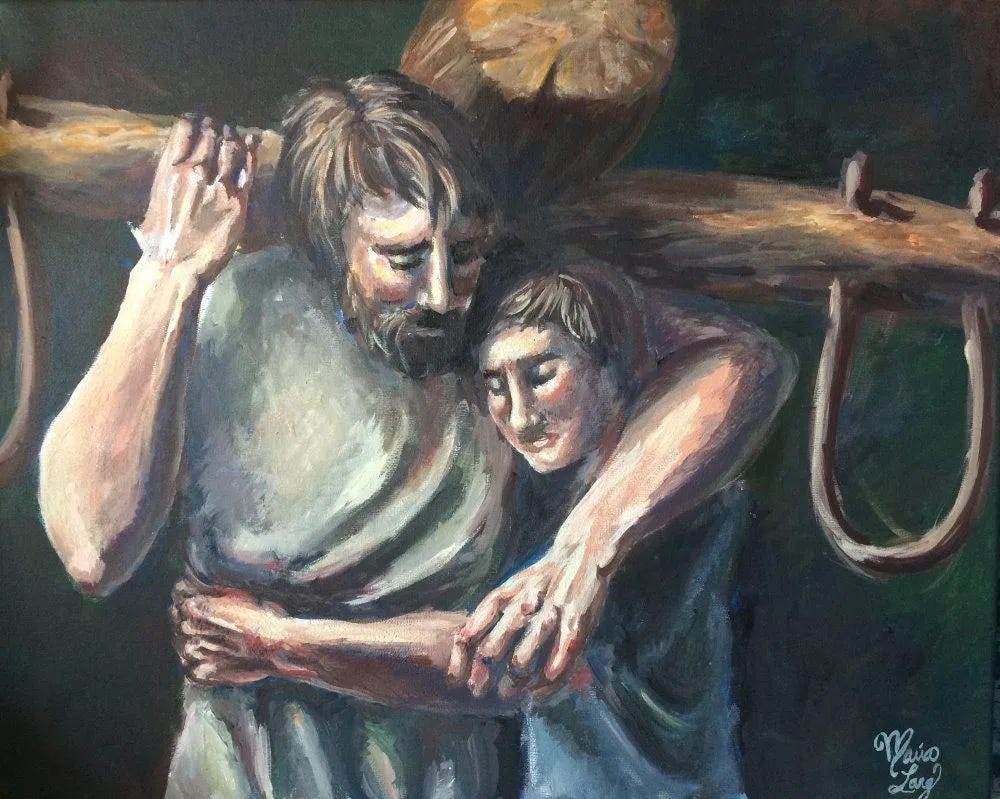
That is why Jesus says, “Take my yoke upon you” (Matthew 11:29). A yoke was ordinarily used to join two animals so they could carry a load side by side. It is an image of shared labour, not solitary struggle. So even if Jesus does not promise to remove the burden, we can be assured that He carries it with us. The heaviest burden we likely carry is actually not our work or our responsibilities but the feeling that we carry the weight of the world by ourselves. We feel like everything depends on us. But it doesn’t. We have a God who walks beside us. Christ does not simply stand at a distance telling us to keep going. He steps beside us and helps us bear the heavier end of the load.
There is a beautiful saying I chanced upon on Facebook: “When you leave everything in God’s hands, you will start seeing God’s hand in everything.” Isn’t that what today’s Gospel is teaching us? Rest begins when we finally entrust our concerns to the Lord. We may still answer, “I’m tired,” or even, “I’m not okay yet.” But we can also say with conviction, “I’m not alone. Christ is with me.” It is when we stop trying to force our own outcomes that we open our eyes to see how perfectly things are already being orchestrated for us. We begin to see that nothing is random; the blessings, the protection, and even the detours and delays are God’s purposeful hand working for our good.
When Christ walks beside us, our circumstances may not change overnight, but our hearts surely do. Our burdens may remain, but they no longer define us, because Christ walks beside us. Peace is not the absence of burdens; it is the certainty that we never carry them alone. And when we surrender everything to Him, His promise remains true: “You will find rest for yourselves” (Matthew 11:29).