Homily: Solemnity of the Most Holy Body and Blood of Christ (Corpus Christi)
Deuteronomy 8:2-3, 14b-16a / 1 Corinthians 10:16-17 / John 6:51-58
7 June 2026
Fr. Ricky Cañet Montañez, AA
Have you ever been so stressed over something that you cannot seem to eat? Others stress-eat when they have problems. They keep eating and eating to help them forget their problems. “Kumain na lang tayo.” (“Let us just eat.”) “Ikakain ko na lang ito.” (I will just eat.”) They do this knowing that food does not really solve the problem. Not all hunger is physical. Many today are weary from the burden of responsibilities, others are weighed down by grief and disappointment, immobilised by uncertainty, and simply pressured to hold everything together. Often, these struggles remain hidden behind ordinary smiles and daily routines, creating a hunger for relief, consolation, and resolution.
The Feast of Corpus Christi celebrates a beautiful, consoling truth: God never stops feeding His people. When the Israelites were lost in the wilderness, their own strength failed them. In that vulnerability, God showed them the extent of His providence. Moses says that God “fed you with manna” and taught you that “not by bread alone does one live, but by every word that comes forth from the mouth of the Lord” (Deuteronomy 8:3). The desert was not just a place of hardship; it was where they discovered absolute dependence, radical trust, and the quiet faithfulness of a God who provides daily sustenance and never abandons His own.
Many of us are walking through a wilderness right now—emotionally drained, financially strained, quietly grieving, or anxious about the future. Into this hunger, Jesus does not just offer advice; He offers Himself. “I am the living bread that came down from heaven” (John 6:51). The Eucharist is not a symbol of God’s love; it is God transforming Himself into nourishment for His people. He says, “My flesh is true food, and my blood is true drink” (John 6:55). Usually, we try to satisfy our deepest longings with success, entertainment, and distraction, but the heart can only rest in what is eternal. Jesus is the peace, hope, and meaning we crave, and He gives Himself to us as Bread for the journey.
Sometimes we can fall into the habit of seeing Holy Communion only as an obligation or routine—failing to observe the one-hour fast or the proper spiritual disposition to receive the consecrated host with reverence. Corpus Christi reminds us that Communion is not just about lining up for a thin, tasteless wafer but rather opening ourselves to a deeply personal experience of a God who knows us in our weakness and accepts us. He knows our fears, our exhaustion, our hidden struggles, and the burdens we carry silently. He knows what we hunger for in the deepest part of our soul, and He feeds us with His own presence so that He can sustain us and ensure that we never journey alone.
Jesus does not wait for us to be perfect before inviting us to His table. We come to the Eucharist hungry, tired, and wounded—and still He says, “Whoever eats my flesh and drinks my blood remains in me and I in him” (John 6:56). The Eucharist is not a celebratory meal for winners or a reward for the strong. It is food for pilgrims and sustenance for the struggling. Even when our faith falters and showing up is hard, Christ nourishes us quietly and faithfully. Like a well-balanced diet, Communion builds our spiritual strength little by little, compounding our patience, hope, and courage for the daily journey.
Moreover, Saint Paul reminds us in the Second Reading that “because the loaf of bread is one, we, though many, are one body” (1 Corinthians 10:17). The Eucharist is never just about “me and Jesus”—it is a call to become nourishment for others. Once we receive Christ, we are sent to be His compassion, patience, and mercy to a world deeply hungry for love and healing. Ultimately, the truest witness to the Eucharist is not just what we receive at the altar, but who we become after we leave it. As we receive Jesus at the altar, we are asked to be Christ in the world.
My dear brothers and sisters, perhaps today we came to Mass carrying burdens no one else sees. Perhaps we ourselves are tired or searching for strength. And today, on this Feast of Corpus Christi, Jesus gives us this enduring assurance: God has not abandoned His people. He still walks with us. He still feeds us, and He still gives us the Bread from heaven—the bread that sustains us on our journey and brings life to the world.
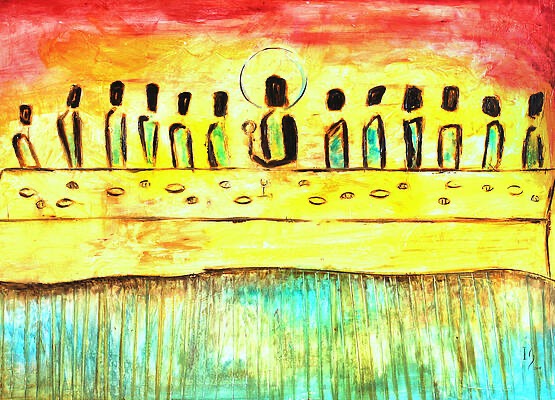
The Last Supper by Ivan Guaderrama

