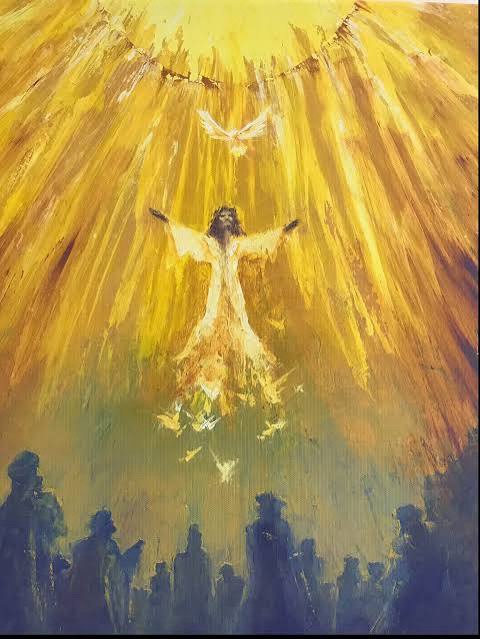
Homily: Solemnity of the Ascension of the Lord (A)
Acts 1:1-11, Ephesians 1:17-23, Matthew 28:16-20
17 May 2026
Fr. Ricky Cañet Montañez, AA
Who among us have seen Jesus Christ with his/her own eyes? Maybe some of us have dreamed of Him, but I can guarantee that none of us has seen Him. Most especially in times of difficulty, it is so easy to exclaim, “Lord, where are You now?” When problems seem to persist, when responsibilities pile up, when relationships become painful, when we feel tired of being strong, or when we pray and are met with a deafening silence, we call out to God. Does that really mean He is not there for us?
As we celebrate the Solemnity of the Ascension, we are faced with an uncomfortable truth—Jesus has left the earth and gone back to heaven. The disciples have mixed feelings of fright, awe, and abandonment as they are left staring at the sky (Acts 1:9–11). It must have felt like Jesus had left them behind. However, the Ascension is not about the absence of Jesus. It is about a new kind of presence. In the Gospel, before ascending, Jesus says: “And behold, I am with you always, until the end of the age” (Matthew 28:20). The last words of Jesus are not goodbye but words of gentle reassurance.
Most of the time, we think God is present only when life is easy, when prayers are answered quickly, or when we feel spiritually strong. Howeever, the Ascension teaches something deeper: Christ may no longer be visible, but He remains powerfully present in ways we often fail to recognize. He is present in the strength that somehow carries us through another difficult day—present in the person who listens when we are close to giving up; present in the quiet peace after tears; present in the Eucharist; present in the ordinary courage to continue.
Many burdens in life do not disappear overnight. Some people grieve the loss of loved ones for years. Others carry family worries, loneliness, financial struggles, hidden disappointments, or silent exhaustion almost to the breaking point. There are crosses we carry that nobody else fully sees. And perhaps one of the hardest burdens is this: when God seems distant and indifferent to our suffering.
That is why today’s celebration is important. The Ascension tells us that even when Jesus is no longer physically seen, He has not abandoned His people. In fact, because He ascended, His presence is no longer limited to one place. He can now walk with every person, in every sorrow, and in every corner of the world.
St. Paul, in the Second Reading, prays that God gives us a Spirit of wisdom and understanding so that “the eyes of our hearts may be enlightened” (Ephesians 1:18). This is the grace we need today: not necessarily the immediate removal of all burdens, but the ability to recognize that Christ is still near in the midst of them.
The disciples looked up at the sky because they thought Jesus had gone away. Eventually, they would discover that He was closer than ever—in the Spirit, in their mission, and in the community gathered in His name (Acts 1:8). The same is true for us. Sometimes Christ is closest precisely in the moments when we feel weakest. Sometimes He is quietly carrying us when we think we are walking alone.
The Ascension reminds us that heaven is not far removed from human suffering. Jesus carried our humanity into the very heart of God. As St. Paul says, the Father seated Christ “at his right hand in the heavens” (Ephesians 1:20). This means our tears, wounds, struggles, and hopes are not meaningless. They are seen, embraced, and redeemed by Christ Himself.
Hence, if our hearts are heavy today, let us not think that the Lord has gone far from us. He ascended—yes—but He does not abandon us. From His home in heaven, He is able to attend to us more closely as He continues to prepare a place for us when the time comes.