Homily: Fourth Sunday of Easter / Good Shepherd Sunday
Acts 2:14a, 36–41 / 1 Peter 2:20b–25 / John 10:1–10
26 April 2026
Fr. Ricky Cañet Montañez, AA
We have all had moments when something deeply moves us—a retreat, a homily, a church song, or even a quiet prayer before the Blessed Sacrament. We feel deeply touched. It seems as though something has truly pierced our hearts, and we begin to think: this is it—the beginning of a new life.
But after a few days, life quietly returns to its old patterns. We fall back into the same habits, the same attitudes. This is a very human experience. In the Acts of the Apostles, we see exactly this same moment: the people are “cut to the heart” and ask, “What are we to do, my brothers?” (Acts 2:37).
Today, however, there is a quiet confusion that can easily slip into Christian thinking: “As long as I accept Jesus as my Lord and Saviour, I am saved.” Is it really that simple? Is that already enough? We raise our hands in surrender, we feel this strong emotional stirring—and then we think we are set for eternal life.
But if that were sufficient in itself, why does Scripture still call us to repentance, to baptism, to a new way of living? The truth is, the struggle to live a devout and holy life is a continuing one. It requires vigilance, intention, and effort. As Saint Paul reminds us in his Letter to the Galatians, “The only thing that counts is faith working through love” (Galatians 5:6). Faith is not something static; it is alive—it moves, it transforms, it takes shape in love. And in his First Letter to the Corinthians, Paul deepens this truth: “So faith, hope, and love remain, these three; but the greatest of these is love” (1 Corinthians 13:13). Even faith finds its fulfilment in love.
This is why we must be careful of what Dietrich Bonhoeffer calls—“cheap grace”—a grace we claim without allowing it to truly change us. No conversion, no struggle, no growth. In today’s Second Reading, Peter reminds us to be patient when we suffer for doing what is good. He further adds tells: “Christ also suffered for us, leaving us an example, that we should follow in His steps” (1 Peter 2:21). Yes, grace is free—but it is not cheap. It cost our Lord everything. And when we truly receive it, it begins to cost us something as well—our old ways, our old selves. It reshapes the way we live.
Even the Gospel corrects this misunderstanding. In the Gospel of John, Jesus says, “Whoever enters through me will be saved.” (John 10:9) This should comfort us: as the true Shepherd, Jesus does not simply point out the way—He goes ahead of us. He has already walked the path of suffering, through the Cross, and into new life. At the same time, He says, “I am the gate.” This means He is not only the one who leads—He is Himself the way. A gate is not something we admire from a distance; it is something we must pass through. To believe in Christ is not just to know about Him, but to enter into Him—to entrust our lives to Him, to follow His voice, and to remain in Him. And because He goes before us and is Himself the way, we can be certain: He does not lead us into danger, but into true life—life in abundance.
Still, we must choose to follow. Moreover, how do we know when Christ is calling us? The Gospel tells us that the sheep recognise the voice of the shepherd (cf. John 10:4). Faith, then, is not simply believing that the Shepherd exists—it is learning to listen, to follow, and to trust His voice above all others.
In the same way, salvation is not merely affiliation—“I belong to this group, so I am fine.” In the Acts of the Apostles, we hear of the remarkable work of the apostles: “Those who accepted Peter’s message were baptised… and about three thousand persons were added.” (Acts 2:41). However, membership alone is not enough—what is needed is conversion. Those who were saved were not merely affiliated; they were transformed.
Notice that they did not stop at being moved or mesmerised by Peter’s words. They asked what needed to change. And Peter answered clearly: “Repent and be baptised… and you will receive the gift of the Holy Spirit” (Acts 2:38). This is not passive faith; this is a life being radically reoriented.
Thus, when we are asked, “Where is ‘faith alone’ in Scripture?”, we can answer honestly: faith is the beginning—but the faith the Bible speaks of is never meant to stand alone. It becomes love, it becomes obedience, it becomes a new way of living.
And so, the good question for us this Good Shepherd Sunday is not simply, “Do I believe in Jesus?” but rather: “Am I listening to His voice? Am I following where He leads?”
After all, real faith does not end with good feelings or positive emotions about Christ. It moves us to walk with Him—our Good Shepherd—no matter how difficult the path may be. It is to trust that He will lead us to true life, a life lived in fullness and abundance.
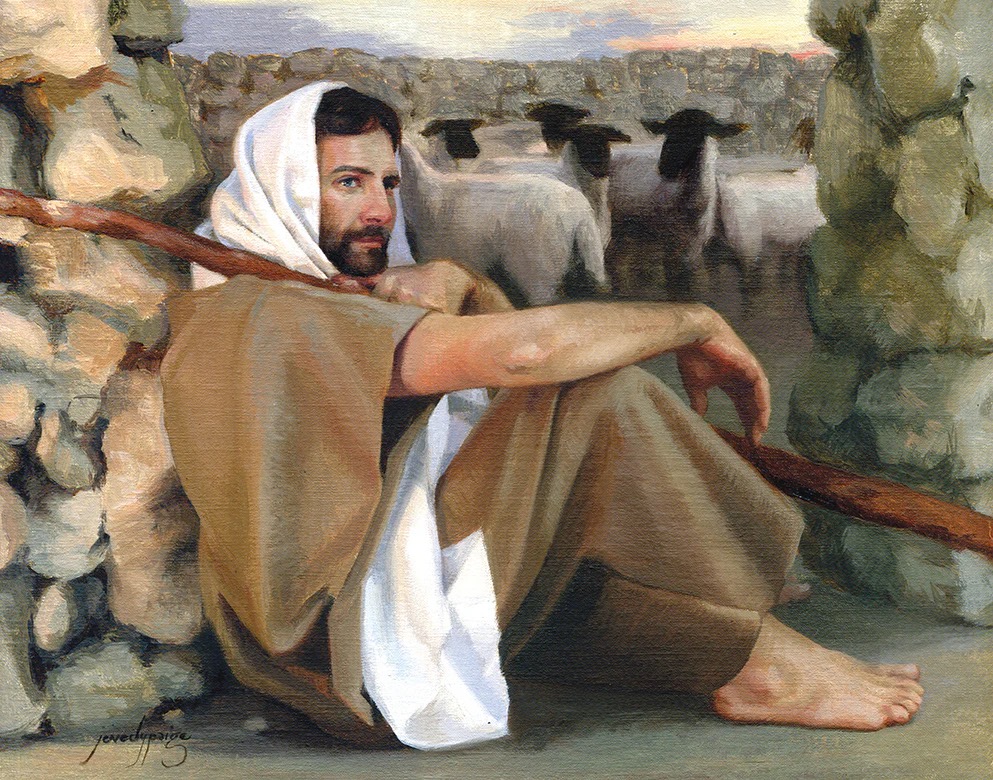
“The Gate” by Jenedy Paige
 Sunday Gospel Reflections