HOMILY: Solemnity of Pentecost
John 20: 19-23
5 June 2022
Fr. Ricky Cañet Montañez, AA
We have a beautiful church with many beautiful images. Some of them are still up on the choir loft. Look around! We see Jesus, Mama Mary, St. Joseph, San Roque, angels, etc. However, do you see representations of the Holy Spirit around? Sadly, even in other churches, there are usually very few. For many of us, the Holy Spirit, the third Person of the Trinity is undoubtedly the least understood member of the Triune God. Not only that, how many of us honestly invoke the Holy Spirit as much as we do the Father and the Son when we pray?
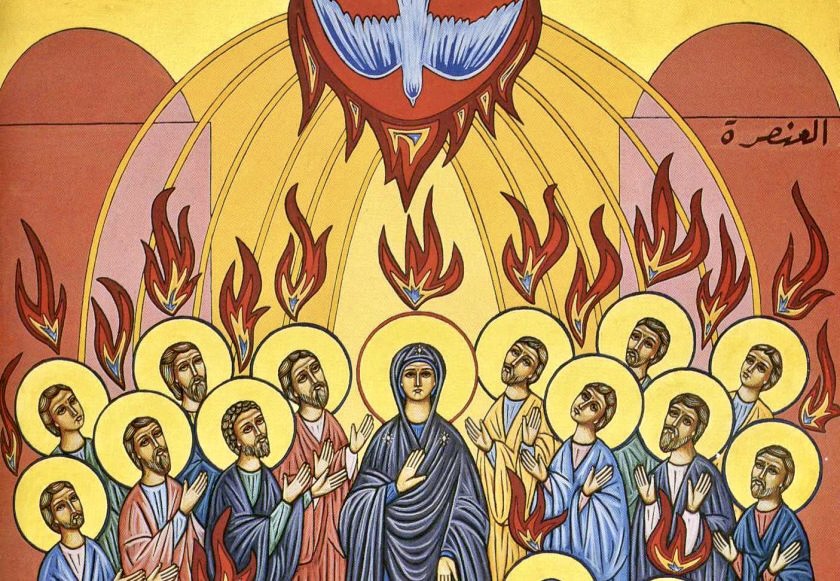
We sometimes refer to the Holy Spirit as the Holy Ghost. Spirits and Ghosts are what we do not see. I guess that is why there is no adequate likeness for the Holy Spirit, except the variety of symbols representing the Holy Spirit that we can gather from the Bible. Let me point out three of the more familiar scriptural symbols of the Holy Spirit. One of the most common symbols of the Holy Spirit is the “DOVE”. In the story of the Great Flood, it was a dove that signalled the end of their voyage. (Gen 8:8-12). It is an image of HOPE which we also associate with the Holy Spirit. We are told that when Jesus was baptized, the heavens were opened and the Holy Spirit descended upon Him in the form of a dove. To me this gives rise to an image of PEACE. The peace of knowing that the salvation has finally come to humanity. (Mt 3:16; Mk 1:10; Lk 3:22; Jn 1:32).
Then, we have the “TONGUES OF FIRE OR A FLAME” as the other representation of the Holy Spirit we find in Luke’s Pentecost account. The passage recounts that when “tongues as of fire came to rest over the head of each of the disciples, they were filled with the Holy Spirit (Acts 2:3-4). Fire is an age-old symbol for God. We recall Moses speaking to God out of the bush which was on fire. (Exodus 3:2). In their wanderings in the desert, the Israelites were accompanied during the night by a pillar of fire. John the Baptist tells the crowds that Jesus would baptize with the Holy Spirit and fire. (Luke 3:16). Jesus Himself said, “I have come to set the earth on fire” (Lk 12:49). Fire is a symbol of purification, just as gold is purified in fire. The Holy Spirit purifies us of anything that is unworthy in God’s eyes. It is a also a symbol of power. Fire is passion. Fire has the capacity to create and destroy. We see this in the disciples who are empowered to preach the gospel, do miracles in Jesus’ name, rebuke the evildoers and cast out demons. Fire is also a source of light. It illuminates the darkness. The Holy Spirit is also a guide for us — helping us to discern God’s will for us.
Lastly, one of the key symbols used to describe the presence of the Holy Spirit is “Wind” or “Breath”. We begin with the creation story. The wind represents the Holy Spirit’s share in the creation of the world (Gen 1:2). In today’s Gospel, the bestowal of the Holy Spirit is portrayed with Jesus’ breathing on His disciples and telling them, “Receive the Holy Spirit.” (John 20:22) This is reminiscent of the creation of human beings in the Genesis story. (Gen 2:7) In doing so, Jesus gives them new life making of them a new creation. Let us note that one of the Hebrew words for “breath” (rûah) is translated as “spirit”. Hence, the spirit of God is also the breath of God. I have also read that in Greek, the word for “spirit” and “wind” is the same (pneuma).
Breath is actually my favourite symbol for the Holy Spirit because it is something that exists constantly within us. Every so often we need an experience of the Holy Spirit to remind us of His presence. We may not see doves or fire frequently but we always breathe! A few months ago, there was a TikTok video made by an American girl about how every human breath — every inhale and exhale is essentially speaking the name of God, calling to Him. As you slowly draw breath through your mouth, you are actually making the sound YH and as you slowly exhale through your mouth, you make the sound WH. You can try it now. Both sounds put together is the Old Testament name of God — Yahweh. I like this imagery because it reminds me that it is God who breathes life in me. It is God who sustains me. And when times get difficult, the default mode of my body is still to call on the Lord as I breathe! It also keeps me aware that my life is aided and guided by Him and ultimately lived for Him. It is by my life on earth, that I can glorify my Creator. I like to think that is why Jesus breathed the Holy Spirit on His disciples at Pentecost, instead of simply laying His hands on them or holding them over their heads.
Today, we celebrate Pentecost — the day the Lord bestowed the Holy Spirit on His disciples and essentially all of humankind who chooses to receive the Holy Spirit. We are told that the Old Testament was the time of God the Father’s manifestation to humanity, and the New Testament is the revelation of Jesus, God the Son, to the humankind. After the Ascension, it is deemed the time of the Holy Spirit. For the past 2000 years all up unto this very day, God still roams the earth through the Holy Spirit. We may not see Him and sometimes we miss His presence and intervention in our lives but it does not mean He is not there to guide us, to give us peace, to restore us, and to strengthen us. If He does all that for us when we are not mindful of Him, imagine what He can do for us if we invoke Him? How do we recognize that the Holy Spirit is working in us and through us? We know by the fruits borne of our thoughts, words and actions. In his letter to the Galatians, St. Paul lists the nine fruits of the Holy Spirit: love, joy, peace, patience, kindness, generosity, faithfulness, gentleness and self-control (Gal 5:22-23) Make it a habit to reflect at the end of the day, and see if your day’s existence has borne these fruits for yourself and others. You will be more sensitive to how the Holy Spirit enriches your life and you will find reason to be grateful.
During His lifetime, Jesus’ presence was a comfort as well as a security for His followers. Being with them physically had helped tremendously in dealing with their confusion and doubt as they try to learn the ways of the Lord. In the Farewell Discourse of Jesus in John’s gospel, He told His disciples that it was better for them that He should go back to the Father in heaven so that the Holy Spirit would come to them. (John 16:7) Through the Holy Spirit Jesus could very well be present — guiding, strengthening and loving His followers — even more intimately than being with them physically. We live in the Age of the Holy Spirit. We are blessed because Jesus can now be more intimately present to us through the Holy Spirit. This is indeed a gift but at the same time a tremendous challenge. As we mature as Christians, we are invited to discern at all times God’s presence within ourselves so that we can be directed by His saving power.
 Sunday Gospel Reflections
Thank you Fr.
LikeLike