HOMILY: Sixteenth Sunday in Ordinary Time (B)
Mark 6:30-34
18 July 2021
Fr. Ricky Canet Montanez, AA
After reading through the comments of netizens on the results of a local singing contest, my friend tweeted… “Sana ganyan din tayo kabusisi mamili ng ihahalal nating pinuno. Ang daming marunong ha?” They say most Filipinos are hard to please and are very critical of performing artists. In one of her interviews, I remember our very own internationally-acclaimed broadway star, Lea Salonga saying (as excellent an artist as she is) that it is always more demanding to perform for the “home crowd” because Filipinos have very high expectations of performers. Just visit our social media pages. Kung mamintas at manlait ang ilan sa pinaka-maliit na pagkakamali – wagas – abot langit! Sobra tayong perfectionist. Ang taas ng standards! Kung sana ganun din kataas ang standards natin sa pagpili ng ating public servants. I wish we were as meticulous when choosing our leaders. (Parang di kasi tayo ganun ka-critical magbusisi sa ating mga pulitiko.)
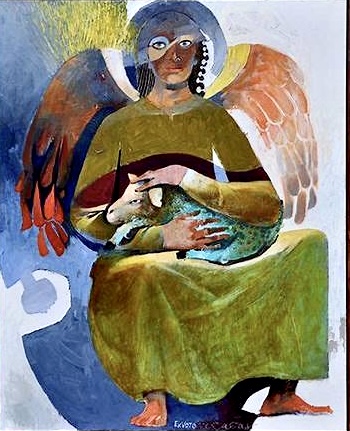
Today’s readings contrast between good and bad shepherding. In the First Reading, the prophet Jeremiah talks about leaders who do not have their people’s best interest at heart. They do not care for the people’s needs. Jeremiah even says that not only have they neglected the people of God but they have also misled them. Speaking through the prophet, the Lord addresses these self-serving leaders as such… “You have scattered my sheep and driven them away. You have not cared for them.” (Jeremiah 23:1) So God speaks of sending a leader for God’s people, “the great shepherd of the sheep” who will pasture His people after His own heart. We know this good shepherd to be none other than Jesus Christ.
In his Letter to the Ephesians, St. Paul highlights the union that has been accomplished in Christ. In Christ, those who were once “far off” from the faith have now been brought together as one people in their faith in Him. (Ephesians 2:13) In talking about “breaking down the wall of enmity” (Ephesians 2:14) St. Paul seems to refer to the divisions between the Jewish Christians and the Gentile Christians that have all been reconciled in Christ. In doing so, St. Paul presents Christ as a model for leaders to promote unity rather than division among the people.
We also have the beautiful Twenty-Third Psalm. The psalm offers a couple of images of repose and of restful waters and the refreshment that the Good Shepherd brings to those who take their refuge in the Lord. The Gospel shows Jesus as a leader who takes good care of His apostles. He makes sure that they all get rest, be re-energized and fit for the work ahead. Jesus Himself doesn’t get to have his share of rest as the crowd has been eagerly trying to follow Him and His disciples wherever they went. Though exhausted, when Jesus sees these people “like sheep without a shepherd,” He would unreservedly attend to their needs and “… teach them many things.” (Mark 6:34)
As in the time of Jeremiah, many of us who are in leadership roles have so much to answer for. Many of us need to relearn, understand and recognise how best to exemplify authority for service. By the life He led, Jesus showed the disciples how authority is first and foremost, bestowed for the purpose of service. This is a continuing lesson for us all. When this is forgotten, power and privileges that come with authority are abused and the common good is forgotten. This happens when leaders (civic or church) forget they are supposed to be public servants, servant leaders.
Our readings encourage us to be carefully discerning in choosing well our leaders in the next elections. Dependable shepherds walk with us in the dark valleys of our lives. They do not leave us alone to fend for ourselves. They will never say or act in a manner that suggests, “Bahala na kayo sa mga sarili ninyo”. They are willing to sacrifice their own convenience for the sake of their flock. They even go as far as risking their own safety for the sake of their constituents. “I am the Good Shepherd. The good shepherd lays down his life for the sheep.” (John 10:11) They, too, have the capacity to promote unity rather than division among the people. Good leaders rally people to work together for the common good.
Our national election is sooner than we think. I think 75 days left to register for all our new voters and the like. Magpa-rehistro tayo! We should take responsibility for the future of our country. This time, we really have to be able to choose well our national leaders. We have to be perceptive and wise in matters that will affect all of us and future generations. We are reminded through our readings to be cautious of made-up truths spread on social media and to be wary of those behind them. Don’t be deceived by appearances, grandstanding and false witnessing. Nakasalalay ang ating kinabukasan sa sino man ang ating pipiliing mga mamumuno sa atin sa susunod na 6 na taon.
As we take refuge in and assurance from Jesus, we are privileged to experience our Good Shepherd’s care for us. Thus, we, too are invited to be good shepherds to one another. We do this according to the example of Jesus who has shown compassion for each of His sheep, seeking them out when they stray and loving them unconditionally. May we always look to the Good Shepherd for inspiration in choosing our shepherds and in shepherding others. With Him as our guide we will never go astray.
 Sunday Gospel Reflections
Praying for and your flock Father.Sent from my Galaxy
LikeLike
“I am the Good Shepherd. The good shepherd lays down his life for the sheep.”(John 10:11)
This best describes what a good leader should be. It means service above self. A good leader should promote unity, encourage teamwork, be truthful, be fair and just and have compassion for his flock.
With all the politicking and abuses of power and authority, true leader/shepherd is hard to come by.
But with God in our midst, we can start with ourselves, whatever position we may find ourselves in, by being a good shepherd and hope it will trickle down to our flock that they may become good shepherds too.
LikeLike
Love this, Ester! We have to be good shepherds to one another, in our own spheres of influence. God bless you! Thank you for taking time to write your comments on my homilies!
LikeLike