Homily: Sixth Sunday in Ordinary Time
Mark 1:40-45
14 February 2021
Fr. Ricky C. Montanez
A good friend of mine had the misfortune of contracting Covid. I had been so worried that when she informed me that she had recovered, I was so grateful to God for sparing her life. As she recounted to me her experience, she said that the fatigue, shortness of breath, loss of smell and taste, and the other physical struggles that Covid patients have to endure were nothing in comparison to the loneliness one feels in isolation. That proved to be the greatest difficulty for her. She could barely cope with having to live apart from family and friends from whom she needed support and comfort during her Covid 19 journey. Thanks to modern means of communication she, just as many Covid patients, managed to stay in touch with family and friends and survive the desperation of living in complete isolation. Technology has truly played an important role in the lives of those rendered infirm by the virus. On one occasion I was even able to talk with a Covid patient and give a blessing through an audio call on Viber a few days before she died peacefully in the hospital.
Isolation of the afflicted was common in ancient times and resurfaces through history when people are quick to fear what they cannot understand or control. In the 80’s, HIV positive people suffered such a stigma that even their loved ones were afraid to touch them. The late Princess Diana allowed herself to be filmed and photographed hugging children with AIDS in an attempt to correct the misconception that HIV was transmitted through touch. Today, the world knows how to treat HIV positive and AIDS patients with more understanding and compassion. From the Old Testament times well into the New Testament days, those afflicted with leprosy found themselves in a more miserable lot since no cure was available for all forms of infectious and contagious diseases. They had to live in complete isolation from people and were treated as social outcasts. As you might know, any disease in those days was viewed as punishment for one’s sinfulness. A leper not only deals with a disease that destroys his appearance, but he becomes a social outcast and is viewed as a sinful person. One suffers a spiritual crisis and a social stigma while bearing the physical and emotional burdens of illness. To make things worse, one could not simply hide one’s self away to conceal one’s shame and deplorable state because it was a leper’s duty to call attention to himself when others were approaching so they could avoid them. They were practically the walking dead.
This places into context how the healing of the leprous man by Jesus was truly an astounding miracle to the people of their day. I read somewhere that rabbis claimed that the healing of leprosy was as difficult as the raising of the dead. This feat, as we know, is not beyond the power of Jesus, who, in some gospel accounts brought the dead back to life. It is no wonder why it was nearly impossible for the man to keep quiet about this extraordinary divine favour given to him by Jesus. He is able to integrate himself back into society as he goes around talking freely to others about what Jesus had miraculously done for him. In his mind, he was restored to his spiritual, physical and social wholeness.
It is interesting to note that the leper asked Jesus to be made clean, not to be cured. (Mark 1:40) Recall that they must announce their presence shouting “unclean, unclean” (Leviticus 13:45) and not “leper, leper”. By this act they even enable society that ostracizes them. The fact that he wants to be made clean implies that social and religious acceptability seems to be more important to him than physical healing. In the same way, recovered patients want to be healed from the stigma of having contracted the Covid 19 virus. I am told they do not want to be identified as “Covid survivors” because the disease becomes the dominant description of their identity. They would rather be called “persons who survived Covid” so as to give more emphasis on who they are as persons and members of society more than being associated with a sickness they got. Nevertheless, with or without the threat of Covid 19 there are many among us who experience alienation and isolation due to the lack of fraternal charity on the part of others. There was a time when there was hardly a need for care homes for the aged. Now the elderly are realizing it is very hard to grow old when there is no one to take care of them, to visit them, or to simply make them feel they are not alone in carrying their personal crosses. I know of a parishioner of ours who was once what we would call a big shot. He was successful in his career, well connected, wealthy, and often the centre of attention in any gathering. When he retired, he got sick, his investments failed, and his wealth was depleted. Gone were the drivers and fancy cars, the personal chefs and numerous househelp. He and his wife had to manage on their own, and his children could not care for them exclusively as they would want to because they have their own families. Now that his wife has passed, he moved out of his big house and is living with relatives who care for him. He misses his old neighbours and friends and being able to come to Christ the King for masses. He is rather lonely and often longs for the good old days.
In the Gospel, we are told that Jesus was moved with compassion upon seeing the man’s predicament. Jesus is not one to be repelled by human suffering. Jesus does not recoil, but rather embraces and shares the emotional turmoil and consoles those who are in despair. He would welcome and connect with all those who approach Him and with a mere touch could restore them back to wholeness allowing them to reincorporate themselves into the circle of their community.
In the many battles we are facing at this time, more significantly the fight against Covid 19, we cannot afford to be complacent when we ourselves are safe and healthy, if at the same time we are leaving the afflicted to feel alone and alienated. There are many things we can do to offer support to those who are sick and to the families of those who are suffering. Pray for them! Remind them through your emotional presence that God is with them. We need to have the same trust and confidence in the power and goodness of God that is at work in our everyday lives and constantly remind people of this. We simply have to open our eyes to His presence amidst our helplessness, our pain, our struggles. My friend who survived Covid said that it helped her a lot to know that her family and friends were all united in praying for her recovery. Indeed, the fraternal and prayerful support of the community had emboldened her and eased the burden of her suffering and loneliness such that she was able to endure her Covid 19 ordeal.
“Be imitators of me, as I am of Christ.” (1 Corinthians 11:1) St. Paul’s words to the Corinthians challenge us to extend His compassionate hands to those in need. We persist in seeking this grace when we pray the Oratio Imperata at every mass asking God to “Give us the grace in these trying times to work for the good of all and to help those in need. May our concern and compassion for each other see us through this crisis and lead us to conversion and holiness.” God has blessed us so much that we will always have something to contribute, if we only choose to do the work. In many instances, Jesus asks His disciples to pray for “labourers for His harvest” (Luke 10:2/ Matthew 9:38). All of us baptised are similarly called to be labourers in various ways — to be heralds and witnesses of the Good News of Christ in our own unique vocation within our families and communities. Let us be inspired by St. Teresa of Avila who offers her own understanding of what it is to cooperate with God in His continuing work of salvation when she said “Christ has no body now but yours, no hands, no feet on earth but yours. Yours are the eyes with which He looks with compassion on this world. Christ has no body now on earth but yours.” May God bless us all with a heart for others, courage to minister to them even in difficult times, and the creativity to work around all the limitations life presents to us because we are all in this together.
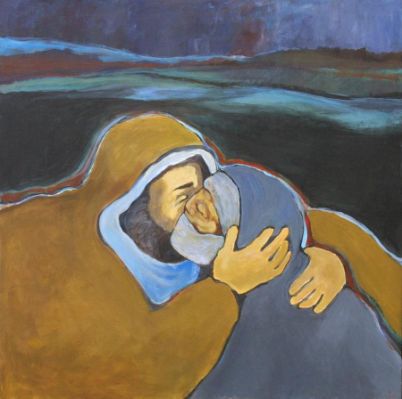
Jesus Heals The Leper Painting from pixels.com
 Sunday Gospel Reflections
Thank you very much😊 Fr. Ricky for another meaningful homily as always. Gives me lots of thoughts and reminds me of some life experiences too.
LikeLike
Thanks, Lolita! I am glad the reflection helps you in your meditation! 🙏🏼
LikeLike
Thank you Fr. Happy Hearts Day.Sent from my Galaxy
LikeLike
Welcome!
LikeLike
I could empathize Fr Rick. My sister died of psoriasis turned to skin cancer. Her sores were painful and i could sense her depression. people were scared to go near her for fear of getting contaminated. Before she got sick, She was a loving thoughtful very independent person always sharing whatever she has. Then she suddenly had to depend on others. I believe God made me an instrument in helping take care of her. I felt sad when she departed but happy her pain and suffering ended. I continue to pray she is in a better place now
LikeLike
Beautiful story, Edna. Yes, indeed in suffering we become witnesses of our own vulnerability and our need for God and one another. May she rest in peace!
LikeLike
If one look at the people who suffered leprosy before and the people who suffered fr Covid these days, there is one thing in common. They are left alone, alienated and treated like an outcast.
It is bad enough to suffer the pain of being sick but to be alone and alienated, it is like bayonetting the wounded.
The same goes to the old and elderly. There is no one there when they needed them. Alone and helpless, the days and nights seem so long, fear and sadness can drive them to depression.
May we have the compassion for the poor and the needy, the sick and the elderly that they can find God in each one of us who are there to reach out to them.
LikeLike