Homily: Solemnity of Our Lord Jesus Christ, King of the Universe (A)
Matthew 25: 31-46
22 November 2020
Fr. Ricky Montanez
Yesterday, we did a rewind of the concert we staged last year to celebrate Christ the King Parish’s 40th anniversary. That evening was the grand launch of the CTK Hymn, Christ in Our Hearts. Every day, since the lockdown, all our livestreamed masses begin and end with that song. By now we are already familiar with the lyrics… “Christ is Our Home, Christ in Our Hearts, Hail Christ Our King and Servant of All.” Beautiful! However, I wonder… if I conducted a survey today to ask, ‘Who is Jesus to you?’, would “King” be among the top answers?
We, Catholics, commmonly relate to Jesus Christ as Friend, Teacher, and Healer. We are taught to build an intimate relationship with a God who persistently knocks on the doors of our hearts, who cares, who listens, who accompanies us through the highs and lows of life, like a friend. And when we need guidance, some of us ask ourselves ‘What Would Jesus Do?’ Or we go to the inspired word — the Bible, to review the teachings of Jesus. The Gospels record many instances of Jesus preaching to crowds, teaching them in parables, interpreting scripture, and proclaiming the Kingdom of God. For the Jews in those days Jesus was Rabbi, for us, He is Teacher. When we or our loved ones fall sick, we get to know Jesus as healer more than anything. Most especially during this pandemic where the cloud of illness looms and spreads over the earth, we consistently implore Him to look on us with mercy and to touch us with His healing power to restore all to good health. The New Testament even details the many healing wonders He performed to merit the title ‘Miracle Worker’. Jesus — Friend, Teacher and Healer… But what is our experience of Jesus as King? And of the Universe, at that?
On this celebration of Christ the King, our readings invite us to reflect on the kingship of Christ, the kind of leader Jesus is, and what it entails to be subjects to Him. In the First Reading, Ezekiel talks about God as the Shepherd of His people Israel and this image is mirrored in the well-loved Psalm 23 — The Lord is my Shepherd. In the days of Israel’s Kings, the sovereign was anointed by God to be His visible representative bestowing on him the divine title of shepherd. Many of them fell short of this divine commission. No matter how they had managed to please the Lord, at some point these kings became recalcitrant, self-indulgent and neglectful of the needs of God’s flock. “They fed themselves rather than the flock”. (Ezekiel 34:8) It is in this context that God promises His people, through the Prophet Ezekiel that He, Himself, would shepherd them. “I myself will look after and tend my sheep… The lost I will seek out, the strayed I will bring back, the injured I will bind up, the sick I will heal…” (Ezekiel 34:16) He is a King that restores wholeness, that unifies and sets things aright. In the Gospel, Jesus, describes to His disciples the Parousia or the Second Coming where the king comes as judge and ruler of all humankind. This same king shall judge rightly and authoritatively. He will sort out the sheep from the goats making each one account for one’s choices in life. In the Creed we profess that Christ will come to judge the living and the dead — a clear reference to the reckoning or judgment in the final days. However, in my experience this is something many of us find hard to accept. We don’t want to be judged on that day. We hope for mercy from the kind-hearted friend we struggled to emulate in life.
It’s hard for us to relate with Jesus as our Leader, our King who calls us to task because none of us have physically seen Him or spoken to Him. He is not photographed in royal robes, or videoed delivering speeches and royal decrees or leading the masses into action. Church structures no matter how ornate or richly clad in gold can not be considered the palace of Christ the King. We cannot seem to associate His kingship with something we see and feel and touch. When I was in London I could feel the reverence most of the British people have for their monarchy. I visited Buckingham Palace in several occasions and saw where they officially reside when in the city. I witnessed how events graced by royalty automatically got media mileage. Even the passports of British citizens have a crest on the cover pertaining to the United Kingdom of Britain and Northern Ireland. If Jesus is Our King, where is the proof of His Kingship? Jesus says during his interrogation by Pilate, “My Kingdom is not of this Earth.” (John 18:36) Does this mean we must wait for the end times to know and recognize the Kingship of Jesus? What do we do in the meantime? Don’t we absolutely despise absentee leaders — those nowhere to be seen at the height of a crisis; who remain silent when people desperately need inspiration and hope; who are slow to give directives when people desire immediate action?
I think this solemnity is the perfect time to be reminded that Jesus, as King, is not absent from our current circumstances. He is ever present through you and me! The Kingship of Jesus is integral to His identity. When we receive Jesus in the sacraments, we receive Him completely. Our baptism is the passport that identifies us as citizens of His kingdom and His presence in our heart is the indelible mark of His presence in our life! When we follow His commands, and treat one another compassionately, loving our neighbor as ourselves, we are, in fact, already living as His subjects. Under His leadership we endeavour in our lifetime to be good, to be fair and just, to be sensitive, to be giving towards others, to be loving and merciful. We have to work hard to live a life in service of God and in service of others for whatever we do to the least of these needy children of God, these brothers and sisters of Jesus, we do to Jesus our King Himself.
There are those among us who have the privilege to hold positions of authority. Following the example of Jesus’ leadership requires that we become shepherds in our own right. Authority is first and foremost bestowed… a gift given for the purpose of service. When this is forgotten and taken for granted as a personal power and privilege, the gift is abused. In the process, the common good is laid waste. Problems occur when leaders (civic or church) take the reins of the community or a country and get lost in their power and influence; forgetting the value and essence of their leadership which is humble public service. There always seems to be a ready excuse to get away with one’s mistakes, or one’s negligence. Nobody prefers to admit being wrong and held accountable for poor decisions. Such is the necessity to relearn, understand, and recognise how we can best live out and give meaning to authority for service.
As loyal subjects of God’s kingdom, it is our duty to live our belief and our conviction that Jesus is King over us all. When we do so, we become ambassadors of Christ and our spheres of influence become an embassy of God’s kingdom. Just as an embassy is the residence of an ambassador and its territory belongs to the country it represents, so do our homes, schools, workplaces, parishes, and communities become visible and palpable proof of God’s kingdom on earth, where Jesus already reigns supreme as King. Maybe then, when He returns and asserts His role as judge and ruler, we will not fear. We can happily be held accountable for the care we extended, especially to the least among us, confident that in all our attempts to feed the hungry and the thirsty, to welcome strangers, to clothe the naked, to attend to the sick, to visit prisoners, we have paid homage and brought honour to Jesus Christ, our King.
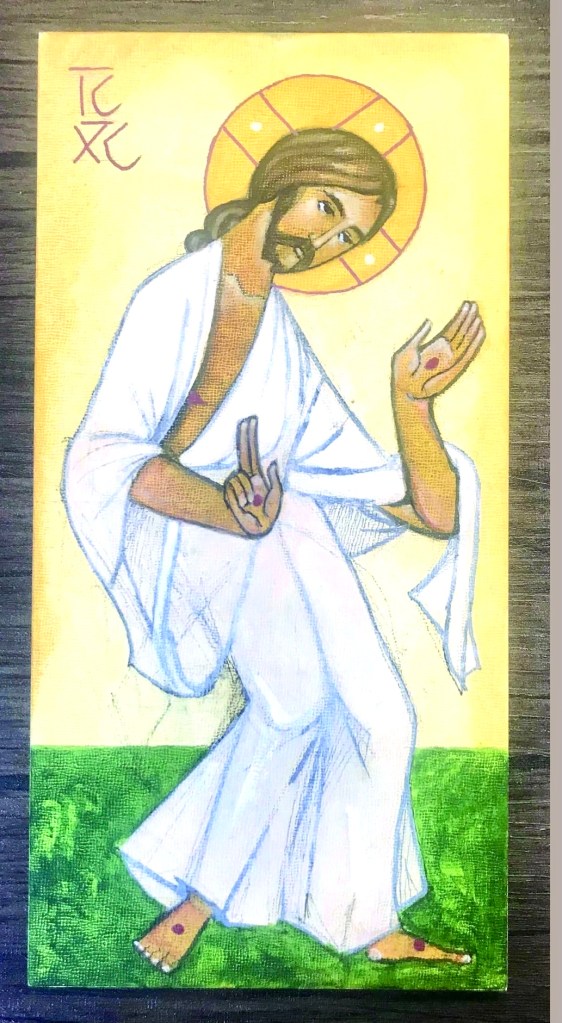
Illustration by Blair Paulus Nuyda, AA
 Sunday Gospel Reflections
Thank you Fr.Sent from my Galaxy
LikeLike
Let us honor Christ the King by resolving to be exactly like Him who did His kingly role by shepherding others rightly
LikeLike
May all leaders follow Christ who is a true leader sent to serve and not to be served. And may we, as His loyal subjects understand that we can only serve the Lord, our God, if we serve our neighbors.
LikeLike
Very well said, Ester! 🙏🏼
LikeLike
Thank you again for sharing this homily. More power to you.
LikeLike
Thanks, Mrs. Pen!
LikeLike