Homily: Solemnity of All Saints
Matthew 5:1-12
01 November 2020
Fr. Ricky C. Montanez
“Bangtan Sonyeondan” which translates to “Bulletproof Boy Scouts”. They are popularly known the world over as BTS, a Korean boy band that has taken the world by storm. They have a huge following across the globe, across all age groups, spanning different continents. Just to give an idea of how big they are… A music video of theirs can earn over 56 million views within its first 24 hours. Not even the Pope’s mass has registered that many online viewers! Their fans are so devoted that they are known to camp out for a week in the parking lot of the arena where this Korean boy band is set to perform. I was told that these BTS guys have so much influence that when they donated 1 million USD to Black Lives Matter, the Army (which is their fan base) matched it with another 1 million USD in less than 24 hours. The lives of these boys, the talent they share and the causes they promote affect multitudes of millennials, ‘gen Zers’ and even ‘gen Xers’ moving them to support and emulate them.
I’d like to think that the Catholic Church is not short of people worthy of emulation as well. I recently received a link to a Facebook page that listed over twenty young people from the ages of 12 to 25 who have been declared servants of God on the way to sainthood or have already received the honour of beatification or canonization. Among them is our very own Darwin Ramos from the Diocese of Cubao and the recently celebrated Blessed Carlo Acutis. These young believers, in the words of Pope Francis, were able to discern his or her own path, that they bring out the very best of themselves, the most personal gifts that God has placed in their hearts (1 Cor 12:7).
Today is All Saints’ Day. You know there are a few things that make our other Christian brothers and sisters very uneasy with how we practice our Catholic Christian faith. One of them is our veneration of the saints, particularly that of our Blessed Mother Mary. Many of them accuse us of idolatry for allegedly worshipping Mary and the saints. As we celebrate the Solemnity of All Saints, ask yourself — Do you? Do we, really worship them? The answer is a resounding NO! Of course, we don’t. We only worship the Triune God, the Living God! What is most fitting to say is: We honour Mary and all these holy men and women who have been exemplars of the Christian life for all of us. As children we are taught that saints are intercessors — meaning we can, in prayer, ask the assistance of those whose prayers reach God readily since they already stand in His presence, behold Him face to face, and “see Him as He is” (1 John 3:2). As we become adults, we are asked to focus more on the challenge to imitate the virtues of the saints. This aspect of our faith practice as Catholics is where we have much opportunity for growth. Sometimes we can overemphasize our former childhood understanding so as to neglect the latter.
How do you relate with the Blessed Mother and the saints? Who are they to you in your faith life? I am not here to downplay their role in leading us to Jesus, our Lord vis a vis obtaining for us special favours. There is nothing wrong with this. We do this all the time when we ask others to pray for us. The danger there is when we put these holy men and women so high up on a pedestal that they become too far removed from us, that they simply become an icon of admiration rather than of imitation. Saints are exemplars of the Christian life explicitly revealed in the Sermon of the Mount. They are the ones who, in the words of the First Reading from the Book of Revelation, had “washed their robes in the Blood of the Lamb” (Revelation 7:14). Hence, they are the perfect model of how to become true witnesses of our Christian faith, especially in these times. We are to take encouragement from them. As St. Paul says quite boldly, “Be imitators of me, just as I also am of Christ.” (1 Corinthians 11:1)
We often think of sainthood as something that is beyond our grasp. We imagine saints to be people who seem to have done everything right; very much unlike us who often falter and make a lot of mistakes, rendering the possibility of becoming one highly unlikely. But the more we learn about them, we realise that they are no different from us. They, too were far from being perfect or without sin. They were fully human like you and me. They had the same weaknesses, the same human inclinations, the same faults and failings as we all have. What sets them apart? The fact that they have never forgotten who God is for them. They drew strength from God to persevere despite their trials. Through it all, they remained steadfast and so “survived the time of great distress” (Revelation 7:14). Today as we remember all of these holy men and women, we celebrate their lives as examples of holiness and models for our imitation.
“While the church recognizes through the processes of beatification and canonization “exemplary imitations of Christ,” Pope Francis urges believers “to be spurred on by the signs of holiness that the Lord shows through the humblest members of God’s people,” what he calls “the saints next-door.” (Gaudete et Exsultate #8) Holiness is not beyond our grasp. We have already been made saints in baptism where we are made children of God. So, says St. John, “We are God’s children now.” (1 John 3:2) The very nature of our Christianity challenges us to live our life in a way that embodies our identity as God’s children. Each one of us is called to holiness. That is why if we look around us, we come to realise that we are surrounded by what the Letter to the Hebrews refers to as a great “cloud of witnesses” (Hebrews 12:1).
Have we not encountered people whose lives were imbued with a genuine holiness? John Paul II, when he visited the Philippines as Pope for World Youth Day in the early nineties had that kind of presence. One was filled with emotion and moved to joyful tears by even just watching him on TV or having an actual glimpse of him as he passed in the pope mobile or to just behold his hand raised in blessing over the sea of faithful in Luneta. He did not even have to speak a word. One simply need look at him to perceive the holiness of his person. John Paul II is a prime example of how we can exude holiness without needing the affirmation of the Church by beatification or canonization. Pope Francis said in his Apostolic Exhortation Gaudate et Exsultate (Rejoice and Be Glad!), “I like to contemplate the holiness present in the patience of God’s people: in those parents who raise their children with immense love, in those men and women who work hard to support their families, in the sick, in elderly religious who never lose their smile. In their daily perseverance I see the holiness of the Church militant. Very often it is a holiness found in our next-door neighbours, those who, living in our midst, reflect God’s presence.” (Gaudete et Exsultate #7) Think of the selfless love of parents for their children. Can that not be an avenue for sanctification? Imagine the street sweeper who assists his children with their school work by the light coming from a lamp post. We recall the dedication and sacrifices of teachers in ensuring that none of our children is deprived of the right to education even during this difficult time. We also think of the many who in our time are persecuted for their Catholic Christian faith. The most recent being the sacristan at the church of Notre Dame in Nice, France. Vincent, along with two others was murdered by beheading by an Islamist extremist. Many more like him have been put to death because of their loyalty to Christ. We cannot ignore them or forget them. They are proof, that we ordinary people, have the capacity to attain such distinctions for the glory of God and in defence of our faith.
The Second Vatican Council’s Dogmatic Constitution on the Church, Lumen Gentium states that “all the faithful of Christ of whatever rank or status, are called to the fullness of the Christian life and to the perfection of charity” (Lumen Gentium Chapter V #40). I ask you to reflect on your lives and see how you have experienced being blessed by the holiness of others. We, in turn are invited to be a blessing to others by living up to our destiny as children of God. We are all “called to be saints”. (1 Cor 1:2) Today’s celebration of All Saints’ Day is a challenge for us to be “imitators” of all these holy men and women renowned as saints in heaven. May we be numbered among God’s holy ones forever praising and thanking the good Lord as citizens of the eternal homeland!
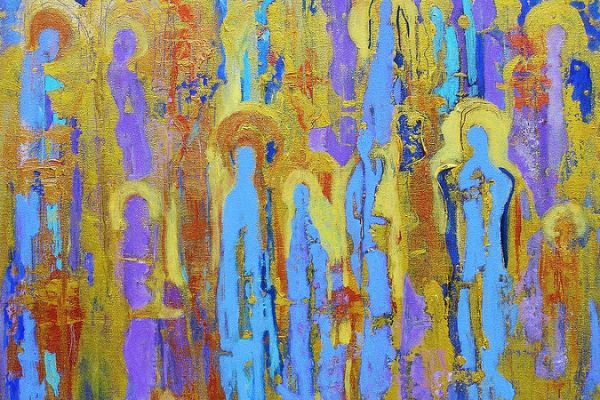
Illustration from fineartamerica.com
 Sunday Gospel Reflections
Thank you once again for sharing your beautiful homily Fr Ricky..
LikeLike
Fr. Thank you.Sent from my Samsung Galaxy smartphone.
LikeLike
Yes,there is nothing wrong to pray to Mama Mary and all the saints and other departed souls to intercede for us. If we follow other people’s logic just to pray and talk to God directly, why is there a need for us to pray for other people, the same way
we request other people to pray for us.
Saints are good models for us bec we can relate to them, with all their human shortcomings and all. It makes us realize that doing good, being holy and becomings saints are possible for us.
Thank you, Fr Ricky, for this realization.
LikeLike