Homily: Twenty-First Sunday in Ordinary Time (A)
Matthew 16:13-20
23 August 2020
The expression on one’s face easily communicates that which remains unsaid. Lately, it is proving to be a challenge to adequately understand each other what with the mandatory wearing of face masks (and now face shields) we are prevented from completely seeing each other’s facial expressions. A simple smile that lights up one’s face to send a firm message of positivity to another now requires extra effort to express the same charm with only one’s eyes. (For those of us with big, beautiful eyes, now is their time to shine! Gollum!) Who would’ve guessed that masks would be an integral part of our life? We have seen all sorts of face masks being sold online from the utilitarian to the more fashionable ones to the downright funny. Though awkward and inconvenient, the wearing of masks has become a must to protect ourselves and others from the deadly virus.
Masks have always been considered a form of disguise—an attempt to conceal a person’s true identity. It is not just used in theater or in the Mission Impossible movies but it’s pretty common in everyday life. Masks hide our fears and insecurities, give us courage to act boldly, and help us to function in uncomfortable situations. When I trained to conduct recollections, retreats or spiritual encounters on self-awareness, we had to always include a session on the taking off of our masks or the breaking down of our personal defences as an essential point of departure to achieving self-actualisation. The logic there is that we can only become the persons God intended us to be, if we are willing to shed off those masks we put on ourselves in order to look good to other people. In the First Book of Samuel, God directs the prophet , “Do not consider his appearance… The Lord does not look at the things people look at. People look at the outward appearance, but the LORD looks at the heart.” (1 Samuel 16:7)
Jesus was not one to wear masks. In fact He was always true to Himself. However, the nature of His person was too complex to be fully comprehended by those who encountered Him. He did not take it against them, nor did He force them to know Him and accept Him. In His love and compassion for people, He allowed the mystery of His identitiy to be gradually revealed to them by what He taught and in the way He lived.
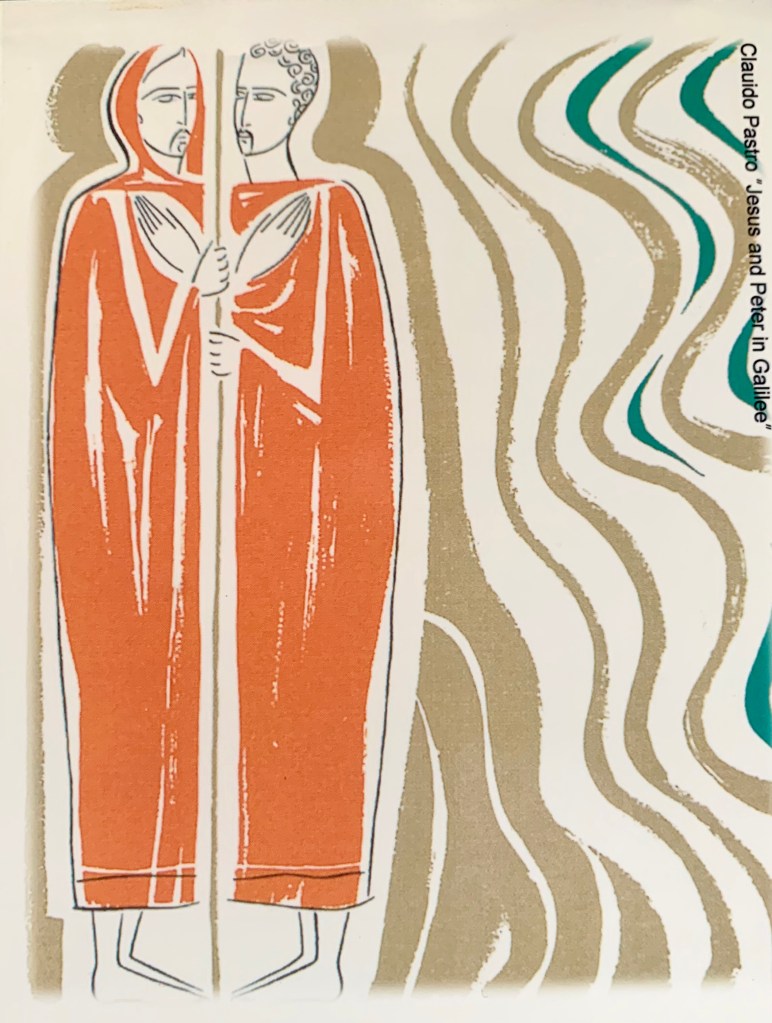
In this Sunday’s Gospel passage from Matthew, Jesus conducts an assessment of how His words and actions were being understood by the people in relation to His messianic identity. “Who do people say that I am?” (Matthew 16:13) The varying impressions provided by the people about the identity of Jesus reveal the varied messianic expectations existing at that time. “Some say John the Baptist, others Elijah, still others Jeremiah or one of the prophets.” (Matthew 16:14) Then Jesus poses this question to His disciples. “But who do you say that I am?” (Matthew 16:15) Speaking on behalf of the others, Peter leads them all into a profession of faith. Peter confesses, “You are the Christ, the Son of the Living God.” (Matthew 16:16) Scholars say, God the Father opened the minds and hearts of the disciples through this declaration of Peter.
I’m sure you are familiar with the sayings…”birds of the same feather flock together” or “great minds think alike”. It presupposes that we gravitate to those we identify with and allow to influence us. To be affiliated and identified with someone means you acknowledge your commonality whether it is pre-existing, like a life experience, or forged such as sharing in that person’s vision, life perspective and values. The accuracy of Peter’s answer is an important element in today’s story because not only did it signify that he was beginning to see Jesus for who He really was but it was an affirmation that Peter was willing to share in Jesus’ identity and mission. This had serious consequences in the life of the disciples and how they identified themselves in their society. They lived closely with Jesus, listened to Him, observed His actions and learned from Him. Their share in His identity was especially manifest when they began their ministry after Jesus had ascended into heaven.
We as followers of Jesus in this day and age are posed with this very same question and are made to consider the implications of our answer. What does it mean for us to profess with Peter that Jesus is the Anointed One (the Christ), the Son of the Living God today, especially at this time of the pandemic? Are we expected to stand in street corners and preach to thousands, heal the sick and cast out demons? Well, some do…. but for many of us, it is enough to get to know Jesus by reading the Bible, learning about Jesus, praying and participating in online masses, and trying our best to live a life in the service of others. Just last week, Nurse Mary Lorraine Pingol had the opportunity to witness to God’s love and care for the least among us. On her way to work, she encountered a homeless woman in labor on a Makati sidewalk. She stopped without hesitation, and assited in the childbirth.
It could also mean making an effort to be compassionate, patient and understanding with people and situations beyond our control. A friend of mine who is the manager of a company told me how she was moved by the sense of solidarity of their employees when they announced a day’s closure for lack of deliveries. Sensing my friend’s sadness and frustration, an employee approached her and said: “Huwag na po kayo malungkot Ma’am. Makakayanan po natin itong mga pagsubok na ito basta sama-sama po tayo. Naiintindihan po namin. Di rin po kami bibitaw dahil hindi niyo rin po kami pinababayaan.” (Don’t be sad, Ma’am. We will get through these challenges as long as we are together. We will not give up on you because you have never abandoned us.)
As a Church, we profess our faith in Jesus the Messiah and Son of God, by allowing God to work through us—to ensure that the poor, the powerless, the marginalized are never abandoned and left to fend for themselves. The Catholic Church through Caritas Manila along with some business groups had provided over 1 billion pesos worth of aid to poor families affected by the lockdown. This fact escaped the radar of those who criticized God’s people asking, “Where is the Church in this time of crisis?” In imitation of our Lord, the Church has no desire to toot its own horn or “magbuhat ng sariling bangko”. Jesus tells us in Matthew 7:16: “By their fruit you will recognize them.” As it identifies to being a Church of the Poor, it is enough that the Church continues to work tirelessly but silently to help those in need.
We, Christians, are still very much a work in progress. We are far from being “a peg in a sure spot” (Isaiah 22:33) in terms of our faith living. Like Peter, who was not always “the rock” Jesus intended him to be, we, too have our shortcomings and we do many things that are contrary to our identity as Christians. But through “the depth of the riches and wisdom and knowledge of God” (Romans 11:33) we have the strength to continue the struggle to be faithful to our shared identity as Christians. May we strive to become authentic witnesses of Jesus, God’s Anointed One, in our homes and in our communities.
 Sunday Gospel Reflections
A big thanks Fr. Ricky.Sent from my Samsung Galaxy smartphone.
LikeLike
Thank you, Melds! God’s blessings on you!
LikeLike
Thank you Father Ricky! Happy Sunday pp.
LikeLike
And to you! Best regards to the group!
LikeLike
Yes we are all work in progress. Thank you Fr once again for reminding us of our identity as Christians…
LikeLike
Beautiful message, Father Ricky! Lord, give us the graces we need to be a Christ for others! I hope mother and baby whom Nurse Mary helped are healthy and doing well, Father…such a miracle!
LikeLike
Many thanks. Yes, our aim is always to be Christ-like in our dealings with one another. I believe it was a successful childbirth. Both mother and baby were eventually brought to the hospital after… Stay safe, Janelle!
LikeLike
Thank you Fr Rick for always giving us a beautiful message❤️
LikeLike
You are welcome Herms! Stay safe! Best regards to the Ka-Berks!
LikeLike
Yes, as the saying goes, “Chip of the old block”. When we focus on God, read and understand the Bible, learn fr Jesus, and living a life serving others, our effort to be Christ like would slowly come naturally.
Subconsciously, we tend to follow Christ even in the midst of crisis. That’s is why we should never take our eyes off God that we may never go astray.
To love God is to be like Him.
LikeLike
To conform ourselves more and more to the ways of the Lord… This should be our goal! So help us God! Thank you, Ester!
LikeLike