Homily: The Solemnity of the Most Holy Body and Blood of Christ
14 June 2020
John 6: 51-58
I am very fond of my nieces and nephews. When they were much younger, I would bring them little gifts and delight in seeing their eyes widen with surprise and their lips break out in wide grins as they excitedly squeal their ‘thank yous’. They are always grateful for whatever I give them… but these days, for all my effort, I would occasionally receive a smiley emoji by text. Millenials! 🙂
Thank you — two words that carry a lot of significance in our lives. Did you realize that when a child learns to speak, these are among the first words they are taught? I read that ‘giving thanks’ is taught early on in life to condition young minds to recognise that there is a special relationship between the giver and the receiver. Do we all still remember this valuable lesson? Or have we become so full of ourselves, being critical of what we receive and always demanding more?
I recently came across this social media meme that said: “Sa three months na pandemic nakaligtas ka! Isang ‘thank you’ naman diyan kay Lord at hindi ka niya ginutom o hinayaang magkasakit.” (You have survived 3 months of the pandemic. Perhaps it would not hurt to say ‘Thank You Lord’ for keeping you fed and healthy.) I was reminded that despite our difficulties during this pandemic, it was important to count our blessings.
In the passage from Deuteronomy, we are told that as the Israelites experienced hardships in their journey they began to grumble against God, forgetting all that He had done for them. Moses exhorts the people to remember God’s bountiful blessings to them in the past—how God delivered them from their bondage and slavery in Egypt; how God guided them and protected them from all dangers in the wilderness as they journeyed towards the Promised Land; how God miraculously provided them with food from the skies and water from the rocks when they needed nourishment. Moses scolds them for their self-centeredness and exposes them as a people unworthy of God’s protection and love. However, we are told that God chooses not to abandon them to perish in their wickedness. Psalm 147 also highlights this divine protection and providence in the fortification of the City of Jerusalem and the abundance of blessings heaped upon her children. It reads “For God has strengthened the bars of your gates and He has blessed the children within you…with the best of wheat he fills you.” (Psalm 147:13, 14)
Today is the solemnity of CORPUS CHRISTI. We are invited to acknowledge that the spiritual sustenance we receive in the Body and Blood of Jesus, is very much an act of God’s providence. It is very easy to take this mystery for granted but we have to learn to be grateful for this wonderful gift. To give thanks is to acknowledge the graciousness of another, and to understand that the gift is more a reflection of the generosity of the giver, than a measure of what we deserve. God gives from the wealth of His grace and He cannot be outdone in generosity. He goes as far as sending us His only beloved Son to suffer at the hands of men, that He may, in turn give us His Body and Blood in a continuing act of redemption. In the Gospel, Jesus foretells how He would offer Himself— His body and blood to give fullness of life to all those who believe in Him. He repeatedly declares (4 times to be exact) his flesh is food and his blood is drink. We receive of this spiritual nourishment in the bread and wine offered on the altar at every mass. Regrettably, this pandemic has prevented majority of the faithful from receiving Holy Communion. Although we trust that our merciful God sends us nourishment supernaturally when we pray the act of spiritual communion, we are confident that soon we may be privileged again to partake of the gift of the Eucharist, and benefit from this indelible sign of God’s generosity to us!
If you have been to Greece, you must have heard people say very often: Ευχαριστώ πολύ (Efcharistó polý), which is how you say ‘Thank you very much!’ in modern Greek. According to the Catechism of the Catholic Church #1328, “Eucharistein and eulogein are Greek words that recall —- most especially during a meal — the Jewish blessings that proclaim God’s works of creation, redemption, and sanctification.” In essence, the Eucharist is “an act of thanksgiving to God.” (CCC #1328) This illustrates how the Eucharist is a privileged moment for all of us Christians to express our gratitude to God for all favours received from His goodness. At every Eucharistic celebration the priest invites the people, “Let us give thanks to the Lord our God’, and the assembly replies “it is right and just (the proper thing to do)”, recognizing that we are dependent on God and that there is so much in life to be thankful for.
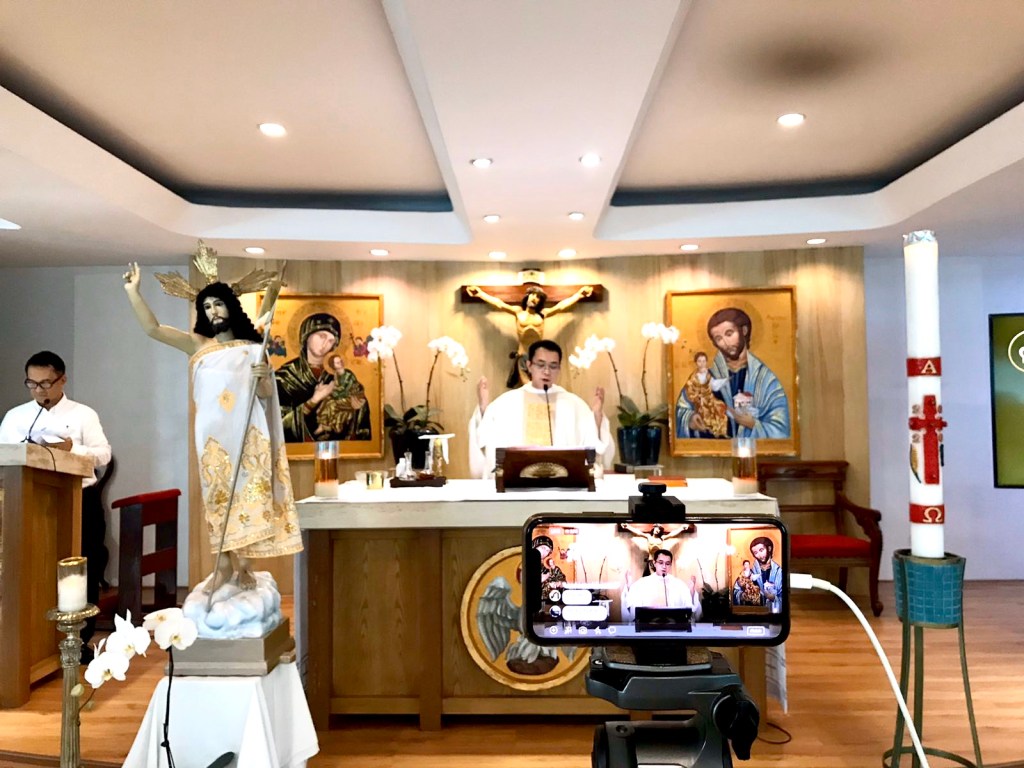
With all our problems mounting from the continued scourge of this Covid-19 pandemic, God becomes less of a priority and we easily lose sight of all the blessings we have received through His graciousness. These feelings of hopelessness and helplessness can be overwhelming and the tears in our eyes prevent us from seeing the many ways God has been faithful to us in our lives. We are constantly beset with bad news of businesses closing, hunger escalating, unemployment rising and COVID cases increasing and we wonder if God still cares about us. Perhaps, we just need to step back and breathe deeply, each time acknowledging that every breath we take is already a gift! Let that be the starting point for counting our blessings. Moreover, by participation in the live streaming of the eucharistic meal we can be reminded of the abiding presence of God in our lives through the spiritual nourishment He gives to sustain us in such difficult times.
Having established earlier that a gift reflects the generosity of the giver, we affirm that GOD’s generosity can never be surpassed because His giving is fully motivated by a pure and ardent love for us. Through the Eucharist, we are given the opportunity to participate in the self-giving love of Christ when we manifest love to our brothers and sisters in Christ. St. Paul asks: “The cup of blessing that we bless, is it not a participation in the blood of Christ? The bread that we break, is it not a participation in the body of Christ?” (2 Corinthians 10:16) The word thanksgiving in itself contains two powerful words: ‘thanks’ and ‘giving’. Thanksgiving then draws us out of ourselves and forces us to look towards another and see their miseries. When we are grateful and aware of how blessed we are, we must make the effort to share our blessings in an attempt to ease the suffering of others. The experience of the eucharist inspires us to take our thanksgiving a step further and address the needs and concerns of others that we may be a blessing to them.
Lastly, may I emphasize that thanksgiving is a way of life! It is not simply devoting an hour of Sunday worship to express gratitude for the rest of the week. The popular phrase… “adopt an attitude of gratitude” encourages us to look at life with the eyes of humility, acknowledging that every moment, every opportunity, every person is a gift from the bounty of our great and loving God. And in case, I have not said this often enough, thank you to all of you. You have blessed my life with your presence and I thank God for you. 🙂
 Sunday Gospel Reflections
Thank you Fr.Sent from my Samsung Galaxy smartphone.
LikeLike
You are welcome! God bless you!
LikeLike
Inspiring words, Toto Fr Ricky. Salamat gid. Every moment is a gift from God. To connect to His wisdom through yours is also gift. Stay well.
LikeLike
I am so grateful to our loving God for the gift of life, family and friends. I also thank the Lord for you. A blessed feast of Corpus Christi.
LikeLike
Thank you Fr Ricky for these beautiful weekly words of reflection and wisdom, they have been helping us through lockdown and during these important Sundays for the Catholic Church away from the ‘physical’ church. I thank God for having let us cross our path with yours here in East London. God bless! Enrico (Vera’s husband)
LikeLike
Never realized until now that the word “thanksgiving” contains 2 important words, “thanks” and “giving” and should work hand in hand. Yes, it should be our attitude, a way of life because being grateful for all the blessings we have but doing nothing about it is of no value unless we share our blessings with those in need. Thank you, Fr Ricky, for this reminder.
LikeLike