The Spirit’s Gift of Courage in the New Normal

Homily: Solemnity of Pentecost

31 May 2020

John 20: 19-23

Metro Manila is set to be on General Community Quarantine starting June 1. When the news broke, reactions were divided. Some heaved a sigh of relief while others took to social media to express their fears that the city had inadequately prepared for the transition to GCQ. In Twitter, #Survivor Philippines trended, another comic jab at our experience such as the MMGCQ or Matira Matibay General Community Quarantine. Yet others joked that after making it through nearly 3 months of a large scale ‘Pinoy Big Brother’ (PBB) scenario, we are now being hurled into the Endgame where we are teased: “May the best immune system win!”

They may seem funny to us but if you think about it, it subtly reveals that society is actually scared for its safety! Filipinos are rather known for making light of difficult situations. In fact a British friend of mine recently remarked: “As if the coronavirus crisis were not enough, you now battle a strong typhoon! And yet I see smiles on the faces of suffering Filipinos in the news.” We make jokes but it does not mean we do not worry. Sometimes it merely veils our fears. 

In the early stages of the pandemic, we have seen and heard countless accounts of panic buying and rude behavior in grocery stores. Sometimes, even the educated and the wealthy, from whom you would expect more civility, displayed impatience, irritabiliy and selfishness because fear had gotten the better of them. Remember the toilet paper crisis and the hoarding of alcohol and disinfectant? Who would have thought it would come to the point of rationing these items? While this pandemic has been an occasion to show the best of humanity, it has also exposed their unpleasant side. 

As we go into GCQ, the excitement of finally being free of our home prisons is diluted by yet another fear. Under stricter circumstances, the protocols to keep society safe were easier to implement but as the public surges back into the world, one wonders how to ensure everyone practices social distancing and proper hygiene. There is even a newly-coined term for people who misbehave or act with abandon, oblivious of their own safety or of those around them. These “covidiots” ignore warnings for public health and safety, and who hoard goods, thus denying access to those who also need them. To be honest, it is this reprehensible behavior that scares even me! I can not imagine how I can reintegrate myself into the world burdened with these fears. People often tell me, that as much as possible, they’d rather stay home till a vaccine is available or a permanent solution to the pandemic has been found. Till that time comes, are we just supposed to hide?

The Gospel of John relates to us a similar atmosphere of paralyzing fear experienced by the disciples after the crucifixion of Jesus. They all gathered in the Upper Room and locked their doors for fear that they would be arrested and they may meet the same fate as Jesus. They were afraid that they would no longer be free to do the simple things that they used to do or move about as they pleased because they could be identified as followers of Jesus. This crippling fear even led them to doubt what Jesus had revealed to them that he would rise after suffering a painful death. In their fear, they allowed the darkness of Jesus’ death to cloud their minds and hearts, preventing the light of Jesus’ resurrection to break forth. Then, Jesus appears!!! We imagine that the sight of Jesus, alive and well would by itself, dispel their darkness and fill them with a renewed sense of courage. However, the gospel confirms that even this marvelous moment of truth, was insufficient to embolden them. Courage only came to them upon receiving the Holy Spirit, a gift that Jesus promised them as he ascended into heaven. Jesus encouraged his fearful disciples with a greeting of peace and an invitation to take courage: “I have told you this so that you might have peace in me. In the world you will have trouble, but I have conquered the world.” (John 16:33) In the Pentecost account in the Book of Acts we see these disciples, once gathered behind locked doors, have found the guts to get out into the open and speak in a public place proclaiming that Jesus had indeed risen from the dead, and all other such wondrous things God has done through Him. They do this now without fear of the danger to their lives.

This Pentecost, let us ask the Holy Spirit to come to us and bestow on us the gift of courage. Courage we will need as we transition into GCQ and adjust to the changes and inconveniences of the new normal. We ask the Holy Spirit to fill us with a fearlessness that is not arrogant (“maangas”) but one characterized by mindfulness of actions, knowing that our personal choices affect others. St. Paul reminds us in the Second Reading: “As a body is one though it has many parts, and all the parts of the body, though many, are one body.” If we read further in this letter, Paul would say: “If one part suffers, every part suffers with it, if one part is honoured, every part rejoices with it.” (1 Cor 12:26). Having been brought together as one in the Risen Lord, we strive to look after one another. We choose always to act with compassion and consideration not just for the benefit of our loved ones but also for the people around us because we bear in mind that they too are treasured and cherished by their loved ones. As we pray the words of the Sequence, we ask the Holy Spirit to strengthen us inwardly… “to bend our stubborn heart and will, to melt the frozen, warm the chill and guide the wayward home once more!”

Do I seem to advocate that we all dare to go out into the world tomorrow? Don’t get me wrong. I am merely saying, our fears should not keep us from doing what is necessary. We, as individuals, have unique gifts that we share with one another, contributing to the collective of society, in the hopes of elevating humanity. We all have a mission in life, that we strive to accomplish as we live and breathe. We are fathers, mothers, workers, students, employers, law enforcers, media practitioners, medical workers, leaders, etc…. We still have a role to play in society. The gift of fortitude from the Holy Spirit helps us realize that although the threat of Covid 19 is real, life has not come to an end and we should not be paralyzed by our fears. St. Paul reminds us that we who have been filled by the Spirit of Jesus are not to live in fear but rather in hope. We believe that the One who raised Jesus from the dead will also make us rise above our present woes and lead us toward fullness of life.

Tomorrow, the government allows us to unlock our doors. As we assimilate back into the world, let us invite the Holy Spirit into our hearts, to fill us with the courage we need to discover our place in the new normal with people who have suffered with us in this pandemic. May we become brave enough to continue the pursuit of our mission in life all for the glory of God!

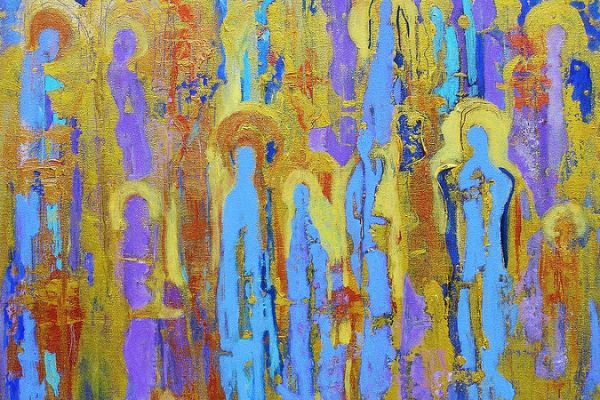
Photo of Taize stained glass on the Descent of the Holy Spirit from http://www.pinterest.com

In one storm but in different boats…

Homily: The Solemnity of the Ascension of the Lord

24 May 2020
Matthew 28:16-20

There is a man named Dodong. He is a 58-year old fish vendor from Caloocan. He was among 400 apprehended quarantine violators. On May 7th he was detained by Navotas authorities after he attempted to cross the city border from Caloocan without a travel pass.

A week had gone by before his family was able to locate him. Despite raising the P3,500 bail money, he remained in detention because his family failed to comply with other requirements. They had been asked to produce a photo of their house, four sets of coloured profile pictures of the accused with each photo bearing his signature, a certificate of detention, Barangay Residence Certificate, and a location sketch of their home certified by the Barangay Captain.

These requirements are crazy over-the-top to be true, wouldnt you say? But it’s all true. “Mang Dodong’s plight was documented in the Facebook post of photojournalist Vincent Go which has been shared 30,800 times, received 727 comments, and 50,800 reactions.”

I can only guess that Mang Dodong, the fish vendor, desperately needed to go to Navotas because he had to make a living so his family could eat but sadly he only ended up suffering more indignities. Isn’t it a stark contrast to how other more prominent ECQ violators are treated during the lockdown? They, too cross borders to get to where they want to go but only need their “face value” as a travel pass.

Going into lockdown, our first priority was to secure our needs. Those who could afford to, filled several carts at the grocery with more than their necessities while others barely had enough to fill their basket with cans of sardines and a bag of rice. The socio-economic gap in our society became even more apparent when people started posting about their activities in lockdown. Paul Meim illustrates this disparity among us in his article saying we may be in the same storm and yet, not in the same boat. He says further: “For some, this is a desperate crisis. For others it is facing loneliness. For some, a period of peace, rest time, vacation. For others, torture. Some are concerned about a brand of chocolate or coffee. Others are concerned about rice for the weekend, if the noodles and sardines will last for a few more days.” May I go a bit further to say that while others among us are comfortably working from home, many have already lost their jobs and many still are going to be laid off. Same storm, but not in the same boat.

Our readings this Sunday remind us of our interconnectedness as a community of believers. We have been baptised into one faith — a community of persons of the Father, Son and Holy Spirit. Because of our baptism we are meant to live a divine fellowship with one another. So even if this lockdown has forced most of us into isolation, we should be able to take comfort knowing we are not alone because we have each other. In fact, we belong to one another. St. Paul tells us: “None of us lives for ourselves alone, and none of us dies for ourselves alone.” (Romans 14:7). As we continue to wage war against Covid 19 we come to realize that this is not a battle for personal survival but rather a collective one. For instance, when I make the effort to stay home and leave only when necessary it is not just for the protection of the family I love but for the safety of others. In Christ the King, our parishioners continue to contribute generously to OPLAN COVID that helps provide the needs of the less fortunate and assistance to our overworked medical frontliners. I was personally amazed after reading that rival schools Ateneo de Manila University and De La Salle University called a truce to provide joint support to the most vulnerable sectors affected by the COVID-19 pandemic. On a larger scale, we can look to countries with women leaders who have fared better in addressing the Covid-19 crisis. Observers attribute this to the capacity of female leaders to be more collaborative in their approach. They know how to listen and seek help from others and do not pretend to have all the answers. I am sure each of you listening can tell us your own examples of compassion and generosity during this lockdown. Truly, if we want to emerge triumphant from this battle, we have to keep our act together. As we rally together to fight our common enemy, we cry out: “We heal as one!”

In today’s account of the Ascension, Jesus calls the disciples, not as individuals but as a group forming the nucleus of the People of God. As the new Body of Christ, together they are commissioned to “Go, therefore, and make disciples of all nations.” We too, like them, are empowered to be ministers of communion for all peoples and places where life brings us. This begins in a special way in our most immediate community —our family. This lockdown has been a moment of grace for families because it has given them the opportunity to rediscover each other, to appreciate one another and to learn to live peacefully with each other. In the rectory, Fr. Steve, Fr. Jojo and I live as “family” but before the lockdown, weekends were so busy that we could hardly sit together for meals. Since the quarantine, we always eat together and over these meals we have had the chance to get to know each other and work together to become more effective pastors in the parish.

The task of fostering communion among peoples isn’t easy. It is a tremendous mission for us and back then even the early church was daunted. St. Paul prays for the disciples at Ephesus that they may be provided with all they need to carry forth this mission of bringing all peoples together in the Lord. Of course, it is inevitable that our differences as people tend to cause discord but we need to remind ourselves that the Holy Spirit has given us the power to be the unifying presence of Christ for others. As we ask the Lord to strengthen our resolve to be witnesses of His love, we join St. Paul in praying “May the eyes of our hearts be enlightened that we may know what is the hope that belongs to His call, what are the riches of His glory in His inheritance among the holy ones.”

We may be in different boats in this storm of the Corona virus pandemic but let us not allow this virus to further divide us as a people. We simply need to invite Jesus into the boat with us to give us courage and hope, to guide us and inspire us to help other boats alongside us navigate these stormy waters toward safer lands!

Illustration by Laura Carlin used in the article of Paul Meim

The Reason of our Hope

Homily: Sixth Sunday of Easter (A)

17 May 2020

“Great news! Carona (Corona) Virus vaccine ready. Cures patients 3 hours after injection. Hats off to US Scientists!” That was the gist of Trump’s announcement that Roche Medical Company was set to launch a vaccine with millions of doses available for distribution!

Some friends of mine commented: “Sana TRUE!” Sadly, this bit of news released in March proved to be a hoax. Had there been any truth to it, we would have been out of quarantine by now and everything would have gone back to normal, right? But here I am, and there you are, all of us, still stuck at home.

This was but one of many supposed cures to Covid-19 being circulated on social media. These types of messages do more harm by giving already distressed people ‘false hopes’ for a solution. In contrast to the false hopes that hound us in cyber space, our readings this Sixth Sunday of Easter direct us to our true hope. Throughout the bible, scripture teaches us to pin our hopes on God rather than on people, possessions and things of this passing world. We recall how the prophet Isaiah pronounces: “Woe to those who rely on horses, who trust in the multitude of their chariots and in the strength of their horsemen, but do not look to the Holy One of Israel or seek help from the Lord. (Isaiah 31:1). It continues to juxtapose the mortality of an army with the power of the Messiah, who brings true deliverance from oppression. The Psalms further remind us “not to trust in princes, in mortal men, who cannot save.” (Psalm 146:3) In Psalm 20 we hear: “Some trust in chariots and some in horses, but we trust in the name of the Lord, our God. (Psalm 20:7). This trust in God set apart the ancient Israelites from their oppressors. Much later, we even hear St. Paul exhorting Timothy: “Command those who are rich in this present world not to be arrogant nor to put their hope in wealth, which is uncertain, but to put their hope in God, who richly provides us everything for our enjoyment.” (1 Timothy 6:17)

If there is one lesson that many of us should have learned during this health crisis it is that we are not invincible and we are foolish to think we have full control of our lives and our fate. All the achievements of mankind and the values of the world have consistently deluded us into placing our trust in created things— things that glorify the human intellect and celebrate the extreme capacities of the human body. Essentially, we have placed our trust entirely on ourselves. It took a global pandemic to expose us to the frauds that we are. Despite our scientific and technological advances all it took was a microscopic virus to shut down the world and fell nations. No matter how exceptional we are, we still have our limitations. We are, after all, but imperfect creatures.

We Christians, are fortunate that we have been taught dependence on a Higher Being whose existence and power are boundless and infinite. Our experience in the first half of 2020 merely reminds us that our hope must be grounded on the One who promises us that He would not leave us orphans and who would comfort us through the Spirit of Truth that dwells with us, in us. (John 14:17) Our hope rightfully rests in Jesus Christ.

Recently, I was seized by this candid shot of a gray-haired Nanay on Catholic Connect’s Instagram Account shared by Atty. JB Batiancila. She stands at the threshold of her humble home, that actually seemed more like a shed, intently focused on a well-worn book, perhaps the only book in her possession. It turns out she was reading the Bible while there was daylight since her house had no electricity. I found this to be a beautiful image of giving primacy to God’s word amidst the seeming hopelessness and helplessness of our present reality. I believe the example of this elderly lady is inviting us to be steadfast in spirit, to have the mettle to endure, to make personal sacrifices for loved ones and even strangers, hoping against hope, because the bible is proof that God is true to His Word. If our God is indeed trustworthy, would you not say that our hope is properly placed in Him?

I find it necessary to emphasize that hope is always a choice. We can always choose to direct our thoughts and feelings towards being hopeful or hopeless. It is so easy for us to focus on more depressing news such as the fact that the number of COVID cases is still increasing. Can we not choose to highlight the positive such as the fact that we recorded the highest number of recoveries (145) in a single day during the feast of Our Lady of Fatima? It is up to us to choose what lens we use to look at our given situation.

We all have the capacity to see life in the midst of death and sickness around us. For us Christians the story never ends in death, but in life because of the gift of mercy, redemption and salvation from Jesus Christ. First Peter says the reason of our hope (Jesus Christ) was “put to death in the flesh, but was brought to life in the Spirit.” Just recently the streets of Lambunao, Iloilo reverberated with the sound of drums celebrating the recovery of five members of a family stricken by Covid-19. Closer to our homes, The Medical City (TMC) announces a Code Joy over their PA system every time a COVID patient recovers and is discharged. It brings together the entire hospital to a simple but powerful act – a round of applause – to boost the morale of both patients and staff.

Many people have been asking, myself included, “When will this end?” (including this homily) According to a Yahoo News article citing historical data, pandemics typically have two types of endings: “the medical, which occurs when the incidence and death rates plummet and the social, when the epidemic of fear about the disease wanes.” So, when will this end? Reliable sources say a vaccine might be ready by the end of this year or early 2021. (Sana soon and Sana all!) But is that the measure by which we are to live? I say choose a different perspective. A mindset where this situation ends when we choose to hope rather than despair, when we acknowledge that our life depends on God more than on ourselves, when we choose life over death. Let us come out of this experience a renewed people, open to surrender our present and our future to God, completely believing in His power to turn the tide of hopeless situations into a fountain of grace.

Making Manifest God’s presence in our Midst

This period of quarantine has forced us to be reacquainted with every nook and cranny of our houses. Most, if not all, of our activities lately are limited to the boundaries of our homes, inspiring the more comedic among us to poke fun at our house arrest. I am amused at some of the more creative memes online such as this one posted before Easter: “Still have not decided where to go for Easter… debating between the living room or the bedroom.” Another one goes something like this: “Today we visit the kitchen again – the Capital of our House!” The situation is even more challenging for those who are quarantined in single room houses where social distancing is not only difficult but impossible. They do not have much room to stretch their legs, enjoy a little privacy or maintain some personal space. One meme shows a small nipa hut with several residents who have each nestled in the corners of the house and even perched themselves in the rafters to comply with the directive for social distancing! Such is our awareness of our homes today.

In the gospel for this Fifth Sunday of Easter, Jesus talks about God’s House. What is the extent of our knowledge about God’s House? Do we know it as well as our own homes?

Jesus describes it as having many dwelling places, which other translations refer to as “many rooms”. This image of ready accommodation makes this Bible passage a favourite for wake and funeral masses. We are used to thinking of God’s House as “Heaven” — a place where all the righteous departed now enjoy a beatific vision of God and living an eternity of happiness with Him. However, there are those with a more spatial perception of God’s dwelling place, who understand the text as a reference to the Temple of God — the Church, a structure of brick and mortar where God is believed to reside. Still, others with a more nuanced interpretation of this divine dwelling place see it as the many ways by which God’s presence is made manifest and in which His will is done here on earth, thus transcending all time and space. Recall in Luke’s gospel when Jesus answers the question on the coming of the Kingdom of God He says: “Nor will they say, ‘Look, here it is!’ or, ‘There it is!’ For behold, the kingdom of God is in your midst.” (Luke 17:21)

Although, we cannot provide an accurate definition of God’s House, I am already comforted knowing the House of the Father is indeed a welcoming place. Its many rooms tell me He allows for the gathering of different people from all walks of life into a single community of believers. This is evident in the Acts of the Apostles where we hear that those who became obedient to the faith significantly increased in number. In God’s house, it’s definitely “The More the Merrier”.

More importantly, this faith community is inclusive. It makes room in life for others because every member is deemed of value. It strives to work for the good of all, neglecting no one. It is when all parties are treated fairly and divisive tensions are settled through dialogue, that God is truly made present. Notice that the First Christians even selected a few reputable men amongst themselves to regulate the fair distribution of food and other necessities. They made sure that no one would be overlooked.

St. Peter reminds us that we, as Christians are being built up into a spiritual house with Jesus Christ as its cornerstone. To have Jesus Christ as the foundation of our existence gives us the courage and strength to go beyond limits to perform wondrous deeds for others. The second reading from 1st Peter says: “We are called to declare the wonderful deeds of Him who called you out of darkness into His marvellous light.” (1 Peter 2:9) During this ECQ, we witness how this faith in Jesus Christ has allowed many among us to behave with altruism and selflessness, attesting to a reality that God builds His home in our hearts.

We hear on the news of four honest individuals who returned the financial assistance they received because another family member had already claimed the benefit. They could have easily pocketed the amount in silence because in times of crisis everyone does all they can to survive but instead, they chose to look beyond themselves. They said it was their way of helping and ensuring that others in worse conditions were not deprived of their needs.

Jumar Soliven, a policeman in Pagadian City, carried an elderly PWD down a flight of stairs, aiding her in her journey to claim government financial aid. If only there was a Jumar to help 94-year-old Lola Magna of Bagong Silang, Caloocan who could not avail of the SAP because no one could help her fill out the necessary forms. She bewails: “Wala akong pamilya, mga anak ko, mga namatay na eh. Ako na lang ang natitira.” I remain hopeful that following that report, someone did come to the aid of Lola Magna.

By chance, today is also Mother’s Day. There are moms who as frontliners have not seen their children for months now and who cannot even celebrate Mother’s Day with their loved ones. They have sacrificed their personal happiness to fulfill their duty to the community. We think of mothers like Rosemarie Tirones, a customer care team leader of PLDT who had to miss her daughter’s 18th Birthday to ensure that internet services remain uninterrupted and field personnel were swiftly dispatched to immediately address connection problems. She was thinking of all the other people who relied on the internet to remain connected with loved ones and to keep services available to the public.

Brothers and sisters, these are just some of the ways by which ordinary citizens like us have made manifest the presence of God among us in this difficult time. As we continue to celebrate the risen Christ during this Easter season, let us pray for the gift of openness to God’s grace so that He may reside permanently in our hearts and that we will always be ready to make room for others in our lives. Through us, may God’s presence be felt in every corner of every home!

The Challenge of the Good Shepherd’s Voice

One of the last few movies I saw in the cinema (way before the possibility of any lockdown was even considered) was Frozen 2. Throughout the most part of the story, Elsa, Queen of Arendelle, keeps hearing an unknown mysterious voice. She discovers that the voice haunting her in the Enchanted Forest was leading her to Ahtahollen on a quest to self-discovery. This Mysterious Voice is an element in the movie that made a lasting impact on me. Whose voice was it? Was it really her mother’s? Some say that the voice calling Elsa is none other than her own – the very spirit latent within her. Whatever it was, it had the power to disturb her and push her on a journey of life-altering proportions.

Our gospel passage from the 10th chapter of John also highlights a powerful voice — the voice of the Good Shepherd. It tells us that his sheep recognize his voice and they follow him.

When sheep hear their shepherd’s voice calling them to graze, they are assured to be led where the pasture is green and lush and the streams refreshing. His familiar voice is an assurance that he is watching and he will not let any harm come to them even if they pass through dark valleys and dangerous terrain. It is a voice they know intimately and gently calls each one of them by name. They associate this voice with care that is consistent and dependable. It is a voice they trust with their lives.

Jesus is the Good Shepherd and we are the flock He cares for, guides, and protects. He knows and loves each of us intimately and He guarantees that if we follow Him, we shall have life. That’s great, right? However, you may ask, if we are His sheep, how do we recognize His voice? None of us here have seen Jesus with our own two eyes or touched Him with our hands, so how do we expect to hear Him? The answer, brothers and sisters, is not in our ears. We may not know Jesus in the physical form BUT if we nurture a personal relationship with Him, we get to know him intimately by faith and love such that His voice becomes audible in the silence of our hearts.

Jesus’ voice speaks to us gently. We hear him guiding and leading us on right paths through our conscience. We hear his calming, comforting voice when despite our troubles, we are overcome with a feeling of peace in the company of our loved ones or beholding the beauty of nature. In these instances, we cannot deny, that there is a great being out there looking after us, ensuring each of us is loved, and at the same time keeping order in the universe. The subtle assurance that God is in control gives us the strength and the courage to go on through trials and difficulties just as what we experience today.

Jesus’ voice also speaks loudly enough to disturb us and compel us. It drives us to look beyond the satisfaction of our own needs and interests for the benefit of others. St. Peter tells us: “For this you have been called, because Christ also suffered for you, leaving you an example that you should follow in his footsteps.” When we humbly allow Jesus to direct us, He uses us to speak to people. We become His voice to one another.

Rodel Nuyles, a police trainee from Sipocot, Camarines Sur was moved to buy a face mask for a man who was too poor to buy one for himself. The consoling voice of Jesus rings clear and true to that poor man because of the actions of Rodel.

It is the voice of Jesus that patients hear when they are comforted by the sincere and competent care rendered by Filipino nurses in hospitals worldwide. I remember our cook in London who was so appreciative of the Filipino nurses caring for her because they took time to talk to her and treat her as a person. She was not merely another patient in the ward. They always spoke kindly to her and addressed her by her name—Brigid.

In this time of pandemic, never has the voice of the Good Shepherd been so resonant! His voice is heard when doctors reassure their patients that they are getting the best care, when government leaders issue directives that protect the lives of the citizenry, when ordinary human beings coordinate to bring relief to those in need, when frontliners console their family members with the hope of a reunion after the sacrifice of temporary separation, when family members gather to pray for the world or friends link up on video calls to keep each other sane. Through all these instances of compassion, and more, Jesus speaks to humankind through the voice of His people because the voice of Jesus is the voice of love.

On this Good Shepherd Sunday, we are all invited to come to know Jesus and to recognize His voice and be sensitive to the slightest of His whispers be it in our conscience, in the voice of the people around us, or in the beautiful intricacies of nature. We are all challenged to humble ourselves, to listen to the voice of Jesus that leads us, moves us and beckons us to be His voice to others.

In closing, I would like to quote the lyrics of a hymn by David Haas entitled Voices that Challenge. It goes… “Call us to hear the voices that challenge deep in the hearts of all people. By serving your world as lovers and dreamers we become voices that challenge, for we are the voice of God.”

Going Back to Jerusalem in Faith

April 26, 2020
Fr. Ricky Montañez
Homily
Lk. 24: 13-35

Last Friday, the President decided to extend the Enhanced Community Quarantine until May 15 to enforce social distancing and give the authorities more time to do what is necessary to further impede the spread of the virus in the country. The announcement drew mixed reactions from different sectors. A good number of us comprehend the wisdom in taking on these extreme measures but there are those who were dismayed because they had been eagerly anticipating the lifting of the quarantine. (Sorry guys, I’m afraid, we have to wait longer to enjoy Fr. Steve’s promised ramen treat. We have not forgotten that promise.)

The ECQ extension is disheartening for all of us who have been restless in lockdown for almost six weeks now. I am thinking Cleopas and his fellow disciple travelling on the road to Emmaus in today’s Gospel were feeling a similar agitation and despondency. Note that the gospel never ascertains that both travellers were men. Some Bible scholars even assert that Cleopas might have been travelling with his own wife, the one referred to in the gospels as “Mary, wife of Clopas” who was present at the crucifixion and witness to the empty tomb. (Now before you react, I assure you that “Clopas” is a variant spelling of “Cleopas”). Whatever the case may be, it is safe to say that both disciples had come to know Jesus closely in His lifetime, enough to pin all their hopes on Him, believing, without a doubt, that He is the much-awaited redeemer of all Israel! Bearing witness to Jesus’ trial, shameful crucifixion, His death, and the disappearance of His corpse were enough to make them question their beliefs and the manner in which Jesus had inspired them to live their lives. With their hopes dashed, they left Jerusalem, the place of defeat and death of their hopes and headed to a village called Emmaus.

Distressed and depressed, they allow a stranger to walk with them. As is common, when people are overly emotional, they fail to note the obvious and do not recognize it is Jesus walking with them. He accompanies them and stays with them. Interpretation of scripture makes for odd conversation for strangers travelling together, right? But that kept them preoccupied until it was time to rest and eat. After they recognized Jesus in the breaking of the bread, things start to become clear to them. Only after He disappears do they realize that through their discussions, their TEACHER had taken them out of their narrow perception and opened them up to fresh insights and new possibilities. “Weren’t our hearts burning within us while [Jesus] spoke to us on the way and opened the Scriptures for us?”

In the same light, the circumstances brought about by this health crisis prevent us from easily recognizing Jesus in our midst. But He is here, with us, always! This crisis is shaking us out of our complacency and forcing us to envision ourselves in a new light. Hopefully, we have grown more astute in spotting the many ways Jesus approaches us and joins us walking along the path of life. The suspension of our public masses since March 16, challenged the church to discover how it encounters Christ under these circumstances. Where do we see Jesus today? Christ is here, interpreting for us the Scriptures through the inspired homilies of preachers in our livestream masses and prayer services. He is also present among our families when in attendance of these online services, we listen to the word, receive spiritual communion and pray together as a domestic church. (I recall this meme where Satan boasts to God saying “With Covid 19, I have closed all your churches. Then God calmly responds, “On the contrary, I just opened one in every home.”).

Christ is very much in our midst today. Christ is very much alive in the husband who tirelessly pushes his wife on a borrowed wheelchair for 6 kilometres from Batasan to Fairview thrice a week so she can have her dialysis treatment; He is alive in the loving ingenuity of a mother who successfully stretches her dwindling food stocks and makes an effort to provide her family with healthier meal options instead of just canned goods. Yes, Christ is in the motorcycle-riding couriers of food and supplies, our garbage collectors, our news reporters, supermarket clerks, bank personnel, military and police force that keeps order on our streets, and of course our medical teams— all of them putting their health at risk to keep society safe, all of them hero-frontliners. If we only focus our eyes away from the things we miss about our usual lives we will see that Christ lives and continues to make His presence felt among those who help us all to survive this crisis.

When moving forward can be confusing and uncertain there is always the great temptation to go back to the Emmaus of our old habits and ways of life — of what is familiar. The two disciples, defeated and disillusioned, were leaving Jerusalem in search of a new hope, essentially leaving behind all the wondrous things they had learned and experienced through Jesus. They are not the only disciples who ran away. Other Gospel accounts, tell of disciples who went back to a life of fishing — to who they were before meeting the Messiah. We look at ourselves and see how quickly, we too, return to our former life and its patterns when things don’t go as we expect. We slip back into old routines, relive old practices, taking us backwards instead of forward. This Covid 19 crisis compels us to evolve and form new mindsets to help us adapt to what may be the ‘new normal’ — a situation so unlike what we have grown accustomed to. More importantly, we have to move into the future bearing the wealth of learnings that we have gotten from our ECQ-Covid 19 journey. That is the real challenge. My dear brothers and sisters, if we fail to be conscientious and sensitive, reflective and observant, we may miss out on the many plusses, the many lessons learned, the many relationships forged and renewed while we journeyed through this ECQ.

Michael Baylosis wrote an article in the Inquirer asking: “Is society ready for a world after quarantine?” He proposes that “there is no normality to return to. Only a “new normal to live.” The experience of Jesus in the breaking of the bread gave the two disciples the courage to return to Jerusalem at the end of the Gospel passage—returning to the place of their disappointment, shame, and helplessness, to face their New Normal. No longer were they filled with incredulity but with hearts burning, eyes and mind open, ready to embrace life renewed by having known Jesus.

Let us therefore continue to pray that the confines of our Covid 19-ECQ journey will be, for us, an Emmaus where we encounter the Risen Christ in our families and small communities, setting our hearts afire, preparing us to bring Christ alive for others to the world we return to after the ECQ.

Amen.