Making Manifest God’s presence in our Midst

This period of quarantine has forced us to be reacquainted with every nook and cranny of our houses. Most, if not all, of our activities lately are limited to the boundaries of our homes, inspiring the more comedic among us to poke fun at our house arrest. I am amused at some of the more creative memes online such as this one posted before Easter: “Still have not decided where to go for Easter… debating between the living room or the bedroom.” Another one goes something like this: “Today we visit the kitchen again – the Capital of our House!” The situation is even more challenging for those who are quarantined in single room houses where social distancing is not only difficult but impossible. They do not have much room to stretch their legs, enjoy a little privacy or maintain some personal space. One meme shows a small nipa hut with several residents who have each nestled in the corners of the house and even perched themselves in the rafters to comply with the directive for social distancing! Such is our awareness of our homes today.

In the gospel for this Fifth Sunday of Easter, Jesus talks about God’s House. What is the extent of our knowledge about God’s House? Do we know it as well as our own homes?

Jesus describes it as having many dwelling places, which other translations refer to as “many rooms”. This image of ready accommodation makes this Bible passage a favourite for wake and funeral masses. We are used to thinking of God’s House as “Heaven” — a place where all the righteous departed now enjoy a beatific vision of God and living an eternity of happiness with Him. However, there are those with a more spatial perception of God’s dwelling place, who understand the text as a reference to the Temple of God — the Church, a structure of brick and mortar where God is believed to reside. Still, others with a more nuanced interpretation of this divine dwelling place see it as the many ways by which God’s presence is made manifest and in which His will is done here on earth, thus transcending all time and space. Recall in Luke’s gospel when Jesus answers the question on the coming of the Kingdom of God He says: “Nor will they say, ‘Look, here it is!’ or, ‘There it is!’ For behold, the kingdom of God is in your midst.” (Luke 17:21)

Although, we cannot provide an accurate definition of God’s House, I am already comforted knowing the House of the Father is indeed a welcoming place. Its many rooms tell me He allows for the gathering of different people from all walks of life into a single community of believers. This is evident in the Acts of the Apostles where we hear that those who became obedient to the faith significantly increased in number. In God’s house, it’s definitely “The More the Merrier”.

More importantly, this faith community is inclusive. It makes room in life for others because every member is deemed of value. It strives to work for the good of all, neglecting no one. It is when all parties are treated fairly and divisive tensions are settled through dialogue, that God is truly made present. Notice that the First Christians even selected a few reputable men amongst themselves to regulate the fair distribution of food and other necessities. They made sure that no one would be overlooked.

St. Peter reminds us that we, as Christians are being built up into a spiritual house with Jesus Christ as its cornerstone. To have Jesus Christ as the foundation of our existence gives us the courage and strength to go beyond limits to perform wondrous deeds for others. The second reading from 1st Peter says: “We are called to declare the wonderful deeds of Him who called you out of darkness into His marvellous light.” (1 Peter 2:9) During this ECQ, we witness how this faith in Jesus Christ has allowed many among us to behave with altruism and selflessness, attesting to a reality that God builds His home in our hearts.

We hear on the news of four honest individuals who returned the financial assistance they received because another family member had already claimed the benefit. They could have easily pocketed the amount in silence because in times of crisis everyone does all they can to survive but instead, they chose to look beyond themselves. They said it was their way of helping and ensuring that others in worse conditions were not deprived of their needs.

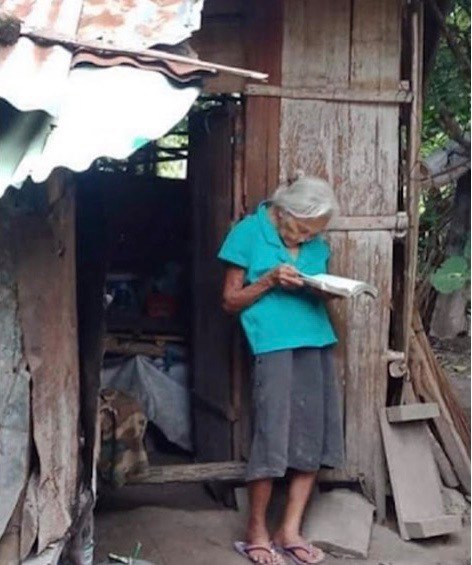
Jumar Soliven, a policeman in Pagadian City, carried an elderly PWD down a flight of stairs, aiding her in her journey to claim government financial aid. If only there was a Jumar to help 94-year-old Lola Magna of Bagong Silang, Caloocan who could not avail of the SAP because no one could help her fill out the necessary forms. She bewails: “Wala akong pamilya, mga anak ko, mga namatay na eh. Ako na lang ang natitira.” I remain hopeful that following that report, someone did come to the aid of Lola Magna.

By chance, today is also Mother’s Day. There are moms who as frontliners have not seen their children for months now and who cannot even celebrate Mother’s Day with their loved ones. They have sacrificed their personal happiness to fulfill their duty to the community. We think of mothers like Rosemarie Tirones, a customer care team leader of PLDT who had to miss her daughter’s 18th Birthday to ensure that internet services remain uninterrupted and field personnel were swiftly dispatched to immediately address connection problems. She was thinking of all the other people who relied on the internet to remain connected with loved ones and to keep services available to the public.

Brothers and sisters, these are just some of the ways by which ordinary citizens like us have made manifest the presence of God among us in this difficult time. As we continue to celebrate the risen Christ during this Easter season, let us pray for the gift of openness to God’s grace so that He may reside permanently in our hearts and that we will always be ready to make room for others in our lives. Through us, may God’s presence be felt in every corner of every home!

The Challenge of the Good Shepherd’s Voice

One of the last few movies I saw in the cinema (way before the possibility of any lockdown was even considered) was Frozen 2. Throughout the most part of the story, Elsa, Queen of Arendelle, keeps hearing an unknown mysterious voice. She discovers that the voice haunting her in the Enchanted Forest was leading her to Ahtahollen on a quest to self-discovery. This Mysterious Voice is an element in the movie that made a lasting impact on me. Whose voice was it? Was it really her mother’s? Some say that the voice calling Elsa is none other than her own – the very spirit latent within her. Whatever it was, it had the power to disturb her and push her on a journey of life-altering proportions.

Our gospel passage from the 10th chapter of John also highlights a powerful voice — the voice of the Good Shepherd. It tells us that his sheep recognize his voice and they follow him.

When sheep hear their shepherd’s voice calling them to graze, they are assured to be led where the pasture is green and lush and the streams refreshing. His familiar voice is an assurance that he is watching and he will not let any harm come to them even if they pass through dark valleys and dangerous terrain. It is a voice they know intimately and gently calls each one of them by name. They associate this voice with care that is consistent and dependable. It is a voice they trust with their lives.

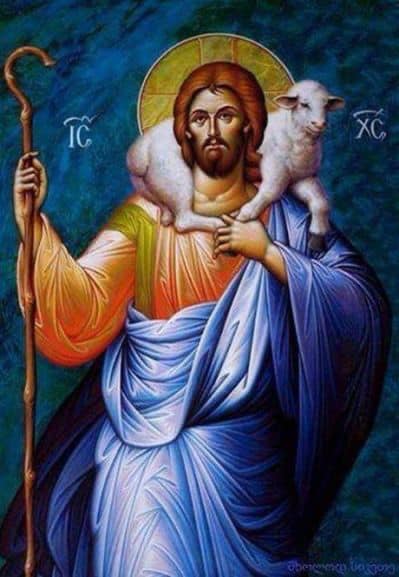
Jesus is the Good Shepherd and we are the flock He cares for, guides, and protects. He knows and loves each of us intimately and He guarantees that if we follow Him, we shall have life. That’s great, right? However, you may ask, if we are His sheep, how do we recognize His voice? None of us here have seen Jesus with our own two eyes or touched Him with our hands, so how do we expect to hear Him? The answer, brothers and sisters, is not in our ears. We may not know Jesus in the physical form BUT if we nurture a personal relationship with Him, we get to know him intimately by faith and love such that His voice becomes audible in the silence of our hearts.

Jesus’ voice speaks to us gently. We hear him guiding and leading us on right paths through our conscience. We hear his calming, comforting voice when despite our troubles, we are overcome with a feeling of peace in the company of our loved ones or beholding the beauty of nature. In these instances, we cannot deny, that there is a great being out there looking after us, ensuring each of us is loved, and at the same time keeping order in the universe. The subtle assurance that God is in control gives us the strength and the courage to go on through trials and difficulties just as what we experience today.

Jesus’ voice also speaks loudly enough to disturb us and compel us. It drives us to look beyond the satisfaction of our own needs and interests for the benefit of others. St. Peter tells us: “For this you have been called, because Christ also suffered for you, leaving you an example that you should follow in his footsteps.” When we humbly allow Jesus to direct us, He uses us to speak to people. We become His voice to one another.

Rodel Nuyles, a police trainee from Sipocot, Camarines Sur was moved to buy a face mask for a man who was too poor to buy one for himself. The consoling voice of Jesus rings clear and true to that poor man because of the actions of Rodel.

It is the voice of Jesus that patients hear when they are comforted by the sincere and competent care rendered by Filipino nurses in hospitals worldwide. I remember our cook in London who was so appreciative of the Filipino nurses caring for her because they took time to talk to her and treat her as a person. She was not merely another patient in the ward. They always spoke kindly to her and addressed her by her name—Brigid.

In this time of pandemic, never has the voice of the Good Shepherd been so resonant! His voice is heard when doctors reassure their patients that they are getting the best care, when government leaders issue directives that protect the lives of the citizenry, when ordinary human beings coordinate to bring relief to those in need, when frontliners console their family members with the hope of a reunion after the sacrifice of temporary separation, when family members gather to pray for the world or friends link up on video calls to keep each other sane. Through all these instances of compassion, and more, Jesus speaks to humankind through the voice of His people because the voice of Jesus is the voice of love.

On this Good Shepherd Sunday, we are all invited to come to know Jesus and to recognize His voice and be sensitive to the slightest of His whispers be it in our conscience, in the voice of the people around us, or in the beautiful intricacies of nature. We are all challenged to humble ourselves, to listen to the voice of Jesus that leads us, moves us and beckons us to be His voice to others.

In closing, I would like to quote the lyrics of a hymn by David Haas entitled Voices that Challenge. It goes… “Call us to hear the voices that challenge deep in the hearts of all people. By serving your world as lovers and dreamers we become voices that challenge, for we are the voice of God.”

Going Back to Jerusalem in Faith

April 26, 2020
Fr. Ricky Montañez
Homily
Lk. 24: 13-35

Last Friday, the President decided to extend the Enhanced Community Quarantine until May 15 to enforce social distancing and give the authorities more time to do what is necessary to further impede the spread of the virus in the country. The announcement drew mixed reactions from different sectors. A good number of us comprehend the wisdom in taking on these extreme measures but there are those who were dismayed because they had been eagerly anticipating the lifting of the quarantine. (Sorry guys, I’m afraid, we have to wait longer to enjoy Fr. Steve’s promised ramen treat. We have not forgotten that promise.)

The ECQ extension is disheartening for all of us who have been restless in lockdown for almost six weeks now. I am thinking Cleopas and his fellow disciple travelling on the road to Emmaus in today’s Gospel were feeling a similar agitation and despondency. Note that the gospel never ascertains that both travellers were men. Some Bible scholars even assert that Cleopas might have been travelling with his own wife, the one referred to in the gospels as “Mary, wife of Clopas” who was present at the crucifixion and witness to the empty tomb. (Now before you react, I assure you that “Clopas” is a variant spelling of “Cleopas”). Whatever the case may be, it is safe to say that both disciples had come to know Jesus closely in His lifetime, enough to pin all their hopes on Him, believing, without a doubt, that He is the much-awaited redeemer of all Israel! Bearing witness to Jesus’ trial, shameful crucifixion, His death, and the disappearance of His corpse were enough to make them question their beliefs and the manner in which Jesus had inspired them to live their lives. With their hopes dashed, they left Jerusalem, the place of defeat and death of their hopes and headed to a village called Emmaus.

Distressed and depressed, they allow a stranger to walk with them. As is common, when people are overly emotional, they fail to note the obvious and do not recognize it is Jesus walking with them. He accompanies them and stays with them. Interpretation of scripture makes for odd conversation for strangers travelling together, right? But that kept them preoccupied until it was time to rest and eat. After they recognized Jesus in the breaking of the bread, things start to become clear to them. Only after He disappears do they realize that through their discussions, their TEACHER had taken them out of their narrow perception and opened them up to fresh insights and new possibilities. “Weren’t our hearts burning within us while [Jesus] spoke to us on the way and opened the Scriptures for us?”

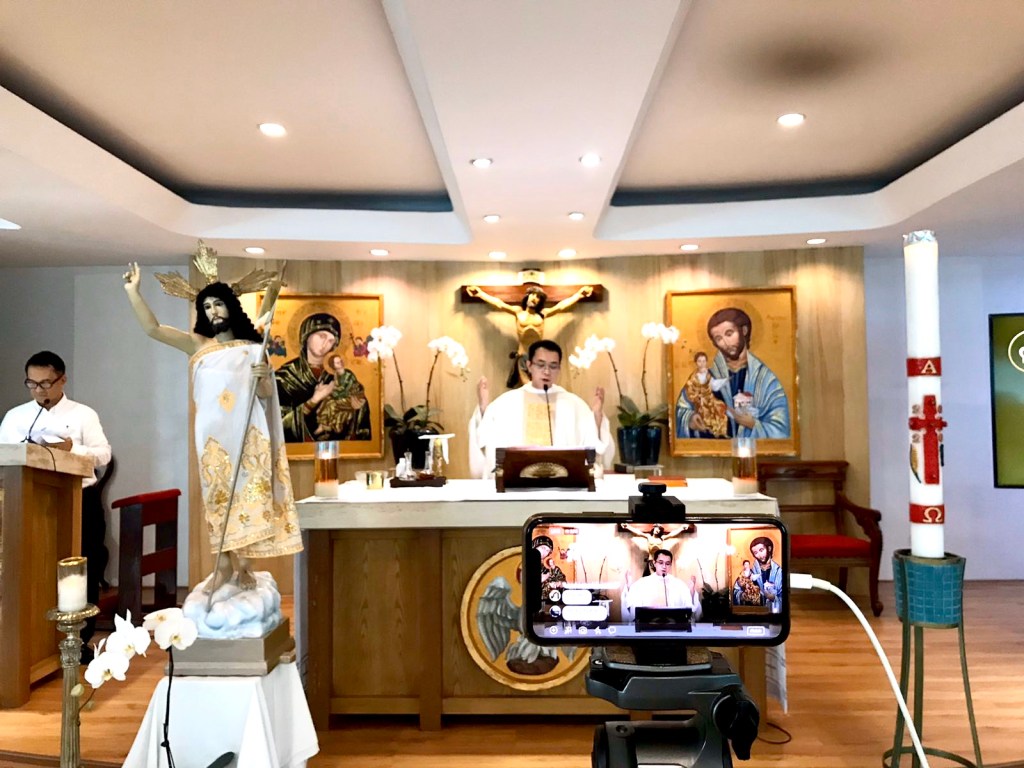
In the same light, the circumstances brought about by this health crisis prevent us from easily recognizing Jesus in our midst. But He is here, with us, always! This crisis is shaking us out of our complacency and forcing us to envision ourselves in a new light. Hopefully, we have grown more astute in spotting the many ways Jesus approaches us and joins us walking along the path of life. The suspension of our public masses since March 16, challenged the church to discover how it encounters Christ under these circumstances. Where do we see Jesus today? Christ is here, interpreting for us the Scriptures through the inspired homilies of preachers in our livestream masses and prayer services. He is also present among our families when in attendance of these online services, we listen to the word, receive spiritual communion and pray together as a domestic church. (I recall this meme where Satan boasts to God saying “With Covid 19, I have closed all your churches. Then God calmly responds, “On the contrary, I just opened one in every home.”).

Christ is very much in our midst today. Christ is very much alive in the husband who tirelessly pushes his wife on a borrowed wheelchair for 6 kilometres from Batasan to Fairview thrice a week so she can have her dialysis treatment; He is alive in the loving ingenuity of a mother who successfully stretches her dwindling food stocks and makes an effort to provide her family with healthier meal options instead of just canned goods. Yes, Christ is in the motorcycle-riding couriers of food and supplies, our garbage collectors, our news reporters, supermarket clerks, bank personnel, military and police force that keeps order on our streets, and of course our medical teams— all of them putting their health at risk to keep society safe, all of them hero-frontliners. If we only focus our eyes away from the things we miss about our usual lives we will see that Christ lives and continues to make His presence felt among those who help us all to survive this crisis.

When moving forward can be confusing and uncertain there is always the great temptation to go back to the Emmaus of our old habits and ways of life — of what is familiar. The two disciples, defeated and disillusioned, were leaving Jerusalem in search of a new hope, essentially leaving behind all the wondrous things they had learned and experienced through Jesus. They are not the only disciples who ran away. Other Gospel accounts, tell of disciples who went back to a life of fishing — to who they were before meeting the Messiah. We look at ourselves and see how quickly, we too, return to our former life and its patterns when things don’t go as we expect. We slip back into old routines, relive old practices, taking us backwards instead of forward. This Covid 19 crisis compels us to evolve and form new mindsets to help us adapt to what may be the ‘new normal’ — a situation so unlike what we have grown accustomed to. More importantly, we have to move into the future bearing the wealth of learnings that we have gotten from our ECQ-Covid 19 journey. That is the real challenge. My dear brothers and sisters, if we fail to be conscientious and sensitive, reflective and observant, we may miss out on the many plusses, the many lessons learned, the many relationships forged and renewed while we journeyed through this ECQ.

Michael Baylosis wrote an article in the Inquirer asking: “Is society ready for a world after quarantine?” He proposes that “there is no normality to return to. Only a “new normal to live.” The experience of Jesus in the breaking of the bread gave the two disciples the courage to return to Jerusalem at the end of the Gospel passage—returning to the place of their disappointment, shame, and helplessness, to face their New Normal. No longer were they filled with incredulity but with hearts burning, eyes and mind open, ready to embrace life renewed by having known Jesus.

Let us therefore continue to pray that the confines of our Covid 19-ECQ journey will be, for us, an Emmaus where we encounter the Risen Christ in our families and small communities, setting our hearts afire, preparing us to bring Christ alive for others to the world we return to after the ECQ.

Amen.