Removing Obstacles; Making Room for Christ

Homily: Second Sunday of Advent (B)

Mark 1:1-8

6 December 2020

Fr. Ricky C. Montanez

When I was a kid one of my favourite family activities was decorating the house for Christmas. We really did not have much but we always did that together. We used the same decorations every year, sprucing up a little here and there because Christmas never felt complete without all the tinsel and trimmings. We wanted our house to reflect the celebratory mood of the Christmas festivities and I guess, it is the same for every Filipino family. As residents of Metro Manila, Christmastime is marked by the spectacular lightshows of the Ayala Triangle in Makati, the magical displays of the Meralco Compound, the Cubao shopping district, and the famous Policarpio Street in Mandaluyong. Who would want to miss the very intricate and vibrant hotel and mall decors which have always been a feast for the eyes? Every year, Christmas has been associated with glitter, sparkle and brilliance — everything always “EXTRA”. Go big or go bust. This year has to be different. 

I have noticed that decorations came up a bit late this year and those on display are kept to a minimum. I think our experience of 2020 has forced us to focus on what is truly essential in every aspect of life including our manner of preparation for Christmas. With the economic downturn people are fiercely guarding their finances; those who have lost loved ones are still in the process of grieving; (Hindi pa nakapagbabang luksa.) and with the quarantine still enforced, parties are discouraged and we can expect that the holiday rush will not be as overwhelming. We’ve sobered up from the intoxicating mood of revelry and excess.  In most respects, the pandemic has made us revisit and appreciate the significance of some of our personal and family Christmas traditions. Have you seen the Christmas ad for Disney Europe featuring a young Filipina girl and her grandmother?  The story of the mag-lola and the Christmas lantern brought tears to many of us as it highlighted the beautiful family-oriented celebration of Christmas in the country.  It made me wonder, why Christmas needs to be a showcase of twinkling lights when in the first place all we need is a ‘parol’ to remind us of the Light of the World who came to illumine the darkness of this world? 

In this Sunday’s Gospel reading from Mark, John the Baptist proclaims the urgency of “preparing the way of the Lord.” (Mark 1:3) He invites us to prepare well by calling people to repentance. Just as paving the way was necessary to welcome returning victorious kings or generals, so are we all directed to remove any obstacle that might prevent us from making room for the Lord in our lives this Christmas. But what does it mean for us to pave the way for Jesus in a year such as this? I think, that given the situation we find ourselves in, this year’s preparation for Christmas will be quite special. Although we have had to contend with so much loss this year — in terms of loved ones, finances, and various opportunities, this year has still given us a remarkable gift — the blessing of time for introspection. It has given us the chance to see where we were in life, where we are, where we ought to be and who we need to be. When everything else is dissolved, St. Peter asks: “What sort of persons ought you to be?” (2 Peter 3:11)

Preparation for Christmas used to mean fun parties, shopping, sumptuous meals, foreign trips, exchange gifts, this year without big events and numerous parties or the mad rush of Christmas shopping at the malls, we are forced into a more quiet, solemn and prayerful preparation for the coming feast. Most of us will be celebrating a no-frills Christmas this year, with many of us attending a livestream Christmas mass in the comforts of the home. This will be followed by a simple Noche Buena meal with our immediate family. Some families who must sacrifice their traditional large family gatherings for the safety of their loved ones have organised a Christmas family gathering via zoom or other social media platform. This brings to mind the wisdom of a social media meme that said “Skipping large family gatherings for the holiday season of 2020 might just ensure you get to see those family members in 2021.” This year we can savour the togetherness that we tend to lose amidst hectic and frantic Christmas celebrations. Family will be more amplified and valued as part of the real meaning of the holy season. 

We have also been given a chance to practice temperance. In our zoom parties, we have learned to patiently wait for one another, listen to one another and give each other the chance to be heard and appreciated. As we stumbled our way through safety protocols and various levels of quarantine, we realised that we need each other in order to make it through this most trying time.  Those among us who are achievers and control freaks have been taught by circumstance to accept failure and to trust in the Lord, to be patient and learn to follow His lead. Moreover, all of us have had to struggle with ourselves to overcome our tendency to fight to get our way. With certain laws set in place to ensure the safety of all, we have learned to accept that we cannot always insist on what we want. We have learned to let go in order to make room for the good of the majority.  We’ve learned to take the higher ground and perceive the bigger picture. Whether we like it or not, life is not fair and people are not perfect. There is always room for improvement.  We do recognize, that no matter what state we are in, there is a chance to do better and always something to contribute to help ease the difficulties of others. In the words of the Prophet Isaiah, “there are certain valleys in our lives that need to be filled in; a number of mountains and hills that need to be made low; a few rugged lands that shall be made plain and still rough countries that need to be become broad valleys.” (Isaiah 40:3-4)

In context of this year’s challenges, we have had a chance to stop and look at ourselves, our values, our priorities, our capacity to rebound from hardship…  What kind of persons have we become through our experiences this year? We are all a work in progress, but we must not wallow in what is missing or lacking. We have to learn to celebrate the incremental character upgrades we have achieved during this time of the pandemic and see that as we become less selfish and more others-centred we are already doing the work of paving the way for God. Let us continue to walk on the path of holiness and righteousness hastening the coming of the day of the Lord.

Advent: Running Forth to Meet the Lord

Homily: First Sunday of Advent (B)

Mark 13:33-37 

29 November 2020

Fr. Ricky Montanez

When I was in London, one of my priestly duties was to hear confessions of children from one of the parochial schools in preparation for their First Communion.  To one little boy, I intended to give the penance of an Our Father so I asked him if he knew how to pray it.  The little boy answered shyly, “I only know the Lord’s Prayer.” I smiled and said: “They are the same.” The boy responded, “Oh, very well indeed.”Then, I told him, you may now say the Act of Contrition. Confused, he asked: “What is that all about?” I told him the “O my God…” He smacked his palm on his forehead and laughed, “Of course!” 

We are not so different from this little boy, in the manner by which we understand and observe our Catholic practices and liturgical observances. We tend to know some of the Catholic terminologies but take for granted the richness of their meaning.  Other times, we are so moved by a church experience but do not have the words to identify and discuss them. The Season of Advent, which we begin today is oftentimes merely a “liturgical” word for us, with not much meaning in our lived experience, if we are not mindful. 

Advent, which in Latin is “adventus” translates in English as “arrival” or “coming”. For us Catholics, it is a season comprised of four (4) Sundays after the Feast of Christ the King and just before the 25th December, Christmas Day. It is an anticipation of the celebration of the blessed day when our God, sent His Son to be born as one of us, to save us from the misery of sin. Just as we find ourselves preparing for the arrival of valued guests in our home, the church deems it necessary to establish a period of preparation among the faithful that places them in the proper disposition to receive our God made flesh. We are taught that Advent is intended to be a preparation for more than just Jesus’ coming to us at Christmastime. It is a foreshadowing of The Second Coming of our Lord in the Parousia, which He divulges to His disciples before His Ascension.  We are invited to observe a period of intense preparation which characterizes the Season of Advent. 

In the Philippines, we are more prone to skip Advent altogether because we celebrate Christmas long before it is celebrated elsewhere in the world. Usually, the BER-months signal the start of the Christmas season for Filipinos. The experience is thus often taken for granted especially when eclipsed by the eager anticipation of the Christmas festivities. In view of this, a friend of mine curiously wondered whether many of us Catholics have a concrete understanding of what Advent preparation entails. In the liturgical calendar, it is akin to the Season of Lent in the sense that both are marked by the colour violet and that both seasons require the faithful to assume a more introspective demeanour. It is the time to bow our heads to reflect on two great moments in the plan of our salvation by our God — the Incarnation and Jesus’ Passion, Death and Resurrection. The discipline of Lent renders a clear idea of the penitential aspect of the season as it highlights prayer, fasting and almsgiving. It takes on a somber air because it forces us to bring to the fore an awareness of our sinfulness and a depiction of the intense suffering endured by God on our behalf.  Advent, for certain, is not to be regarded as a miniature Lent. It is a time of joyful anticipation for the celebration of the Coming of the Son of God in the flesh roughly 2000 years ago.  However, since we are also anticipating with hopeful hearts the Second Coming of Christ, should there be a penitential aspect to the celebration of Advent?   Let me begin by saying this. For sure we regard Advent as a season of preparation. We are told that we have to prepare our hearts for the Coming of the Lord. But what are the things we can do to prepare ourselves internally, spiritually?  

The readings for the First Sunday of Advent suggest that there is a penitential aspect of this joyous Season of Advent. First of all, we are asked to be aware of the inadequacies of our existence and how God is our hope for deliverance. Through the words of Scripture, we are invited to cultivate a greater sense of mindfulness of our need for God’s presence in our lives. In the passage from the Prophet Isaiah we see a people in dire need of liberation from their captivity in Babylon. Realising the disastrous consequences of their infidelity, they have acknowledged their sinfulness and their need for a saviour to rescue them from their predicament. I believe for Advent 2020, we are having a similar experience of that awareness of our need for God to save us from this pandemic and all the hardship it has brought on us.   

Secondly, we must trust in God’s divine plan and the part He intends each of us to have in His plan. “You are our Father; we are the clay and You the potter: we are all the works of Your hands.” (Isaiah 64:8) Our Advent prayer consists in the consciousness that we are clay in God’s hands and it is He who continues to shape, mould and form us to be the persons He intends us to be. We are to trust that God, our Divine Potter works on us patiently until He is satisfied with the finished products. We need to trust that He has something beautiful for each one of us. We are His masterpieces. His Potter’s Hand will never rest in shaping and reshaping us until we are perfected. And just as the Chosen People called on God’s help to free them from the clutches of their captors, we, too earnestly implore the Lord in our Advent prayer to sustain and rescue us through all the challenges we continue to face in our life these days. 

Finally, we take on the enduring spiritual value placed on the practice of fasting and other forms of penance and see them as ways of purifying our hearts.  These religious observances can help us make a more conscious and purposeful Advent preparation so we can celebrate Christmas more meaningfully.  Christmas is after all a great feast.  I read somewhere that we cannot really feast on Christmas without a fast. When I am anticipating an invitation to a sumptuous meal, I often skip or do not eat as much in the meal prior so that I can fully enjoy the feast laid down before me. Doesn’t it make sense? I think one good example of true preparation is our Filipino tradition of dawn masses (Misa de Gallo) and Simbang Gabi. It is one way of concretely and consciously preparing ourselves for the celebration of the Coming of Jesus among us. During this novena, we humbly approach the altar declaring our need for Him, making the sacrifice of waking up early or sleeping late to complete nine (9) days of masses where we listen to readings and homilies that help dispose ourselves for Christmas. Through these spiritual practices, Advent becomes an opportune time for us to prepare our hearts and welcome the riches of the grace of God in the gift of His Son. 

In the Gospel, we are told that the servants were not waiting idly for the house owner’s return. They were found mindfully and responsibly doing their tasks as the coming of the householder will be sudden and unscheduled. St. Paul reminds the Corinthians that they have been given all the gifts and talents that they need to use in order that they may be found ready to meet Christ when He comes as judge of the universe. (1 Corinthians 1:7) Similarly, we too have been gifted with talents and resources that we are to put to use and share with others for the common good. We are to bring the good tidings of Christmas to all our brothers and sisters especially to those in dire need during this difficult time. We just need to be a little creative. A friend of mine who turned 40, spent the 39 days prior to her birthday doing random acts of kindness to people whom she thought needed help. This was her way of making her 40th birthday more special and meaningful for herself and for all those whose lives she was able to touch.  

As we begin this season of preparation, let us make the most of this time by keeping our eyes and hearts open and earnestly implore: “Lord, make us turn to you; let us see your face and we shall be saved.” (Psalm 80:3) And as we prayed in the Opening Prayer: “May the Lord grant us the resolve to run forth to meet Christ with righteous deeds at His coming, so that, we may be worthy to possess the heavenly Kingdom.”

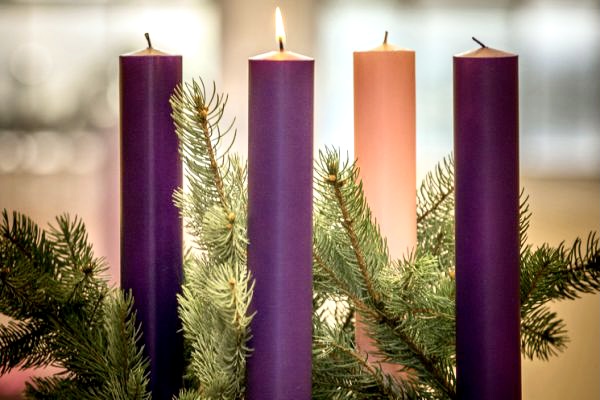
A lit candle is seen on an Advent wreath. Advent, a season of joyful expectation before Christmas, begins Dec. 2 this year. The Advent wreath, with a candle marking each week of the season, is a traditional symbol of the liturgical period. (CNS photo/Lisa Johnston, St Louis Review) See FAITH-ALIVE 42 Oct. 25, 2018.

Reigning by Example; Ruling to Serve

Homily: Solemnity of Our Lord Jesus Christ, King of the Universe (A)

Matthew 25: 31-46

22 November 2020

Fr. Ricky Montanez

Yesterday, we did a rewind of the concert we staged last year to celebrate Christ the King Parish’s  40th anniversary. That evening was the grand launch of the CTK Hymn, Christ in Our Hearts. Every day, since the lockdown, all our livestreamed masses begin and end with that song. By now we are already familiar with the lyrics…  “Christ is Our Home,  Christ in Our Hearts, Hail Christ Our King and Servant of All.” Beautiful! However, I wonder… if I conducted a survey today to ask, ‘Who is Jesus to you?’, would “King” be among the top answers? 

We, Catholics, commmonly relate to Jesus Christ as Friend, Teacher, and Healer.  We are taught to build an intimate relationship with a God who persistently knocks on the doors of our hearts, who cares, who listens, who accompanies us through the highs and lows of life, like a friend. And when we need guidance, some of us ask ourselves ‘What Would Jesus Do?’ Or we go to the inspired word — the Bible, to review the teachings of Jesus. The Gospels record many instances of Jesus preaching to crowds, teaching them in parables, interpreting scripture, and proclaiming the Kingdom of God. For the Jews in those days Jesus was Rabbi, for us, He is Teacher.  When we or our loved ones fall sick, we get to know Jesus as healer more than anything. Most especially during this pandemic where the cloud of illness looms and spreads over the earth,  we consistently implore Him to look on us with mercy and to touch us with His healing power to restore all to good health.  The New Testament even details the many healing wonders He performed to merit the title ‘Miracle Worker’. Jesus — Friend, Teacher and Healer… But what is our experience of Jesus as King? And of the Universe, at that? 

On this celebration of Christ the King, our readings invite us to reflect on the kingship of Christ, the kind of leader Jesus is, and what it entails to be subjects to Him.  In the First Reading, Ezekiel talks about God as the Shepherd of His people Israel and this image is mirrored in the well-loved Psalm 23 — The Lord is my Shepherd.  In the days of Israel’s Kings, the sovereign was anointed by God to be His visible representative bestowing on him the divine title of shepherd.  Many of them fell short of this divine commission. No matter how they had managed to please the Lord, at some point these kings became recalcitrant, self-indulgent and neglectful of the needs of God’s flock. “They fed themselves rather than the flock”. (Ezekiel 34:8) It is in this context that God promises His people, through the Prophet Ezekiel that He, Himself, would shepherd them. “I myself will look after and tend my sheep… The lost I will seek out, the strayed I will bring back, the injured I will bind up, the sick I will heal…” (Ezekiel 34:16) He is a King that restores wholeness, that unifies and sets things aright. In the Gospel, Jesus, describes to His disciples the Parousia or the Second Coming where the king comes as judge and ruler of all humankind. This same king shall judge rightly and authoritatively. He will sort out the sheep from the goats making each one account for one’s choices in life.  In the Creed we profess that Christ will come to judge the living and the dead — a clear reference to the reckoning or judgment in the final days. However, in my experience this is something many of us find hard to accept. We don’t want to be judged on that day. We hope for mercy from the kind-hearted friend we struggled to emulate in life. 

It’s hard for us to relate with Jesus as our Leader, our King who calls us to task because none of us have physically seen Him or spoken to Him. He is not photographed in royal robes, or videoed delivering speeches and royal decrees or leading the masses into action. Church structures no matter how ornate or richly clad in gold can not be considered the palace of Christ the King. We cannot seem to associate His kingship with something we see and feel and touch.  When I was in London I could feel the reverence most of the British people have for their monarchy. I visited Buckingham Palace in several occasions and saw where they officially reside when in the city. I witnessed how events graced by royalty automatically got media mileage.  Even the passports of British citizens have a crest on the cover pertaining to the United Kingdom of Britain and Northern Ireland. If Jesus is Our King, where is the proof of His Kingship?  Jesus says during his interrogation by Pilate, “My Kingdom is not of this Earth.” (John 18:36) Does this mean we must wait for the end times to know and recognize the Kingship of Jesus? What do we do in the meantime? Don’t we absolutely despise absentee leaders — those nowhere to be seen at the height of a crisis; who remain silent when people desperately need inspiration and hope; who are slow to give directives when people desire immediate action? 

I think this solemnity is the perfect time to be reminded that Jesus, as King, is not absent from our current circumstances. He is ever present through you and me!  The Kingship of Jesus is integral to His identity. When we receive Jesus in the sacraments, we receive Him completely. Our baptism is the passport that identifies us as citizens of His kingdom and His presence in our heart is the indelible mark of His presence in our life! When we follow His commands, and treat one another compassionately, loving our neighbor as ourselves, we are, in fact, already living as His subjects.  Under His leadership we endeavour in our lifetime to be good, to be fair and just, to be sensitive, to be giving towards others, to be loving and merciful. We have to work hard to live a life in service of God and in service of others for whatever we do to the least of these needy children of God, these brothers and sisters of Jesus, we do to Jesus our King Himself. 

There are those among us who have the privilege to hold positions of authority. Following the example of Jesus’ leadership requires that we become shepherds in our own right. Authority is first and foremost bestowed… a gift given for the purpose of service. When this is forgotten and taken for granted as a personal power and privilege, the gift is abused. In the process, the common good is laid waste. Problems occur when leaders (civic or church) take the reins of the community or a country and get lost in their power and influence; forgetting the value and essence of their leadership which is humble public service. There always seems to be a ready excuse to get away with one’s mistakes, or one’s negligence. Nobody prefers to admit being wrong and held accountable for poor decisions. Such is the necessity to relearn, understand, and recognise how we can best live out and give meaning to authority for service.

As loyal subjects of God’s kingdom, it is our duty to live our belief and our conviction that Jesus is King over us all.   When we do so, we become ambassadors of Christ and our spheres of influence become an embassy of God’s kingdom. Just as an embassy is the residence of an ambassador and its territory belongs to the country it represents,  so do our homes, schools, workplaces, parishes, and communities become visible and palpable proof of God’s kingdom on earth, where Jesus already reigns supreme as King. Maybe then, when He returns and asserts His role as judge and ruler, we will not fear.  We can happily be held accountable for the care we extended, especially to the least among us, confident that in all our attempts to feed the hungry and the thirsty, to welcome strangers, to clothe the naked, to attend to the sick, to visit prisoners, we have paid homage and brought honour to Jesus Christ, our King.

Illustration by Blair Paulus Nuyda, AA

In Making the Most; In Going Beyond the Given

Homily: Thirty Third Sunday in Ordinary Time (A)

Matthew 25: 14:30

15 November 2020

Fr. Ricky Montanez

In Making the Most; In Going Beyond the Given

People can’t wait for 2020 to be over.  Many will say it’s the worst year of their life yet. It’s already November but the bad news keeps coming from different parts of the world. In the Philippines, we began the year with the eruption of Taal Volcano. Then Covid 19 hits our shores and in no time, is declared a worldwide pandemic and we follow suit as countries go into lockdown. The crisis has had a negative impact on society, particularly the economy, the health sector, labour, national security and a host of other rights and freedoms we take for granted like education, worship, etc.  And if this was not enough, we were recently blindsided by two strong typhoons, the first, dubbed the strongest tropical cyclone in the world this year and the second so devastating that it has displaced a large number of people in many parts of Bicol, NCR and other regions of Luzon. Not to frighten you, but the year is not over yet. Who is to say what awaits at the 11th hour? 

This year’s circumstances have pushed us to live in fear of many things… unemployment, hunger, illness, political and social unrest, economic disaster. Disaster response to the health crisis was poor and slow. Anywhere in the world, authorities scrambled to gather their experts to figure out what was going on and to find a solution. As other countries went into general lockdowns, the Philippines had to be a little bit more creative with its permutations of CQ acronyms. All of it is reactionary.  That’s why Filipinos are tired of being described as resilient. (Indulge me. I will be brief.) There is nothing wrong with being resilient. It’s a great character trait of a people. Resilience is one’s capacity to rise and recover from difficult conditions. The premise however is that one has taken a beating. The question is, why must we always be blindsided by crisis in the first place? Why must the punches land solidly on our face? In boxing, small, necessary movements and sharp anticipation will help you to dodge any jab, hook or uppercut. Preparation is the answer. I feel that the Filipino people are looking for leadership that focuses on learning from the mistakes of history to properly plan and prepare us for any crisis instead of one that allows the people to suffer the blows and expect to be consoled by compliments on our resilience. 

On this Sunday’s gospel passage from Matthew we are invited to imbibe this attitude of preparedness every day of our lives in anticipation of the coming of the Kingdom of God and the return of Christ our King. Through the gospel parable we are made to look towards the ‘day of reckoning’ and the preparations we need to make in order that we may live “in the Master’s joy”. Notice that the Master did not give any specific instructions as to what his servants were to do with the talents he entrusted to them. The two servants were conscientious and creative enough to make a profit from the talents given them. Take note also, that the parable never said they had to go to school or learn a new trade in order to prosper the Master’s possessions. They simply went about the natural course of their business, using skills they already possessed. Their industry brought impressive returns on their efforts.  The wife described in the First Reading from the Book of Proverbs, also exhibits a similar situation. The text indicates clearly the characteristics and duties of a good wife. Everything mentioned is within the scope of her role as wife. It does not require her to learn or possess extraordinary skills that will be of no use to the tasks of her role and circumstances. 

In the same way, God does not ask the impossible of us.  He has entrusted each of us with the blessing of being alive and of being stewards of His creation. He has equipped us with the knowledge, strength and grace that enable us to go through life wisely and productively and to each fulfill our unique mission for Him.  Paul reminds us “all of you are children of the light and children of the day…. let us not sleep as the rest do but let us stay alert and sober.”  (1 Thessalonians 5:5-6) As long as we persevere and prosper with the means and capacity we have been given, there is no need for us to worry and be anxious about things we may have no control over.  We are assured that as long as we do what we must, we will be prepared for any eventuality.

At this point, I would like to commend the local government of Marikina for quickly evacuating people by the river and being ready with their disaster response teams. The experience of flooding during Ondoy has taught them to be prepared for inundation and as a result, fewer lives were lost and rescues did not have to drag on for days. Beautiful Batanes has been consistently hit by storms, even before I can remember. If you visit the place you will behold how their homes and their way of life help them to adapt and thrive despite the unfortunate circumstance that their location is often in a typhoon’s track. Japan is also a good model of preparedness. Earthquakes are frequent and common in Japan so the Japanese developed a technology that allows their buildings to withstand any seismic stress.  They no longer run or cower when the earth begins to shake. Even the children know what to do.  The Japanese people are confident that they are well-prepared for the occurrence. 

In the examples I just mentioned, people are rewarded for their astuteness in being prepared — they get to continue to live their lives. They are not consumed by fear of the unknown because they live in expectation of these occurrences — not to invite them, but to be prepared should they happen at any time. As Christians, we live in anticipation of the coming of God’s Kingdom. St. Paul in his First Letter to the Thessalonians says that “the day of the Lord will come like a thief in the night.” (1 Thessalonians 5:2) The end would come suddenly and unexpectedly. Jesus said that only God the Father knows the exact day and hour. Until then, we must deal with another unknown deadline. I speak of the limits of human life. We all have a finite number of years to spend on earth. No one lives forever.  We don’t know when it is our time to die. We don’t know when God, our Master, will call us to Himself and make an accounting of what we have done with the blessings He has given us. Hence, as God’s servants, we should be most prepared. Now. Always.  As Christians we are invited to live daily as living witnesses, working examples of a true Christian, grounded in imitation of Jesus Christ, instructed by the Church, and guided by the spiritual and corporal works of mercy such as praying for the living and the dead, comforting the afflicted, giving shelter to the homeless; feeding the hungry, and clothing the naked. We cannot be complacent and lazy lying in wait like the third servant in the gospel parable. Paralysed by his fear of the master, the third servant was negligent with what was entrusted to him. The fact that no returns were gained on the talent means he was remiss in his typical duties, leaving his talent unused and buried in the ground. 

In closing, I would like to tell you of a man who was forced to work from home because of the lockdown. Although he continues to work to earn a living, he is now able to spend precious time with his son every day to guide him, teach him and encourage him. The crisis has enabled the man to be the dad, husband and family man he needed to be — one who not only provides the financial needs of his family, but who supports his wife in managing the household and in raising their child to be a good Catholic Christian and productive member of society. As early as now, he is helping his young son discover his gifts and preparing him for life so that no matter what happens he is ready and he need not live in fear. He was surprised when his son declared that 2020 has so far been the BEST year of his life! That, to him, was enough reward.  We learn from this little family the attitude of being true to our calling, making good use of our time and resources, and doing our best to be always prepared. It gives us an assurance that on the day God holds us accountable for what was entrusted to us, we, too, may be as esteemed as the dutiful wife and the industrious servants, and be worthy of an eternal reward.

Opting to Wait; Opting to be Ready

Homily: Thirty Second Sunday in Ordinary Time (A)
Matthew 25:1-13
08 November 2020

Fr. Ricky Montanez

Opting to Wait; Opting to be Ready

In this parish, I know a vibrant group of senior citizens with such a zest and appreciation for life. Maintenance meds and a variety of aches and pains don’t get in the way of their desire to live life to the fullest. They love to dress up, shop together, dine with each other, dance, and watch movies, concerts and stage shows. They are also regular daily massgoers and often at the forefront of parish and social outreach programs. When the country went into lockdown all their activities came to a sudden halt. They stayed home for their safety but after nearly eight (8) months into the quarantine they’ve begun to wonder when they will be allowed to go out?  They tell me how they yearn to be physically present at mass again and to go on little adventures with each other, drawing in the sights and sounds of the city and basking in the energy of humanity. With a shrug of my shoulders, I can only tell them to wait. And to do so patiently. 

Waiting. For many of us, it is rather a challenge and we’d much rather skip it if we can. This pandemic has forced us all into a lengthy period of waiting for life to return to some semblance of normalcy. Every day, more and more people get wearied and tired from the psycho-emotional effects of this worldwide crisis. Nonetheless, we have no choice but to wait for a vaccine, or any solution that offers salvation from this dire situation. We must learn how to wait. 

To be sure, we have had to deal with waiting and delays in life even prior to 2020. However, living as we do, in a society which demands instant gratification of our needs, and where everything is geared to take the waiting out of wanting, we’ve managed to find ways to eliminate the process of waiting. Why else do you think we have fast food centres, online banking, instant noodles, instant microwavable ulam (viand), etc?  When buying things online, there’s always the express delivery option for those who would pay extra so they can get their purchases sooner! And what about the culture of paying a little extra under the table or in the form of gifts to bypass the bureaucracy in an office? We want everything resolved the soonest possible time. It presupposes two things — first, that we believe we can control everything, and second, that we have the arrogance to believe only our time matters. 

This Sunday’s set of readings offers us a bit of an insight to help us deal with the “delays” we have to face in life and those that we are experiencing at present brought about by this health crisis. In the Gospel, the ten virgins are tasked to wait attentively for the bridegroom’s arrival. Five of these maidens are identified as ‘wise’ while the other five as ‘foolish’ as exhibited by their degree of preparation for the big event. Notice that all ten came prepared.  To be certain, they had been advised of the possible ETA of the bridegroom and so they dressed appropriately, knew when they needed to be present at the entrance and what they needed to bring.  Let us note that the “delay” we all perceive is from the frame of reference of the 10 maidens waiting. Technically, how can the bridegroom be late when the party only officially starts with his arrival?  Without him, there is no party. ‘Pack up na!’ The guests go home sad. Right?  I believe the five wise maidens were self-aware, acknowledging that they were there to do a job —- to meet and welcome this prestigious guest. They recognized that it was the bridegroom’s affair, his honour, and not theirs and since they were at the mercy of the uncertainty of the situation, they thought it best to be ready and bring extra provisions to sustain them and keep their lamps burning should there be delays.  

Often times we worry so much. We forget that many things are beyond our control. As humans we are beset by many limitations of time and space.  Not everything will always go as we wish. No matter how smart or powerful we are, we cannot manipulate every variable to ensure all outcomes are in our favour. Jesus, himself, advises the worriers among us, “Therefore do not worry about tomorrow, for tomorrow will worry about itself. Each day has enough trouble of its own.” (Matthew 6:34) If anything, this pandemic reminds us that everything remains within God’s providence, within God’s design, within God’s purpose. We may think this situation has dashed our dreams or put on hold all our plans but the truth is, everything we have, every blessing and opportunity has always been a gift from God. Job shows us perfectly the kind of attitude we ought to have when he says, “The Lord gave, and the Lord has taken away; blessed be the name of the Lord.”  (Job 1:21) This applies to everything under the sun, especially the fragility of human life. The Thessalonians in the second reading were obsessed with the second coming of Christ and were grieving the loss of their loved ones whom they believed to have missed it altogether. They bewail that Jesus is “late” and their loved ones have missed His triumphant return.  St. Paul tells them “not to grieve like the rest who do not have hope” (1 Thessalonians 4:13). What they failed to understand was that Jesus is the resurrection and the life and whenever He chooses to arrive, He is sure to bring life.  It is for us to nurture that hope in the coming of our Saviour.  

In episode 7 of the recently-concluded K-Drama series “Record of Youth”, the character of Sa Hye-jun receives a book as a gift and in it is a wisdom-laden inscription. It cleverly advises whosoever waits for a breakthrough in their life to always remember that “the most precious present in the world is living in the present, learning from the past and planning your future.” This is to say that to live life fully we must focus on making the best of the present.  We need not stress over what we perceive as delays to a future we desire or expect. We ought to draw from the lessons of the past to help us deal with the struggles of today, trusting fully that the present is preparing us to receive the future. This is where we must learn how to wait with purpose.  Why wait in idleness and futility? We can opt and make a conscious choice to maintain a healthy and Christianly-productive perspective of waiting. Given the limits of our situation, we can still help ease the suffering of our very own family, friends and neighbours. Tapping on our inner reserves, we recall the words of the Prophet Isaiah: “Is it not to share your food with the hungry and to provide the poor wanderer with shelter— when you see the naked, to clothe them, and not to turn away from your own flesh and blood? Then your light will break forth like the dawn, and your healing will quickly appear.” (Isaiah 58:7-8) 

Going back to the senior citizen barkada, I mentioned at the start of the homily.  I was happy to report that they are using their waiting time wisely. They each have their own hobbies, be it gardening, crafts, watching K-drama or cooking. They have also since, managed to learn zoom and videoconferencing to be able to check in on each other to ascertain their friends are doing okay. They have also learned to access livestreamed masses on FB and religiously attend sometimes more than one mass a day. They delight in the presence of their families especially at meal time and they’ve initiated family prayer in their homes. To help the community and society, they were also able to donate generously, according to their capacity, to outreach programs for the poor and the frontliners. They are a wise bunch for having learned to enjoy the gift of the present moment with hope in their hearts for the future. After all, who is to say when they are to be called back to the Father before the pandemic ends?  In fact, they already lost a few of their friends in the months under quarantine. The present is all they have. It is all we have.  By being fully present in the moment we can at least achieve a level of peace of mind and heart that helps anyone cope with the life interruptions brought by this most uncertain time. 

In closing, I urge you, as Jesus does, to be prepared, be vigilant and to stay awake because we do not know the hour nor the day of His return. Let us strive to live with a clear conscience and to conduct all our affairs as we would in the presence of the Lord. We pray for the grace to be humble and allow the Lord to work within us as He pleases, the keenness to wait patiently and wisely for God’s time, and the sensitivity to recognize when God is already taking the lead.

Holiness Within Our Reach

Homily: Solemnity of All Saints

Matthew 5:1-12

01 November 2020

Fr. Ricky C. Montanez

“Bangtan Sonyeondan” which translates to “Bulletproof Boy Scouts”. They are popularly known the world over as BTS, a Korean boy band that has taken the world by storm. They have a huge following across the globe, across all age groups, spanning different continents. Just to give an idea of how big they are… A music video of theirs can earn over 56 million views within its first 24 hours. Not even the Pope’s mass has registered that many online viewers!  Their fans are so devoted that they are known to camp out for a week in the parking lot of the arena where this Korean boy band is set to perform. I was told that these BTS guys have so much influence that when they donated 1 million USD to Black Lives Matter, the Army (which is their fan base) matched it with another 1 million USD in less than 24 hours. The lives of these boys, the talent they share and the causes they promote affect multitudes of millennials, ‘gen Zers’ and even ‘gen Xers’ moving them to support and emulate them. 

I’d like to think that the Catholic Church is not short of people worthy of emulation as well. I recently received a link to a Facebook page that listed over twenty young people from the ages of 12 to 25 who have been declared servants of God on the way to sainthood or have already received the honour of beatification or canonization. Among them is our very own Darwin Ramos from the Diocese of Cubao and the recently celebrated Blessed Carlo Acutis.  These young believers, in the words of Pope Francis, were able to discern his or her own path, that they bring out the very best of themselves, the most personal gifts that God has placed in their hearts (1 Cor 12:7). 

Today is All Saints’ Day. You know there are a few things that make our other Christian brothers and sisters very uneasy with how we practice our Catholic Christian faith. One of them is our veneration of the saints, particularly that of our Blessed Mother Mary. Many of them accuse us of idolatry for allegedly worshipping Mary and the saints. As we celebrate the Solemnity of All Saints, ask yourself — Do you? Do we, really worship them? The answer is a resounding NO! Of course, we don’t.  We only worship the Triune God, the Living God! What is most fitting to say is: We honour Mary and all these holy men and women who have been exemplars of the Christian life for all of us.  As children we are taught that saints are intercessors — meaning we can, in prayer, ask the assistance of those whose prayers reach God readily since they already stand in His presence, behold Him face to face, and “see Him as He is” (1 John 3:2).  As we become adults, we are asked to focus more on the challenge to imitate the virtues of the saints. This aspect of our faith practice as Catholics is where we have much opportunity for growth. Sometimes we can overemphasize our former childhood understanding so as to neglect the latter. 

How do you relate with the Blessed Mother and the saints? Who are they to you in your faith life? I am not here to downplay their role in leading us to Jesus, our Lord vis a vis obtaining for us special favours.  There is nothing wrong with this. We do this all the time when we ask others to pray for us. The danger there is when we put these holy men and women so high up on a pedestal that they become too far removed from us, that they simply become an icon of admiration rather than of imitation. Saints are exemplars of the Christian life explicitly revealed in the Sermon of the Mount. They are the ones who, in the words of the First Reading from the Book of Revelation, had “washed their robes in the Blood of the Lamb” (Revelation 7:14). Hence, they are the perfect model of how to become true witnesses of our Christian faith, especially in these times. We are to take encouragement from them. As St. Paul says quite boldly, “Be imitators of me, just as I also am of Christ.” (1 Corinthians 11:1) 

We often think of sainthood as something that is beyond our grasp. We imagine saints to be people who seem to have done everything right; very much unlike us who often falter and make a lot of mistakes, rendering the possibility of becoming one highly unlikely. But the more we learn about them, we realise that they are no different from us. They, too were far from being perfect or without sin.  They were fully human like you and me.  They had the same weaknesses, the same human inclinations, the same faults and failings as we all have. What sets them apart? The fact that they have never forgotten who God is for them. They drew strength from God to persevere despite their trials.  Through it all, they remained steadfast and so “survived the time of great distress” (Revelation 7:14). Today as we remember all of these holy men and women, we celebrate their lives as examples of holiness and models for our imitation. 

“While the church recognizes through the processes of beatification and canonization “exemplary imitations of Christ,” Pope Francis urges believers “to be spurred on by the signs of holiness that the Lord shows through the humblest members of God’s people,” what he calls “the saints next-door.” (Gaudete et Exsultate #8) Holiness is not beyond our grasp. We have already been made saints in baptism where we are made children of God. So, says St. John, “We are God’s children now.” (1 John 3:2) The very nature of our Christianity challenges us to live our life in a way that embodies our identity as God’s children. Each one of us is called to holiness. That is why if we look around us, we come to realise that we are surrounded by what the Letter to the Hebrews refers to as a great “cloud of witnesses” (Hebrews 12:1). 

Have we not encountered people whose lives were imbued with a genuine holiness? John Paul II, when he visited the Philippines as Pope for World Youth Day in the early nineties had that kind of presence. One was filled with emotion and moved to joyful tears by even just watching him on TV or having an actual glimpse of him as he passed in the pope mobile or to just behold his hand raised in blessing over the sea of faithful in Luneta. He did not even have to speak a word. One simply need look at him to perceive the holiness of his person. John Paul II is a prime example of how we can exude holiness without needing the affirmation of the Church by beatification or canonization.  Pope Francis said in his Apostolic Exhortation Gaudate et Exsultate (Rejoice and Be Glad!), “I like to contemplate the holiness present in the patience of God’s people: in those parents who raise their children with immense love, in those men and women who work hard to support their families, in the sick, in elderly religious who never lose their smile. In their daily perseverance I see the holiness of the Church militant. Very often it is a holiness found in our next-door neighbours, those who, living in our midst, reflect God’s presence.” (Gaudete et Exsultate #7) Think of the selfless love of parents for their children. Can that not be an avenue for sanctification? Imagine the street sweeper who assists his children with their school work by the light coming from a lamp post. We recall the dedication and sacrifices of teachers in ensuring that none of our children is deprived of the right to education even during this difficult time. We also think of the many who in our time are persecuted for their Catholic Christian faith. The most recent being the sacristan at the church of Notre Dame in Nice, France.  Vincent, along with two others was murdered by beheading by an Islamist extremist.  Many more like him have been put to death because of their loyalty to Christ. We cannot ignore them or forget them. They are proof, that we ordinary people, have the capacity to attain such distinctions for the glory of God and in defence of our faith. 

The Second Vatican Council’s Dogmatic Constitution on the Church, Lumen Gentium states that “all the faithful of Christ of whatever rank or status, are called to the fullness of the Christian life and to the perfection of charity” (Lumen Gentium Chapter V #40). I ask you to reflect on your lives and see how you have experienced being blessed by the holiness of others. We, in turn are invited to be a blessing to others by living up to our destiny as children of God. We are all “called to be saints”. (1 Cor 1:2) Today’s celebration of All Saints’ Day is a challenge for us to be “imitators” of all these holy men and women renowned as saints in heaven. May we be numbered among God’s holy ones forever praising and thanking the good Lord as citizens of the eternal homeland!

Illustration from fineartamerica.com

Going to the Heart of the Matter

Homily: Thirtieth Sunday in Ordinary Time (A)

Matthew 22:34-40

25 October 2020

Fr. Ricky Montanez

There is a household inhabited by people known to publicly practice their faith and spread the gospel. Their neighbors believe them to be so kind to have employed a helper despite her hearing disability and history of abuse. Their helper is trustworthy, and hardworking and has a cheerful disposition. She sincerely cares for the family and normally goes beyond her duties to see to it that they are comfortable. They speak to her kindly  and take her on a shopping spree on her birthday. Her employers claim to appreciate and love her very much. Lately she asked if she could be taken for a check up since she was experiencing painful urination, lower back pain and persistent low grade fever.  They refused! They downplayed her need for medical attention, saying her symptoms were chronic and nothing serious anyway and that she risked contracting worse illnesses in the hospital. They feel justified in their actions because they claim to care about her. Would you say their actions were genuinely motivated by love and concern? What can you say about how they prioritized their expression of compassion for their helper? 

For sure, priorities can differ among people. These are extremely personal to each one of us and they are formed by our values, environment and life experiences. What are your priorities in life? Have they been changed by your experience of the pandemic? The economy is in recession, businesses have closed down, jobs have been lost and more people are experiencing poverty. Are the things you thought absolutely necessary before, equally indispensable now? 

St. Augustine once said the essence of sin is disordered love. His statement suggests that there is a proper order of loving. We are to love God above all, in recognition and appreciation that we are His creatures.  It is but right that we worship Him. If we place anything or anyone before God, that becomes the thing we worship. Romans 1:25 warns against exchanging the truth of God for a lie, and worshipping and serving the creature rather than the Creator, who is blessed forever. The order in which we love is also evident in the way we live. We look at our motivations and see what drives us to do the things we do. When you do good things for others are you looking at what others really need or are you trying to glorify yourself? Why do some people donate gowns and party clothes and expired food items to the calamity stricken? Do they truly love others? When people are more concerned with appearing generous or compassionate, it is their image they love more than anything. Another measure of your priorities would be to ask what you fear losing the most. If your house was on fire, what would you save first? Your family? Your jewelry? A prized painting? Your pet dog?  Jesus said: “For where your treasure is, there your heart will be also.” Matthew 6:21  

Recently, I presided over a wedding here at CTK.  There were only six (6) people in attendance. I’ve been used to observing the grand church productions that could make a bid for “the wedding of the century”. The groom joked, “It’s less stressful and cheaper to get married these days.” The bride’s comment, however, touched my heart. She said, “We decided to push through with the wedding despite the odds because we want the Lord’s blessing on our life together more than anything else. This is something we cannot postpone nor forego.” I admire these engaged couples who recognize what is truly essential about the sacrament they are asking of the church. 

Also commendable are parents with their newly-born children  who sought Baptism for their little ones the moment the quarantine restrictions permitted. It didn’t matter that only a maximum of ten (10) people were allowed in the baptistry or that they could not hold a huge celebration in a proper venue with throngs of invited friends and family.  What mattered was that they could have their little one initiated into God’s spiritual family and ensure the salvation of the child’s soul. 

These are stories of how people learned to prioritize higher values. They have learned the proper order of love.  In this Sunday’s gospel, a scholar of the law tests Jesus by asking Him to identify the greatest commandment from among the 613 laws of the rabbinical tradition. “Teacher, which commandment in the law is the greatest?” Their intention, was to trap Jesus, as it was last Sunday. Remember that the query was posed by the Pharisees, the experts in the law.  Had Jesus selected one among the 613 laws, they would have easily argued their way into making Jesus appear, heretical or blasphemous.  Jesus, however, seeing through their intentions, responds by going to the very heart of the matter. He doesn’t choose from among the clear cut laws. He captures uniquely a truth that none of them can contest: to love God with one’s entire being is a commandment above all others. Then Jesus adds the expression of the love of others as an extension of the self. The first commandment is lifted from the Book of Deuteronomy 6:5, known as the Shema, which is committed to heart and recited morning and evening by every devout Jew. The second one is a citation from Leviticus 19:18, which is an injunction to love one’s neighbour as oneself.  The two commandments are inseparable and inter-related. 

In pointing this out Jesus does not negate the other commandments. Instead, Jesus clearly reminds them that everything else that they do shall be measured against the highest ideals of love.  Jesus revolutionizes the perception of God, from the prevalent Old Testament archetype of someone who metes out  punishment and must be feared and obeyed, to a God who relates to human beings with love and to whom we are invited to respond with love, rather than fear. For Jesus, God is our Father — full of compassion and is meticulously attentive to the most vulnerable, defenceless, and disadvantaged among His people. Jesus shows his adversaries that it is not enough to memorize the law and live it to the letter. Of more importance is learning that love for God ought to be the very core from which all our actions flow. 

The second half of Jesus answer suggests that one’s love for God should not only remain on the level of thought and speech but should come to fruition through our loving actions toward our neighbour. He reveals that love of oneself should form the basis of our love for others. It may strike you as odd, because Jesus’ entire life is a testament to selflessness, of putting the needs of others before our own. Why does he say “Love others as you do yourself”? Does this not presuppose that you must love yourself first in order to afford love to others?  I guess the answer lies in the same principle behind the saying, “We cannot give what we do not have.” Recall also the familiar instructions on flights that should cabin pressure drop, you must put an oxygen mask on yourself first, before you help others put on theirs. In his letters, St. John writes: “Whoever claims to love God yet hates a brother or sister is a liar. For whoever does not love their brother and sister, whom they have seen, cannot love God, whom they have not seen.” (1 John 4:20) Furthermore, St. Paul cites the Christians of Thessalonica as an example of how their commendable life has served as a witness of their faith in Jesus Christ for others. “You have become a model for all the believers in Macedonia and in Achaia,… but (also) in every place your faith has gone forth, so that we have no need to say anything.”  

As we all continue our struggle to find some normalcy in our present setting, may Jesus’ commandments of love be our guide, helping us to order our priorities correctly.  St. Augustine famously said: “Love, and do what you will.” If we train ourselves to love God above all, we can be assured that we will not do anything in life to offend Him. May our loving God truly be “our rock of refuge, our shield, our horn of salvation, our stronghold” to see us through difficulties.  May we always walk together in love as brothers and sisters in Christ.

Keeping Our Allegiances Straight

Homily: Twenty-Ninth Sunday in Ordinary Time (A)

Matthew 22:15-21

18 October 2020

Fr. Ricky C. Montanez

When was the last time you’ve been to a party? I hope, none of you would answer “recently”. As we know, gatherings are still prohibited these days.  Back when I could accept invitations to parties, I’d always remind myself to steer clear of certain topics for conversation. I’ve been advised that I might as well keep my political and religious views to myself if I want to keep the peace.  

Politics and religion are highly contentious matters that can easily heat up any conversation.  As regards these topics, people tend to adhere strongly to their opinions. They can easily get riled up and take offence whenever ideas contrary to their beliefs are discussed, most often resulting in heated arguments instead of a general consensus.  The fact is, political opinions and affiliations have always divided a people.  We are, however, now living in unnatural times. We need to have a united front in the war against Covid 19 and set aside all forms of dissension and division among us.  

We heard earlier, in the gospel, a question posed to Jesus by the Pharisees and Herodians who meant to trap him in a dilemma — “Is it lawful to pay the census tax to Caesar or not?” (Matthew 22:17) If Jesus were to say that it is rightful to pay taxes he would catch the ire of the observant Jews. On the other hand, if he were to say that it is unlawful, he would risk being considered a subversive. It’s a tricky situation! I’m sure, at some point, we’ve all experienced a “damned, if you do, damned, if you don’t” kind of predicament. Jesus was well aware that either way, He would get in trouble. 

Various commentaries on this passage say that “the ‘trick’ to winning this verbal sparring is to pose a counter question – one with a Biblical allusion. In this case that allusion is in the word ‘image’.” Jesus retorts, “Whose image is this and whose inscription?” (Matthew 22:20) The Book of Genesis relates how we are made in the image and likeness of God. (Genesis 1:2) So, while the denarius coin bears Caesar’s image, we all bear the image and likeness of our Maker. In saying this Jesus admonishes the Pharisees and Herodians who ought to know more than anyone, that they owe their allegiance to no one but God alone. Everything belongs to God! As the Lord declares to Cyrus, his anointed one: “I am the Lord and there is no other, there is no God besides me.”  (Isaiah 45:5) St. Thomas More famously told his accusers: “I am the king’s good servant, but God’s first.”  Now, how do we give God what belongs to God? Today’s psalm offers an answer: “Give the Lord glory and honour . . . the glory due his name.” (Psalm 96) Let all we think, do and say bear the mark of our allegiance to God. 

This does not mean, however, that we are to shun our government and defy our civil laws. “Render to Caesar what belongs to Caesar.” (Matthew 22:21) This is a reminder that we also have a duty to give to society what it asks of us — basically our cooperation to promote the common good. We work hand in hand with our civil authorities in order to bring about a society where we hope the values of the Kingdom of God are upheld and promoted. To my understanding, the Philippines is still a country with a large Christian demographic.  As a nation of believers in Jesus, we expect that our leaders and our laws would reflect the values of the Kingdom.  This is also the reason why we are encouraged to hold our civil leaders accountable whenever decisions made, policies approved or laws enacted conflict with those of the Christian faith expressed through the teachings of the Church. Offences such as a double standard in the application of the law are transgressions that must be denounced. A few days ago, a three-month old baby died because her detainee mother was not granted the same concessions and considerations afforded high profile prisoners. God rest the soul of Baby River. These instances force us to look at our society and strive to make things better. 

I believe that in these days of the pandemic, we, too, stand as Jesus did, seemingly caught in the tension of abiding by current laws and working to establish God’s Kingdom. We know the Church functions independently from the government by virtue of the separation of the Church and the state. However, in this time of crisis, we are bound to work closely with the government inasmuch as our civil leaders are obligated to give us a clear and unified directive so we can all work for the common good. To do anything contrary at this moment would be morally unacceptable. Even though we observed civic groups, many of whom are members of the Church, mobilize their manpower and resources to swiftly bring help or “ayuda” to sectors of society desperately waiting for government aid, they did so in line with the guidelines of the Inter-Agency Task Force for the Management of Emerging Infectious Diseases   (IATF-EID). They acknowledged that the rules were meant to keep order and to ensure the safety of the majority. We work together for everyone’s best interest at this given time and situation. 

We must admit that to be alive on this earth we cannot escape being governed by some entity or be subject to an authority. The challenge for us is not to be complacent and indifferent. The character of Edith in Enola Holmes quite plainly says that if one has no interest in changing a world that already suits them, then politics may be of no interest to them. As we know, our world is far from perfect. Ultimately, as members of the Church, we are called as God’s chosen people to work tirelessly like St. Paul, Silvanus and Timothy within the structures of our society, being ever vigilant to guard against threats that make us forget that we are God’s and that everything belongs to God.

Clothed in Righteousness

Homily: Twenty-Eighth  Sunday in Ordinary Time (A)

Matthew 22:1-14

11 October 2020

Fr. Ricky C. Montanez

I believe it has been established that one of the ways to control the spread of Covid 19 is to wear a face mask. Strangely enough, some people still refuse to wear one! Understandably, those with breathing problems, some forms of physical or mental handicap and babies cannot comply especially since they do not leave the confines of their homes.  Those of us who must comply, may believe in the principle of using masks but fail to be mindful how to wear them properly. Take a look at this chart I chanced upon showing how masks have been incorrectly worn by people.  These are some of them… “The Escape Hatch”, “The Earring”, “The Sniffer”, “The Stache”, “The Nose Plug”, and “The Neckbeard”. Comic as it appears, we might be surprised to find that we, ourselves, may have been guilty of these improprieties.

In today’s Gospel passage we are presented with a king who became tremendously angry during his son’s wedding banquet for two reasons — One, some of the invited guests ignored and abused his invitation with some even mistreating and killing his servants; and Two, when one of the stand-in guests did not dress up accordingly for this most special occasion hosted by no less than the king. “My friend, how is it that you came in here without a wedding garment?” (Matthew 22:12)

I am sure we will be in agreement that the mistreatment of the servants is reason enough to merit the king’s anger. However, one wonders why the king is so enraged by just one man who is not dressed in a wedding garment? Why was it of utmost importance that that man be dressed properly when in fact he was only a stand-in? The guests are identified to be street people — good and bad alike who were rounded up by the servants to fill the banquet hall.  We then wonder: Why, is the king so meticulous… Why is his majesty so demanding of his guests who were practically picked up off the streets? Some commentators point out that it is customary that the best garments suited for the occasion were provided for all the invitees. And usually the host’s best provisions are offered to the guests.  Thus, for this solitary man to be dressed inappropriately, we can rightly assume that he flat out refused the clothes generously given by the King. This sort of insult and disrespect has no place at a royal wedding feast. 

As Catholics we understand that the king, is God the Father. The same one described in the Second Reading as fully supplying whatever need in accord with His glorious riches in Christ Jesus. We know that the wedding garment is also a metaphor for the white garment we wear at our baptism.  St. Irenaeus refers to it as the “garment of righteousness”. In his sermon #90, St. Augustine calls this the “wedding garment of love”.  At our Christening we were told: “You have clothed yourself in Christ. See in this white garment the outward sign of your Christian dignity. With your family and friends to help you by word and example, Bring this dignity unstained into the everlasting life of heaven.”

In baptism, we become eligible to receive the other sacraments made available to us by the Church.  In effect, baptism gives us access to the wedding banquet of the Lord— a rich wellspring of grace enabling us to partake in His divine life. We are all encouraged to make use of these channels of grace, to cooperate with God’s generosity, to wear the wedding garment of virtue and righteousness in all circumstances of our lives. We are challenged to always strive to “clothe ourselves with the Lord Jesus Christ” (Romans 13:14) so as to be true to our baptismal promises at all times.

Yesterday was the beatification of Carlo Acutis, the first of the millennial generation to become officially known as a “blessed.”  Just recently his remains were found to be “fully integral”.  His remains were dressed in a pair of Nike’s, jeans and a hoodie, very typical of kids these days. He was an ordinary kid who did ordinary things kids loved to do. He got sick and made the most of his short life on earth by being the best version of himself.  He loved his PlayStation but he didn’t think twice about spending his gaming money to buy a homeless man a sleeping bag. He had a heart for kids at school who were bullied, or whose parents were going through divorce. He did what he could to help others regardless of their state in life. When he died, his funeral was packed with many of the city’s poor residents to whom he had shown generosity and compassion. It is said that Blessed Carlo Acutis shows each of us how to be clothed in righteousness, living our Christian faith in this day and age. The video-game playing Italian shows us that all of us, especially our young people can also grow closer to God and become witnesses of the faith in our time. We need to see as a Church that sainthood, heaven, and eternal life with God is real and attainable. 

As Catholics, we must dress in accordance with the dignity of our baptism. The world and all its troubles and temptations can alter how we perceive ourselves but God gives us the grace to overcome all these impediments. We take inspiration from St.  Paul who confidently says, “I can do all things in Him who strengthens me.” (Philippians 4:13) Through this challenge of the Gospel and the pious example of Blessed Carlo Acutis, may we, “as the elect of God, holy and beloved, clothe [ourselves] with compassion, kindness, humility, gentleness, and patience.” (Colossians 3:12) So that when the time comes, we may find ourselves welcomed into the heavenly banquet!

Celebrating the Abundance in Scarcity

Homily: Twenty-Seventh Sunday in Ordinary Time

Matthew 21:33-43

4 October 2020

Fr. Ricky C. Montanez

Before this Covid 19 pandemic, we found ourselves always rushing from one activity to the next. We barely had time for simple physical exercises, to catch our breath, more so whisper a prayer to God. We were just too busy! Ironically, now that the quarantine has afforded us the luxury of time there are still many of us who are finding it hard to manage this opportunity properly.  Sans the hours spent caught in traffic or waiting in line at establishments, I still hear complaints of having so many things to do and so little time to do them. We never run out of excuses for not doing what we have always wanted to do. Now that circumstances force families to be home together more, you’d think they would deliberately strive to pray as a family, right? A good friend of mine even told me that praying together has always been a challenge for her family and she snatches up every moment to nap, Netflix or shop online instead of setting aside 15 minutes for a nightly rosary.  It really is still a question of perspective, of how we have lived the abundance in this period of scarcity, or of how we have poorly made use of the richness of our poverty in this time of the pandemic.  

The passage from Matthew’s Gospel illustrates how the tenants of the vineyard responded poorly to the graciousness shown them by the vineyard owner. All necessary steps were taken by the owner of the vineyard to ensure a bountiful harvest—he ensured the terracing of the hilly terrain and the removal of stones, rocks and boulders to make the ground viable and productive. The landlord had to even build a watchtower and plant hedges around the vineyard for its protection. All his effort yielded him nothing  because treacherous tenants took advantage of him at vintage time. They seized, beat, stoned his servants and eventually even killed the owner’s only heir. The disheartening response of the vineyard’s tenants was a far cry from the expectations of the overly-generous landowner. 

A similar scenario is found in the song sung by the Prophet Isaiah about his friend’s vineyard that yielded sour grapes instead of good ones. “What more was there to do for my vineyard that I had not done? Why, when I looked for the crop of grapes, did it bring forth wild grapes?”  Isaiah then tells of how his friend intends to lay the vineyard to ruin and turn it into grazing land instead.  Do note that in both instances the disappointed owner does not take abrupt action. Time passes to grant opportunity for a better yield.

We are God’s cherished people, and God has provided us with everything we need to make the vineyard prosper. And so, we are called to produce good fruits in the vineyard of the Lord, in the places where we are found. Every day we live we have the opportunity to live as God would want us to live keeping in mind that He is the owner of the vineyard and we are asked to work in it and yield much fruit. For those of us who choose to be selfish and lazy, Jesus gives a stern warning at the end of the Gospel passage, “The Kingdom of God will be taken away from you and given to a people that will produce fruit.”

There are many of us who are good and faithful tenants who acknowledge that they have been given more than they expect and deserve thus becoming agents of God’s tender care for His people. Despite the scarcity they are now experiencing because of the pandemic they still manage to responsibly use their resources to make others experience the abundance of God’s love and care. A couple, good friends of mine, own a barbershop, among their businesses.  They shared with me that they ought to close their barbershop because there are hardly any customers now but they choose to continue operations for the sake of the barbers whose families rely upon them to survive. A chef-friend who initiated a feeding program among the poor children in Makati persists in this good work despite the disappointing returns from her business.     

It is not just in material wealth that we gauge our abundance but consider also our talents, skills, and our time. I know of an artist who sold his artworks so he can help the poor families in his neighbourhood.  Some months ago I came to know of this Filipina OFW in Dubai who uses her own savings and puts to use her cooking skills to prepare meal packs on weekends and distributes them from a street corner for the hungry.

All these acts of charity, whether done by those who have much to spare or from those who are simply getting by, are all equally considered a healthy yield in God’s vineyard. Their generosity of spirit, resources, and skill to benefit those in need stem from a profound gratitude for whatever blessings they have received from the Lord. They give according to their capacity. They give out of love and compassion and they give with joy. These are the workers we must strive to emulate because when we honestly look to ourselves we are sure to find that despite our personal difficulties, we are never without something to give. 

Today, the 4th of October is also the Feast of St Francis of Assisi. He counsels us on the importance of being charitable to one another saying… “It is in giving that we receive.”  In another occasion he also reminds that at the end of our lives what “we will carry with us is the reward of our charity and the alms we give. For these, we will receive from the Lord the reward and recompense we deserve.”

In closing, let us pray with St. Paul for the grace to always fill our minds with “whatever is true, whatever is honourable, whatever is just, whatever is pure, whatever is lovely, whatever is gracious, if there is anything worthy of praise, think about these things.” When we do so, we will realize how blessed we truly are because our God is a generous God. In recognizing His abundant love for us, we should endeavor to do our best to maximize the yield for God’s harvest. 

Photo of the artwork entitled Abundance of Roopsi Jain