Built Not on Marble, But on Mercy

Homily: Feast of the Dedication of the Lateran Basilica in Rome (C)

Ezekiel 47:1–2, 8–9, 12 / 1 Corinthians 3:9c–11, 16–17 / John 2:13–22

9 November 2025

Fr. Ricky Cañet Montañez, AA 

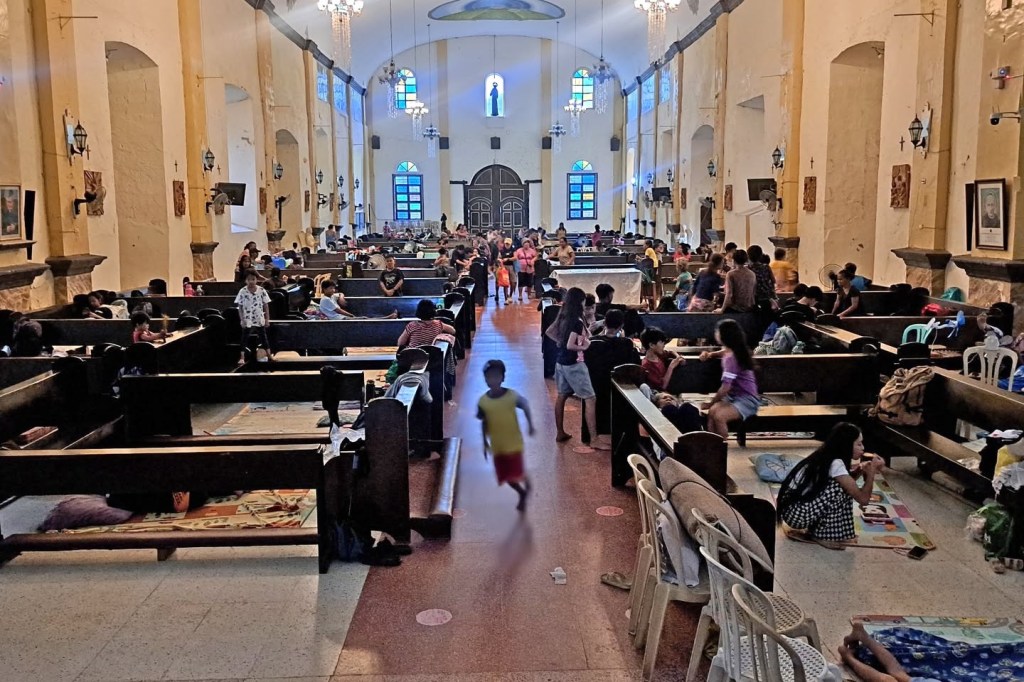
Whenever there is a typhoon, I am filled with dread over the flash floods that halt transportation, displace residents, and endanger lives. There are often scenes on social media of families on rooftops, homes swept away, and soaking children clutching plastic bags of clothes. However, there is another scene flooding feeds that warms my heart and fills me with hope — parishes opening their doors, neighbours sharing food, and strangers helping others with quiet generosity. Grace is truly at work when out of the muddy waters, compassion flows. 

Today, we celebrate the Dedication of the Lateran Basilica in Rome. Before the Vatican was built, this place is where the Pope held office for centuries. This feast reminds us of the centrality of church to our worship of God. Spelled with a small letter “c”, the church refers to the sacred structure where the faithful gather for the sacrifice of the mass. On the other hand, the Church with a capital “C” refers to all of us, the community of believers in Jesus Christ, who gather to worship God. Our readings today speak to us about the temple — both as a sacred building and as the people themselves — to remind us that the true temple of God is not just a monument, but a movement of love. God does not dwell in buildings that glitter; He dwells in hearts that give, in lives that overflow with mercy and compassion. 

In the gospel passage from St. John, we hear of the cleansing of the temple by an angry Jesus who is upset because money changers and vendors have dishonoured the place reserved for the dwelling of God. His anger reveals how sacred the temple has to be — a place where God’s presence dwells and gives life. That same truth is beautifully expressed in the First Reading, where the prophet Ezekiel speaks of a river flowing from the Temple, bringing life wherever it goes. The terrain of the Holy Land is mostly desert area where nothing grows so the image of life-giving water flowing from the temple allowing fruit trees to grow and fish to be abundant and living things to multiply, is proof that God, the Source of life, is present there. This image finds its fullness in Jesus, who reveals that He Himself is the new Temple — the living dwelling place of God among us — who will be torn down and raised up in three (3) days through His death and resurrection. From the Temple of His body, life and mercy flow out for the world when blood and water pour from His pierced side. 

In the Second Reading, St. Paul tells us that as believers, we have also become the temple of God because the spirit of God dwells in us!  If we are His Body, then the living water that is Jesus, must flow through us. The question is: do we allow Christ to flow from us or have we allowed this living water to be stagnant?  These days, there are mega-churches that seem to have taken on the look and feel of concert halls — glamorized by stage lights, state of the art facilities, vibrant applause — rather than places of worship. One cannot help but ask, “Did I come here to watch a concert, or did I come to worship?” They are impressive structures, but when the floods come, people do not run there for shelter. They are beautiful but distant. There are also groups who, though claiming to act in God’s name, become caught up in rallies and causes that, deep down, only serve the interests of those already powerful — the very people who exploit, deceive, and neglect the poor. 

The real Church of Christ — the one founded on compassion, not convenience — is found where the poor are. In chapels that double as evacuation centres… In parishes that smell not of perfume but of “baha (flood) and “lugaw” (hot porridge). In priests, sisters, and lay volunteers who choose to stay with the people when the waters rise. It is not built on marble — it is rather built on mercy.  Pope Leo XIV, in Dilexi Te, writes: “In the poor we see the suffering of the innocent, and therefore the suffering of Christ Himself.” He also says that true faith must bring a change of mentality that affects culture itself.  Ang ibig sabihin, hindi lang ito tungkol sa pamimigay ng tulong. (It means this is not just about giving help or material aid.) It is about reshaping how we see the world — standing with the powerless instead of flattering the powerful.  When we see Christ in the jeepney driver whose route is flooded, in the teacher still showing up despite delayed pay, or in the child sleeping on a pew in an evacuation centre — that is when we become a Church that smells like “tubig ng buhay” (water of life) not perfume. 

So, let us be that kind of Church: humble, open, courageous. A Church that does not stand with the powerful, but with the powerless.  A Church that, when the next storm comes, people can run to — not for a show, but for shelter because the Church of Christ does not stand above the storm — it steps into it. It kneels with the wounded and prays with the soaked. It carries not the scent of luxury, but of life — the smell of water, of mercy, of hope.

From Publiko’s Post

Alive in God’s Heart

Homily: Commemoration of the Faithful Departed

Wisdom 3:1–9 / Romans 6:3–4, 8–9 / John 6:37–40

2 November 2025

Fr. Ricky Cañet Montañez, AA

When someone we love dies, it feels like a part of our heart goes missing — that space reserved exclusively for them. Over the years, it gets easier to manage the longing, but there are days we wake up and remember, and that quiet ache returns. It is a pain words cannot really fix. I have heard some say that such pain is proof of something beautiful: it means we still love.

Today, some if not all may have noticed that instead of the liturgy for the Thirty-First Sunday in Ordinary Time, the Mass Commemorating our Faithful Departed has taken precedence. The change in mass focus reflects the Church’s profound theological emphasis on praying for the dead, as an act of charity and faith in the Communion of Saints.  The emphasis today is more than death itself, but it is really about love — a love that does not stop, even when the person we love is no longer here.

Just the other week, I was talking to a dear friend from a parish where I previously served. She suffered the tragedy of suddenly losing her daughter a few months ago. Every month since their family’s loss, she would post a photo of her daughter online — with a heartfelt message that would end with: “We miss you. We love you always.”  She told me, “Father, people assume it is a way of managing my pain, but for me, it is a way of remembering her with love. I cannot hold her anymore, but I can still love her.”  And that really touched me. Because that is what we do when we pray for our departed — we continue to love. We are not talking to just memories; we are speaking to souls who are alive in God.

The Book of Wisdom says, “The souls of the just are in the hand of GOD,” (Wisdom 3:1)and it offers such a comforting image. Our loved ones — parents, friends, even children who have passed — they are not gone. They are safe. God is holding them close with His gentle hands. Our loved ones are not lost. They have simply gone ahead to be with Jesus.  St. Paul tells us, “If we have died with Christ, we shall also live with Him.” Romans 6:8) That is not just poetry — it is a promise, and someday, by God’s mercy, we will see our departed loved ones again. This is echoed in our gospel when Jesus assures us, “Everyone who comes to me I will not reject… and I shall raise them up on the last day.” (John 6:37) Their names, their faces, their laughter — all are alive in God’s heart.

Our faith teaches us that no one we love is ever forgotten. When we pass from this life, we hope to all be reunited in Christ together with the Communion of the Saints, and until then, it is prayer that bridges the divide. While we who remain offer our prayers for them, those in heaven continue to pray for us and offer spiritual guidance so we can bear the burdens of life. As we try to make good use of our time on earth, we must strive to live and love that we may also be remembered with love. 

Today, as we light candles, visit graves, or whisper their names in prayer, we take time to mourn our dead but more importantly to remember them with gratitude because every tear we shed is a sign that love is still alive. Death may end a life, but it cannot end love.  Love is stronger than death — because love comes from God, and God never dies. Let us pray that when our own journey ends, our hope may be justified. May we see that those we have missed for so long were never really far away — but simply waiting on the other side of love.

Holiness Hidden in Ordinary Lives

Homily: Solemnity of All Saints

Revelation 7:2–4, 9–14 / 1 John 3:1–3 / Matthew 5:1–12

1 November 2025

Fr. Ricky Cañet Montañez, AA

A few years ago, I was at the wake of a quiet woman from our parish. She was not the type to stand in front or hold positions. She sat in the back pew, prayed quietly, and always smiled when you pass by. But during the eulogies, story after story came out — how she quietly paid part of a neighbour’s hospital bill, how she would bring cooked food to an old man who lived alone, how she prayed the rosary every night for those who were sick or struggling.  People said, “We did not know she was doing all that!”  And I thought to myself — ah, maybe that is the point! 

Today we celebrate holiness — not just the great, canonised saints with feast days and statues, but also the ones who walked among us in silence and kindness. In the First Reading, John sees “a great multitude that no one could count” (Revelation 7:9) — people from every nation, standing before God in white robes. These are the saints who went through life’s struggles and remained faithful.  Some of them are recognized by the church for their exceptional virtue or holy martyrdom and we know them by name — Augustine, Francis, Teresa, Faustina, Lorenzo Ruiz, Pedro Calungsod and many others. Many of them though go nameless in history but they are never nameless to God. Their holy lives and good works are always before the eyes of our Lord. 

St. John in the Second Reading, tells us something beautiful: “See what love the Father has bestowed on us, that we may be called children of God.” (1 John 3:1) In other words, sainthood begins not in heaven, after we die, but it starts with accepting that we are God’s children and that we are loved so very much, right here, right now.   This is something that should motivate us to nurture that gift, little by little, every day so that we grow in relationship with God and all those whom He loves. 

In our gospel Jesus gives us signposts for holiness in the Beatitudes: He says, “Blessed are the poor in spirit… the merciful… the peacemakers.” (Matthew 5:1–12)

            •          The poor in spirit — maybe that is the widow who prays every day for others or the doctor who willingly goes on mission to remote areas. 

            •          The merciful — maybe that is the nurse who stays late to comfort a patient or the neighbour who helps when our family is in crisis. 

            •          The peacemakers — maybe these are the parents who choose patience instead of anger… or the child who apologises first after a sibling squabble.

The Beatitudes is not a list of impossible goals for those with special powers. It is a portrait of “the saints next door” painted in the likeness of ordinary people.

The saints are not a distant group of superhuman people. They are the ones who chose love when it is easier to look away, who forgive when it hurts, who remain kind even when no one notices. And maybe we have met them — the grandmother who prays for everyone by name, the catechist who serves year after year without recognition, the tricycle driver who says a quiet “Thank You, Lord” before every trip. They are the ones who need not announce themselves as they work to build Christ’s kingdom. They just love quietly but tangibly. If we could see with God’s eyes, we would realise that the Church is full of these hidden saints — unsung, unnoticed, but radiant in His sight.

Thus today, as we honour all the saints, we are all invited:  Let us not only admire them, let them be our inspiration — proof that our human weakness is not a permanent block to becoming holy. Holiness, after all, is not about doing big things or strictly observing Church rules; it is about doing ordinary things with great love. This is the mark of Christ.  Yes, sisters and brothers, let us do our best, in our own ways, to bring holiness down to earth — to our kitchens, classrooms, offices, and communities, with the hope that one day, we may also join the saints in Heaven.

Maybe, years from now, when a few would remember us, they will tell small stories of kindness, patience, and prayer. And someone might whisper, “We did not know she was doing all that.” “We did not know he was doing that!” And God will smile and say, “Yes, I did!”

No Space, No Grace

Homily: Thirtieth Sunday in Ordinary Time (C)

Sirach 35:12-14, 16-18 / 2 Timothy 4:6-8, 16-18 / Luke 18:9-14

26 October 2025

Fr. Ricky Cañet Montañez, AA

Imagine someone coming up to you to give you a big box containing ten (10) million pesos in cash, legitimately and tax free (‘Di po galing sa ghost project!’)…. but you are holding your phone and a bag in one hand and your favourite snack in the other. Would you drop everything to receive that gift?  Sometimes we hold on to things we have too tightly and are unwilling to let go when we need to.  We fail to receive God’s grace because our hands — and our hearts — are overflowing with ourselves.

In today’s gospel, Jesus tells the story of two men who went up to the temple to pray. The first was a Pharisee, a man known for his religious discipline. He stood tall and prayed, but his prayer sounded more like a report card: “I fast twice a week. I give tithes of all I possess.” (Luke 18:12) Then he added, “I am not like that tax collector over there.” (Luke 18:11) His focus was not really on God but on himself and his righteousness as compared to others. The tax collector, meanwhile, stood at a distance. He did not even dare to raise his eyes to heaven. His prayer was short, almost painfully honest: “O God, be merciful to me, a sinner.” (Luke 18:13) And Jesus tells us that it was this man — the sinner, not the religious man — who went home right with God.

The difference is simple but profound. The tax collector came before God with empty hands. The Pharisee came with hands full — full of pride, full of self-righteousness. The tax collector asked God for mercy, and he received it. Sirach tells us that “the prayer of the lowly pierces the clouds.” (Sirach 35:21) God hears the cry of those who come before Him with nothing but their need. God does not listen because we impress Him with our good deeds, but because we open our hearts to Him. That is the power of empty hands — they leave room for grace. St. Paul understood this. Near the end of his life, he writes to Timothy, “I have fought the good fight, I have finished the race, I have kept the faith.” (2 Timothy 4:7) Those are not words of pride; they are words of surrender. Paul knows he has done his part, but he also knows that the crown of righteousness is pure gift. His hands are empty, but his heart is full of grace.

Sometimes, though, we forget this. Like the Pharisee, we can wear our faith like a badge of merit instead of a blessing. We might think, “I’m better than others because I go to Mass,” or “because I pray the rosary.”  There are other Christian denominations who even think themselves better than Catholics because they read the Bible more, or are more spiritual. But whenever faith becomes a contest of who is holier or who is more right, we lose sight of what is sacred. The moment we start comparing, we stop praying. The moment we start feeling superior, we stop being humble before God. Faith is not about proving ourselves. It is about letting God love us. It is not about showing how full we are or how great we have become, but about admitting how much we still need. God’s mercy flows downward — to those who bow low, to those who come empty.

Lastly, it is important to note that the Pharisee asked for nothing from God, and so he received nothing.  Sometimes, our obsession with our possessions and accomplishments keep us dissociated from our purpose and our mission in life that we fall complacent and are oblivious of what is needed around us.  This shows as disinterest, a lack of passion and even nonchalance.  You may recall someone having asked you what needs to be done and you dryly answer “Whatever!” or “I don’t care!”.  We do not know what to ask for because we are not as involved or do not feel the need to be.  When we are not mindful as workers, as parents, as children, as citizens of a nation we are unaware of what is needed to better our relationships and the impact we can achieve through our struggles.  Remember that even in these matters, God is willing to help because He wants us to involve Him in our lives. 

So today, maybe the Lord is inviting us to pray like the tax collector again — with the honesty that says, “Lord, have mercy on me, a sinner.” That short prayer, whispered with humility, is enough to open heaven. In the same way that we must not be afraid to ask, we must also be equally ready to receive.  When we come before God empty, He fills us. When we come before Him proud, He lets us hold on to our pride — and nothing more. In the end, it is only empty hands that can be filled with grace, and only a humble heart that can go home justified.

Holding the Line of Faith

Homily: Twenty-Ninth Sunday in Ordinary Time (Year C)

Exodus 17:8–13; 2 Timothy 3:14–4:2; Luke 18:1–8

19 October 2025 

Fr. Ricky Cañet Montañez, AA 

These days I have observed that many Filipinos are so tired. Tired of working for little pay. Tired of paying taxes that do not benefit the nation. Tired of injustice. Tired of the lack of accountability among some of our leaders. Tired of corruption that never seems to end. Tired of trying to do good when it feels like those who cheat get ahead. Even in the Church we feel like calling out, “Lord, how long?”  Sadly, some even go as far as getting tired of praying and waiting.  

This is exactly what our readings today are about — holding the line when faith feels heavy.  In the First Reading, Moses stands on the hill while the Israelites are fighting a battle below. As long as he keeps his hands raised, they win. However, when his hands start to drop, the enemy begins to take over. Remember Moses is an old man. It is expected that he will tire easily. Thus, his friends, Aaron and Hur, come beside him. They hold up his hands until the sun sets — until the people of God win the battle.  

This story is not just about Moses. It is also about us because sometimes, we are the ones on that hill — trying to keep our hands raised in faith while the battle rages below. We keep praying for peace in our world, for healing in our families, for justice in our country — but we get tired. Sometimes, it feels like the answer never comes. And naturally, like Moses, we rely on others to hold us up.  Maybe, that is our family, our friends, our prayer group? But lucky for us believers in Christ, we can also rely on other Christians and members of our Church to be our “Aarons and Hurs.”  Faith does not mean we never grow weary. It means that when we do, we let others help us keep believing.  

St. Paul tells Timothy in the Second Reading, “Be persistent, whether it is convenient or inconvenient.” (2 Timothy 4:2) In other words — hold the line. We should not give up when it is uncomfortable, or when our prayers seem unanswered.  Because faith is not tested in the easy times — it is proven when everything feels uncertain.  

In the Gospel, Jesus speaks to His followers about persistence in prayer. He tells us about the relentless widow — a woman with no power, no money, no connections, but refuses to stop asking for justice. She does not give up until the unjust judge finally gives in.  That widow is like every ordinary Filipino who keeps hoping, keeps praying, keeps standing for what is right, even when it seems like nothing changes. Her story is a reminder that faith is not just believing in God — it is believing with God, walking with Him day after day, even when the answers take time.  

To have faith is to acknowledge that we need not win quickly, but rather to remain faithful slowly. Hence, maybe today, Jesus is asking us:  Will we keep believing when things are hard? Will we keep praying when nothing happens yet? Will we keep doing good when others stop? Yes, my friends, when we feel tired — tired of the situation of our country, tired of life, tired of praying — let us remember Moses. Let us remember the persistent widow. Let us remember that we are not alone. Let us welcome others to hold up our hands, and let us be willing to hold up theirs too.  

Faith is not always spectacular. Sometimes it is just quietly saying, “Lord, I am still here.” And when we do that, we are actually holding the line — and God, who is always faithful, will never let us down!

When God’s Ways are Hidden in the Ordinary

Homily: Twenty-Eighth Sunday in Ordinary Time (C)

(2 Kings 5:14–17; 2 Timothy 2:8–13; Luke 17:11–19)

12 October 2025

Fr. Ricky Cañet Montañez, AA 

Have you ever noticed how often God surprises us — and not always in ways we like? How many of us are familiar with Oprah Winfrey? Yes, she trained for a career in journalism. She worked as a TV News co-anchor but she had the tendency to go off script and was too emotional when reporting so she was fired from her job.  She was later offered a different job — this time as co-host of a local low-rating talk show. She quickly transformed the show’s ratings and soon she was hosting her own talk show. The enormous success of the Oprah Winfrey Show allowed her to start her cable channel OWN, cementing her status as a media mogul. Getting fired must have seemed like the end of her TV career but God had better plans for her. Sometimes the hardest part of faith is not believing that God can work miracles, but accepting how He chooses to do them. 

Sometimes we tend to have our own ideas as to how God should operate or conduct His business of being God.  Do we presume to be better and wiser than God? In today’s First Reading, Naaman, the proud army general comes for healing to the prophet Elisha loaded with gifts, servants, and expectations. He is ready for a grand ritual, a dramatic prayer, something worthy of his status. However, what does Elisha tell him? “Go, wash seven times in the Jordan.” (2 Kings 5:10) That’s it. No ceremony, no special blessing. The Jordan was a muddy little river and I bet Naaman almost walked away. God’s grace felt too simple for someone like him. But when he finally humbled himself and obeyed, that is when healing came.  God’s power was hiding in something ordinary. 

The same thing happens in the Gospel.  Ten lepers yearning to be healed beg Jesus for mercy. And what does He say? “Go, show yourselves to the priests.” (Luke 17:14) He does not touch them nor does he pray over them. He just sends them to the priests — still sick, still waiting. In those times, lepers were ostracized and made to live separate from society and only the priests could declare them healed and fit to rejoin the community. Imagine what they must have been thinking as they made their way to the priests still covered with sores. I imagine they might have been grumbling and debating amongst themselves over Jesus’ credibility when one by one, they shockingly discover they were healed! Grace happened on the road when no one else was looking. 

This is the scandal of God’s simplicity.  We expect fireworks, but God works through small, quiet things — a word of forgiveness, a moment of patience, a prayer said with faith. His grace often offends our pride because it does not look “grand” enough.  St. Paul reminds us: “If we die with Him, we shall also live with Him.” (2 Timothy 2:11) And sometimes, what needs to die is our need for control —  our insistence that God must act the way we want.  If you have ever been to a charismatic gathering you would have observed that  the speaker greets the group with a hearty “God is good!” And everyone responds loudly “All the time.” The speaker echoes “All the time…”, and the members declare even louder “God is good.”  Many of them may be feeling lost while bearing heavy burdens in life but they still answer with such conviction. True faith means trusting that God is ever generous and merciful even when grace looks ordinary, even when we do not understand what is going on. 

Sometimes, the greatest miracles do not come with thunder — they begin in the muddy waters of trust. Today, we ask ourselves: Can we recognize God’s mercy when it comes in forms we do not choose? Can we let Him heal us through the simple, the quiet, the humble? When we finally humble ourselves, that is when grace surprises us most!

Ten Lepers Healed by William West

When God Speaks in Silence

Homily: Solemnity of Our Lady of the Rosary of La Naval de Manila (Diocese of Cubao)

Zechariah 2:14–17; Acts 1:12–14; Luke 1:26–38

12 October 2025

Fr. Ricky Cañet Montañez, AA 

The past few weeks have been difficult for our brothers and sisters in Masbate, Cebu and the Davao Provinces. Social media is loaded with videos of these areas being battered by storms and shaken by earthquakes. We see first-hand footage of people fearfully muttering “Lord, Lord” or solemnly repeating, “Jesus, Jesus”!  In the chaos around them, what centres them and gives them courage is a prayer said almost quietly — no yelling, no big gestures but an appeal to a God who listens but communicates in silence. 

Have we ever noticed that God’s greatest miracles rarely begin with noise? They don’t start with thunder or applause. They begin… in silence.  In Nazareth, a young woman was simply going about her day. There was no spotlight, no thundering noise — just the typical quiet sounds of an ordinary home. It was in that silence that an angel spoke and Mary listened. That’s when the impossible began: “The Word became flesh.” (John 1:14) Not with an awesome display of power, but in listening… in stillness. In the same spirit, after Jesus returned to the Father, the disciples did not rush out to the world to preach or to prove themselves. They went back to the Upper Room and they prayed — with Mary.  They had not yet experienced the fire or wind of Pentecost.  There was just silence. In that silence their faith grew and the Church was born. 

Today, we honour Our Lady of the Rosary of La Naval because she was declared patroness of Quezon City in 1973. Even in the story of La Naval, the real victory did not begin with ships or swords. It began when frightened people fell on their knees and prayed the Rosary. The miracle at sea started with hearts on land that trusted in God’s saving power. If we have a chance to visit the image of our Lady enshrined at Sto. Domingo Church, we will notice that she looks so calm. She is not panicked. She is not shouting. She is praying. And in her prayer, she reminds us: silence is not the absence of action but the beginning of transformation. 

When our lives become loud — when fear, anger, and endless noise surround us — God often whispers. That overwhelming feeling brought by the constant hum of anxiety, the sharp sting of anger, the endless chatter of the world — can make  us feel confused and utterly lost and alone. But even in that deafening chaos, when we are sure we have been forgotten by the world, isn’t it a comfort to know God never leaves us? He does not join the clamour; instead, He waits with an infinite, quiet patience, offering a love so deep it can only be conveyed in a gentle whisper. Only the listening heart can hear Him.  

Imagine the relief when we finally pause, take a breath, and realise the very presence we were desperately searching for has been right there all along, waiting for our attention. In that moment of stillness, His gentle voice reminds us of His constant love and grace. Let us not let the noise steal our peace! Let us quiet our soul just enough to hear the voice of God present, calming and ready to meet us. 

Thus, when we find ourselves surrounded by noise — by worries, by pressure, by things beyond our control — let us go to our own Nazareth, our own Upper Room. Let us pray. Let us listen. Let us wait. Because God speaks most clearly to hearts that are calm, trusting, and open to His grace. Yes, in the silence of prayer, something new begins — God’s grace, alive once more in us.

Unprofitable Servants, Unshakable Faith

Homily: Twenty-Seventh Sunday in Ordinary Time (C)

Habakkuk 1:2-3; 2:2-4 / 2 Timothy 1:6-8, 13-14 / Luke 17:5-10 

5 October 2025

Fr. Ricky Cañet Montañez, AA 

Do you find it easy to work with a team? Or do you prefer to work alone?  A friend of mine found himself working with a group of backward thinkers, whose lack of passion matched their outdated skills. He wanted to quit multiple times but he felt God wanted him to stay. So instead, he prayed desperately for divine intervention. Six (6) years later a new leader took over, boosted morale and improved efficiency.  His prayers were answered. Although six (6) years seems a long time, it was still God’s perfect time. 

It is not easy dealing with different personalities. There are hard-workers but there are also slackers. There are big whiners and there are silent workers. There are those who revel in the spotlight and those who choose to work behind the scenes. This is very evident even among church volunteers, isn’t it right?  However, if we focus too much on personalities, nothing will get done. We will just keep  getting annoyed with each other. In the First Reading, we have the prophet Habakkuk complaining in frustration over God’s delayed help. He prays and prays for divine intervention and yet God does not seem to hear or answer. God finally answers and assures him that fulfilment will come and he just needs to wait.  Whenever it comes, it will never be late, because it is in God’s perfect time. 

While waiting, what are we to do? We need to continue on and keep our focus. What is important is that we accomplish the task God has given us. Recently, the Philippines hosted the International Volleyball World Championships (FIVB). If we have watched any of the games we would have observed that when a player gets tired, injured, they immediately pull him out and send in a substitute. No matter how good that player is — even if he is the star — another player enters, the team adjusts, and the tournament moves on. The game does not stop. At first, it feels harsh to think that no one is truly irreplaceable. But this is the reality: the team is bigger than any single player.  This is exactly what today’s Gospel is also about. Jesus reminds, “When you have done all you have been commanded, say, ‘We are unprofitable servants; we have done what we were obliged to do.’” (Luke 17:10) 

Some of us might even comment, that sounds pretty discouraging.  Doesn’t God value our work?  Of course He does! Jesus is not telling us  we are useless, but He is clarifying that the mission of God’s Kingdom is not dependent on our achievements. The Church, the Gospel, the faith — they do not rise or fall because of one person’s success or failure. Even St. Paul, as zealous as he was, told Timothy to guard the treasure of faith and pass it on, because the mission must continue beyond him. 

Here is the best part: even if the Kingdom does not rely on us, God still chooses to involve us. Just like a coach who can always find another player but still puts one on the court, God delights in giving us a chance to play our part. He trusts us with His mission, not because He needs us, but because He loves us and wants us to share in His work.  This is the reason Jesus warns against pride or self-adulation in ministry. The moment we start thinking, “The Church cannot go on without me,” we have missed the point. Our value is not measured by how irreplaceable we are. Our value lies in being chosen, loved, and sent.  

As workers in God’s vineyard it should be our delight to serve at the pleasure of our God! Perhaps this is the real challenge: to serve faithfully without counting the cost, to do our duties without expecting applause, to give our best for the Kingdom knowing that, yes, the game will go on even without us — but how wonderful that right now, God still sends us onto the court, still places the ball in our hands.  No matter how unskilled we are or how poorly we play, He still lets us play. 

At the end of the day, saying “We are unprofitable servants” is not self-pity. It is humility. It is recognising that we do not serve to become heroes or stars, but rather we serve because God, in His mercy, allows us to be part of His winning team.

Who is the Lazarus at Your Gate?

Homily: Twenty-Sixth Sunday in Ordinary Time (C)

Amos 6:1a,4-7; Psalm 146; 1 Timothy 6:11-16; and Luke 16:19-31 

28 September 2025

Fr. Ricky Cañet Montañez, AA

Is it a sin to be rich? Raise your hand if your answer is “no”! As for those of you who did not raise their hand, do I assume your answer is “yes”?  If you won one hundred (100) million in the lotto, would you give it away? Let us be real. Nobody prays for poverty, right?  We even  consider rags to riches stories inspiring.  We work to be successful and prosperous. We all strive to improve our lives because to be rich is not a bad thing. 

The rich man in today’s Gospel is not described as cruel.  He is not a deplorable human, despised by the people around him. In fact, the story suggests that Lazarus gladly fed off the scraps from the rich man’s table. He did not insult Lazarus. He did not throw him away. Actually, he knew him by name, recognising him immediately in the after-life and asking for him by name. “Father Abraham, have pity on me. Send Lazarus to dip the tip of his finger in water and cool my tongue…”  (Luke 16:24) Why then does the rich man end up in a place of torment while Lazarus revels in comfort? The answer lies in the rich man’s indifference. Day after day, he dressed in the finest clothes and dined sumptuously while Lazarus, covered in sores, remained at his door, waiting for scraps. Only a man with a heart so full of himself could be so blind to the plight of others. 

That is the danger of being comfortable and complacent. Comfort itself is not bad. However, when it makes us forget others, when it dulls our compassion, it becomes deadly for the soul.  We hear a stern warning in our First Reading from the prophet Amos: “Woe to the complacent in Zion! Lying upon beds of ivory, stretched comfortably on their couches, they eat lambs taken from the flock, and calves from the stall…they will be the first to go into exile and their wanton revelry shall be done away with.” (Amos 6:4-7) They entertained themselves, drank wine, and pampered themselves with fine oils but were unmoved by the injustice and moral decay of Israel. 

Sometimes, we spend too much time enjoying the fruits of our labour that we forget we are mere stewards of the blessings God has blessed us with. We think, we are not sinning when we buy forty (40) luxury vehicles or eighty (80) million peso chandeliers because we are not hurting anyone.  The question is, are these wants or needs? If we have the capacity to help other people survive, why are we not helping? More often than not, we do not have to look far to find Lazarus. He is the child knocking on car windows at a stoplight, selling Sampaguita or wiping windshields. She is the grandmother waiting long hours in a health centre with no money for medicine. He is the farmer working the fields, yet still unable to afford rice for his own family. She is the overseas worker who sacrifices comfort, dignity, even family presence, just so her children in the Philippines can go to school and eat three (3) times a day. 

Psalm 146 says: “The Lord secures justice for the oppressed, gives food to the hungry.” (Psalm 146:7) God never forgets the poor — even when society does. He does not come down from heaven to hand a plate of food to the starving. That is not how He works. He blesses people with resources so they can do the work required to uplift the lives of the needy.  Each one of us helps according to one’s own capacity. No matter what our status in life is, we have the capacity to give and to help. The question is: do we?  If God has given us a good home, a good job, and a good family, do we close ourselves off to the suffering around us? If our home is not affected by floods during rainy season, do we sit comfortably in our air-conditioned home and remain mum when those affected have taken to the streets to clamour for justice? Do we choose to be unmoved? 

Who is the Lazarus at our gate? Maybe it is not a beggar on the street, but a parish volunteer who quietly needs support; a young person in our family longing for time and attention; a co-worker struggling with debt but too embarrassed to say. The Gospel today warns us: if we let our comfort blind us, we are digging a chasm between ourselves and others — and perhaps, between ourselves and God. Nevertheless, if we open our eyes now, if we choose compassion today, then we are already building bridges toward eternity. 

Finally, if God has allowed us to prosper and  be wealthy, let us be grateful. We are blessed! On the other hand,, if we keep ignoring the Lazarus at our gate, then one day we may find ourselves on the wrong side of the great divide.

Lazarus and the Rich Man by Nigel Lawrence

When God Calls Us to Account

Homily: Twenty-Fifth Sunday in Ordinary Time (C)

Amos 8:4-7 / 1 Timothy 2:1-8 / Luke 16:1-13

21 September 2025

Fr. Ricky Cañet Montañez, AA 

Are you upset by the news of corruption in the government? You should be! A government post is a public trust. Whatever resources are given to government officials and authorities do not belong to them. They are mere stewards entrusted with a responsibility to see to it that the needs of the people are met. Any misuse of public funds and abuse of their power is atrocius and they must be held responsible. 

This is exactly what Jesus is talking about in today’s Gospel — the story of the steward who squandered his master’s property. He was not faithful, but when he realised he was about to lose everything, he became clever. Jesus is not praising his dishonesty. He is praising the fact that the man thought ahead, that he realised he had to act decisively. It, by no means, exonerates him, in fact, Jesus makes a strong point: “You cannot serve both God and money.” (Luke 16:13) 

We do not need to look far to see how this plays out. Lately, corruption scandals and ostentatious lifestyles involving obscene amounts of money have been brought to light in various countries. In the Philippines alone, money intended to solve the problem of flooding, the improvement of education and healthcare and seeing to the plight of the poor, has been ending up in private pockets, funding excessive lifestyles at the expense of the nation. Often we feel helpless and silently shake our fists, wondering if justice shall be served. The prophet Amos, in the First Reading (Amos 8:4-7), gives us hope as he assures us that God sees this — every injustice, every abuse of power. He will not forget their misdeeds. They will get what is coming to them, if not in this life, then in the next. 

But before we point fingers too quickly, we also need to look at ourselves. How do we use what God has entrusted to us? Our time, our relationships, our talents, our resources — do we spend them wisely, or do we waste them on things that do not last?  We all have to deal with things that are not ours — a company car, people we manage, or even businesses we oversee. For parents, do you realise that your children are entrusted into your care by God? You will answer for them when the time comes.  In all things, do we take our duty as stewards seriously? Or do we take the opportunity for granted and lay it to waste, misuse it, or worse — be so presumptuous as to believe we own anything? 

I am very much inspired by the young Carlo Acutis who was recently canonised. He died at only 15 but at such a young age, he possessed a wisdom beyond his years. He said: “I die serene because I have not wasted even a minute of my life in things God does not like.”  This is actually the heart of today’s Gospel. Life is short, time is precious, and everything we have is only borrowed from God. We are stewards, not owners. The question is: when God calls us to give an account, can we say, like Carlo, that we did not waste our life? 

Finally, let us recognise what has been entrusted to us — our time, our talents, our very lives — and not squander them on things that fade away. Maybe, the challenge for us is simple but powerful. We must use our time well. We must use our money responsibly. We must use our influence for good.  Above all, let us use everything we have in the service of God and others, not for our own personal gain. In the end, we discover that only God is worth serving.