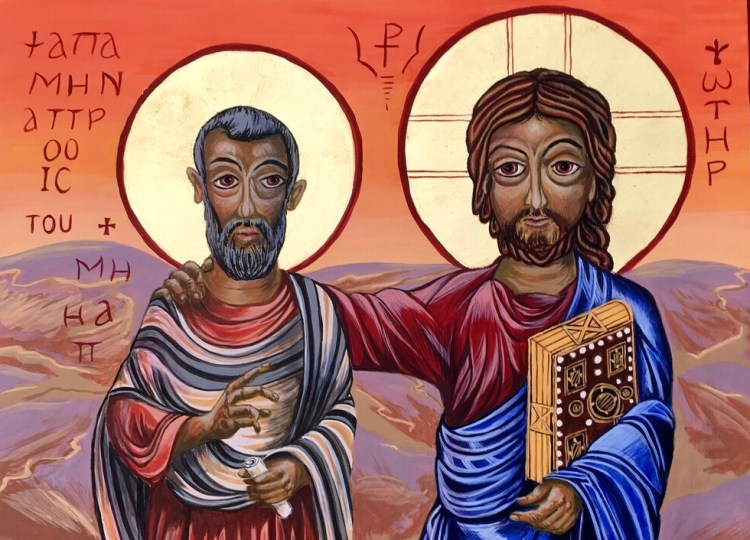
OPEN for HIS transforming grace

HOMILY: Third Sunday of Lent (A)

John 4:5-15

12 March 2023 

Fr. Ricky Cañet Montañez, AA

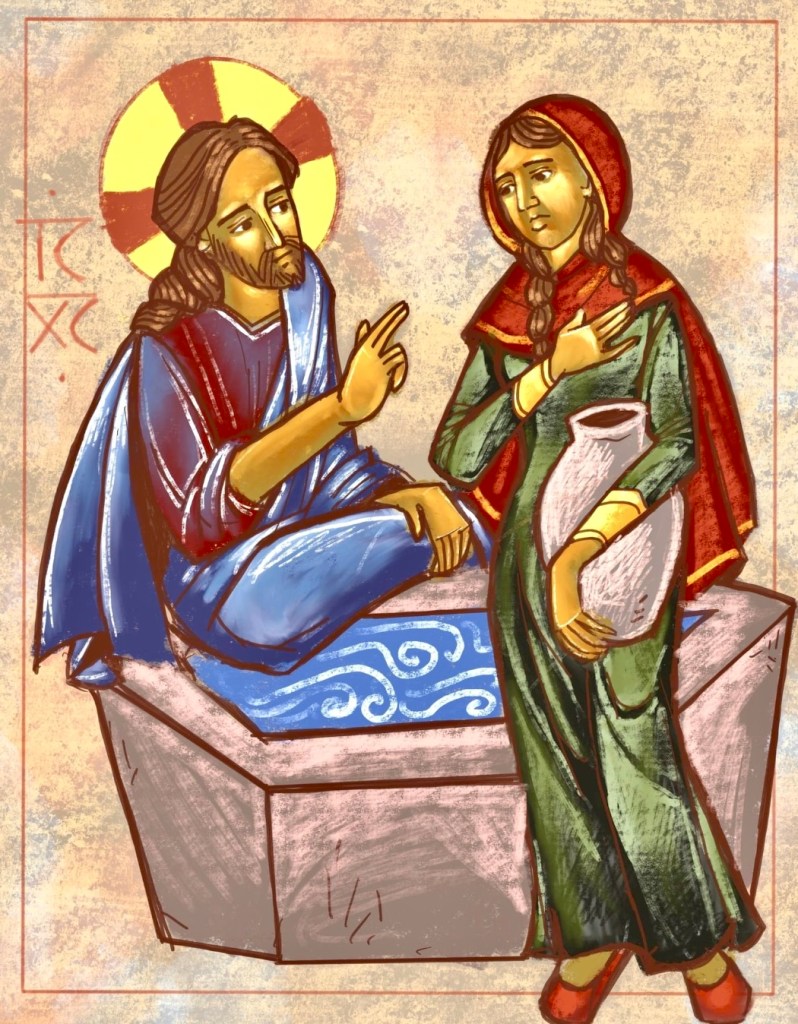
Have you ever made an effort to avoid certain people because you feel judged? That’s exactly what the woman in the gospel does! She went to the well at noon, instead of the usual early morning, probably to avoid the “gossipmongers” (“marites”). It is not surprising that her affairs interest others foremostly because, she is a Samaritan and their kind is not accepted by the Jews. Second, her love life is quite an issue as she has been with a number of men. 

In her conversation with Jesus, we can observe that she has no awareness nor shame over her practice of immorality. Indeed, when we have become so used to a sinful pattern of living, we can become blind to what we need to correct. We continue to sin because we are numb to our sin. At times, we can be as stubborn and stiff-necked as the people in the wilderness whom Moses had a really hard time dealing with. They were saved from slavery in Egypt; Yet, they still had the proclivity to get angry, to demand and grumble the moment they experience thirst. Despite, their ill behaviour, God provides water for them. As Moses strikes his staff on the rock, water flows out fit for them to drink. Like the Israelites in the wilderness, we can also be way too stubborn for our own good. Yes, we are invited to listen to people who truly care for us so that we can get out of certain patterns of behaviour that deter us from truly becoming the persons God intended us to be. 

Only the sincere concern of Jesus enlightened the Samaritan woman. He recognises that she has been filling the void in her life with unhealthy relationships. Jesus offers her living water. He says that whoever drinks it will never go thirsty and it will become a spring within them welling up to eternal life. Despite her sins, Jesus offered her a lifelong solution to her thirst. Her decision to acknowledge her shortcomings and eventually open her heart to Jesus brings her a new lease on life. 

The gospel challenges us to think about where we have gone astray. We must find courage to let go of our sinful patterns of behaviour and to choose to be found in the Lord. Let us remember that Christ’s coming into the world made no sense to those who had no need for Him (those who thought they were already righteous). Jesus came for those who knew they had sinned and were aware that they needed to be saved from their own transgressions. The Samaritan woman’s encounter with Jesus brought about healing and transformation.  

Consequently, the Samaritan woman’s conversion moved her to be a herald of the Good News to her community. She returned to their place and told the story of her encounter with Jesus as the Messiah. They invited Jesus to the town and He stayed there for two days! Her testimony brought the people to a deeper faith in Jesus. The people professed their new-found faith in Him saying, “We no longer believe because of your word; for we have heard for ourselves, and we know that this is truly the saviour of the world.” (John 4:42) Like her, our relationship with the Lord must lead us to a more zealous proclamation and living out of the Good News. 

Brothers and sisters, we are sinners, but Jesus loves us so much despite our unworthiness. This is what St. Paul speaks about in the Second Reading. “God proves his love to us…that while we were still sinners Christ died for us.” (Romans 5:8) Let us open ourselves to God’s transforming grace so that our lives may be a visible testament of the Good News for others.

Artwork by Blair C. Nuyda, AA

Leaving our comforts; Heeding HIS Word

HOMILY: Second Sunday of Lent (A)

Matthew 17:1-9

5 March 2023

Fr. Ricky Cañet Montañez, AA

We are persons of habit. When we like something or have a habit of doing something, we will choose it or do it over and over again. We eat the same food, watch the same TV shows, go to the same barber for haircut, etc. When we are comfortable and are set in our ways, we are not too keen on making changes even if it is for our own good. A smoker for thirty years will not find it easy to quit the habit. Those who are used to taking coffee first thing in the morning are cranky if they must go without their usual cup. We resist and refuse to succumb to what is unfamiliar, uncomfortable and possibly difficult.  We do not want to be inconvenienced.  

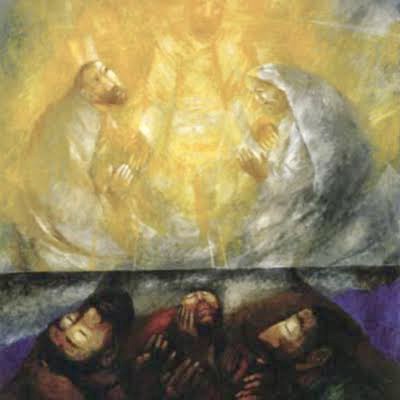
In the gospel reading for this Second Sunday of Lent, we hear of the Transfiguration. Peter, James and John caught sight of the true glory of Jesus. Peter’s reaction was a bit strange. He was in awe of Christ. This is the image of the saviour he has been looking and waiting for, not the ordinary person they meet every day who is oppressed and despised by the authorities. “Lord, it is good that we are here. If you wish, I will make three tents here…” (Matthew 17:4) While Peter is eager to stay and get settled, the implied message of Jesus’ transfiguration is actually a challenge to those who follow Him. If we are to partake in Jesus’ glory, we cannot simply stay where it is safe.  We cannot stay where we are always winners, where we are always at peace  and where we are always the hero, especially if those around us are suffering and falling into error and evil.

In the passage from the Book of Genesis, we are told of how God’s call demanded a radical change from Abraham. He left the security of his home to travel to another which was completely foreign to him. He had to leave behind what he knew and loved and journeyed into an unknown future. Because Abraham listened to God and believed in His promises, he was greatly blessed throughout the days of his life.     

Similarly, we cannot simply sit back, stay put and be content with the status quo. The one who truly listens to Jesus’ words… the one who takes heed of Jesus’ teachings cannot just stay and remain the same. We who have been blessed to come to know Jesus and have a personal relationship with him are akin to those who have ascended the mountain and encountered God.  But we should not simply stop there. We must come down the mountain to share with others what was learned from Jesus! We have to live out the demands of that Holy Voice that directs and leads us where to go and what to do. This is how we can witness to others the truth that Jesus lives and that He is the only true path to eternal life. 

The Transfiguration of Jesus is meant to encourage us to have hope and to look forward to our own transformation. We all have hope to change for the better even those whom we think are beyond redemption. It will not be easy. We may even have to pay dearly and sacrifice much as followers of Christ. There will be many challenges but we need to be strong.  In the Second Reading, St. Paul encourages Timothy, “Bear your share of the hardship for the gospel.” (2 Timothy 1:8) He also gives assurance that God will provide him the strength that is needed to carry out what God wills — not only for Timothy but for us all.  Again, it will not be easy but the outcome will be our spiritual growth and maturity. As disciples of Christ, let us trust in Him and persevere. Let us keep the hope alive that one day, we may share in the glory of Jesus in Heaven.

With HIM at Our Side

HOMILY: First Sunday of Lent (A)

Matthew 4:1-11

26 February 2023

Fr. Ricky Cañet Montañez, AA 

“I’m only human.” This a phrase that we may have heard of and even used at some point in our life. We use it to justify our weaknesses that cause us to fall prey to temptations. However, it is our humanity that should constantly remind us of where we stand before the Lord — how we draw our strength from Him and find refuge in our Creator.

On the First Sunday of Lent we usually hear one of the Synoptic Gospel accounts of the Temptation of Jesus. This year, we hear St. Matthew’s version.

Many Bible scholars have noted that if we look closely at the three (3) temptations of Jesus in the wilderness, they could actually be classified into just one temptation. What  then is this temptation of Jesus? If we take into consideration the First Reading, the temptation to which Adam and Eve succumbed is set within the context of their being creatures. The devil enticed them to abandon their dependence on God by making them believe that they themselves would become “like gods”. In their desire to be equal with their Creator, they denied their reliance on Him as His creations. They, too, wanted the knowledge of good from evil and be independent of God. 

Contrast this with Jesus’ responses to the devil. “One does not live on bread alone…” (Matthew 4:4; Deuteronomy 8:3) “You shall not put your God to the test…” (Matthew 4:7; Deuteronomy 6:16) “The Lord, your God, shall you alone worship and Him alone shall you serve.” (Matthew 4:10; Deuteronomy 6:13) Each of these answers illustrates how the created being should relate with God, how a creature is necessarily dependent on the Creator alone. Hence, Jesus’ temptation in the form of food, prestige and power were the devil’s ways to make Him forget His reliance on the Father. Jesus was able to resist the devil’s temptation for satisfaction, power and wealth because He was humble. Although He Himself was God, He always deferred to the will of His Father. According to St. Paul in the 2nd Reading, redemption and new life entered the world through the obedience of Jesus whereas sin and death entered the world through the disobedience of Adam.

In fact, these three tests would recur throughout Jesus’ life. In every instant He would overcome it by choosing to serve God alone. According to a commentary I read on this gospel narrative, here are a few of those trying moments in Jesus’ life:

First, we recall that in two occasions, He multiplied bread for the multitude. He did so not for Himself but rather to feed the hungry crowd. (Matthew 14:13-21) Second, He rejected calls from His opponents to prove Himself by performing some wondrous signs. He insisted that the only sign that would be given them was that of His own death and resurrection. (Matthew 16:4) Third, after one of the feeding of the multitude accounts in John’s gospel, the crowd  wanted to make Him king. Instead, he fled, sought the Father’s guidance in prayer and moved on to other villages where He could also minister to others in need. (John 6:1-14)

Jesus would pass all three tests and would continue to do so during His life right up to the moment of His death. “In the Garden of Gethsemane, Jesus would ask to be spared the horrors of His Passion, but He would eventually put aside His own fears of suffering and death and voluntarily submit to the Father’s will. (Matthew 26:42) On the cross Jesus would make the despairing cry: “My God, my God, why have you forsaken me?”, and soon after, in total surrender He would say as He breathes His last: “Into your hands I commend my spirit.””

We all struggle with the temptation to abandon our loyalty to God for seemingly more attractive and easier paths of life that give us false security.  The temptations of Jesus also come into our lives in varying forms. We are all tempted to desire comfort. This is not the ordinary comfort that God wants us to have through hard work and perseverance, but rather the kind that we achieve through selfishness and indulgence. We are all tempted to desire success, to be somebody. Sometimes, we pursue this no matter the cost. We are all tempted to desire power: to run things, to run people, to be in charge to the point that we neglect the humanity and needs of people involved. Sometimes, we do not make room for God to work in our lives anymore. God’s will becomes secondary to our will. These are basic human desires, desires that we are inclined to want for ourselves no matter what it takes. These are inclinations that we need to be aware of, inclinations that we need to confront.  For us, too, the battle against evil never stops. It is a constant struggle as we try to be faithful followers of Jesus. 

Let our Lenten observance be a grace-filled moment where we can stand utterly naked before God, acknowledging our total dependence on Him who created us. Let us resist the temptation to believe that we can do things on our own without God’s help. Let us always call on God in moments of temptation. With Him at our side, we shall conquer bravely every temptation that comes our way.

GOD’s Way: Going the Extra Mile

HOMILY: Seventh Sunday in Ordinary Time 

Matthew 5:38-48

19 February 2023 

Fr. Ricky Cañet Montañez, AA

Not everyone is easy to love. There are people who disagree with us, people who disrespect us, who hurt us! We perceive these people to be selfish, self-centred, and downright cruel. The funny thing is, we may have just as well described ourselves! Is it not? The negative traits I mentioned are found in all people. I am sure we have acted out of selfishness at some point and our actions may have hurt others either deliberately or indirectly. You may say: “Uy, Father, di naman lagi.” (“Hey, Father, not always.”) Perhaps we are just better at controlling ourselves than others. Does that make us undeserving of love? 

Jesus’ words in today’s gospel passage are probably among the most challenging of His teachings. He says “offer no resistance to one who is evil. When someone strikes you on your right cheek, turn the other one as well. If anyone wants to go to law with you over your tunic, hand over your cloak as well. Should anyone press you into service for one mile, go for two miles. Give to the one who asks of you, and do not turn your back on one who wants to borrow.  Love your enemies and pray for those who persecute you…” (Matthew 5:39-44) Jesus’ command is strange, isn’t it? For real? They say we should not fight against those who do us harm or those who are oppressing us or taking advantage of us. It is very difficult, isn’t it? Maybe, we want to say: “Are you kidding me Lord?” We would rather fight, take revenge or “abuse” others instead. I am sure WE have heard the saying that there are two types of people: the sheep and the wolves. There are the cheaters and those who allow themselves to be cheated. (May manloloko at may naloloko.) Why would we choose to play the victim? Why should we choose to be stupid? 

The answer is also in our reading.  In the Second Reading, we hear: “The wisdom of this world is foolishness in the eyes of God.”  (1 Corinthians 3:19) The world teaches us that we protect ourselves and our interests. But God’s knowledge is wider. His knowledge and wisdom encompass all, including, past, present and future. He knows everything we have been through that has influenced who we are, what we are going through that affects how we interact with each other today, and our destiny — there may be hope that we will improve in the future and become instruments of goodness in our community. For this reason, God does not judge us for our isolated mistakes. He knows that we have the capacity for both good and evil and He gives us the chance to make amends while we are alive. God considers all of us as His children and “He makes His sun rise on the bad and the good, and causes rain to fall on the just and the unjust.” (Matthew 5:45)

God’s only Son, Jesus was no different. One of His Seven Last Words while He was hanging on the cross tells us that he prayed for His persecutors! He said “Father, forgive them, they know not what they do” (Luke 23:34).  In this prayer, Jesus is telling us that we should pray for that which our enemies lack: an awareness and recognition of their fault. Sometimes, when we are struggling or we are the ones who are hurt, we don’t think about the effect of our actions and words on others. What is important to us is to overcome our suffering or our pain. We become unaware of how we are affecting others. That is why when people realise their mistake they say: “I am sorry. No offence intended.” But even if they don’t apologise and say they know what they are doing, as followers of Christ, we should choose to understand them and just pray for them. We have to pray then that their hearts and minds will be opened and that they will realise their faults, their misgivings, their shortcomings, be sorry for them and make serious amends. More often than not, they too have been hurt in the past and we need to pray for their inner healing, for the restoration of peace and their inner security.  

Furthermore, in teaching the disciples to go the extra mile, to turn the other cheek and outdo themselves in generosity, Jesus is not suggesting that they allow themselves to be abused. Instead, He wants them to right the wrong done by overcoming evil with good, not with revenge. The way of Christ is not to beat sense into people but rather to melt the hardest of hearts with kindness and mercy.  “In doing this, you will heap burning coals on his head, and the Lord will reward you.” (Proverbs 25:22) By believing in the basic goodness of all human beings, we can tear down the aggression of the oppressor with acts of goodness. Even if we do not see it right away, let us trust that goodness will always prevail because our God who is good is the most powerful of all, and He will conquer evil in due time.

Loving as God loves is not easy. In fact, it may prove too much for us human beings who are bent on resentment, revenge, and minimal giving. On our own, this may prove to be impossible. St. Paul, in his First Letter to the Corinthians gives us some encouragement saying we “possess the power of the Spirit of God that enables [us] to overcome [our] prejudices and go beyond [our] antagonisms.” (1 Corinthians 3:16) We need the grace of God so that we can even attempt to love our enemies.
 
Today we ask for the grace to pray for our persecutors and to pray for the gift of insight — to see into what blinds those who harm and hurt us, so that we may understand them and be patient with them. We also pray that they may overcome their weakness and avoid becoming instruments of pain, of anger, of division. In this manner, may we grow as Christians who love as generously as God loves.

God’s Law: Grounded on Love

HOMILY: Sixth Sunday in Ordinary Time

Matthew 5:17-37

12 February 2023 

Fr. Ricky Cañet Montañez, AA

“Be the change you wish to see in the world.” That is according to Mahatma Gandhi. “The way to change other’s minds is through affection and not anger.” That is according to the Dalai Lama. Both of these men are considered among the wisest men who have ever lived. But there is One whose wisdom is far greater than these two. What is the answer? GOD! The wisdom of God is so vast and great. No creature can ever match the wisdom of God. 

St. Paul tells us that God’s wisdom is not the same as man’s wisdom. It is rather mysterious. It cannot be discerned by us unless God does not reveal it to us. He uses the words “what eye has not seen, ear has not heard, or entered the human heart..” (1 Corinthians 2:9) to emphasize that we are not privy to the details and the entirety of the grand plan that God has predestined for us. Why is Teresa married while Marisol is still single until now? Why did I become a priest while my companions in the seminary did not continue on? Why did you study in UP instead of Ateneo? Why were you born with a disability? Why are your parents poor instead of being rich? We don’t know what God plans for each of us. Nevertheless, we are assured that in God’s infinite wisdom, His plan is for the good of all who love Him. 

Sirach tells us two very important things. First, he reminds us that God’s wisdom is immense — “mighty in power and all-seeing”! (Sirach 15:18) God sees our hearts and knows all our actions. Nothing escapes the eyes of God even our most hidden and secret sins. Second, he reminds us that we are free to choose to trust in God’s wisdom or reject it. The choice is ours — fire or water, death or life, good or evil. (Sirach 15:17) God will never be on the side of evil. So, if we choose to sin and act unjustly, we are essentially saying we do not trust in the wisdom of God’s ways. It’s like telling God that we know better. But as said earlier, we are mere creatures who will never be able to match God’s wisdom.

In our gospel today, Jesus makes clear that He did not come to abolish the law but rather to fulfill it. Why does He not abolish the law? Because there is nothing wrong with the law that the Jews follow. Where do their laws come from in the first place? Is it not contained in God’s Ten Commandments? It was God, Himself, who spoke to Moses and relayed the Ten Commandments! We can be assured that those rules were borne of God’s wisdom, for the good of those who believe in Him. Now out of those 10 rules, the Jewish Law was expanded to 613!!! There are so many! All aspects of their life are covered in detail — food, clothing, rituals, purification, worship and so on. Where is the problem? It was the interpretation and strict adherence to the law mandated by their leaders that caused people to forget the spirit of the law. Recall that Jesus summarized the Ten Commandments into two (2) — Love of God and Love of neighbour! That is the spirit of the law! 

Jesus respected the law, naturally, because its origin was God the Father. He even says “not the smallest letter or the smallest part of a letter will pass from the law until heaven and earth have passed away and all things have taken place” in accordance to God’s plan. (Matthew 5:18) But why does Jesus seem to expand the interpretation of the laws? It is because Jesus goes one step further and asks us to guard our thoughts and feelings as they translate into actions. He says anger is already tantamount to killing because when someone takes the life of another in anger, it is because he/she has already killed all love and compassion for that person in his/her heart. When a man looks lustfully at a woman who is not his wife, his heart becomes restless with desire for that woman. That’s when he starts thinking that… “Sana dalawa ang puso ko”. (How I wish I have two hearts!) That is already a betrayal of his marriage vow to love his wife wholeheartedly.  Essentially, the law is good because it was based on God’s word. Jesus fulfills the law because He is the WORD made flesh! 

Everywhere Jesus went He demonstrated to all, by His words and actions, the spirit of the law — how people should love God and how they were to love one another. When He goes to the extreme of saying, “If your hand causes you to sin, cut it off or if your eye causes you to sin, tear it out and throw it away.” (Matthew 5:29) Jesus is cautioning humanity to be aware of what causes them to sin repeatedly.  Jesus seems to be saying that it is very important that we use our freedom to choose obedience to the laws that God has ordained. If we sin and reject God, we lose heaven forever. So, at all costs, do whatever is necessary to live a life pleasing to God — a life of love.

In the readings of the past weeks, we hear of the Pharisees criticising Jesus for feeding His hungry disciples or healing the sick on the Sabbath. Jesus always stands up to them in an attempt to help them see that in their desire to strictly obey the law, they failed to uphold the spirit of mercy and compassion which the law is grounded on. Love. Pag-ibig. That is the be-all and end-all of God’s laws. Hence, the question we have to ask ourselves in everything we do should always be: “Is this a loving thing to do?” For Jesus there is no doubt or confusion about this. Nor should we doubt it.

Brothers and sisters, let us try to live according to God’s will and instructions. Remember that our choices in life reveal our level of confidence in God. As Christians, we must fully trust God and His plan for us, even if we don’t fully understand it. Today, we ask Jesus — the Word of Life, God’s Word made flesh — to help us live our lives as He did — filled with love, compassion and mercy. AMEN.

Entrusted with a Mission

HOMILY: Fifth Sunday in Ordinary Time

Matthew 5:13-16

5 February 2023

Fr. Ricky Cañet Montañez, AA

Does someone believe in you? Is it important that others have confidence in your abilities? Sometimes others see our potential and help us discover it. The world-renowned author Stephen King, who published over 65 novels, most of which were turned into movies, may not have succeeded if his wife did not have faith in him! The first one he wrote was rejected 30 times so he threw it away. But his wife had strong confidence in his ability so he persuaded him to persevere. He was able to publish “Carrie” that has sold more than four million copies! It was turned into four movies and a broadway musical. When Stephen King was struggling, he never imagined the impact his novel would make in the world.

Why are we talking about this? It is because our gospel is proof that God also has full confidence in us. Jesus believes that we have the potential to make a huge difference in the world His Father created. The gospel tells us that we are to be like salt and light. No one said, “this only applies to those who are good, or to the intelligent, or to the religious.” What is being referred to here speaks of all of us who recognise and accept Christ. We all have the potential to affect the world in a positive manner. 

In today’s gospel, Jesus uses two metaphors to characterise the essence of discipleship: salt and light. Both metaphors help us understand that our faith finds deepest expression in relation to others. As Pope Francis once said: “Both salt and light are for others, not for oneself: salt does not give flavour to itself; light does not illuminate itself”. Can we eat salt by itself? Salt is bitter when eaten on its own and becomes useful only when used as a flavour enhancer or meat preservative. In the same way our faith is bland when it is not lived out in relation to others! Just as light is not placed under a bushel basket but rather on a pedestal, our faith can only become significant when it serves as light to the darkness of other people’s lives. Just as the light of a city on a high hill becomes the traveler’s guide in a dark night. Our Christian discipleship then is meant to lead us out of ourselves to serve others and continue the saving work of Jesus. The metaphors of salt and light help us understand that our faith finds deepest expression in relation to others. We are salt meant to enhance others; we are light meant to shine for others!

How can we be salt and light? This is answered in our second reading. St. Paul says that “our message and proclamation are not with persuasive words of wisdom, but with a demonstration of Spirit and power…”  It is not through persuasive speech and wisdom that we can reveal the good news but through our actions driven by the Holy Spirit and power from God on high. To become salt and light for the world does not require us to be such great public speakers like Nelson Mandela or John F. Kennedy. The most effective proclamation of the Gospel is the witness of our lives. As Ralph Waldo Emerson was attributed to have said: “Your actions speak so loudly, I cannot hear what you are saying.” 

In the first reading, we heard some concrete examples of good works by which we can make our light shine for others. Good works such as sharing bread/ food with the hungry, sheltering the homeless and oppressed, and clothing the naked, allow us to become the light shining forth God’s presence and salvation to the world. Let us not turn our backs on our neighbours and let us remove oppression from our midst, false accusations and gossiping from our lives. If we do this, God’s glory will always be behind us, protecting and supporting us and whenever we call on God for help, He will answer us. 

What does it mean to be salt and light these days? Being salt for the earth and light for the world can be as simple as teaching our children the Christian way of life by word, and especially by example. How can we teach our children to be respectful if we ourselves are disrespectful when talking to elders, those in authority or people we consider below our status in life? How can we encourage our children to pray and go to church if we ourselves forget and would rather spend time on other things? We need to practice honesty and responsibility in fulfilling our tasks! We have to show moderation by not being wasteful. If we go to a buffet restaurant, let us not take more than we can eat and let us not wrap up the food right away before everyone has eaten! (Kung pupunta sa buffet o sa mga kainan, huwag kukuha ng susobra sa iyong makakain at huwag magbabalot agad ng handa habang di pa lahat nakakakain!) These are only some of the ways we can prove to be true disciples of Christ!

As we conclude, I just want to reiterate that the work and responsibility of being salt and light has been given to all of us. We all have the potential to be good examples to our neighbours, especially to the youth. Aren’t we amazed at how much trust Jesus has in each one if us? Let us not think that we cannot do this or that this work is only for the religious, priests or nuns or for the hardworking, intelligent and talented. The moment we were baptised we signified it that we wish to belong to Him and in turn we are entrusted with a mission to be a light shining in the world and salt that seasons the world with the flavour of the gospel. Yes, we are not perfect and we always stumble and make mistakes but we never lose our potential to do good. Christ has more trust in us than we may have in ourselves. Never lose hope.  Let us trust in His power to transform us. Trust in His power to lead us and to accomplish great things for His glory.

The Kingdom: Already Here But Not Fully Yet

HOMILY: Fourth Sunday in Ordinary Time

Matthew 5:1-12

29 January 2023

Fr. Ricky Cañet Montañez, AA

Do you know persons who do not drink water? They will only eat if they have a very cold soda at hand? However, when they are already very thirsty, they can also consume a ton of cold water. Water, mind you is what truly refreshes the body and quenches a thirst. Everything else is filled with either sugar, flavouring or additives that make you even thirstier. How easily we are distracted from the things that are best for us. We only recognise them when we are in dire straits or left with no options. 

In the Sermon on the Mount, Jesus gives five long discourses that envision a life He proposes to all His followers. Matthew presents Jesus as the new Moses leading the chosen ones out of what enslaves them into redemption. These five long discourses are seen to match the Pentateuch (the first five books of the Bible) that embody the Jewish Law. Just as the Pentateuch encapsulates the Jewish way of life, the Sermon on the Mount presents the ideal life Jesus offers His followers.  There are two things I would like us to consider today. First, “To whom has the Kingdom been promised?” Second, “When will we experience God’s Kingdom?”

“To whom has the kingdom been promised?” In the Beatitudes, Jesus assures the poor in spirit, the bereaved, the meek, the hungry and the thirsty for righteousness, the merciful, the clean of heart, the peacemakers, and the persecuted that they will possess the Kingdom of Heaven and its manifestations.  They are promises of a brighter tomorrow. What about those who are satisfied in life, those who are laughing now, those who have complete families and those who do not experience humiliation, and persecution? Are they not part of the promised future? Of course, they are! However, it is more difficult for them because their state and experiences in life prevent them from noticing the signs of the Kingdom or desiring the Kingdom enough to seek it. They are likely to be tempted into believing that they have it all and have achieved it all on their own; thus, they can keep it that way even if they seemingly will take it all for granted and not be as vigilant as they should be. Those who are used to drinking juice, soda drinks, iced tea, milk tea and alcohol, probably will not be happy with just ordinary water… even though water gives the most health benefit to the human body. The Kingdom of Heaven is a promise of better things for all, but we have to choose to want it for ourselves. It is those who suffer in this life desperately seeking relief from their present woes who will find respite and salvation in God’s Kingdom. 

“When will we truly experience God’s Kingdom?” Jesus tells us that this beautiful scenario of a just society all comes together in the Kingdom of Heaven. The future tense in Jesus’ statements emphasises aspects of the very distant reality — which we can only grasp in fullness if we get to Heaven. I quote… “You WILL be …comforted… You WILL inherit the land… You WILL be satisfied, etc.” Everything is in the future tense. This explains why we vaguely perceive ‘the Kingdom of Heaven’ in terms of its future fulfilment.  We think of it as something that we all have yet to experience. Accordingly, heaven can only be reached if a person is already dead. We can only enjoy the fullness of the Kingdom of God in the next life because the world we live in is imperfect and is surrounded by the effects of sin. The imperfections of the world are borne of the sins of human beings. As long as we succumb to the weaknesses of our human nature, we are likely to sin and the consequence of our sin makes life difficult for us and others. 

Does this mean that the poor in spirit, the hungry, the weeping, the persecuted etc, will never catch a break in this life? (Hindi naman.) If we look at the Scriptures, there are instances where Jesus explicitly speaks of God’s reign as already in our midst, in the here and now. Jesus tells the Pharisees: “For behold, the Kingdom of God is among you.” (Luke 17:21) Are we already confused? Yes, the fullness of the God’s Kingdom will only be realised in the next life, but Jesus Christ has given us a foretaste of this Kingdom. It is our duty as followers of Jesus to share what we have received from God.  Our society still has a long way to go in making this Kingdom of Heaven a reality. There is still so much injustice in the world. Many are wanting of the basic necessities while others can afford to be extravagant and wasteful. This is why we, as God’s people, have so much to do to build up the world we live in and help make it a place of truth, love, compassion, justice, freedom and peace.

So, what did we learn today? That we must… drink water! The Kingdom of God is real because Christ has proven it to us with His words and deeds. And as Christ’s disciples, we have the responsibility to make others feel the beauty and serenity we ​​hope to have with God the Father in His Kingdom.

May God make us true disciples every time we pray “Thy Kingdom Come!” so we can do our part in helping others experience God’s Kingdom and share in the hope that one day we shall all rejoice and be glad in the presence of the Lord.

Belonging to Jesus

HOMILY: Thanksgiving Mass, University Week, West Visayas State University

La Paz, Iloilo City

(Memorial of St. Frances de Sales, Bishop and Doctor of the Church)

24 January 2023

Gospel: Mark 3:31-35

Fr. Ricky Cañet Montañez, AA

Alumnus 1992, BSED-English College of Education

It is so nice to be back at our alma mater! It warms my heart to see so many familiar faces, albeit more mature faces, of people who figured in my life as a student. I have had many fond memories in this school and this is where I first experienced a sense of family outside of my own  relatives. I am pretty confident that you will share my sentiments. We owe a debt of gratitude to this institution for providing us with an amazing experience. 

Today’s gospel passage also talks about family that is forged by something other than ancestry and genetics. Jesus changes the definition and constitution of His own family from one that is defined by blood, to one that is defined by allegiance and obedience.  When He is advised that His mother, and brothers are there to see Him, He answers “whoever does the will of My Father, is my brother, sister and mother.” (Mark 3:35) This must have been a shock to those listening! Even today, some misinterpret this as blatant disrespect. How can this be? Suddenly belonging to Christ is not about being related to Him by lineage! Jesus reveals that He genuinely considers anyone obedient to His Father as His very own brothers and sisters. Obedience to God’s will becomes the true mark of belonging to Jesus. The Son surrendered to the Father and effectively obtained for us salvation from sin. It is following the example of Jesus that merits assimilation into God’s family. Each one of us is invited to mirror that surrender in our own lives, making the will of God our own. It is only in doing so, that we will experience total liberation and become united as one with Him.

We cannot buy our way into God’s family the same way we are able to bribe our way into someone’s favour and good graces by lavishing them with whatever they enjoy — food, drink, jewelry, gadgets, money etc. In the Letter to the Hebrews we hear the irony that the best sacrifices offered on altars do not fully please God — “in burnt offerings and sin offerings you took no delight”.  (Hebrews 10:6) The passage proposes that it is our total union with the will of God that is the highest form of sacrifice. In the same way, our unfulfilled promises of repentance, extreme displays of self-mortification, grand gestures of generosity, even the rubbing of elbows with the top ranks of church heirarchy mean nothing if we do not personally submit to the will of God.

To call ourselves Christians, we have to be attuned to God’s will in our lives in order to submit ourselves to it. How do we know what GOD wills for us? We need to establish a relationship with God and nurture it consistently through daily prayer, reading and studying scripture (which is His Word) and Sunday worship with the rest of the Church body.  Submitting to the will of God allows us to enter into an intimate relationship with Jesus. We look to Mother Mary as an excellent model of perfect obedience to the will of God. Her FIAT (her YES to God) brought her into the closest of relationships with Jesus. She may not have understood the repercussions of her role in God’s plan but she gave an unconditional “yes” and never withdrew it. It was enough for her to know that it was God’s will for her. 

At the start of this reflection, I mentioned that throughout our tenure here and up to this day for you dear students, we consider ourselves part of the WVSU family. If we continue to choose to be proudly identified with this school, we owe it to our alma mater to embody the ideals it upholds. The diploma we hold and the pictures we have saved from our school days are just pieces of paper that could burn or disintegrate over time. However, if we consistently live by the standards our school has instilled in us, people will always recognize us as WVSU graduates! I invite you to recall our school hymn and mull over the lyrics with me.  “West Visayas State University… let genius bridge the earth and boundless sky. Set the youth to task half-begun, seek their rightful place ‘neath the sun… Till the youth their tasks fully done, find their rightful place ‘neath the sun.”   Clearly we have been primed to aim high, perceive the boundless possibilities, ensure we finish what we have begun, and make a mark for ourselves in the world!  This year’s homecoming theme emphasizes precisely that — transcending excellence through creativity, talent and innovation! My dear fellow alumni and students, excellence is the mark of WVSU that we must leave on everything we do. This is what forever binds us to the WVSU family. 

How we live out our profession, our vocation, and our lives in general, impresses on other people to whom we belong in this world. By our works, the way we treat others, the way we communicate are but a few ways of how we are indentified as part of a family — whether it be our clans, our provinces, our schools, and even our religion. Let us be mindful of this so we never forget who we are and what makes us what we are today. Let us be mindful of this so that each mark we leave in this world becomes a beautiful testament to the families to which we belong, most importantly our membership in God’s own family. 

In closing, I ask you all to pray with me our responsorial psalm and really mean it.  “Here I am Lord! I come to do your will.” (Psalm 40:7-8) Together we ask God to help us be obedient to His will in our life, in imitation of Jesus’ submission to the Father’s will and Mary’s Fiat. Lord, grant us sensitivity to Your voice and the courage to always do what is pleasing to You!

Bearers of Christ’s Light

HOMILY: Third Sunday in Ordinary Time

Matthew 4:12-23

22 January 2023

Fr. Ricky Cañet Montañez, AA

It feels good to always win. It’s awesome when we seem to come out on top of each game of chance.  We could be lucky in the lottery, lucky in business, lucky at work, lucky in marriage or lucky in our children. Which of us here is lucky at work? (Raise your hand!) …with your children? …with one’s spouse? (Of course, you won’t know if your marriage is really okay until you’re married and going through hardships… Today especially, the Lunar New Year celebration, we want good fortune.  I bet, there are some of us who buy lucky charms for this Year of the Water Rabbit.

The reality of life though is that we are not always dealt the good cards. Sometimes, we experience defeat, losses, disappointments. At most times, it can be frustrating, annoying or disheartening. But there are some losses that are devastating. Can we think of what we can lose that will bring us to the brink of insanity? 

Today, the lands of Naphtali and Zebulun are mentioned both in the First Reading and the Gospel. They are important lands in the ministry of Jesus. These lands nevertheless border the pagan territories and hence, they are viewed in a light that is less than complimentary. For the Jews, it was very important to keep their race pure and to maintain their food, dietary and worship customs intact. Hence, those places that did not conform to their customs were called pagan territories and lands of darkness. So, if you are born there, you are considered unfortunate. Most likely your Jewish neighbours would look at you differently and very unfavourably. One may also look down on you as if you cannot receive the grace of God.

Thus, it is surprising that Jesus chose to live there, to teach and to perform miracles there. In today’s gospel passage it is to these lands that Jesus appears proclaiming the Kingdom of Heaven. We heard that “He left Nazareth and went to live in Capernaum, by the sea, in the region of Zebulun and Naphtali.” He comes as a fulfilment of Isaiah’s prophecy. Every Christmas Eve mass we read… “The people who walked in darkness have seen a great light; upon those who lived in a land of gloom a light has shone.” (Isaiah 9:2) For us, this is to signify that all aspects of life, all corners of the world even those covered in darkness are illumined by the light of Christ. Those dwelling in darkness are not condemned forever. Jesus went to them and showed them the light. Jesus did this not only in His Word, and teaching but also in the miracles He performed. He proved that God’s mercy is offered generously and it is for everyone. 

What we see in the readings this Sunday are encouraging, hopeful images for those of us who may be losing our zest for life due to certain losses we have had to deal with. Of course, what hurts the most is the loss of our loved ones.  It could also be because we are grieving over our personal losses of freedom, of our independence, of our perceived control over our family, our work or even the very environment where we are. Didn’t we seem to be mourning during the lockdown since we couldn’t go out of our houses? The other sick people or the elderly who are bedridden seem to have no desire to live anymore. Or when there is a calamity — an earthquake or a flood or a typhoon that withers in an area where there is almost nothing to save for the residents… Aren’t those very difficult events that will test the strength of our hope? When we experience such losses, we tend to retreat into ourselves and fail to see clearly into the whole world that is filled with hope, beauty and positivity. 

Once, I accompanied a parishioner. This is someone who was going through the grieving process that was the result of the unexpected death of a fiancée a month before their wedding. So, they had been dating for a long time and are looking forward to their upcoming wedding. Everything was ready. They were excited, then suddenly the man died. It was painful and devastating how their nine-year relationship ended. It was difficult to find the words to console her, especially since the grief was raw. When the dust settled, it afforded us the opportunity to talk about the “dyings and risings” that make up the cycle of life. At the end of our conversation, her tears also stopped. She may not have fully accepted what we talked about but I’m sure that somehow his sadness was relieved through my presence.

As Christians, we have been given the assurance of the promise of rising again in each of our experiences of dying through the Paschal Mystery. This spurs us to believe that we will overcome every adversity in life. The mystery of Jesus’ life, His death and resurrection is a great gift to us.  With each death we come to experience… we can anticipate that new life will stem from it. So we should not lose hope.We believe that a great light will dawn upon us even in the midst of life’s gloominess.  What a gift indeed!

The fact that we are recipients of this “light”, it is our responsibility to be witnesses and bearers of this Light to others!  If we can only be sensitive, we will see that many around us are eager for the Christ’s light. May we let the words of this church hymn be our prayer… “May we bear the Christ-light for others in the night-time of their fears. May we hold our hand out to those who are in the darkness of grief and speak the peace they long to hear.” Let us not lose hope despite our defeats and losses in life. God’s light will find us, as long as we hold on and hold fast to Jesus.  God bless us all!

Seeking God’s Guidance

HOMILY: Feast of the Santo Niño (Proper Feast in the Philippines)

15 January 2023

Matthew 18:1-5, 10

Fr. Ricky Cañet Montañez, AA

When I was young… very young, I wished I would grow up as quickly as possible. I simply couldn’t wait to be an adult. Did you have the same experience when you were little? Maybe this is how things are… When we’re little children, we want to grow up right away. But when we are older, we do everything we can to stay younger.

But why did we when we were children want to become adults? It is because we liked  the feeling of being independent. We could go wherever we want. There was no need to always ask permission nor have someone to chaperone us. When we are adults we also seem to be more confident of ourselves. It seems like we know a lot and because of that younger people look up to us. Children know, that adults, are already working so they have the money to buy clothes, food, and nowadays, all kinds of gadgets!

Of course, most of that is true. Yes, problems may keep on coming one’s way and one may feel the hardships of life as well as the weight of one’s responsibility but one is still in control of one’s life. It is really up to each one of us how to make it through life. We will have to find a way to work or do business, get married and support our family. Because we need to fend for ourselves, we have the tendency to feel and act like we do not need guidance, direction or anyone telling us what to do and what not to. Mind you, brothers and sisters this is where we get it all wrong. 

In today’s Gospel passage, Jesus cites once again the example of children to address the dispute, the conflict, the quarrel among His disciples as regards greatness in the Kingdom of Heaven. “…unless you turn and become like children, you will not enter the Kingdom of heaven. Whoever humbles himself like this child is the greatest in the Kingdom of heaven.” (Matthew 18:3) Jesus was actually calling His disciples’ attention to the nature and needs of a child because He wanted them and those listening to realise that even as adults and as His chosen followers, everyone still needs guidance. To receive  it, there is a need to be open and most gracious. In God’s watchful eyes, in God’s directing hand, this is most important. 

When a parent is out of sight, isn’t it that the child gets  nervous? When they realise, they may be alone in public (in the mall or the park) they become fearful and agitated and they start to panic and look around for their mom or dad? But the parent is just there watching. No good parent would leave the child unattended. The child would only calm down when he/she sees the parents again, holds their hands and is lifted up in safety in their arms. Whether young or old, we all need the guidance of God the Father. And we should never hesitate to reach for His hand when we need His protection and guidance. We should accept God’s help and guidance with openness and humility.

Sometimes, we get so caught up in ourselves and our own problems that we do not realise that God is always there for us. He is present in the people around us who show us care and compassion. Usually, we expect that it is a member of our family or persons we love that God uses to guide us. But what if they are the cause of our problems, resentment and hurt — such as a wayward child, an unfaithful or abusive spouse? Or relatives and friends who are abusive and opportunistic? The Lord still does not abandon us. The Lord may be sending us help and guidance through good friends, neighbours or caring church people, strangers or even people you don’t know. It could be a prayer or inspirational post on Viber or Instagram that we read, a voice that we heard on a podcast, or a video that we watched on YouTube or Facebook about things that bring answers to our problems, courage to overcome them, or a little comfort in what we are going through in life. Of course, with God nothing is impossible. He will also use technology and social media to reach out to those He loves, if necessary. We just need to keep our eyes and hearts open to see how God is keeping an eye on us and guiding us.

Today’s gospel passage invites us to be like children with a child-like disposition — open and ready to God’s guidance in our lives. Like children, we have to recognise that we are very much dependent on the mercy and providence of God and we have to entrust our entire life to Him who directs us to what is best for us. 

The devotees of the Santo Niño in Cebu yell…“Pit Señor” as they dance through the streets of Cebu in honour of the Christ-Child. “Pit Senyor” is the short form of “Sangpit sa Señor,” a phrase in Cebuano that means, “to call, ask, and plead to the King.” As we celebrate the feast of the Santo Niño, the Christ-child, let us ASK the Father to make us more and more child-like in our faith, to have recourse in our loving Father and to be more trusting in Him. Pit Senyor!