Extending Jesus’ Healing Touch

Homily: Sixth Sunday in Ordinary Time (B)

Mark 1:40-45

11 February 2024

Fr. Ricky C. Montanez 

Usually we prefer someone who doesn’t talk too much but is profound and enlightening. Today’s gospel is like that. It is short but it is rich in its messaging. Let us first talk about leprosy, as a disease, in Biblical times. Then, let us pay attention to the meaningful details of the story before we finally see what it all means for us today. Okay?

The passage from Leviticus describes how people in the time of Jesus viewed those afflicted with leprosy. A leper is expected to wander about announcing to all that he/she is unclean so people can keep their distance.  Considered “the lowest of the low”, any leper is subject to public shame, isolation and segregation from society.  Most often, they do not only suffer physically from the affliction but they suffer being marginalised, shunned and ostracised by the very community that should be helping them.  In those days, any illness for that matter, is viewed as a consequence of sinfulness. Since leprosy was a chronic and incurable disease, it was a death sentence physically and socially. In fact, anyone who would come into physical contact with a leper will also be considered ritually impure. Only a priest can declare a leper cured or clean enough to rejoin society. Why a priest can and not a doctor? Again, because leprosy is deemed a physical manifestation of punishment for sinfulness. Forgiveness and purification are not for a doctor to determine. 

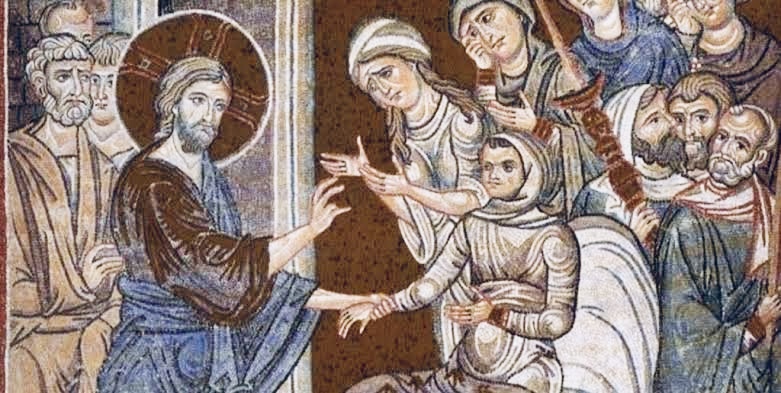
Now, we know how terribly lepers were viewed and treated, we see how special the encounter was between Jesus and this particular leper. This leper most likely chanced upon Jesus alone or with a few disciples. If there was a crowd around Jesus, he would not have been able to approach the Lord and kneel before Him. Crowds gather around Jesus out of curiosity — they were there either to see miracles happen or to observe what rogue teaching or comment Jesus would utter next.  The act of kneeling before someone is very striking because it is an act of humility and an acknowledgement that someone has power over you. The leper kneels before Jesus and does not demand healing but rather leaves the choice to Jesus saying, “If you wish, you can make me clean.”  (Mark 1:40) This is enough to move Jesus to pity that He defies the Mosaic law, reaches for the leper, touches him and says, “I do will it. Be made clean.” (Mark 1:41) It is such a personal encounter. As Jesus reaches and touches the leper, we are reminded how God reached out and entered into our human experience to save us. The story ends with the leper disobeying Jesus’ instructions “not [to] tell anyone” but to show himself to the priest. (Mark 1:44) This act would have certified that he was healed and could be reintegrated into society. However, in his overwhelming joy at being healed, the man did not need a priest to declare him clean. He knew and believed Jesus had healed him so he went around spreading the news of his healing. Sadly, many people missed the whole point of the miracle. They flocked to Jesus not because they believed in Him but they were simply curious. Hence, Jesus opted to remain in the outskirts of cities, in deserted places. 

Nowadays, some of us often find excuses for our faults and shortcomings by blaming others or perhaps calling attention to others whom we think are “worse” than we are. Instead of looking at ourselves very critically, we instead justify ourselves by saying, “Well, at least I am not as bad as he or she is.”  Today, we are invited to humble ourselves before the Lord and admit the reality of our sinfulness. As human beings, we are not immune to sin. Sometimes, we fool ourselves into thinking that what we do is not sinful because it is accepted in society or perhaps because we had good intentions to begin with. This coming Lenten Season, let us take the time to recall how we have been unforgiving, unloving, unkind, selfish, greedy, lustful, jealous, envious, bitter, ungrateful, proud, angry, and vengeful. What is it about our life that merits Jesus’ healing touch? Like the man afflicted with leprosy, are we willing to ask for Jesus’ healing touch? Are we willing to meet Jesus in the Sacrament of Reconciliation and receive His healing? In seeking the Lord’s forgiveness, we allow ourselves to be reintegrated into the family of God as His children.

We all have afflictions of the spirit that need the healing touch of Jesus. Today’s gospel clearly shows us how God feels such compassion for humanity. He has His eyes and ears trained on us. Nothing that happens to us escapes Him. When we call out to Him, He is sure to hear and respond with love and mercy. Like the healed leper, let us also be eager to spread the good news of the impact Jesus Christ has made on our lives. Let us not be embarrassed. Let us not be ashamed. Let us be witnesses to the power of God by the way we live our life. As St Paul encourages us, “Let us be imitators of Christ.” (1 Corinthians 11:1) 
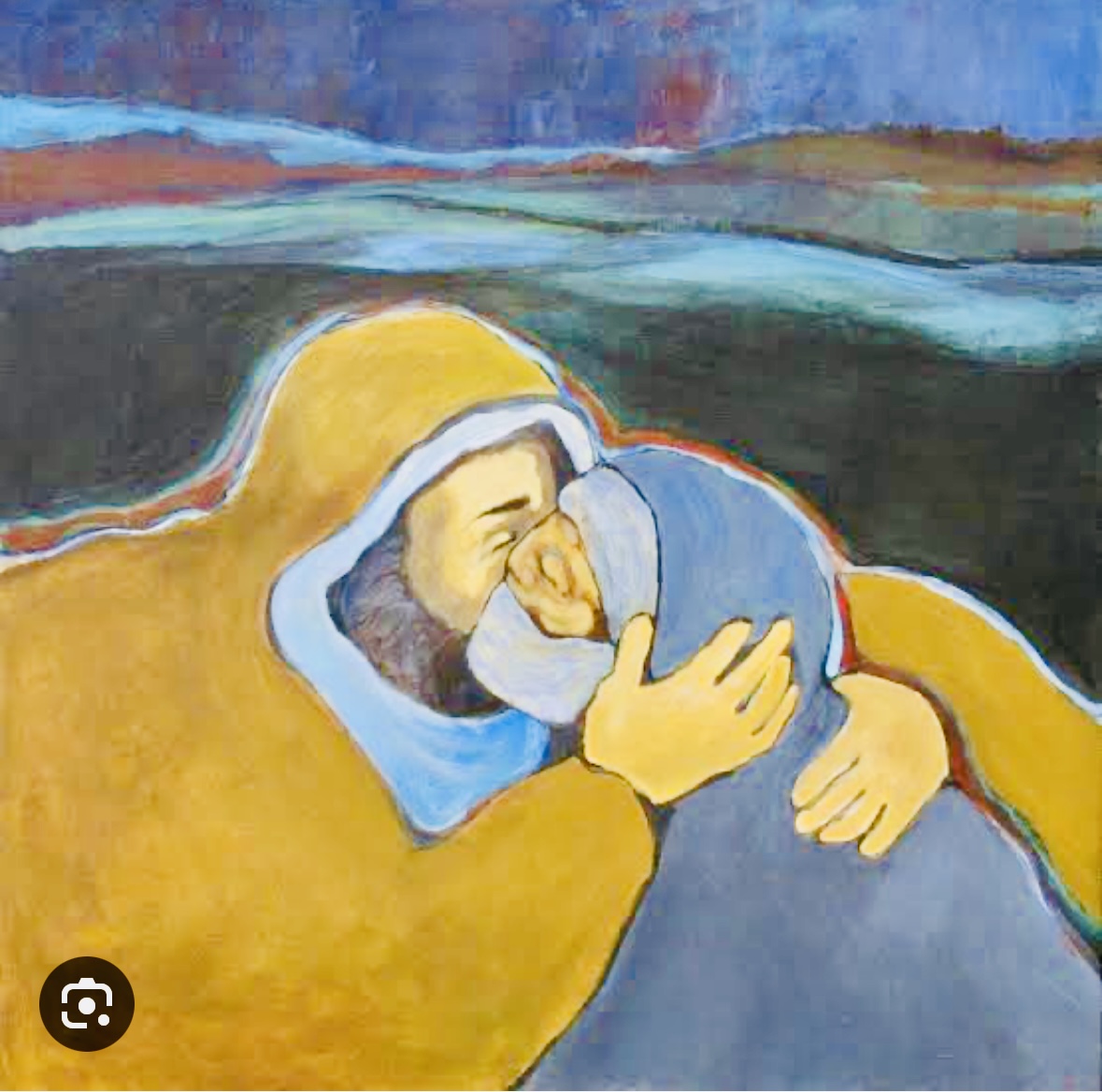
Jesus Heals the Leper Painting by Ann Lukesh

As Channels of God’s Healing Mercy

Homily: Fifth Sunday in Ordinary Time (B)

Mark 1:29-39

4 February 2024

Fr. Ricky Cañet Montañez

On Instagram, I came to know about this 29-year-old Kapampangan living in Nevada USA who became the dedicated full-time caregiver of his lola before she recently passed away at 97 years old. His lola was bedridden and nearly immobile from osteoporosis.  Her fingers were gnarled and twisted from severe arthritis so she could no longer care for herself. This doting grandson fed her, prepared her for sleep, bathed her, changed her diapers, and did her physical therapy. Moreover, he also sat with her, talked with her, amused her and shot video content of what caring for her entailed. It was not an easy job and he had no salary but he cared for her lovingly because he could not stand to see her in a nursing home or an assisted living facility. He had a very personal way of attending to her and it has been appreciated and applauded by their millions of followers who say their story is indeed an inspiration. His name is Chris Punsalan. Find him on Facebook, Instagram , and even Tiktok and be equally inspired by their story. 

In the gospel this Sunday, we are told that Jesus had been reaching out to a great number of people in His healing ministry. He was trying to cover as much ground as possible by going about “the whole of Galilee” healing those afflicted with various illnesses and freeing those possessed by the evil spirits. And yet, there is something personal in the way Jesus attended to those who come to him for healing. Jesus could have readily willed everyone to be healed from a distance. There have been instances where Jesus simply commands someone to be healed without seeing them and once a woman with haemorrhage was healed by simply touching the tassel of Jesus’ cloak. However, in majority of the healing encounters, we observe Jesus taking the time to speak with the afflicted, laying hands on them and praying for them. There is a personal aspect that characterises Jesus’ ministry.

For Jesus, people are not just “numbers” or “projects” to be dealt with in the most efficient way possible. He could have set up a table and had them queue up while he dispensed miracles like a factory production line. In this particular gospel, we observe how Jesus gets up close and personal to Simon’s mother-in-law to heal her. We read that Jesus approached her, grasped her hand, and helped her up.  Take note that the expression “helped her up” is almost always used in resurrection accounts. It was believed in the ancient world that “those who were ill were thought somehow to be in the grips of the powers of death.”  The act of helping her up is the same as saying, Jesus gave her back her life. When I imagined this scene unfolding, I remembered what happened to our cook, while I was living in London.  When she got sick and needed to go to the hospital, she was so appreciative of the Filipino nurses caring for her because they took the time to talk to her and make her comfortable. She felt that they saw her as a unique individual, not merely another patient in the ward. They always spoke kindly to her and addressed her by her name — Brigid.

Through these gospel healing accounts; Jesus is portrayed as someone who promises hope and healing to all those afflicted with various diseases. But far more than just physical healing, these stories of healing point to Jesus’ power to save. Jesus’ healing ministry is a sign of salvation. He brings wholeness and restores what sin has corrupted and destroyed. He puts back together what is broken, saves what is lost, and revives what is lifeless.  Each healing encounter is a personal one because salvation is essentially personal. Jesus will not come and say, I am here to save the entire Mejia clan or the Santos family or the residents of Bagumbayan. Jesus addresses each of us by name… nickname even. He knows everything about us — our fears, our secret sins, our struggles, joys, hopes, and dreams. When we have an encounter with Jesus, it is a very personal experience that reaches deep and touches our very core, so much so that it can be life-changing.  One contemporary example of such encounters are the sacraments. We cannot hope to benefit from the communion of another. We must receive Jesus ourselves that we may be changed from within by what we consume. The reconciliation with Christ in confession is very personal as well. We cannot assume that our sins are forgiven if our mother tells the priest about them while she is in confession. There is no such thing as absolution by proxy. Salvation in Jesus is very personal.

Today, let us thank Jesus for loving us in a very personal way. We thank Him for His continuing effort to save us and preserve us for a life of fullness and wholeness with the Father in heaven. We thank the Lord for people who make that extra effort when caring for others like Chris who chose to be his lola’s caregiver and the Filipino nurses who cared for our cook in London.  Let us ask Him to give us the grace, the compassion, and the patience to also make ourselves present for people who need us — our children, the elderly, the sick, persons with disabilities, the lonely and confused. May Christ use us as a channel for His healing mercy to be poured out on those in most need among us.

Photo from Orthodox Christianity Homily Blog

Living a Life of Integrity

Homily: Fourth Sunday in Ordinary Time (B)

Mark 1:21-28

January 28, 2024

Fr. Ricky Cañet Montañez

Social media influencers hold tremendous influence on today’s youth. They are the ones most listened to when it comes to advice and guidance in life.  It’s funny because some of these influencers are very young, barely out of their teens! These kids get paid to tell their followers what’s cool to wear, best places to eat, where to vacation, and even how to handle real life problems like depression, heartbreak, confusion, etc.   Sadly, many of them will do and say things that increase their engagement and their following even if it is the wrong thing to say or do.  If only they were qualified to dispense advice or if they took to heart their social responsibility.

In today’s gospel passage, we are told that the “People were astonished at Jesus’ teaching because He taught as one who had authority and not as the scribes.” (Mark 1:22) Jesus gives evidence of this authority through His teaching and healing ministry. This authority in Jesus is displayed by the power of His words which yielded corresponding effects that moved hearts to follow His lead and that made the evil spirits tremble at His words. Everything Jesus said and did was an expression of the truth that He was the Son of God and that He had come to save God’s people. He did not have to pretend. He did not put up pretences to win followers. In fact, not everyone appreciated Him. He made a lot of enemies but that was immaterial to Him because He was not out to please everybody. 

The people saw in Jesus someone with authority because He lived a life that manifested what He proclaimed. The integrity of Jesus’ way of life gave His words power, which also drew many to Him and challenged them to live lives of the same integrity. They listened to Him because He they saw Him as a prophet not as someone who can foretell the future but rather as one who spoke the word of God. As the Lord tells Moses: “I will raise up for them a prophet like you from among your kin, and will put my words into his mouth; he shall tell them all that I command him.” (Deuteronomy 18:8) Jesus is the opposite of the scribes who are full of beautiful words but lack the corresponding deeds. Maybe what they teach is right but it is usually empty talk. It does not penetrate the heart so as to persuade people to change their lives and return to God.

Nowadays we have so many sources of information. The internet is wide open to anyone who claims to be an “expert” and who wants to post, speak and give his/her opinion and advice on anything discussed. If we are not careful, we can form ideas or make decisions based on the statements of fake experts or fake prophets. When I see products being advertised by celebrity endorsers, I do not automatically believe them unless they have a reputation for only endorsing products they truly believe in. 

When it comes to matters of the soul, we have to be doubly careful. We should always consider authority to emanate from a life of integrity.  I came across this social media post which clearly illustrates this: “If we say and do what we [believe in; then] everyone will know what we actually believe in. It’s a handy little thing called integrity.”  This is very important for us, Catholics. No one will believe us if we do not practice what we preach. For example, it is difficult to tell a child not to lie if we ourselves do lie. How can they believe us? This is even more true for us, priests who are called shepherds of the faithful. Many of today’s youth are moving away from the church because they are losing confidence in the clergy. Sometimes we really miss out on being a good example ourselves. This happens when we become distracted ourselves with the things of this world. I hope we can count on you to remind us when we seem to forget our commitment to the Lord. As St. Paul reminds us in the Second Reading: “An unmarried man is anxious about the things of the Lord, how he may please the Lord.” (1 Corinthians 7:32) Can we count on you on this?

Brothers and sisters, we are reminded that the only way to manifest authority and to witness to Jesus’ teachings in our midst is by living a life of integrity. As we celebrate National Bible Sunday and the Sunday of the Word of God, let us pray that the Word of God not only sustain us, but also change us and make us persons of integrity. 

Jesus Preaching from a Boat by Jorge Cocco

Leading Our Children to God

Homily: Feast of the Santo Niño (Proper Feast in the Philippines) 

Mark 10:13-16

21 January 2024 

Fr. Ricky Cañet Montañez

Someone once said “Children are the means by which we take hold of heaven.”  The usual interpretation is that we should be child-like to enter the Kingdom of Heaven. However, I think it also reminds us adults that we have responsibilities to children that ensure Heaven is within reach for all of us. 

In today’s gospel, Jesus says that those who belong to the Kingdom of Heaven are akin to little children. He suggests to those listening that children can actually be a model for those who wish to be His followers. Jesus sees children to be in possession of qualities befitting those who want to be His disciples — those who spread His word and continue His redeeming work. Apart from the innocence of their character, it is their natural dependence and trust in their parents that Jesus particularly commends and sees to be very special in them. This quality is what we must have in relation to the Heavenly Father because we are His adopted children. Jesus invites the disciples to understand that “to belong to God’s Kingdom” is to be a child before God.  We should look to them on how we are to be trusting, dependent and reliant upon God rather than solely on our own capabilities. As His disciples, we are invited to adopt the same humble stance. We are asked to have a simple and accepting demeanour toward God’s shaping and reshaping us for His Kingdom. 

In today’s passage from Mark, Jesus saw that His disciples rebuked those who were bringing children for His blessing and He intervened, invited the children closer and blessed them. Jesus tells His disciples, “Let the children come to me; do not prevent them, for the Kingdom of God belongs to such as these.”  (Mark 10:14) He gave them two precious things: His time and presence, which no money can buy. How many times have we been short tempered with children, thinking them to be “makulit” boisterous and quite the nuisance? How many times have we chosen to silence our inquisitive children by shoving a gadget in their hands or dropping them in the hands of a “yaya” (househelp) or their “lola” (grandma) instead of personally attending to their needs? Do we take the time to answer their questions, to compassionately correct their wrongdoing, or to comfort them when they need our assurance? 

It is regrettable that these days, more and more children are robbed of their innocence and their ability to trust in adults. Perhaps, because these are hard times, parents need to devote more time to making a living, but it is still no excuse to neglect their children. Children who are left alone with gadgets unsupervised run the risk of visiting sites, watching videos or playing games that are not appropriate for young minds. The internet cannot make any distinction among its viewers and users. If kids learn to be indifferent to violence, injustice, intolerance, lust, indignities and stupid dangerous stunts, and unbridled hunger for fame, it is not possible to restore their innocence and reset their positivity. If kids are faced with the contradictions of what they ought to do and what they see on the internet, they may perceive adults to be a source of confusion rather than trustworthy and credible sources of learning and guidance. 

As adults, it is our responsibility to look after the future of humanity. Parents have a huge responsibility to raise their children well and to protect them from all types of dangers — especially those that corrupt minds and morals. I think that this is the second essence of the quote I mentioned at the beginning. To raise children is to be given a chance to pass on the faith — to ensure that the Kingdom of Heaven continues to exist on earth, though not completely. To those married in the church, you made a promise before God to bring up your kids in the love and fear of God. This means you must be good Christian role models for them as well because children learn more from observing their parents rather than from angry lectures and scolding. Whitney Houston once sang… “I believe the children are our future. Teach them well and let them lead the way. Show them all the beauty they possess inside.” 

The world will constantly tell us to pursue power, fame and wealth, but if we want to be truly great in God’s eyes, we must, be like little children. On this Feast of the Santo Niño, let us remember that if we wish to enter the Kingdom of Heaven, we should emulate the trust and confidence that children have in their parents. Also, of equal importance is recognising our role in protecting the childhood of little ones from what can destroy their positivity and innocence and ensuring that they are given strong foundations in faith. God is our Heavenly Father who loves and cares for us unconditionally. Let us fully entrust our lives into God’s loving hands! Kini atong gina-sam-PIT kay Señor Santo Niño!

Artwork by: Arnold Ramirez

Remaining in Jesus

Homily: Second Sunday in Ordinary Tim

John 1:35-42 

14 January 2024 

Fr. Ricky Cañet Montañez

Sometimes, when we meet new people we ask veiled questions to get to know them better. When we ask: ”Where are you coming from?” (“Ano ang pinanggalingan mo?”), we are not simply asking what their hometown is but rather we want to know more of their origin. It is like asking: “Who are your parents and what do they do for a living?” and “What is your educational background and work history?” — all in one question. 

Our gospel today has two veiled questions. Jesus first asks the two men following Him:  “What are you looking for?” He doesn’t say: “Who are you looking for?” or “What do you need?” These are the normal questions we ask of strangers who approach us.  Jesus addresses them differently and this tells us that even before they introduced themselves, He already knew their minds. They had a sense of who He was and yet they were unsure of what they could get out of an encounter with Him. More importantly, Jesus knew their hearts. He saw in them a hunger and an eagerness for the truth and a desire for a sign that would give them hope. 

The two men do not respond directly to Jesus’ question but ask another question. “Rabbi, where are you staying?”  If a stranger asked you that, would you reply truthfully? We would think it to be an offensive or a dubious question. However, they are not really asking Jesus for His address. In the context of the gospel, to ask where one “stays” may be translated as “abide” or “remain”. This is a key word in John’s Gospel. According to a few commentaries I read, it refers to a

person’s source of being and ultimate purpose. In John’s gospel account, Jesus would often say that He remains in the Father, so does Jesus remain in all those who have come to believe in Him; and they, in turn should remain in Him. (John 15:4-9) It is the same as the Tagalog question mentioned earlier: “Ano ba ang pinanggalingan mo?” (Where are you coming from?”) “Saan ka ba nanggagaling?” “Ano ba ang pinanghuhugotan mo?” 

Jesus is not offended by their blunt query but He simply says: “Come and you will see”. (John 1:39) He invites the two disciples of John to follow Him and to observe what He says and does and to arrive at the conclusion for themselves. The gospel passage tells us that the two men went with Jesus and they stayed with Him. They went and they saw. Are we all curious as to what they saw? Well, we are not told anything except the outcome of their encounter. This experience of being with Jesus made such an impact on them that they committed to becoming His disciples. We can imagine how they must have been so overwhelmed emotionally that they could not help but share their experience with others and invite others to also see for themselves. Remember that one of the men was Andrew, the brother of Simon Peter who immediately went to his brother and told him: “We have found the Messiah!” (John 1:41)

Like the first two disciples, we are also called upon to stay (to abide, to remain) with Jesus. That is quite straightforward but we know it is not as simple as it may seem. It can be quite challenging considering we are often distracted and discouraged by so many things in life. There are the attractions, temptations, self-absorptions, self-pity, anxieties, comparisons, and fears that we readily allow to dominate our lives. We allow all these negativities to remain with us. We create a space in our hearts for them such that there is no room for Jesus any longer.  Remaining in Jesus means freeing ourselves from whatever is making us unhappy and leaving us empty.  As St. Augustine says, “Our hearts often make a home on many worldly things that give us false joys and pleasures.  Since we are made to make our home in God, we would always find our hearts restless until they rest in God.” This confirms Jesus’ promise that if we abide in Him, we will abide in His joy and we will become fruitful. 

Today, let us remember that Jesus knows our hearts and our minds even when we do not tell Him or when we try to hide our truth from Him. In spite of that, He consistently asks us to remain in Him and come to our own realization of the truth.  Let us ask for the courage and the perseverance to remain in Jesus at all times. Let us choose to make our home in God. Let us remain in Jesus so that the fullness of joy will be ours for the rest of our lives.

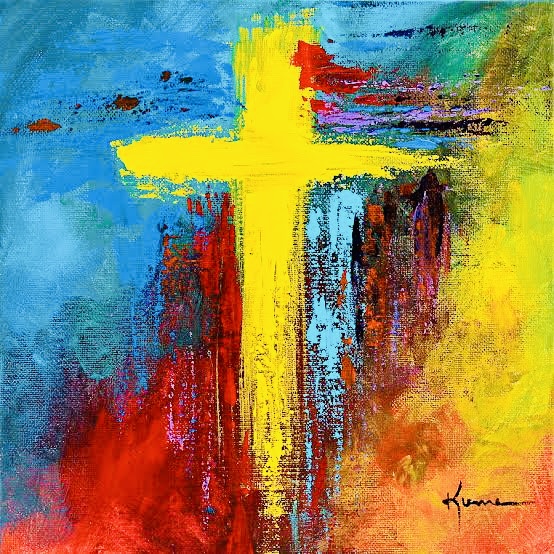
Painting by Kume Bryant

In Our Search for God

HOMILY: Solemnity of the Epiphany of the Lord

Matthew 2:1-12

7 January 2024 

Fr. Ricky Cañet Montañez 

Happy Second Christmas! It may sound strange to our ears but for the Eastern Christians this is when they hold their Christmas feasting! The celebration of Epiphany, meaning “manifestation”, is traditionally referred to as “second” Christmas. (So yung mga di nakapaghanda o nabitin sa handaan ng December 25, puwede pa maghanda uli mamaya.) 😉 

The gospel passage for this feast is all about a search for SOMEONE whose value is beyond measure. The Magi were said to have followed a star to Bethlehem. It must have taken much study and research to determine which of the thousands of stars in the sky was the one they should follow. As it is, there are eighty-eight (88) constellations in the northern and southern hemisphere. Roughly seven (7) new stars are formed each year in the Milky Way. Imagine the lengths they must have gone to ascertain which one star signalled the birth of the Messiah? To many it may have seemed like a “fool’s errand”, but to them, it was worth all the expense and the effort to find the ONE whom they believed to be of incomparable value, not only for the Jews but for humankind.  

Our life is characterised by all sorts of pursuits that we deem important to us. Many of us are caught up in our quest for wealth, fame, pleasure and power.  Imagine how much money politicians spend on a campaign in pursuit of a seat in government; or ordinary people who pull the dumbest acts or most dangerous stunts on Tiktok in the hopes of going viral and hitting it big as an influencer?  Twenty (20) years ago, yuppies worked hard and saved up for luxury bags and watches. Young professionals these days work hard and save up to travel or buy gadgets. There’s really nothing wrong with these pursuits as long as we take care not to lose ourselves in them. 

It is a terrible waste of life to focus all our efforts on accumulating possessions or acquiring feathers in our caps at the cost of our relationship with God and others. No one dies for not owning the latest version of the iPhone or not wearing the hottest stuff in fashion today or for not racking up impressive scores on a video game. We only think we will die, but we won’t. If all our time and energy are spent on making money for worldly pursuits, then they become our idols. They take the place of God, who must be our priority in life. Equally dangerous is the fact that many of us miss out on what truly matters like laying foundations for important relationships with family and friends and being still and sensitive enough to revel in simplicity, love, compassion, and contentment. 

St. Augustine, though revered now as among the greatest saints also wrestled his way toward conversion. He even admits that things of the world kept him from finding God. St Augustine, in his Confessions, writes of his deep regret at spending much of his life seeking the beauty of created things rather than seeking the Creator of such beauty.  “Lo, you were within, but I outside, seeking there for you, and upon the shapely things you have made I rushed headlong – I, misshapen. You were with me, but I was not with you. They held me back far from you, those things which would have no being, were they not in you.” So much so that he would eventually say: “To fall in love with God is the greatest romance; to seek Him, the greatest adventure; to find Him, the greatest human achievement.” 

Our search for God, much like the long and tedious journey of the Magi to find the new-born King of the Jews, can be hard and challenging as well. At times, we may become discouraged and distracted by the world in our search for Jesus. If only we persevere and remain hopeful like the Magi, we will realise that finding God is inevitable not because of our efforts to look for Him but because God always chooses to reveal Himself to us along life’s journey. Through God’s guidance by a star, the Magi found the new-born King of the Jews. Through God’s guidance by a warning in a dream, they evaded trouble with King Herod. Our own journey can be wrought with missed signs and false turns but God’s grace always picks us up and sets us toward the right path. 

St. John Chrysostom once said: “If you knew how quickly people would forget you after your death, you would not seek in your life to please anyone but God (alone).”  This should put into perspective the value God holds over anything else that our life may hold. Let us not grow weary of seeking Him and trust that God will not allow our effort to be in vain.  So, here’s wishing you… Merry Christmas! Happy Feast of the Epiphany!

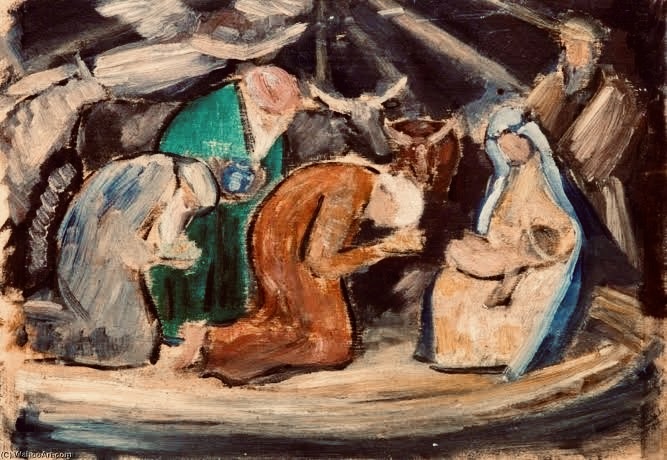
Artwork by: Gertrude Mary Powys

Reflective Openness for the New Year

Homily: Solemnity of Mary, Mother of God

Luke 2:16-21

1 January 2024 

Fr. Ricky Cañet Montañez

I have a friend who is known for throwing parties for her mom.  When her mom turned 80, she decided that all succeeding birthday celebrations of her mom would be extra special. They always had a program where relatives and friends showcased their talents but more importantly, they always had a short tribute for their mother. Everyone, from the children to the great grandchildren, is asked to express their appreciation, gratitude and love for her. My friend believes that while her mom is still alive, they should fill her heart with the assurance that she is loved, cherished and appreciated. She says it is better than delivering a tearful eulogy when she is gone. 

Today is the Solemnity of Mary, Mother of God. This is a very special title bestowed on the Blessed Virgin Mary. It cannot be challenged that Mary was Jesus’ mother because she carried Him in her womb for nine months. Her body kept baby Jesus alive and nourished Him till He was ready to be born into the world. He is flesh of her flesh. Through her, it is possible for Jesus to be human. Do not forget, though that Jesus is also fully divine. Although it is true that Mary is not the source of His divinity, she is still called the “Mother of God” because the two (2) natures of Jesus — human and divine, cannot be separated. He is 100% human and 100% divine. When we honour Mary as Mother of God, we also glorify Jesus in His humanity and divinity. 

The gospel tells us that Mary was someone who reflected on this beautiful and mysterious plan of God for the salvation of His people, that she is now a part of.  With the incarnation of Jesus, God has a new relationship with humanity. Mary readily welcomed God’s invitation to her and willingly cooperated with God’s will. Her reflective openness allowed her to be sensitive to the abiding presence of God in her life and that of her Son. She knew that God was always with her; that God comforted her and encouraged her to persevere despite difficulties. Mary was ever present at significant events in the life of Jesus, even the most painful ones.  Her constant pondering helped her to recognise that all human experiences (both the easy and difficult ones) are never beyond the presence and power of God. 

As we honour Mary today, let us also remember our own mothers.  Through them, we have received the gift of being born into this world — to experience its beauty and joys and to grow stronger and wiser because of the struggles and challenges life presents to us. If your moms are still alive, do not miss an opportunity to honour them and to express your love and appreciation for them. Recently someone posted a list of things she regrets ever saying to her mom whenever there was an opportunity for them to be together.  

“Mi, andito naman ako para mag-aral, sunod nalang ako sa gala ninyo.” (Mommy, I am here to study. I’ll try to join you next time.)

“Mi, next week na’ko uwi.” (Mommy, I will go home next week.)

“Pass muna ako, may work pa.” (I am excusing myself for now, I still have work.)

“Belated happy birthday!”

“Sa weekend nalang.” (I will do it next week.)

If you keep procrastinating spending time with your loved ones, you miss out on precious opportunities to bond.  Worst of all, we can never tell when we may lose the chance altogether should God call them from this life. 

In the age of multitasking, of obsession to productivity and of numerous distractions, it is so easy for us to be caught up in the busy-ness of life that we often miss out on important relationships. Technology gives us so many means of communication but the level of our interactions have become superficial — (emojis and acronyms na lang… IKR). In our encounters with others, we find ourselves preoccupied with so many other concerns or (worse) glued to our screens that we hardly notice the person in front of us at the dinner table. We are physically at home, at work or in the church, but we are not present at all. 

Throughout this year, let us learn to be more present for one another. Presence is not achieved simply by putting our gadgets away (although this is a great start). Perhaps, we should take a moment to look into the faces of our loved ones. When was the last time, we ever looked at each other in the eyes at home? Let us make the effort to keep track not only of what’s the latest in technology and society but more importantly, remain connected with those around us, especially our loved ones. Let us emulate Mary’s posture of reflective openness that we may be attentive to the presence of God and to the opportunities to be closer to Him. It is only by being fully present in each moment that life throughout this year will prove to be meaningful for us. So… here’s wishing you all, “A grace-filled 2024! May the Good Lord smile on us this new year!”

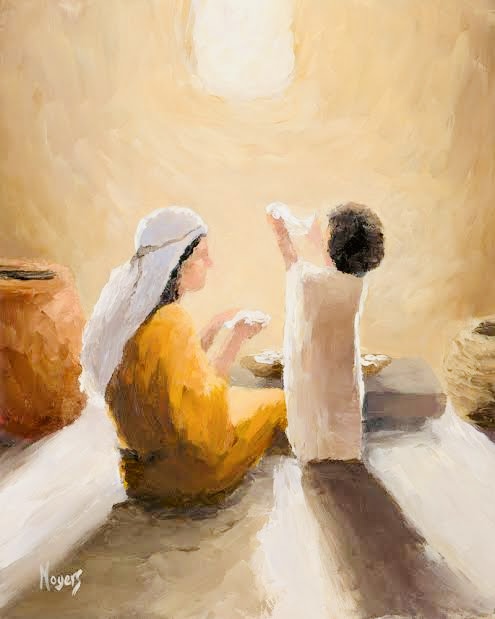
HOLY MOTHER AND CHILD BY MIKE MOYERS

Parenting After Mary and Joseph

HOMILY: The Feast of the Holy Family of Jesus, Mary and Joseph

Luke 2:22-40

31 December 2023 

Fr. Ricky Cañet Montañez

I had the chance to watch an interview of Marian Rivera and Dingdong Dantes on Youtube. In sharing with the host their experiences as parents, Dingdong said he is very firm that their kids will not be dependent on gadgets.  He and Marian make an effort to have activities with their kids, play with them, or have story-telling and crafting sessions. Marian also shared that even if she comes home late from a taping, she still wakes up early to bathe her children and take them to school. She makes it a point to attend all her children’s school activities because as a child her own parents were never around for her and she did not want her children to have the same experience. I was surprised that in spite of growing up in an industry that tends to have misplaced values, they chose to be traditional parents — placing a lot of effort into parenting even if it means sacrificing their convenience and personal wants.  Instead, they are prioritising their children and each other above everything else. 

On this Feast of the Holy Family, we look to Mary and Joseph on how to be good parents. As parents, Mary and Joseph were very much present in the life of their son, Jesus. They were available to Him for guidance and protection. In today’s gospel passage, we are told how fully the Holy Family entered into the religious practices of ordinary Jews of their time. Like all Jewish families, Mary and Joseph brought their son to the Temple to be offered to the Lord. In their family observance of the prescribed religious practices of the Jews, the Holy Family becomes a model for families today on how parents and guardians need to be present for their children and how they need to accompany them in exercising the faith. 

Parents have to personally guide their children through ALL aspects of their faith formation, particularly in the often-neglected aspect of spiritual formation, which is the education and practice of the faith. Perhaps, we need to note a few reminders: Go to mass with the children; do not leave them at home when you come to church on Sundays; try to come as a family and present yourselves before the Lord. Pray together; teach your children the basics of prayer; make appointments for the family to receive the Sacrament of Reconciliation. Learn what and how it is to be Catholic together; refresh your knowledge of our traditions and beliefs; encourage your kids to ask questions and search for answers together; do not rely on their teachers in Catholic Schools or catechists in the public schools; it is more important that your offsprings learn first from you and that they observe you practicing the faith. 

Mary and Joseph were entrusted with a great responsibility. They were to raise the Son of God, no less. Just imagine what it must have been like to be Jesus’ parents. They probably felt totally inadequate for the task, notwithstanding the fact that they were very young abd had never raised a child of their own. Like every parent, they learned on the job. They were not perfect. In fact, at one point they lost Jesus after bringing him along to Jerusalem. They panicked at the possibility of having lost the Son of God. They must have been relieved beyond measure upon finding Him in the Temple days after He went missing. 

Life was not perfect for them either. They were not a rich family. Joseph had to work as a carpenter to make a living for his family. He and Mary also prepared themselves for the eventuality of Jesus leaving their home when the time came for him to fulfill his mission. Through it all, they were never known to grumble nor did they abandon Jesus when life became difficult. They did not rely on their limited capacity to raise Jesus but instead they trusted that since God chose them for this tremendous task, He would also help them to accomplish the task. They persisted in God’s grace and walked into the mystery of God’s plan for their son, Jesus. Despite their own reservations and personal questions, they united their hopes and dreams with God’s plan for the salvation of humanity. 

On this feast day of the Holy Family, we thank God for our families. Just as God entrusted Mary and Joseph with His Son, He has entrusted us with a family to nurture and love. To those who are married and have children: treasure the gift of your spouse and your children; do not be discouraged when your family goes through struggles. Life is never perfect.  Simply pray to God for guidance, patience and understanding. Let us make it a habit to always pray with one another and for one another. Amen.

The Manger Art Print by Mike Moyers

Echoing Mary’s FIAT

HOMILY: Fourth Sunday of Advent

Luke 1:26-38

December 24, 2023

Fr. Ricky Cañet Montañez

Every Fourth Sunday of Advent is usually dedicated to the Blessed Virgin Mary. So, we read once again the account of the Annunciation of the birth of Jesus and we are made to ponder on how she has been prepared for a special role in God’s plan of salvation. 

It is important to note that “special plan” in God’s terms hardly means hitting the jackpot, or winning in the lotto, or being awarded an all-expense paid tour throughout Europe. It usually involves something unusual and difficult, requiring much sacrifice.  The deliverance of the Israelites from Egypt took 7 plagues, walking across the parted red sea and 40 years of wandering through the dessert. Our salvation story begins with a young girl of 14 to whom an angel of the Lord appeared with a message that greatly disturbs her. 

Even in Mary’s time, it was a rare phenomenon to be visited by an angel.  If your son or grandson suddenly sneaks up on you while you are concentrating on preparing meals in the kitchen, wouldn’t you be startled? Imagine seeing a blinding light, a winged being or a stranger in human form suddenly appearing before this young girl while she was alone in a room. That must have been a real fright for her. The gospel tells us that the experience causes Mary to be “greatly troubled”. (Luke 1:29) However, the presence must have been calming and the voice of the angel soothing because she does not run away.

When the angel speaks his greeting must have puzzled her as well. “Hail, full of grace!” (Luke 1:28) — must have shocked Mary. We have to understand that the salutation “Hail” doesn’t simply mean “hello”. In fact, it was only used in one particular context, that is to acknowledge a highly-placed superior. We recall that this greeting was used for the emperor. “Hail, Caesar!” This would have been the common usage in Mary’s time. Imagine yourself doing your usual every day chores in your house clothes and all of a sudden somebody addresses you as… “Good afternoon your highness!” To have a superior being such as the archangel as the source of such salutation is indeed troubling for a teenager in a rural, conservatively religious, middle-eastern community setting. 

Then the clincher, the angel says she will bear the son of the Most High. Mary is so disturbed by this because although she is already betrothed to Joseph, they were not yet married and have not had intimate relations as husband and wife.  She must have wondered how she could become pregnant in the normal course of events. Mary asks, “How can this be?” (Luke 1:34) She does not doubt.  She does not ask for proof, just a little clarification since a virgin birth is unheard of and impossible even today. 

The story of Mary is another instance of how the Lord works in mysterious ways and how His plans do not necessarily make sense to human understanding. This tells us that when we pray for something and things don’t go our way, we have to trust that God has other plans for us and His plan always places us in a better position. Even though all we see is difficulty before us, we have to trust that God sees farther ahead and He knows what good awaits us if we only stick to the course. 

The gospel account also tells us that God does not leave us alone to bear with all the uncertainty and hardship that His plan entails. The angel explains to her that “The Holy Spirit will come upon you, and the power of the Most High will overshadow you…” (Luke 1:35) For us who are children of the Pentecost, we know that the presence of the Holy Spirit is the presence of God. To receive the Holy Spirit is to have God with us. This must not have made sense to Mary though.  What is the Holy Spirit? What did He look like? How would she know that He had already come upon her?  

Without seeking further certitude, Mary readily assents to the message of the angel. “I am the handmaid of the Lord; may it be done to me according to your Word.”  Her faith in God’s goodness was enough to give her the courage to say “YES” to the plan.  As the angel leaves, we assume the Holy Spirit descends upon her signifying the moment that Jesus has life in her womb. 

Our life today is filled with many uncertainties and our life doesn’t always go as we plan. However, we must look to Mary as a model of faith, obedience and submission to God’s will, especially when God’s will does not make sense to us. Let us pray that God will increase our faith and give us the strength to persevere on the path He has laid for us. May we echo Mary’s Fiat at all times, in every circumstance of our lives.

Who We Are as Christians

Homily: Third Sunday of Advent 

17 December 2023

John 1:6-8, 19-28

Fr. Ricky C. Montanez 

“Who are you?” This is the typical question we ask of a stranger or of someone we encounter whom we do not know. The answer to that question can actually vary from an awareness of self, which would answer the question “Who am I?”. To answer “Who am I?” we come to an awareness of a personal understanding of our origins, our comprehensive life experience, our preferences — likes and dislikes, and the formation of our character — positive and negative traits included.  To answer “Who are you?” deals with how we present ourselves to the world, how we wish to be known, or how people come to know us. To have both aspects of our person as identical as possible, is an exercise in authenticity. To be true to one’s self allows us to be happy with our identity.

“Who are you?” This is a key question asked of John in today’s gospel passage. Such question requires an answer that goes beyond simply stating one’s name and occupation or the fact that he is the only son of Zechariah and Elizabeth and cousin to Jesus. Rather, it requires John to go deeper and state his role and purpose in relation to the Messiah. He had that clarity about who he was in relation to the Messiah. We know that John had chosen to live in the wilderness, wearing clothes of animal skin, and surviving on locusts and honey.  This allowed him to fully detach from the pleasures of the world and to fully focus on his mission. John states that he is not the light but he is to bear testimony to the Light. He is rather the “voice crying out in the wilderness” to prepare the way of the Lord. Some of John’s followers believed that he was the anointed one but he had no qualms about dashing their hopes in order to correct all their false assumptions of his identity. 

We may consider John and Jesus to be a good team in terms of bringing to fruition God’s plan of salvation for the world. The Gospel according to Luke draws the parallelism between John and Jesus — where an angel appeared to John’s father and Jesus’ mother to announce their birth, their conception and birth were surrounded by marvellous circumstances, and both were predicted to have an extraordinary destiny.  Each one had a special and irreplaceable role to play in bringing about God’s Good News of salvation to the people. John never pretended to be the Messiah. Even as a baby in the womb, he recognised the divine nature of Jesus!  In the Visitation account, he leaps in the womb of his mother as soon as the pregnant Mary approaches. John knew that his role was to “prepare the people for the coming of the Messiah and to point to Jesus as that Messiah.” Meanwhile, Jesus affirmed by word and deeds the truth of John’s witness. 

They say people are prone to depression these days. Oftentimes, it is a consequence of not knowing the beauty of who they are as persons and their inner strength or exhaustion from putting up pretences and projecting an image that they believe they need to do to be successful, accepted, or simply liked by others. How can one be truly happy when it takes too much effort and energy to pretend to be someone you are not? Those who work in high profile jobs like the entertainment industry, public office, and now content creation, are more prone to suffer from a disconnect between how they present themselves and who they truly are.  What my friend told me about an interview of Heart Evangelista came to mind as a good example. Heart, said in an interview that her videos documenting her preparations and attendance to fashion shows in Milan, Paris and New York are not contrived or staged. She is not playing a part but being herself because she genuinely loves high fashion and is a patron of these luxe fashion houses. She allows herself to be recorded being in honest conversations with family and friends. This is the lifestyle she chooses and it brings her joy and happiness, even if a lot of people misunderstand her. 

To be happy, we need to find out who we are and who God intended us to be. It was only with a greater sense of awareness and appreciation of his role and relationship with Jesus that John was able to live out his purpose and fulfil his mission to the best of his ability. Similarly, all of us followers of Jesus are also called to grow in consciousness of our relationship with our Lord and become more and more committed to our role as Christians to prepare others to recognise Him and receive Him in their life. We hope one day, when we come face to face with Jesus, He need not ask: “Who are you?” but rather, recognise us, immediately as His faithful followers.

Internet Sources of Christ and His disciples Painting by Dan Comaniciu