Homily: The Resurrection of the Lord/ The Mass of Easter Day
Acts10:34a, 37-43 / Colossians 3:1-4 / 1 Corinthians 5:6b-8 / John 20:1-9
5 April 2026
Fr. Ricky Cañet Montañez, AA
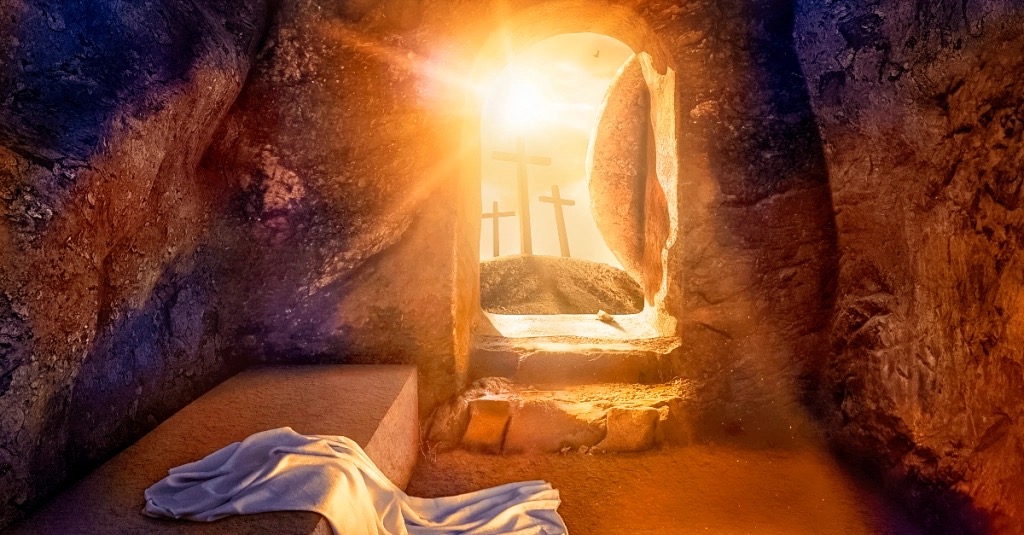
It is often said that to see is to believe, but in today’s gospel what prompts belief is not what is seen, but what is not seen. When the beloved disciple enters the tomb, the Gospel simply says, “He saw and believed” (John 20:8). But what exactly did he see? Not Jesus. Not angels. Not a miracle happening right before his eyes. He saw… absence. The remains of the Lord were nowhere in sight. The place was empty. That’s all. And yet—he believed. It is so strange that it defies logic, it does not make sense! Some of us can’t even believe we have locked our car doors without checking three times, and here John just walks into an empty tomb and… believes.
We usually think faith begins when we see something undeniable—something obvious, something concrete. However, Easter tells us something different: faith often begins not with what is present… but with what is missing. The stone was rolled away (John 20:1), the body was gone (John 20:2–3) and only the linen cloths were lying there (John 20:6–7). These did not feel like clues that provided answers. They only raised more questions. And yet, the emptiness of the tomb became the first whisper of the resurrection.
Sometimes, it is in the silence and in what seems absent that God is most present.
Think about the emptiness in our own lives—a loved one who is no longer there; a dream that falls apart; a desperate prayer that goes unanswered; restless wandering in search of purpose and meaning. All of these, often create a deafening silence that stretches far longer than we could possibly bear. I remember a friend—let’s call her Maria—who cared for her father in his final months. Every day, she hoped for improvement and prayed for a sign that things would get better. Then, one morning, he was gone. She walked into the quiet room… and was met by his overwhelming absence. It really hurts—to be left behind, to be defeated, to lose something or someone. (Grabe, ang sakit ng pakiramdam ng maiwan, nang matalo, nang mawalan.) But in the experience of that absence, something extraordinary happened. She remembered her father’s life, his love, his example. Even though he was gone, the gifts he had given her—his lessons, his care, his laughter—remained. She realised that life, love, and hope do not vanish with what goes missing.
That is exactly what Easter shows us. The empty tomb, at first, does not shout glory, or power, or victory. It whispers absence. It leaves the beloved disciple in a space where he could have despaired… but instead, he believed (John 20:8). Faith, after all is a conviction of things not seen, or should we say, things that give measurable proof. If, for example, the apostles had watched Jesus take a breath and walk out of the tomb, it wouldn’t require faith. They would have had a first-hand, eyewitness account. That is not faith. Faith begins in the empty places. Faith begins when we face loss, silence, or uncertainty… and still dare to trust that God is at work. Easter is not just about the Risen Christ in glory. It is about the Risen Christ who meets us in the emptiness of our lives. In the absence, He shows us that hope is stronger than fear, love is stronger than loss, and life is stronger than death. This is our cause for joy! This is why we exclaim “This is the day the Lord has made; let us rejoice and be glad.” (Psalm 118)
Thus, today we are invited to look at the empty tombs in our hearts—the spaces where we feel loss, doubt, or fear—and still choose to believe. The miracle of Easter is that it does not require a perfect landscape to bloom; it begins precisely where we feel most empty. Where we see only absence, the Risen Christ reveals His most intimate Presence; where we see loss, He plants the seeds of an unshakable hope; and where we see the finality of death, He breathes the fire of eternal life. Let us not be afraid of the emptiness, for it is the very space God uses to prove that love can never be contained. Christ is risen! He has conquered sin and death! Alleluia! Happy Easter to us all!
 Sunday Gospel Reflections