Homily: Fourth Sunday of Lent (A) [Laetare Sunday]
1 Samuel 16:1b, 6–7, 10–13a; Ephesians 5:8–14; John 9:1–41)
15 March 2026
Fr. Ricky Cañet Montañez, AA
Sometimes, the real problem in life is not that we cannot see, but that we fail to recognise what is right in front of us. There is a difference between seeing and recognising. We see many things every day—faces, events, situations—but recognition requires something deeper. It requires attention, humility, and sometimes a change of heart.
This came to mind while I was watching the Korean series, Boyfriend on Demand. The story follows a woman who signs up for a virtual service where she can “summon” an ideal boyfriend—someone attentive, thoughtful, and always present when she needs him. At first, everything feels perfect. The boyfriend says all the right words. He listens. He understands. He seems to fulfill every emotional need. But as the story unfolds, she slowly realises something surprising. While she was focused on the illusion of “perfection,” she had been overlooking someone real in her life—someone imperfect, yes, but someone who genuinely cared for her. In other words, what she had been searching for was already near her. She simply did not recognise him.
In a way, that is exactly what happens in today’s Gospel (John 9:1–41). Jesus heals a man who was blind from birth. But the most fascinating part of the story is not only the miracle itself. The deeper miracle is how the man gradually begins to recognise who Jesus truly is. At first, when people ask him about Jesus, he simply says, “The man called Jesus made mud and anointed my eyes” (John 9:11). Later, when questioned again, his understanding deepens and he says, “He is a prophet” (John 9:17). And by the end of the story, when Jesus reveals Himself to him, the man says, “I believe, Lord,” and he worships Him (John 9:38).
Notice what is happening. The man who was physically blind is the one whose vision becomes clearer and clearer. Meanwhile, the others—the neighbours, the religious leaders, the Pharisees—remain blind to Jesus even though they can physically see. They investigate, argue, and analyse. They discuss the law and debate the miracle. Yet, in the middle of all their analysis, they fail to recognise that God is standing right in front of them.
It is almost ironic to think that there are people who can see, yet do not really see. It is true, isn’t it? This is why the Second Reading reminds us: “Live as children of light” (Ephesians 5:8). To live in the light is not simply to have information or knowledge. It is to recognise the presence of God in our lives.
Moreover, the truth is, to recognise God is not always easy. Like the people in the Gospel, we often expect God to appear in dramatic, extraordinary, and impressive ways. However, when we expect only the spectacular; we may miss the quiet ways God is already present.
Even the prophet Samuel almost made this mistake in the First Reading (1 Samuel 16:6–7). When Samuel saw the strong and impressive sons of Jesse, he immediately thought, “Surely the Lord’s anointed is here.” God, nevertheless, corrected him with words that are very important for us: “Not as man sees, does God see, because man sees the appearance, but the Lord looks into the heart” (1 Samuel 16:7). And so, God chooses David—the youngest son, a simple shepherd, the most unlikely candidate. Once again, the message is the same: what matters is not simply what we see, but whether we recognise how God is working.
This happens in our lives, too. Sometimes, we search everywhere for meaning, happiness, or love. It is only later that we realise that God has already placed the right people, the right grace, and the right opportunities in our lives. It is just that we did not notice. We did not recognise it. Maybe God was already speaking through a friend, through a quiet moment of prayer, or even through a difficulty that slowly changed our heart. But like the people in the Gospel, we can become so busy asking questions, overthinking, or complaining that we forget to recognise what God is already doing.
In a way, faith is not only about learning new things about God. Sometimes, faith is about finally recognising what God has been quietly doing in our lives all along. That is why today’s Gospel invites us to ask a very simple but very important question: “Lord, what might I be failing to see?” Or perhaps more deeply: “Lord, where have You been present in my life that I have not yet recognised?”
Indeed, the real miracle of faith is not only that our eyes are opened, but that we begin to recognise Christ little by little. We begin to recognise Christ—in the ordinary moments of life, in unexpected people, and even in situations we once thought were meaningless.
At the end of the Gospel, the man who was once blind is the one who truly sees. Perhaps that should also be our prayer today: “Lord, open our eyes—not only to see the world, but to recognise You.”
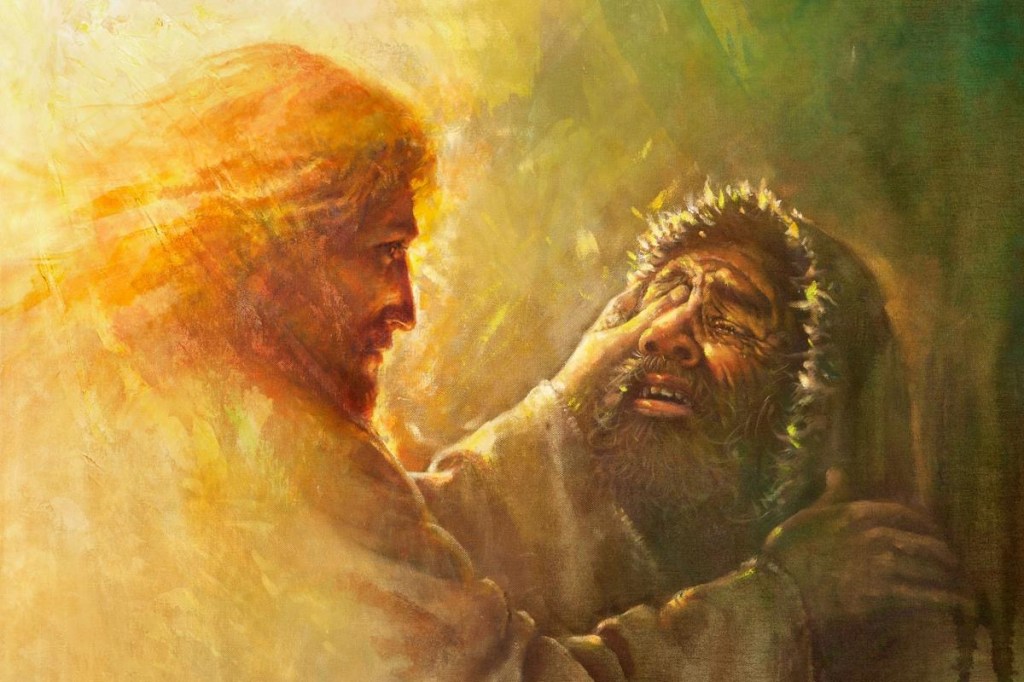
Healing the Blind Man by Yongsung Kim
 Sunday Gospel Reflections