HOMILY: Fourth Sunday of Advent (A)
Isaiah 7:10-14 / Romans 1:1-7 / Matthew 1:18-24
21 December 2025
Fr. Ricky Cañet Montañez, AA
A few years ago, someone came to see me late in the afternoon. He sat down, sighed deeply, and said, “Father, I did everything right. I followed the rules. I tried to be good. Pero bakit parang mas lalo pang gumulo ang buhay ko?” (But why does my life seem to be getting even more complicated?) He had avoided trouble and made responsible choices. He lived decently and yet, at that moment, his life was more complicated than ever. The deepest pain was not the problem itself, but the question that lingered in his heart: “If I was trying to do what was right, why did things turn out this way?”
That question brings us very close to Joseph today because he had every right to ask that same question of God. Joseph was a good man — righteous, the Gospel says. He did what was right. He lived quietly. He had plans. His life made sense. Then one day, he finds out that his fiancée Mary was with child. For Joseph, this was confusion, heartbreak, and public shame all at once. Being a reasonable person, Joseph found a solution that was lawful but still clean and quiet — he decided to walk away. And then God intervened — not to simplify Joseph’s life, but to complicate it even more. In a dream, God asked Joseph to stay, take Mary into his home, and raise a child that was not biologically his. For all his life he would have to live with questions, that would never be fully answered. Why would God do that?
Many of us know this experience. How many times have we thought that leaving a difficult situation was easier than staying? How many times did we wonder if we were justified in protecting ourselves and walking away? Those of us who are married know, that life together as a couple is not always smooth-sailing. Sometimes, family life can be so overwhelming, especially when we are burdened with responsibilities that were not of our choosing. We pray, “Lord, make this easier.” However, God sometimes replies, “Stay. I am with you.” God does not always save us by removing the difficulty. Like Joseph, He saves us by calling us to remain faithful when obedience is costly and the road is unclear.
Notice that God does not explain everything to Joseph. The angel does not give a long lecture. He simply says, “Do not be afraid.” (Matthew 1:20) That is often how God works. He gives us His PRESENCE, not explanations. Saint Paul reminds us in the Second Reading (Romans 1:1-7) that we are called by grace — not because we are ready or because we understand everything. God simply chooses to work through our imperfect lives. Joseph, himself, did not become holy because he understood God’s plan. He became holy because he trusted in God’s abiding presence in his life. Isaiah gives that presence a name: Emmanuel — God with us. It does not translate to “God who removes all complications” or “God who fixes everything instantly”.
Months later, I crossed paths again with the man who had spoken to me. And he said something simple and true: “Father, hindi pa rin malinaw ang lahat. Pero sa gitna ng kalituhan, doon ko nadama — hindi pala ako iniwan ng Diyos.” (Father, things are still unclear. But in the middle of it all, I felt that God had not abandoned me.) That is a clear example of Advent faith! The Emmanuel did not wait for life to become neat and orderly. He was born in the middle of confusion, uncertainty, and unfinished stories.
On this Fourth Sunday of Advent, let us stop asking questions like: “Lord, bakit ganito?” (Lord, why did it turn out this way?) but rather ask “Lord, nasaan Ka dito?” (Lord, where are You in this?) Sometimes, the complicated road we are walking is not a sign that God is absent. It may be the very place He has chosen to stay. Like Joseph, may we choose to trust — not because everything makes sense, but because God (the Emmanuel) has chosen to stay with us!
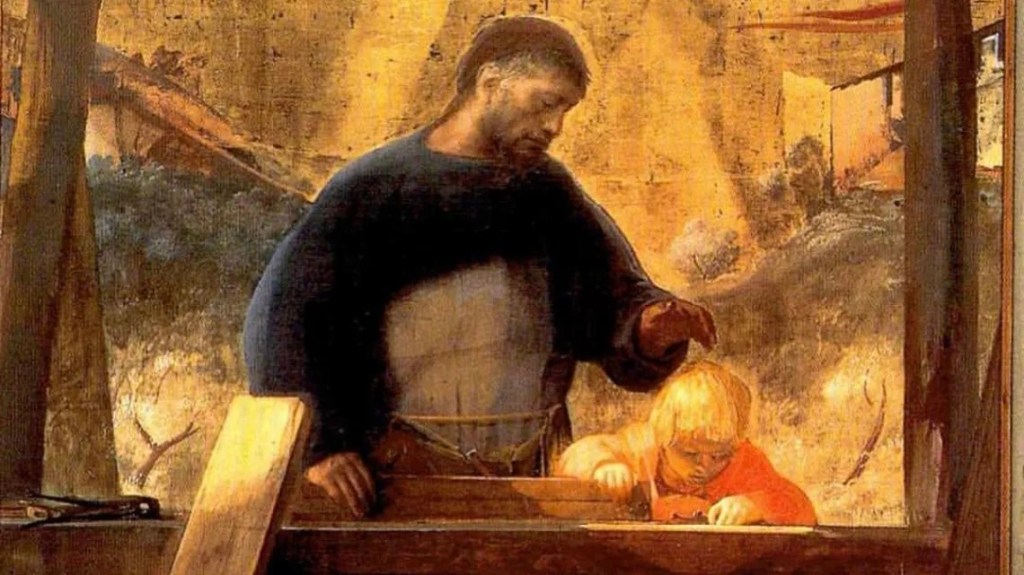
Featured Image: Altarpiece of St Joseph the Worker. Pietro Annigoni (1910-1988). Chapel of the north aisle, Basilica of St Lawrence, Florence. Italy, 20th century.
 Sunday Gospel Reflections