HOMILY: Second Sunday of Advent (A)
Isaiah 11:1-10 / Romans 15:4-9 / Matthew 3:1-12
7 December 2025
Fr. Ricky Cañet Montañez, AA
Have you ever noticed who sits beside whom at gatherings? In meetings, reunions, in school canteens, even simple parish meals, we naturally choose to be with people who make us comfortable. In the same way, there are people we quietly avoid. It is not because we are mad at them, but because being around them is just… draining. Their company can feel complicated, awkward, or just plain exhausting. Once in a while, you see two people who never hang out somehow end up next to each other and, surprisingly, get along really well! They talk. They laugh. And we find ourselves thinking, “Sino’ng mag-aakala?” (Who would have thought?) “Parang imposible dati.” (It seemed impossible for this to happen!)
This surprising image — the impossible sitting together — is exactly what Isaiah describes today in the First Reading. The wolf with the lamb. The leopard with the goat. The calf with the lion. A child leading them all. This is more than the absence of conflict. It involves a transformation so deep that natural enemies can share the same space. Picture the lion — a natural predator, giving up meat to eat grass like a cow. Isaiah is painting for us an image of God’s Kingdom: a holy place where there is “no harm or ruin”, where the incompatible become neighbours, the impossible co-exist, and grace makes possible a peace that defies logic.
If we are honest, each of us has our own “wolves and lambs” moments in life. There are people we avoid because of a difficult or painful past experience, or our personalities often clash with theirs, or because being with them often leads to some misunderstanding. Around them, we exert a lot of effort to hold our tongue and keep our emotions in check to keep the peace. Sometimes we are the wolf in someone’s story — someone finds us difficult or hard to approach. Sometimes we are the lamb — wounded, cautious, preferring distance. Advent invites us to look gently at these places of tension. It is not to solve everything overnight, not to force reconciliation, but to allow God to plant even a small shoot of peace in the ground that has dried and hardened.
This slow, gentle work of God is echoed in John the Baptist’s call: “Prepare the way of the Lord, make straight his paths.” (Matthew 3:3) John warns the wicked to repent and produce good fruit as proof of repentance because God is sending someone mighty, with the ability to “baptize with the Holy Spirit and fire” (Matthew 3:11) who is meant to gather the grain and separate the chaff for burning. This refers to the Messiah’s definitive judgment that will result in the preservation of the faithful and the utter destruction of the unfaithful and the forces of evil. This time of justice is prophesied by Isaiah who describes a Messiah with the “spirit of wisdom and of understanding, counsel and of strength, … knowledge and of fear of the Lord” (Isaiah 11:2) who shall judge the poor with justice, and… strike the ruthless and slay the wicked with His mouth and His breath. (Isaiah 11:4) For those of us now, who look forward to the return of Christ who will usher a time when everyone —Jew and Gentile, will glorify the Lord together. St Paul tells us that all that is written about the coming of Christ is meant to give us hope. He says that as we wait patiently, we must already try to live in harmony with each other.
This Advent, let us not only prepare a straight path for Christ into our hearts — let us also allow God to straighten the paths between and among hearts, especially where relationships have become crooked or blocked. They say some of the hardest roads to repair are emotional ones because there are the hurts we avoid and ignore. It is when we take even a tiny step toward the people we have kept at a distance that the Kingdom begins. Isaiah’s vision reminds us that God does not only change situations — He can change natures. Obviously, wolves and lambs cannot change what they are but grace can transform the way they relate. This means that even if personalities do not change, and even if painful history cannot be erased, God can soften what feels unchangeable. God can give us new instincts: a little more courage, a little more gentleness, a little more desire for peace so being around people who trigger us, does not feel like torture.
And so we return to that simple image from the beginning: who do we sit beside, and who do we avoid? Advent is not about forcing ourselves into uncomfortable places, but about letting God stretch our hearts just enough to imagine the possibility of peace. God dreams of a world where the impossible can finally sit together. Our psalm today reminds us that in God’s time justice shall flourish and the fullness of peace will be felt forever. (Psalm 72:7)
Today, perhaps we can offer a simple prayer: “Lord, give me the grace to take one small step toward the person I never thought I could ever sit beside.” In that humble space, the Kingdom quietly begins.
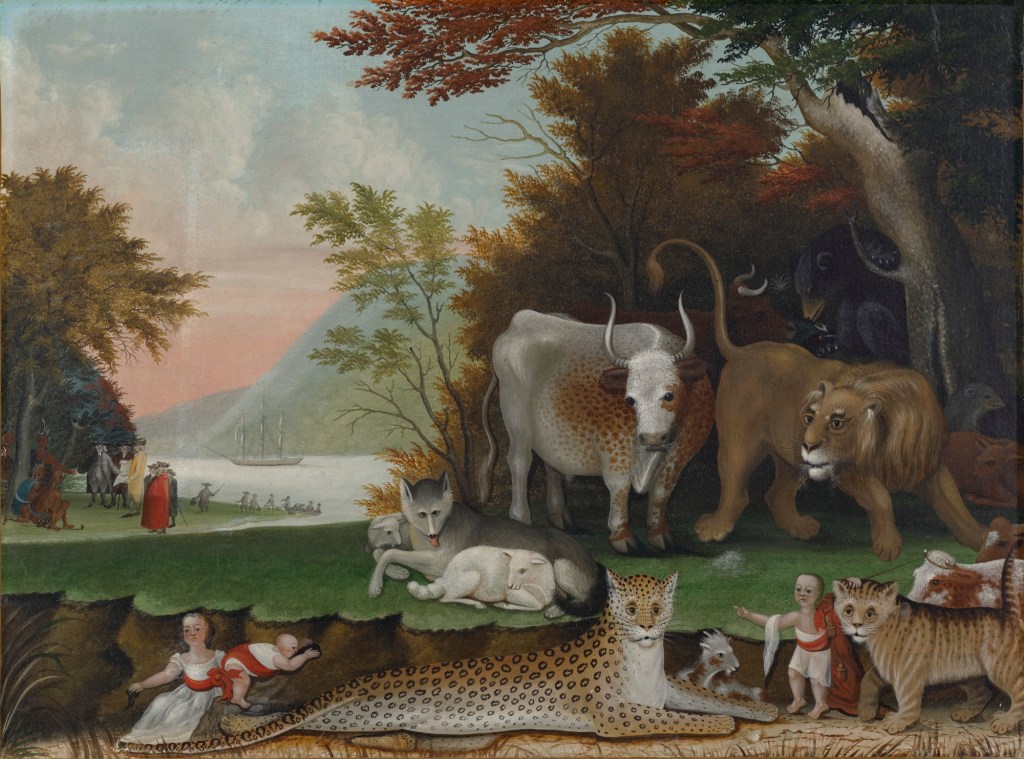
Creator: Buffalo AKG Art Museum Photo Credit: Brenda Bieger
 Sunday Gospel Reflections