Homily: Feast of the Dedication of the Lateran Basilica in Rome (C)
Ezekiel 47:1–2, 8–9, 12 / 1 Corinthians 3:9c–11, 16–17 / John 2:13–22
9 November 2025
Fr. Ricky Cañet Montañez, AA
Whenever there is a typhoon, I am filled with dread over the flash floods that halt transportation, displace residents, and endanger lives. There are often scenes on social media of families on rooftops, homes swept away, and soaking children clutching plastic bags of clothes. However, there is another scene flooding feeds that warms my heart and fills me with hope — parishes opening their doors, neighbours sharing food, and strangers helping others with quiet generosity. Grace is truly at work when out of the muddy waters, compassion flows.
Today, we celebrate the Dedication of the Lateran Basilica in Rome. Before the Vatican was built, this place is where the Pope held office for centuries. This feast reminds us of the centrality of church to our worship of God. Spelled with a small letter “c”, the church refers to the sacred structure where the faithful gather for the sacrifice of the mass. On the other hand, the Church with a capital “C” refers to all of us, the community of believers in Jesus Christ, who gather to worship God. Our readings today speak to us about the temple — both as a sacred building and as the people themselves — to remind us that the true temple of God is not just a monument, but a movement of love. God does not dwell in buildings that glitter; He dwells in hearts that give, in lives that overflow with mercy and compassion.
In the gospel passage from St. John, we hear of the cleansing of the temple by an angry Jesus who is upset because money changers and vendors have dishonoured the place reserved for the dwelling of God. His anger reveals how sacred the temple has to be — a place where God’s presence dwells and gives life. That same truth is beautifully expressed in the First Reading, where the prophet Ezekiel speaks of a river flowing from the Temple, bringing life wherever it goes. The terrain of the Holy Land is mostly desert area where nothing grows so the image of life-giving water flowing from the temple allowing fruit trees to grow and fish to be abundant and living things to multiply, is proof that God, the Source of life, is present there. This image finds its fullness in Jesus, who reveals that He Himself is the new Temple — the living dwelling place of God among us — who will be torn down and raised up in three (3) days through His death and resurrection. From the Temple of His body, life and mercy flow out for the world when blood and water pour from His pierced side.
In the Second Reading, St. Paul tells us that as believers, we have also become the temple of God because the spirit of God dwells in us! If we are His Body, then the living water that is Jesus, must flow through us. The question is: do we allow Christ to flow from us or have we allowed this living water to be stagnant? These days, there are mega-churches that seem to have taken on the look and feel of concert halls — glamorized by stage lights, state of the art facilities, vibrant applause — rather than places of worship. One cannot help but ask, “Did I come here to watch a concert, or did I come to worship?” They are impressive structures, but when the floods come, people do not run there for shelter. They are beautiful but distant. There are also groups who, though claiming to act in God’s name, become caught up in rallies and causes that, deep down, only serve the interests of those already powerful — the very people who exploit, deceive, and neglect the poor.
The real Church of Christ — the one founded on compassion, not convenience — is found where the poor are. In chapels that double as evacuation centres… In parishes that smell not of perfume but of “baha (flood) and “lugaw” (hot porridge). In priests, sisters, and lay volunteers who choose to stay with the people when the waters rise. It is not built on marble — it is rather built on mercy. Pope Leo XIV, in Dilexi Te, writes: “In the poor we see the suffering of the innocent, and therefore the suffering of Christ Himself.” He also says that true faith must bring a change of mentality that affects culture itself. Ang ibig sabihin, hindi lang ito tungkol sa pamimigay ng tulong. (It means this is not just about giving help or material aid.) It is about reshaping how we see the world — standing with the powerless instead of flattering the powerful. When we see Christ in the jeepney driver whose route is flooded, in the teacher still showing up despite delayed pay, or in the child sleeping on a pew in an evacuation centre — that is when we become a Church that smells like “tubig ng buhay” (water of life) not perfume.
So, let us be that kind of Church: humble, open, courageous. A Church that does not stand with the powerful, but with the powerless. A Church that, when the next storm comes, people can run to — not for a show, but for shelter because the Church of Christ does not stand above the storm — it steps into it. It kneels with the wounded and prays with the soaked. It carries not the scent of luxury, but of life — the smell of water, of mercy, of hope.
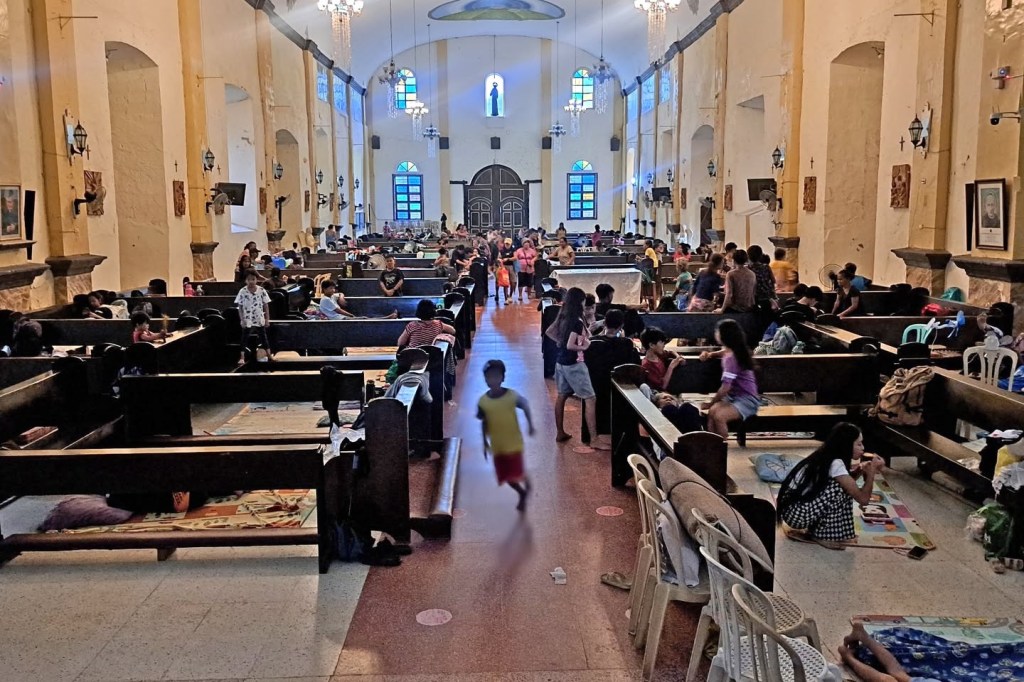
From Publiko’s Post
 Sunday Gospel Reflections