Homily: Solemnity of All Saints
Revelation 7:2–4, 9–14 / 1 John 3:1–3 / Matthew 5:1–12
1 November 2025
Fr. Ricky Cañet Montañez, AA
A few years ago, I was at the wake of a quiet woman from our parish. She was not the type to stand in front or hold positions. She sat in the back pew, prayed quietly, and always smiled when you pass by. But during the eulogies, story after story came out — how she quietly paid part of a neighbour’s hospital bill, how she would bring cooked food to an old man who lived alone, how she prayed the rosary every night for those who were sick or struggling. People said, “We did not know she was doing all that!” And I thought to myself — ah, maybe that is the point!
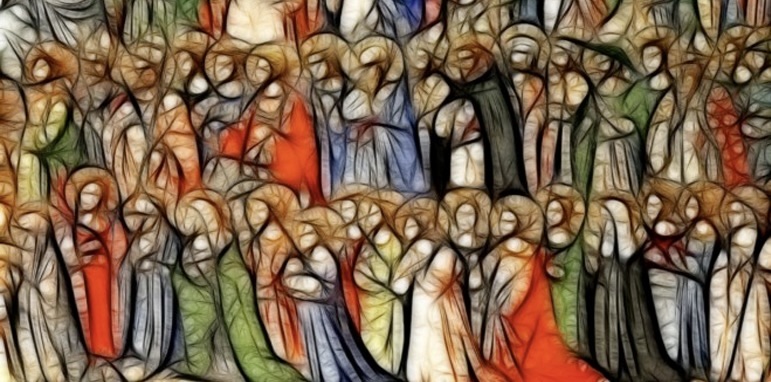
Today we celebrate holiness — not just the great, canonised saints with feast days and statues, but also the ones who walked among us in silence and kindness. In the First Reading, John sees “a great multitude that no one could count” (Revelation 7:9) — people from every nation, standing before God in white robes. These are the saints who went through life’s struggles and remained faithful. Some of them are recognized by the church for their exceptional virtue or holy martyrdom and we know them by name — Augustine, Francis, Teresa, Faustina, Lorenzo Ruiz, Pedro Calungsod and many others. Many of them though go nameless in history but they are never nameless to God. Their holy lives and good works are always before the eyes of our Lord.
St. John in the Second Reading, tells us something beautiful: “See what love the Father has bestowed on us, that we may be called children of God.” (1 John 3:1) In other words, sainthood begins not in heaven, after we die, but it starts with accepting that we are God’s children and that we are loved so very much, right here, right now. This is something that should motivate us to nurture that gift, little by little, every day so that we grow in relationship with God and all those whom He loves.
In our gospel Jesus gives us signposts for holiness in the Beatitudes: He says, “Blessed are the poor in spirit… the merciful… the peacemakers.” (Matthew 5:1–12)
• The poor in spirit — maybe that is the widow who prays every day for others or the doctor who willingly goes on mission to remote areas.
• The merciful — maybe that is the nurse who stays late to comfort a patient or the neighbour who helps when our family is in crisis.
• The peacemakers — maybe these are the parents who choose patience instead of anger… or the child who apologises first after a sibling squabble.
The Beatitudes is not a list of impossible goals for those with special powers. It is a portrait of “the saints next door” painted in the likeness of ordinary people.
The saints are not a distant group of superhuman people. They are the ones who chose love when it is easier to look away, who forgive when it hurts, who remain kind even when no one notices. And maybe we have met them — the grandmother who prays for everyone by name, the catechist who serves year after year without recognition, the tricycle driver who says a quiet “Thank You, Lord” before every trip. They are the ones who need not announce themselves as they work to build Christ’s kingdom. They just love quietly but tangibly. If we could see with God’s eyes, we would realise that the Church is full of these hidden saints — unsung, unnoticed, but radiant in His sight.
Thus today, as we honour all the saints, we are all invited: Let us not only admire them, let them be our inspiration — proof that our human weakness is not a permanent block to becoming holy. Holiness, after all, is not about doing big things or strictly observing Church rules; it is about doing ordinary things with great love. This is the mark of Christ. Yes, sisters and brothers, let us do our best, in our own ways, to bring holiness down to earth — to our kitchens, classrooms, offices, and communities, with the hope that one day, we may also join the saints in Heaven.
Maybe, years from now, when a few would remember us, they will tell small stories of kindness, patience, and prayer. And someone might whisper, “We did not know she was doing all that.” “We did not know he was doing that!” And God will smile and say, “Yes, I did!”
 Sunday Gospel Reflections