Homily: Solemnity of Saints Peter and Paul, Apostles
Readings: Acts 12:1–11; 2 Timothy 4:6–8, 17–18; Matthew 16:13–19
29 June 2025
Fr. Ricky Cañet Montañez, AA
Today we celebrate two giants of our faith: Peter and Paul — pillars of the Church, apostles, martyrs, and saints. They were responsible for the spreading of the faith among the Jews and the Gentiles — essentially the whole world.
These days that job rests mainly on the shoulders of priests. It is a tough job because we give up so much of regular life to care for the people of God and propagate the faith. If you think that many of us are not skilled enough to be priests, many of us feel the same way about ourselves. We are very aware of our own limitations and shortcomings. We often wonder why God chose us. In times like these, what strengthens us is the knowledge that the pillars of the Church were not perfect either. Peter, impulsive and emotional, swore he would never abandon Jesus — only to deny Him three times on the night of His arrest. Paul, brilliant and zealous, did not just reject Jesus — he actively persecuted Christians, dragging them from their homes and sanctioning their deaths. Like Peter and Paul, we priests are not sinless men. We are all wounded men in the same way you are. Like you, we also need to examine our conscience and go to confession. As we have roles to play in building Christ’s Church, so do you. Yes, let us not allow our imperfections to cast doubts on our worthiness to serve God. Let us always keep this in mind: Jesus chooses the imperfect to work wonders in His Church.
In the Gospel today, Jesus asks: “Who do you say that I am?” (Matthew 16:15) Peter, inspired by the Father, answers: “You are the Christ, the Son of the Living God.” (Matthew 16:16) And Jesus declares: “You are Peter, and on this rock I will build my Church.” (Matthew 16:18) Christ is not referring to Peter the perfect disciple — but Peter, the forgiven one. The same Peter who, in today’s First Reading from the Acts of the Apostles, finds himself in prison, shackled, awaiting death — until an angel sets him free. Peter knew that the same God who forgave him was the same God who could deliver him. Paul, in the Second Reading, looks back at his life: “I have fought the good fight, I have finished the race, I have kept the faith.” (2 Timothy 4:7) however, let us listen to what else he says: “The Lord stood by me and gave me strength… I was rescued from the lion’s mouth.” (2 Timothy 4:17) He never says, “I earned this.” He says, “God did it. God rescued me.” That is the heart of today’s feast. Not that Peter and Paul were strong — but that God was stronger than their weakness. Not that they were holy from the start — but that they let grace change them.
In the movie Green Bones, there is a scene where Domingo Zamora says, “Hindi ako mabuting tao.” (“I am not a good person.”) Grossly aware of his errors in life, he is not proud of the things he had done. He is very much convinced that his past disqualifies him from experiencing good. “I have made too many mistakes.” “I am not worthy to serve.” “God cannot use someone like me.” Maybe sometimes we say these to ourselves, too.
However, please pay attention to what Prison Chief Inspector Jorge de los Santos tells him: “Kung bibigyan mo ang sarili mo ng pagkakataon, puwede kang lumaya.” (“If you give yourself the chance, you can earn your freedom.”) That is the same grace Peter and Paul received. God did not erase their past, but He granted them freedom from the stigma of their mistakes. God does not pretend our wounds do not exist; He transforms them into signs of hope. As Paul once wrote: “By the grace of God, I am what I am.” (1 Cor 15:10) And as St. John Paul II echoed centuries later: “We are not the sum of our weaknesses and failures, but the sum of the Father’s love for us.”
Thus today, let us stop hiding our wounds. Let us stop saying, “I’m not good enough.” Moreover, let us start saying, “God is good enough to use even me.” Peter and Paul did not just tell people about Jesus. They told people what Jesus had done in them. Let us do the same. Our story — yes, even the messy parts — might be exactly what someone else needs to hear. May we have the humility and courage of Peter and Paul — not just to preach the Gospel, but to live it through the story of what God has done in our lives!
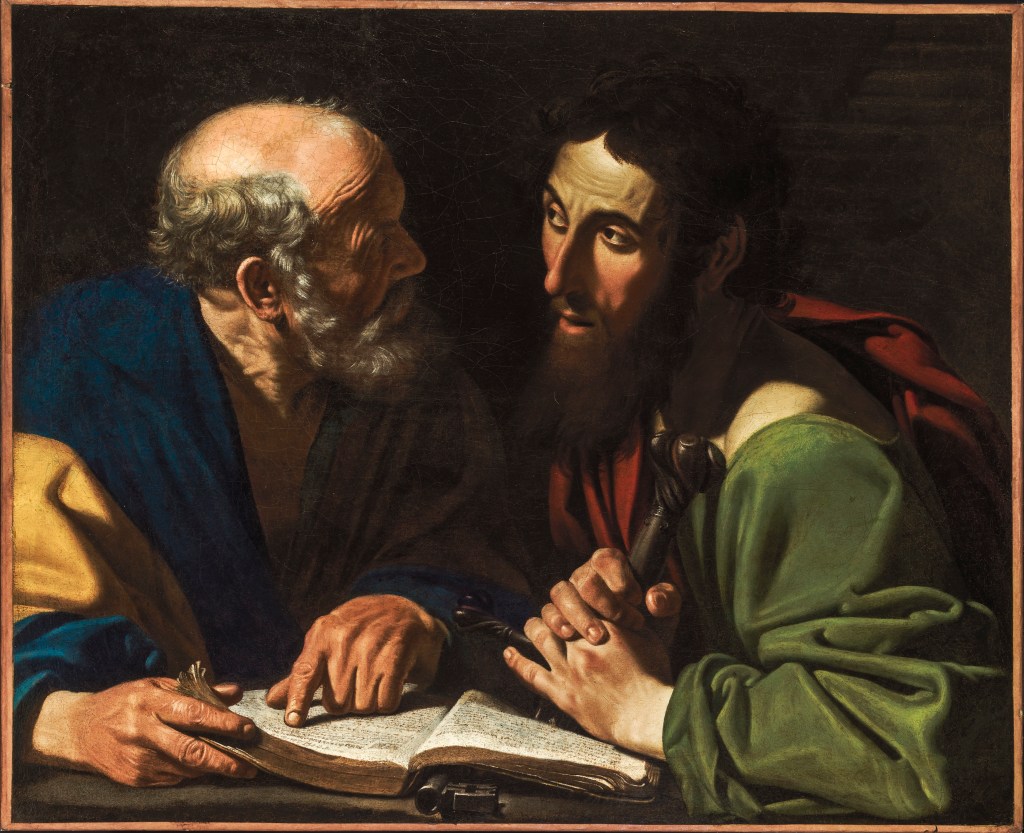
Attributed to Pietro Antonio Novelli (Kress Foundation)
 Sunday Gospel Reflections