Homily: Fourth Sunday of Easter (C) / Good Shepherd Sunday / World Day of Prayer for Vocations
John 10:27-30
11 May 2025
Fr. Ricky Cañet Montañez, AA
When I was a child, whenever my siblings and I were wandering out in public, we knew precisely when Mama was calling us to her side without her even mentioning our names. “Kahit maingay sa paligid, dinig na dinig namin pagsusutsutan kami ni Mama.” (Despite the noise, Mama’s “pssst” still came through us loud and clear.) We stop in our tracks and look her way awaiting the next instruction with the gesture of her hand. Now that I am grown up, and Mama gone, no one can call my attention that way anymore. It worked with Mama because we knew her voice.
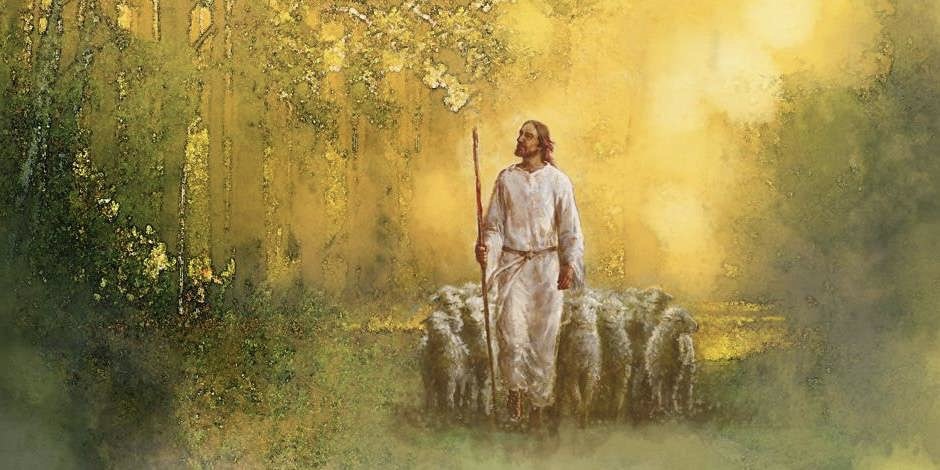
Today Jesus tells us: “My sheep hear my voice. I know them, and they follow me.” (John 10:27) This is a comforting promise to all those who acknowledge Jesus as their Shepherd and Master. If you ask a shepherd today, they will tell you that even if they tend to a large flock of sheep, they can identify each one and tell you the individual peculiarities of the animals. Jesus as the Good Shepherd also knows His sheep, and He knows each of us personally and intimately. Yet, we must not forget that Christ is the Shepherd not just of some, but of all. His voice goes out to the ends of the earth.
In Acts, we see evidence of this universality. Paul and Barnabas went to the synagogue, as they always did, to preach the Word. We are told the influential Jewish men stirred up the persecution of the two, even dissuading the prominent women who were believers. Despite this, they did not retaliate nor speak against them, they simply turned to the Gentiles. They “shook the dust from their feet” and went to Iconium. (Acts 13:51) They say, “We now turn to the Gentiles… for the Lord has commanded us: I have made you a light to the nations.” (Acts 13:47)
It was not an act of spite but rather of openness to other waiting opportunities. This shift is not abandonment — it is expansion. Recall that in Matthew 10, when Jesus sent out the Twelve (12) Apostles for the first time, He told them, to bring nothing with them, to avoid the Gentiles and Samaritans, and if they are not welcomed or listened to, they should leave and shake the dust off their feet. The reason for this being that the Jews were supposed to be the first recipients of the Gospel. After Jesus’ Resurrection and Ascension, the mission expanded to include the Gentiles. The Great Commission in Matthew 28:19 explicitly commands the disciples to “go and make disciples of all nations”. This affirms how the Shepherd’s voice calls out not just to one group, but to the entire world — a growing flock that crossed borders, languages, and expectations.
Something we must remember is that this sheep and shepherd relationship is not a one-way street. We have to remain close to Jesus to be sensitive to His voice. Sometimes, when we are overwhelmed by the noise of the world and the various voices calling our attention, they may drown out the voice of our Shepherd. He promises to care and protect us but we have to choose Him. We have to listen to Him and respond to Him. Jesus promises that His flock shall never perish and that “No one can take them out of My hand.” (John 10:28) However, we tend to jump out of His hand of our own volition. When we sin and reject Christ and His teaching, we are choosing to leave the safety of the fold and the protection of our Shepherd. Despite this, Jesus never tires of seeking us out, sending His disciples, to bring us back to Him.
In our own day, we are reminded of this universal mission especially in the election of a new pope. A few days ago, Robert Francis Cardinal Prevost, was elected as our 267th pope, taking the name Leo XIV. He is an American and an Augustinian who spent many years ministering to the faithful in Peru. We have to bear in mind that whoever is chosen does not become a shepherd only of his country or his continent. He becomes a shepherd for the whole Church — East and West, young and old, rich and poor. He is a successor to Peter, responsible for feeding all the sheep, just as Christ commanded. In this age where a premium on individualism has led to alienation and division, the Church must always reflect the heart of the Good Shepherd — one who seeks out the lost, and gathers God’s children who have scattered.
Let us be part of that mission. Let us listen to the voice of Jesus Christ, our true Shepherd — not just for ourselves, but so that we may help others hear it, too. And let us pray for our Holy Father — that he may, in imitation of our Lord, and guided by the Holy Spirit, shepherd the entire Church with wisdom, mercy, and courage.
 Sunday Gospel Reflections