Homily: Third Sunday of Easter (C)
John 21:1-19
4 May 2025
Fr. Ricky Cañet Montañez, AA
Is there anyone here who believes he/she owes a deep debt of gratitude to someone else? (Meron ba kayong pinagkakautangan ng loob?) I am not talking about a monetary debt, but rather one that arises from another or others saving your life — be it because of their friendship, their compassion, their inspiration or their heroism. Would you take a bullet for them? Donate a kidney if they need it? Some people give their whole lives in humble service and staunchly defend their honour. Others would stand in between them and danger. How far would we go to repay our debt to that person?
Today’s readings highlight the response of Peter to the risen Christ. Remember that Peter was Jesus’ trusted right-hand man. He was among the intimate circle of friends Jesus chose to witness the raising of Jairus’ daughter and the miracle of the Transfiguration. Jesus even openly declared that He would build His church on the rock that was Peter. And yet Peter denied his friendship with Jesus at the onset of the Passion, when his friend needed Him the most. Peter owed his new life to Jesus and yet he betrayed His trust deeply. Imagine how he must have felt seeing his friend alive again yet in the back of his mind he knew they were still not properly reconciled.
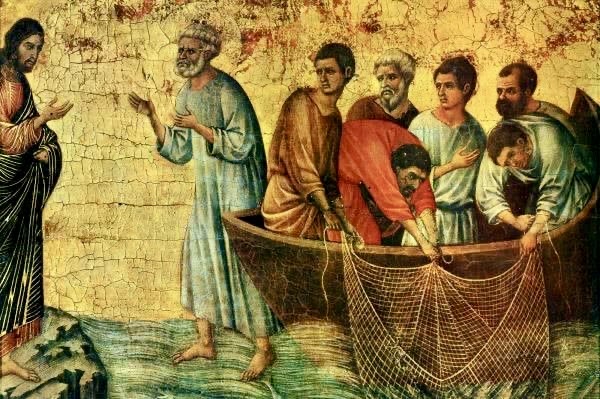
In our gospel we find the disciples back in Galilee and Peter decides to go fishing. In one sense, he is simply returning to what he knows. He is probably wondering what will become of his friendship with Jesus and if he still has a role to play in their mission. He is already considering giving up and going back to his old life. It feels like a quiet kind of defeat — a slipping back into the old ways now that the high drama of Holy Week and Easter morning have passed. And isn’t that our experience, too? After Easter joy, after spiritual highs, how quickly we find ourselves drifting back into old habits, old fears, and familiar distractions.
The other disciples fishing with him are equally discouraged when they catch nothing all night. These are seasoned fishermen and yet they take advice from a stranger on the shore. They seem to have lost confidence in themselves as is typical of a group that has lost their leader. They were sheep who have lost their shepherd. When they finally realise it was Jesus speaking to them, Peter jumps out of the boat and swims to shore to meet Him. He could not wait a minute longer. To his relief, he sees that Jesus has come to them not with judgment, but with breakfast. And more than that, He comes with mercy and memory. He re-calls Peter by repeating the very miracle that called him the first time. A night of empty nets. A simple command. An abundance that breaks the nets.
It is this love — the love of the Risen Lord who comes looking for us, who renews our call when we have faltered — that gives Peter the courage we see in Acts (Acts 5:27–32, 40b–41). Peter and the apostles, having been arrested and humiliated, leave the council rejoicing. Not outraged. Not discouraged. But rejoicing — because they had been found worthy to suffer dishonour for the name of Jesus. The Peter who once denied Jesus three times now refuses to deny Him before the authorities. “We must obey God rather than human beings” (Acts 5:29), he says. That kind of response does not come from sheer determination or personality. It is the fruit of a life so rooted in the Risen Christ, so filled with the Holy Spirit, that even suffering becomes a sign of intimacy with the Lord. This is how Peter repays his debt to the Lord. He devotes his entire life to spreading the gospel of Jesus Christ and witnesses to the truth of God’s infinite love for us.
What changed? Peter did not just believe in a Risen Christ — he had encountered the One who loved him even in failure, the One who filled his empty nets again, the One who said, “Follow me,” again. That is our hope, too. That the Risen Lord comes to us not just once, but again and again. He meets us in our return to “fishing,” in the places we feel stuck or lost — at times when we have failed and doubt ourselves, questioning if we still have a place in His church. And with gentle persistence, He fills our nets and renews our call. I, too, find myself often praying that I might not grumble at the cost of my call to priesthood, but rejoice that even in my hardships I might serve His holy name.
May we have eyes to recognise Him, hearts to receive Him, and courage to obey Him — no matter the cost. And may we, like the apostles, come to see every trial, every hardship, as a chance to walk more closely with the One who first called us and who never stops calling us to conversion, to mission, and His friendship.
 Sunday Gospel Reflections