Homily: Second Sunday of Easter / Divine Mercy Sunday
John 20:19-31
27 April 2025
Fr. Ricky Cañet Montañez, AA
Do you find it easy to forgive someone who offended you? If your answer is “NO”, ask yourself if it is easy for you to ask forgiveness when you are the offending party? Some people only confess during Kumpisalang Bayan (Parish-wide Penance Service) thinking it is better to confess their habitual sins once and avoid going to confession frequently for the same sins. Others are so ashamed of their sins that they cannot bring themselves to speak of what they have done even in the confidentiality of the confessional. Either way, you are short-changing yourself by avoiding the mercy of God. Pope Francis once said “God never tires of forgiving us; we are the ones who tire of seeking his mercy.”
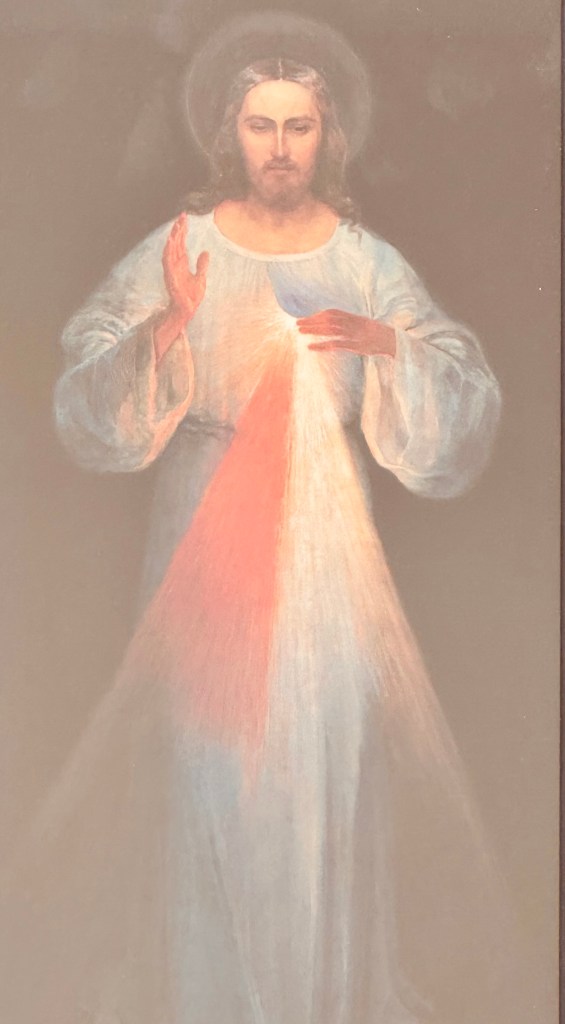
Today, on Divine Mercy Sunday, we reflect on the forgiveness that we can always expect from Jesus, most especially on this Feast. He says that those who go to confession and receive Holy Communion today will receive the complete forgiveness of their sins and the punishment resulting from them. Blood and water gush forth from the heart of Jesus as a fountain of mercy. Even the most hardened sinner, once immersed in the ocean of His mercy will be forgiven. This promise, anchored on the boundless mercy of God, is our ultimate hope. This is something we can count on. Jesus, the Divine Mercy will not fail us if we approach Him with full trust and confidence. He loves us so much that He does not want us to be separated from Him. God our Father encourages us to embrace His forgiveness that He may grant us the opportunity for a renewed life and a deeper connection with Him.
On Holy Monday, I heard the confessions of Persons Deprived of Liberty (PDLs). In my thirteen (13) years as a priest, I have never heard confessions more powerful and heartbreaking than these. One conversation with a lady inmate had such a profound impact on me. The woman hesitantly stepped forward. She admitted she hadn’t really wanted to come for confession but her fellow inmates had urged her to. Avoiding my gaze, she said quietly, “Nagsasayang ka lang ng oras, Father. Hinding-hindi mamahalin ng Diyos ang taong tulad ko.” (“You’re just wasting your time, Father. God will never love someone like me.”) I gently asked, “Bakit mo naman nasabi yan?” (“Why would you say that?”) Her expression hardened as she revealed she had done contemptible things too terrible to mention. “Ang nakikita ko sa sarili ko ay isang taong wala nang kaligtasan. Ang tulad ko, wala nang pag-asa.” (“I see myself as someone beyond salvation. There is no hope for someone like me.”) My heart sank. I felt such pity and compassion for her. I told her “With God, there is always hope. No one is worthless. No one is unredeemable. His mercy is unlike that of human beings because His mercy has no limits. There is no sin so dark and deep that is beyond the reach of His love. Ang Kanyang pagmamahal ay hindi batay sa anumang magagawa mo. “Mahal ka Niya dahil sadya ka Niyang nilikha at inangkin bilang anak.” (“His love is not based on anything you can do. He loves you because He intentionally created you and claimed you as His child.”) I pointed out to her Romans 5:8: “…God demonstrates his own love for us in this: While we were still sinners, Christ died for us.” She looked at me for the first time and I saw tears in her eyes. In that moment, I knew grace had entered the room.
It may not seem sensible that God’s mercy should bypass the full force of His justice, but it does, because His love for us is simply so great! This is the power of Divine Mercy. It does not excuse sin, but it heals it. It does not erase the past, but it gives us a future. And that future is rooted in hope — the hope that no life is beyond redemption, and no one is too far for God’s embrace. By God’s grace, we are freed from the burden of guilt and we receive the Lord’s peace. We are equally encouraged to extend the same mercy to others, reflecting God’s compassion for all.
So today, on this Feast of the Divine Mercy, let us carry this message in our hearts: God’s mercy is bigger than our greatest failure. No matter where we are — in prison, in pain, or in doubt — there is hope. If God can transform the heart of a prisoner, imagine what He can do in our life — if we let Him.
Jesus, we trust in You.
 Sunday Gospel Reflections