Homily: Fifth Week Week of Lent (C)
John 8:1-11
6 April 2025
Fr. Ricky Cañet Montañez, AA
“Bawal ang judgmental!” (“Being judgmental is prohibited!”) I’m sure most of you have heard that line before. It is a very common sentiment these days, especially among the young. In books, memes, movies, videos, and even in everyday conversations, there are reminders not to be “judgy”. However, I bet more often than not, we all make judgments on others. It is just that some of us are better at keeping our thoughts to ourselves. Am I right?
In today’s gospel passage, a group of scribes and Pharisees brought to Jesus a woman caught in the very act of adultery. Hoping to get Him to react in a way that would entrap Him. They wanted Jesus to contradict His teachings and try to get Him to publicly disregard Jewish laws. As the story progresses, we are told that instead of passing judgment on the woman, Jesus “bent down and wrote on the ground with His finger.” John 8:8) Then He challenges them saying, “If any one of you is without sin, cast the first stone”. (John 8:7) He writes on the ground once more and the people walk away from Jesus and the woman. He addresses her and says “Has no one condemned you? “No one, sir,” she said. “Then neither do I condemn you,” Go and sin no more.” (John 8:10-11)
The story shows how judgmental the Jewish leaders were. Worst of all, their judgment of this woman did not stop there. They condemned her for her misdeed and were ready to take her life. I recall one of my professors saying that “If she was caught in the very act of adultery, why did they not bring in her partner as well?” That is a genuinely valid question. Both were guilty of the act and under the Jewish law both of them are supposed to be stoned. Thus, why was it only the woman who was brought in to be judged? That double standard persists today, as evidenced by the use of the term “mistress” or “kabit” to refer to a woman who is involved as the third party in a marriage. However, when a man has an affair to a married woman, what do we call the man? Let me know after mass, if you have the answer!
Jesus shows the woman mercy. He does not belittle her sin, but neither does He take away from her the chance at repentance. He sends her on her way with the mandate to “Sin no more.” (John 8:11) This is parallel to how God the Father has forgiven Israel countless times for their repeated infidelity. The prophet Hosea speaks of how God was willing to take back His people and make them “clean” after they had degraded themselves by worshipping other gods and disobeying the Father’s commandments.
The Gospel passage teaches us to be most mindful in arriving at conclusions and in making judgments. Sometimes, we are given information that normally we consider “nakakasakit ng ulo” (headache-inducing) or “nakakataas ng Blood Pressure” (raises Blood Pressure) Before we react, it is best to take a breath and take a step back to assess whether it is true and if we are seeing the complete picture. More often than not, we overreact or make hasty conclusions about people and situations without making an effort to fact check or learn the whole story.
We live in unusual times where we have access to a wealth of information online and the speed of communication has improved tremendously. Yet, if we are not careful, the act of sharing texts, videos and photos can make us transmitters of lies and destroyers of innocent people’s reputations. These days there is so much fake news, spliced videos and altered photos, that we can no longer accept things at face value. More so now, because AI is making it so easy to create fake videos and photos. Those with the right tools and mischief in mind can easily create a fake narrative and provoke people. We cannot simply believe everything on the internet and social media.
On a final note, let us look at the unusual action of Jesus in the story — “He bends down to write on the ground with his finger.” (John 8:6,8) A Bible commentator says this is reminiscent of Jeremiah’s denunciation of Israel’s infidelities and refusal to repent. The prophet says, “O Lord, all who forsake You shall be put to shame; those who turn away from You shall be written in the earth, for they have forsaken the Lord, the fountain of living water.” (Jeremiah 17:13) Perhaps, Jesus was somehow reminding them that their hard-heartedness was an act of forsaking the Lord? What personally intrigues me is what had written on the ground. Some say Jesus wrote down the private sins of the Jewish leaders such that they opted to back off on the stoning rather than be exposed for their own transgressions. Nevertheless, who is to say if that is true? What is important is that whatever Jesus had written, IT made these leaders think twice about condemning the woman to death. It stopped them from pursuing their wicked plans.
This Sunday, we are invited to place ourselves in that crowd. What would Jesus have to write on the ground to stop us from sinning against God and our neighbor? What would remind us to suspend our judgment and be merciful to others? Let us thank the Lord for welcoming us, accepting us, and loving us despite our flaws. May He transform our hearts that we may always seek the truth and treat others with understanding and compassion.
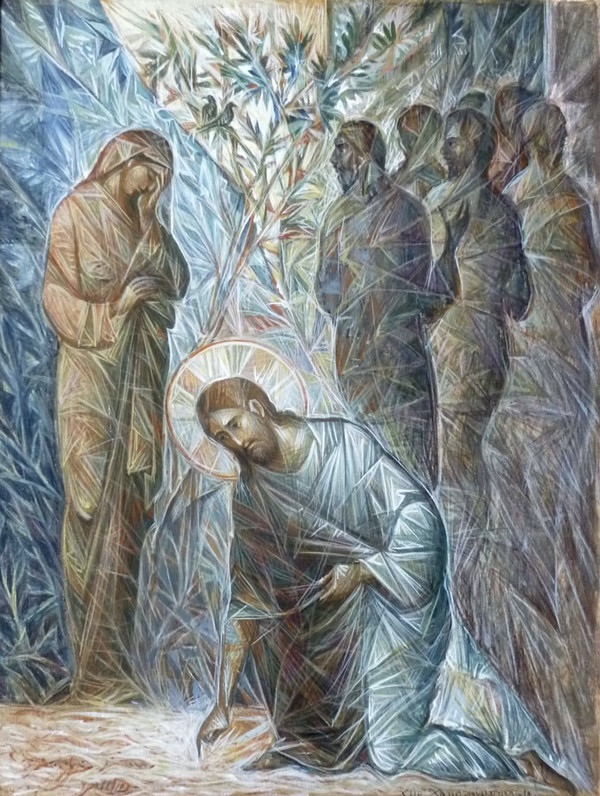
By Charalambos Epaminonda (Acrylic on Wood)
 Sunday Gospel Reflections