Homily: Fifth Sunday in Ordinary Time (B)
Mark 1:29-39
4 February 2024
Fr. Ricky Cañet Montañez
On Instagram, I came to know about this 29-year-old Kapampangan living in Nevada USA who became the dedicated full-time caregiver of his lola before she recently passed away at 97 years old. His lola was bedridden and nearly immobile from osteoporosis. Her fingers were gnarled and twisted from severe arthritis so she could no longer care for herself. This doting grandson fed her, prepared her for sleep, bathed her, changed her diapers, and did her physical therapy. Moreover, he also sat with her, talked with her, amused her and shot video content of what caring for her entailed. It was not an easy job and he had no salary but he cared for her lovingly because he could not stand to see her in a nursing home or an assisted living facility. He had a very personal way of attending to her and it has been appreciated and applauded by their millions of followers who say their story is indeed an inspiration. His name is Chris Punsalan. Find him on Facebook, Instagram , and even Tiktok and be equally inspired by their story.
In the gospel this Sunday, we are told that Jesus had been reaching out to a great number of people in His healing ministry. He was trying to cover as much ground as possible by going about “the whole of Galilee” healing those afflicted with various illnesses and freeing those possessed by the evil spirits. And yet, there is something personal in the way Jesus attended to those who come to him for healing. Jesus could have readily willed everyone to be healed from a distance. There have been instances where Jesus simply commands someone to be healed without seeing them and once a woman with haemorrhage was healed by simply touching the tassel of Jesus’ cloak. However, in majority of the healing encounters, we observe Jesus taking the time to speak with the afflicted, laying hands on them and praying for them. There is a personal aspect that characterises Jesus’ ministry.
For Jesus, people are not just “numbers” or “projects” to be dealt with in the most efficient way possible. He could have set up a table and had them queue up while he dispensed miracles like a factory production line. In this particular gospel, we observe how Jesus gets up close and personal to Simon’s mother-in-law to heal her. We read that Jesus approached her, grasped her hand, and helped her up. Take note that the expression “helped her up” is almost always used in resurrection accounts. It was believed in the ancient world that “those who were ill were thought somehow to be in the grips of the powers of death.” The act of helping her up is the same as saying, Jesus gave her back her life. When I imagined this scene unfolding, I remembered what happened to our cook, while I was living in London. When she got sick and needed to go to the hospital, she was so appreciative of the Filipino nurses caring for her because they took the time to talk to her and make her comfortable. She felt that they saw her as a unique individual, not merely another patient in the ward. They always spoke kindly to her and addressed her by her name — Brigid.
Through these gospel healing accounts; Jesus is portrayed as someone who promises hope and healing to all those afflicted with various diseases. But far more than just physical healing, these stories of healing point to Jesus’ power to save. Jesus’ healing ministry is a sign of salvation. He brings wholeness and restores what sin has corrupted and destroyed. He puts back together what is broken, saves what is lost, and revives what is lifeless. Each healing encounter is a personal one because salvation is essentially personal. Jesus will not come and say, I am here to save the entire Mejia clan or the Santos family or the residents of Bagumbayan. Jesus addresses each of us by name… nickname even. He knows everything about us — our fears, our secret sins, our struggles, joys, hopes, and dreams. When we have an encounter with Jesus, it is a very personal experience that reaches deep and touches our very core, so much so that it can be life-changing. One contemporary example of such encounters are the sacraments. We cannot hope to benefit from the communion of another. We must receive Jesus ourselves that we may be changed from within by what we consume. The reconciliation with Christ in confession is very personal as well. We cannot assume that our sins are forgiven if our mother tells the priest about them while she is in confession. There is no such thing as absolution by proxy. Salvation in Jesus is very personal.
Today, let us thank Jesus for loving us in a very personal way. We thank Him for His continuing effort to save us and preserve us for a life of fullness and wholeness with the Father in heaven. We thank the Lord for people who make that extra effort when caring for others like Chris who chose to be his lola’s caregiver and the Filipino nurses who cared for our cook in London. Let us ask Him to give us the grace, the compassion, and the patience to also make ourselves present for people who need us — our children, the elderly, the sick, persons with disabilities, the lonely and confused. May Christ use us as a channel for His healing mercy to be poured out on those in most need among us.
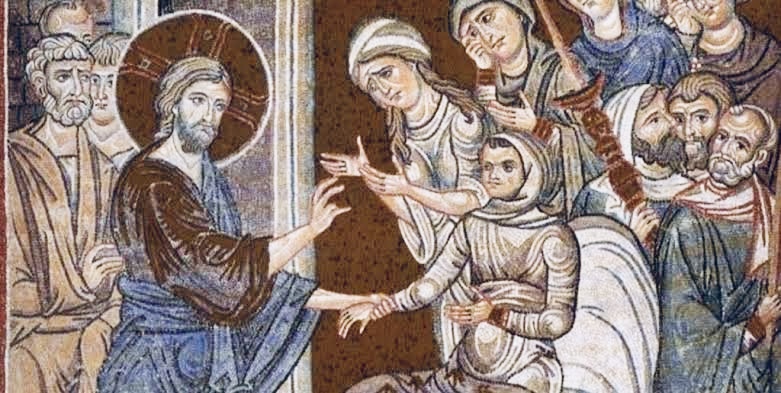
Photo from Orthodox Christianity Homily Blog
 Sunday Gospel Reflections