HOMILY: Thirty-Third Sunday in Ordinary Time
Matthew 25: 14-30
19 November 2023
Fr. Ricky Cañet Montañez, AA
Let us do a bit of Q & A here. Let us say you are blessed with P3.6 million pesos! What would you do with that amount of money? If double that amount, P7.2M or five (5) times more, P18.3M is entrusted to you, what will you do with that sum of money?
This Sunday, we reflect on the Parable of the Talents. We are told that a nobleman puts a certain amount of money in the hands of his servants as he prepares to go on a trip. A talent amounted to about six thousand denarii and one denarius was equivalent to a day’s wage. That is quite a lot of money! On this detail, we note the great confidence the master has for all of his three servants as he gives each of them a significant amount of money. Upon his return, the master asks for a reckoning of what these men had done with the money he had entrusted to them. The first two show due diligence and responsibility by doubling the amount that was entrusted to them. The third servant claimed that he was intimidated by the demanding character of the master so he just buried the money in the ground. Hence, the master scolds him and takes the sum back. He tells that servant that he should have profited from what he received or at least tried to do something with it. The servant not only has nothing but is thrown out into the darkness to suffer.
Similarly, we have all been entrusted with gifts. By God’s grace, some of us are gifted with exceptional talent, others are geniuses in math and science, others have wealth, others have charisma, etc. (Pag di kaya ng talent, daanin sa charm!) We also have been given different opportunities and choices in life. Not everyone can study. Not everyone can go abroad. Not everyone has a high-paying job. Not everyone has children. We are all entrusted with different gifts just as the three servants in the gospel were entrusted with gifts according to their ability. We are equipped differently according to the roles we must play in building up God’s kingdom. We are expected to make a conscious effort to develop what has been given to us.
We need not compare our gifts with one another. Here in our parish, the good singers are with the choir; the good readers become Lectors or Commentators; the good cooks among us can help in our feasts and the feeding programs. Neither should our differences in gifts become an excuse to avoid using what we have for the good of others. No amount of wealth or status in life should determine our capacity to return the favour. St. Augustine once said: “You aspire for great things? Begin with little ones.” Sometimes, when there is a project in the parish, when we want to avoid helping, we hear ourselves saying: “Oh, we have to do it. They are already many there who are good at it. They can do that.” Is that so? (“Ganern?”) Definitely there are those who would do an exceptional job, but in that situation, should we not help at all? Where are we good at? Maybe we can contribute to our project! What really matters in the end is that we have tried our utmost best, to maximise the potential of what we have been given.
Towards the end of the gospel we are told the servant is thrown into the darkness where there is wailing and grinding of teeth. Biblically, God is light, so darkness is a creative way of saying that one is no longer in God’s presence; wailing refers to a place of sadness and suffering; grinding of teeth is the feeling of losing control or direction in life. A bit harsh? But that is the ultimate consequence. To not use our gifts is to insult the Giver. It is proof that we refuse to play our part as a member of God’s family and to cooperate with His grand plan. Essentially our choice to bury our talents is a choice to separate ourselves from God. We must never forget we will be held accountable. Our responsorial psalm says: “Blessed are those who fear the Lord!” (Psalm 128:1) The fear spoken of here is different from the fear of that lazy steward. As children of God, our only fear is that we cannot glorify and honour Him as we should with the grace that also comes from Him.
The faithful wife described in the First Reading is an excellent model of someone who prospers the gifts she is entrusted with. First of all, she has a husband to care for and children to raise. However she does not stop there. She recognises that her immediate community is also a gift to her so she cares for them as well, especially the poor and the needy! With the gift of her femininity and talent for making fabrics, she works lovingly, skilfully and diligently. Because of her labours and good work, she is to be rewarded! God is a generous God and He is never outdone in His generosity so we can imagine how He will reward those He considers good stewards of the gifts He has given them!
To be honest, I have a habit of collecting the receipts of all my purchases every month. My other priest-friends do find it amusing and laugh at me from time to time. I learned this from my religious congregation and it has been a habit since then. It is my way of accounting for the gifts I have received. And I am very grateful for those of you whom God continues to send to support my ministry! I may not be always successful but I make sure that I allocate more to my advocacies/apostolates than my personal expenses. Whatever I receive, I make sure to share it with those I have the capacity to help — those whose lives I can impact in the name of God and for the glory of God.
Never forget that everything we have and enjoy comes from God. He is the Giver and therefore the Owner. Everything is just on loan to us. We are mere stewards of all that we have. Hence, we are to be accountable for what has been entrusted to us. The more we have, the more we will be held accountable. Let us responsibly make use of all our God-given talents not only for our benefit but for the good of all as we strive to build up God’s Kingdom in the here and now.
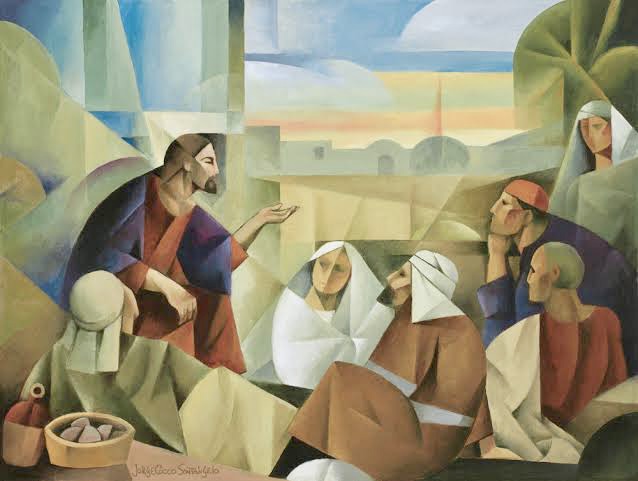
Artwork from Altus Fine Art
 Sunday Gospel Reflections