HOMILY: Twenty-Ninth Sunday in Ordinary Time
Matthew 22:15-21
22 October 2023
Fr. Ricky Cañet Montañez, AA
The Barangay Elections are happening in a few days. Thankfully, we haven’t been hearing any reports of violence during the campaign period. Nothing beats the drama and chaos of a National Election. Here in the Philippines, the electorate eagerly awaits the endorsement of the various religious sects, believing that by the volume of their membership they can sway an election in a candidate’s favour. The members must defer to the authority of their leader who is telling them this candidate is the most qualified to govern the nation. What if they don’t personally believe in that candidate? Would they still vote as one with their church? Would they support the authority of someone they don’t believe in?
In today’s gospel reading, we see how the Jews are governed by two (2) authorities — their homegrown religious leaders and the political leaders appointed by the Roman Empire. In the first century AD, Roman-controlled Judea was a politically and philosophically divided place. The Pharisees and Sadducees were among the Jewish leaders. The Sadducees were powerful. They were more traditional aristocrats who criticized the Pharisees who ran the temple and were more concerned with newer scribal law. Both groups had different philosophies and were not always in agreement. Jesus was born in the time of King Herod the Great. When he died, the region was split up supposedly among the sons. Galilee went to Herod Antipas (who killed John the Baptist). Judea should have gone to the other son Archelaus, but he failed to control Jerusalem, so governance was turned over to the Roman Prefect Pontius Pilate. Day-to-day operations were handled by the Roman-approved temple leader — the High Priest. The prefect would only intervene when necessary, to keep order. Tensions were always high and riots broke out every now and then, disrupting the peace.
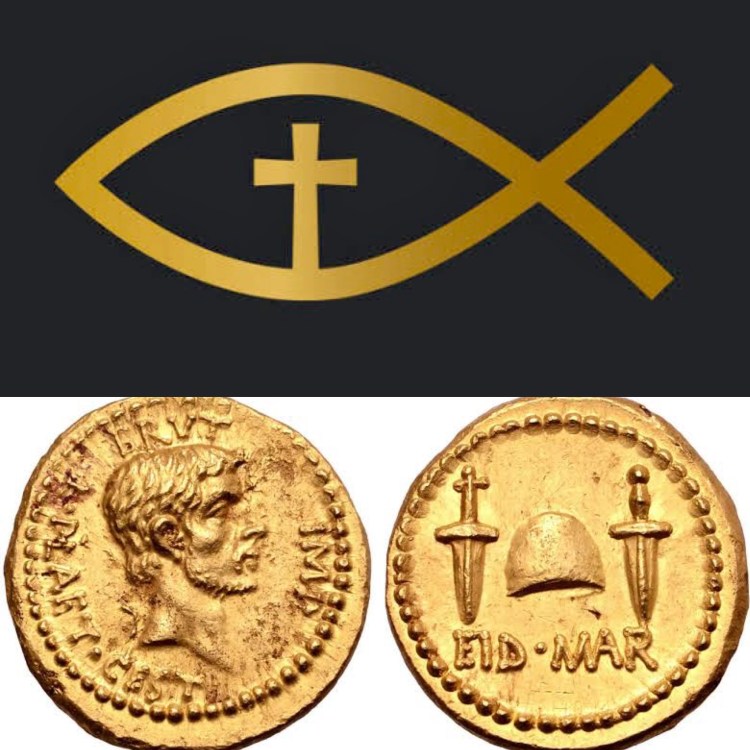
The society in the time of Jesus was marked by a conflict of civil interests and religious values. Being the foreign and pagan power, Rome was seen as the enemy. For the Jews, faith was more than just a religion. It was their very identity and culture as a people. It is in this context that we understand why Jews detested and resented paying taxes to Ceasar with a Roman coin bearing the emperor’s image. Hence, the question posed to Jesus by the opposing factions of the Pharisees and Herodians was a trap. If Jesus said it was permissible to pay taxes He would offend the observant Jews. On the other hand, if he said it was unlawful, he risked being accused as a revolutionary. The question was a double-edged sword designed to get Jesus into deep trouble, no matter how he answered.
Now, how did Jesus answer the question? A commentary on this passage points out that “the trick, in this verbal sparring is to pose a counter question — one that contained a Biblical allusion. In this case that allusion was in the word ‘image’.” Jesus asks: “Whose image is this?” Without much difficulty we could tell right away where this allusion was from… The Book of Genesis 1:27 says that we are made in the image and likeness of God. So while the denarius coin bears Caesar’s image, we all bear God’s image and likeness. Jesus made use of this argument to make them realise that ultimately all of us owe allegiance to God alone for everything belongs to God!
Now, we may ask what exactly did Jesus mean when he said: “Render to Caesar what belongs to Caesar”? (Matthew 22:21) What did Jesus mean by it? It is simply a reminder that although our total commitment should be with our Creator alone, we also have a duty to give society what it asks of us — our cooperation to promoting the common good. We have to trust that God uses people to accomplish His plans, even if these people are of another race, religion, or ideology. In the First Reading (Isaiah 45:1,4-6), the prophet declares that the Persian Emperor Cyrus, though pagan, is God’s anointed instrument to liberate the captive people of Israel from the Babylonians and allow them to return from exile! We cannot help but be governed by civil authorities but we can choose to work with them in order to bring about a society where the values of the Kingdom of God are upheld and promoted.
At the start of the campaign last October 19, Thursday, did you know that all the candidates of the three (3) parties attended our mass and ask for prayers? This is the very essence of the UBAS, Ugnayan ng Barangay at Simbahan. It was such a moving witness of unity for the good of Barangay Bagumbayan. We are fortunate because these days, leaders aren’t simply appointed — we have elections to choose by majority vote who has authority over us. Let us take the time to get to know our candidates and let us pray for guidance that we may discern who are those who can help our community best. May God bless us all!
 Sunday Gospel Reflections