HOMILY: Solemnity of the Most Holy Trinity (Basic Ecclesial Community BEC Sunday)
John 3:16-18
June 4, 2023
Fr. Ricky Cañet Montañez, AA
I chanced upon a video of a young Filipina stand-up comedian cracking a joke about the Catholic practice of making the sign of the cross. She likened it to hand signals used by street gangs to secretly identify their members. I could have shrugged my shoulders and chalked it up to her ignorance but it occurred to me that even those among our ranks often take for granted the act of crossing themselves! The sign of the cross is in itself a prayer, calling on God the Father, the Son and the Holy Spirit for assistance or blessing and acknowledging with reverence the God we worship.
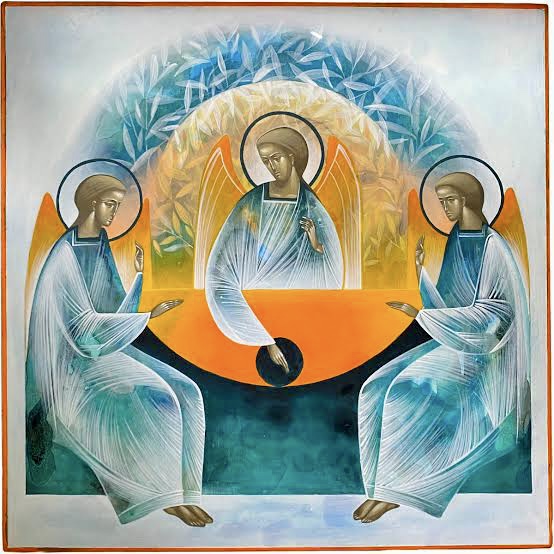
Today is the Solemnity of the Holy Trinity. We give special honour to the Trinitarian God we name in the sign of the cross. We believe there are Three Divine Persons in One God, but it is not something we can really explain, can we? The dogma of the Trinity is difficult God-talk and it is not easy to understand. I remember some of us praying before our comprehensive exam in Theology not to be asked a lot about the Trinity. Although we want to avoid talking about it, we cannot ignore it for it is the central mystery of our faith and the source of our own life and holiness as Christians.
First of all, let us be very clear that human beings did not create the concept of the Holy Trinity. It is rather the result of human reasoning’s collaboration with divine revelation. Any human attempt to define God, or to describe who God really is, would only prove to be inadequate or deficient. God, Himself, in his wisdom and mercy, reveals His reality to humanity. He does this through sacred scriptures — both the Old and the New Testaments. Through the Bible, we arrive at some understanding of the divine essence when we reflect on what God has done for us and for all His people.
In the passage from the Book of Exodus, God Himself reveals His name: YHWH (the LORD)! Then it is followed by a description of what that name means. God is merciful, gracious, slow to anger, rich in loving kindness and truth. (Exodus 34:6)If we look closely, all of these adjectives are relational and somehow associated with God’s relationship with His people. They identify the dispositions of God toward covenant partners. God has revealed some characteristics of divine love. God is merciful that despite the stubbornness, ingratitude and unfaithfulness of the Israelites, God renews His covenant with His people. He does not turn away from them but rather remains faithful to His promises.
This graciousness of God the Father finds fullness in the person of Jesus Christ. Throughout His life on earth, He lovingly gave to anyone and everyone the means to salvation, excluding no one from His saving work. St. John tells us: “God so loved the world that He gave His only Son, so that everyone who believes in Him might not perish but might have eternal life.” (John 3:16) God the Father gives Jesus to humanity, so that Jesus could reconcile us with Him.
In St. Paul’s Second Letter to the Corinthians 13:13, he writes how the fellowship of Father, Son and Holy Spirit is an essential part of God’s character. If we live lives of harmony and peace, we essentially participate in the very essence of the Trinitarian life which is LOVE. That is why St. Paul urges the Corinthians to greet one another with an expression of this love in their encounters. Similarly, we who are all baptised in this truth and who constantly acclaim this during the welcome greetings at every mass are continually called to share in the communion of persons — Father, Son and Holy Spirit. Our belief in the Trinitarian God by which we have all been baptised (“I baptise you in the name of the Father, and of the Son and of the Holy Spirit.”) should propel us out of our lives of isolation and separation to life of communion and fellowship with others.
I am most certain that despite my attempt to help make sense of this Dogma, it still leaves many questions unanswered and it perhaps creates even more questions. This is however the reality of a Divine Mystery. We allow God to reveal Himself to us in moments of our life — not necessarily the defining moments, but even in the quiet seemingly insignificant moments — such as when we quietly cross ourselves when passing a church or before we go to sleep at night. Today we pray that God will increase our faith and keep us attuned to His gentle proddings to encounter Him as Father or Son or Holy Spirit.
Having said of all of these, the Trinity of God is definitely a mystery, which we cannot have a full grasp of. Yet as “we find ourselves mumbling our words in our attempts to understand that which we can never fully understand,” our assurance is Jesus’ promise that through the Holy Spirit we will be led to the Truth of God the Father’s love for each and everyone of us.
Art Work by Kateryna Shadrin
 Sunday Gospel Reflections
Thank you for the lovely homily, Father.
LikeLike