HOMILY: Seventeenth Sunday in Ordinary Time
Luke 11:1-13
24 July 2022
Fr. Ricky Cañet Montañez, AA
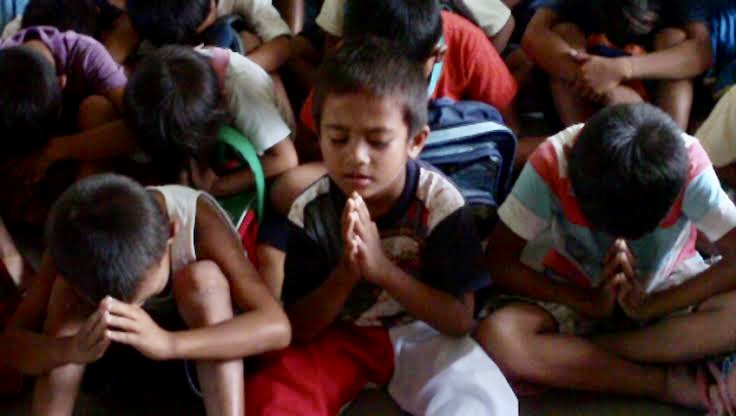
Paano ka magdasal? How do you pray? Kailangan ba nakapikit ka at nakaluhod? Sa loob ka lang ba ng simbahan nakakapagdasal? Do you pray rosaries and novenas? Or do you pray from the heart? To whom do you address your prayer? To God the Father? Jesus? The Nazareno? The Sto. Niño? What do you say? Panay hingi ka lang ba? Nagbibigay puri ka ba? Humihingi ka ba ng tawad? Do you pray for yourself only or for others? Mga kapatid maaaring may iba-iba tayong nagugustuhan o nakagawiang paraan ng pagdarasal pero kuntento na ba tayo doon? May pagkakataon ba’ng ninais rin natin na mas lumalim pa ang ating karanasan sa pagdarasal?
In today’s Gospel the disciples ask Jesus how they ought to pray. Jesus responds by teaching them what we now call as “The Lord’s Prayer” or “The Our Father”. Every Christian — whether Catholic, Orthodox, Protestant, Born Again or whatever denomination — acknowledges and prays this as a legitimate way to converse with God. Some question whether Jesus was teaching us a prayer that we should repeat verbatim (word for word) or simply showing us a pattern to follow in praying. Most commentators believe that it is the latter or both. Para Kay San Augustin ang Ama Namin ay kumpleto nang dasal. He advises: “What we ought to pray for is in the Lord’s Prayer; what is not in it, we ought not to pray for.” There are three things we should reflect on about this moment of Jesus teaching us to pray.
First of all, when Jesus is asked about prayer, Jesus says to call God — Father. The invocation “Father” suggests a relationship that is intimate and child-like. When we pray, we are to speak to God like family, because He is our Father in heaven, and like most fathers on earth, He wants to guide, help and protect us. “What father among you would hand his son a snake when he asks for a fish? Or hand him a scorpion when he asks for an egg?” A good parent would naturally give only good things to his/her child. Notice also the plural pronouns in the prayer — “OUR Father”, “Give US this day”, “Forgive US, etc. — these denote communal character. Sama-sama tayong anak ng Diyos. Hindi lamang sarili natin ang ating inilalapit sa Panginoon kundi pati ang ating kapwa na dapat ituring bilang kapatid.
Secondly, Jesus teaches His disciples to persist in their prayer, as Abraham persisted in begging God’s mercy for the innocent of Sodom and Gomorrah. They are to be persistent in their prayer as characterised by the man who awakened his sleeping friend to offer hospitality for another friend. Neither Abraham nor the man in the gospel was deterred by any obstacle. In one of the commentaries, I read it says that “the English translation “persistence” actually weakens the impact of the original Greek word anaideia. St. Irenaeus and Clement of Alexandria who spoke and wrote in that language, translated the term as “shamelessness” (kawalan ng hiya). In his persistence, Abraham may have even seemed too bold to have haggled with the Lord about divine justice. The needy friend in the story is depicted as shamelessly disturbing the peaceful midnight slumber of his friend and his household. He was also risking his friendship with one friend in order to respond to the need of the other. Take note again, that the two narratives describe prayer as offered for someone else. Confident prayer is confident, daring and yes, shameless as one looks to God as a parent. If you have noticed, the Our Father is prefaced in the mass with these words… “At the Saviour’s command… we dare to say…”) I would like to believe that this shamelessness in prayer is nothing but an expression of deep trust in our heavenly Father’s goodness and His love for us, His children.
Thirdly, our prayer changes us. Through our persistent prayer, we come to the knowledge and consciousness that everything is in God’s hands and to trust that God will respond to our prayers as He sees fit. Pope Francis in one of his instructions on prayer said: “We’ve all experienced this — how many times have we knocked and found a closed door? In those moments, Jesus recommends that we insist and not give up. Prayer always transforms the reality — always. If the things around us don’t change, at least we change, our heart changes. Jesus has promised the gift of the Holy Spirit to every man and every woman who prays.” Laging may higit na kabutihang naidudulot ang pagdarasal. Kung di man nasasagot ang ating hiling na masulusyonan ang problema o pangangailangan natin, maaaring tayo ang pinatatatag ng Panginoon upang malampasan natin ang ating problema.
I read somewhere that God indeed answers our prayers but responds to them in three ways: (1) YES. These are prayers that are granted as they are requested because they are in line with His plan for us. (2) WAIT. He grants it according to His own timing… Sometimes we do not get the things we pray for right away because it is ‘not yet the time’ for us to have them. As they always say: “God’s timing is always perfect and so it is never late!” (3) NO. God answers our prayers but not according to how we want them answered because He has something better for us. What we ask for may not always be good for us! We have to trust that God knows best.
Brothers and sisters, when we pray, we are conversing with the living God who hears and answers prayers. He is our loving Father who persists in a loving relationship with us, His children. Let our prayer be the means to get to know God more and to grow deeper in our relationship with Him. Let us open yourself up in prayer and pray often that we may benefit from its transformative power. Yes, let us be shameless in your persistence and with confidence let us call on God our Father who loves and cares for us, His children!
 Sunday Gospel Reflections