HOMILY: Fifteenth Sunday in Ordinary Time
Luke 10:25-37
10 July 2022
Fr. Ricky Cañet Montañez, AA
Narinig niyo na ba ang kasabihang ang taong mapagkakatiwalaan sa maliit na bagay ay mapagkakatiwalaan sa malalaking bagay? “Whoever can be trusted with very little can also be trusted with much.” (Luke 16:10) The key is consistency. Pag palagi mong ginagawa, nakakasanayan mo na. It becomes a habit. In some instances, you can easily observe the progression. Winners in competitive sports don’t become successful overnight or simply because of luck. They work hard and train regularly to become the best. Sometimes, it’s less obvious such as when one builds character. Nangyayari ito sa loob ng mahabang panahon. Minsan di na napapansin. If you think about it, your actions throughout your lifetime have molded you into the person you are now. You are actually the sum of your experiences.
Bakit kailangang nating banggitin ang pambungad na iyon? Sapagkat importanteng makita natin na sa kwento ng Mabuting Samaritano, ang bida ay kumilos alinsunod sa kanya nang nakagawian. For us listeners and perhaps the other characters in the story he did something extraordinary. However, for the Samaritan, saving another human being in need was the most natural thing to do.
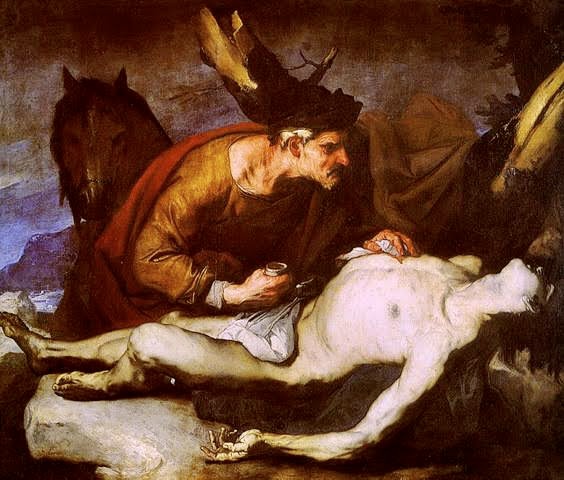
Jesus’ Parable of the Good Samaritan in today’s gospel reading challenges some aspects of our notion of goodness. A commentary I have read on this parable suggests that the act of the Samaritan was good not solely because he attended to the injured man but because what he did was not unusual to what he had been doing all his life. That is to say that this man’s random act of kindness… his attending to the injured man is simply second nature to him. This benevolent gesture however, was just magnified when contrasted to the hesitation, if not the total indifference, of the priest and the Levite. We expect the Jews in the story, by virtue of their race and religion, to rush first to the aid of the injured man; to our surprise, they did not. They avoided him, justifying their actions with their desire to adhere to the Jewish laws for Sabbath and ritual cleanliness. They did not want to be inconvenienced because if they helped him, they would be ritually unclean for the Sabbath and would need to go through the process of purification. Hassle masyado.
Through this story, Jesus is trying to teach the scholar of the Law (and all of us, His followers) two things. Firstly, we are made to see that goodness is cultivated through the practice of good habits and noble character. Goodness is a habitual discipline that requires practice and often entails readiness to make sacrifices. The Samaritan did not start out his journey thinking about the good that he can do for others. When the need arose; nevertheless, he was ready to respond in charity and mercy. He may have been immortalised for his charitable act but to a selflessly good man, doing the right thing is a must, an instinct. Secondly, to be humane is more important than following laws. This is the law written within our hearts — not some legalistic keeping of specific commandments, but rather simply an instinctive concern for the other that arises out of genuine love. The Samaritan did not only bandage the wounds of the injured, but he also brought him to the nearest inn and provided for his immediate and subsequent needs. He personally cares for the victim. To spare no expense to help a stranger is an example of how Jesus teaches us to love… personally, extravagantly, continuously.
Every now and then, when we become frustrated and disappointed with our church and civil leaders, we lament the lack of good men and women in society. They did not become corrupt, greedy, and arrogant overnight. These bad habits and unfortunate characteristics were developed in them over time. Conversely, we need to realise that good men and women come from families where kindness is practiced, respect is fostered, honesty is embraced and integrity is lived. Goodness has to start when we are young. It has to be nurtured and encouraged from a good home. If you are parents, you need to provide this environment for your children to learn compassion. Reinforce and validate their good behaviour and kindness so kids learn to make this a habit.
During the shooting in a school in Uvalde, Texas, a border patrol officer made it to the scene and saved the lives of many frightened school children. He was not there as a trained law enforcer. He was there because he was a good, protective father and a husband. His wife and daughter were trapped in the school and he was there to save them. In the process, he saved dozens of other students. After his family found safety, he continued to risk his own life to save other children. Paano niya kinaya yun? Napagtantong mabuti siyang ama na nagmamalasakit sa anak niya. He saw the other frightened kids and remembered his own children. He could not leave them behind at the mercy of the shooter. He doesn’t like being called a hero because for him, he only did what he would do for his own children.
As Christians, may we strive to cultivate kindness in ourselves and extend the same goodness of heart to those in need among us. May we always keep our eyes open to opportunities where we are needed by others and may we strive to be loving persons, good Samaritans to one another, always guided by the law of love and compassion. And in so doing, may we with God’s grace inherit eternal life.
 Sunday Gospel Reflections