HOMILY: Solemnity of the Most Holy Body and Blood of Christ
Luke 9-11-17
19 June 2022
Fr. Ricky Cañet Montañez, AA
Do you remember what it feels like to be hungry? I’m sure all of us have felt it at one time or another. When I was a student, it was typical for my classmates and I to miss meals when cramming for tests. My teachers would caution us “hindi gagana ang utak pag walang laman ang tyan.” Some of us got really cranky when hungry. I understand theres a term for that these days —- “hangry”. (Angry when you are hungry…) May ganyan ba sa inyo? Parents, generally do not have that luxury. For whatever reason: kulang ang pagkain or walang pambili ng pagkain, they will forego food as long as their children get to eat. Isusubo na lang, ibibigay pa sa anak. What a sacrifice, right?
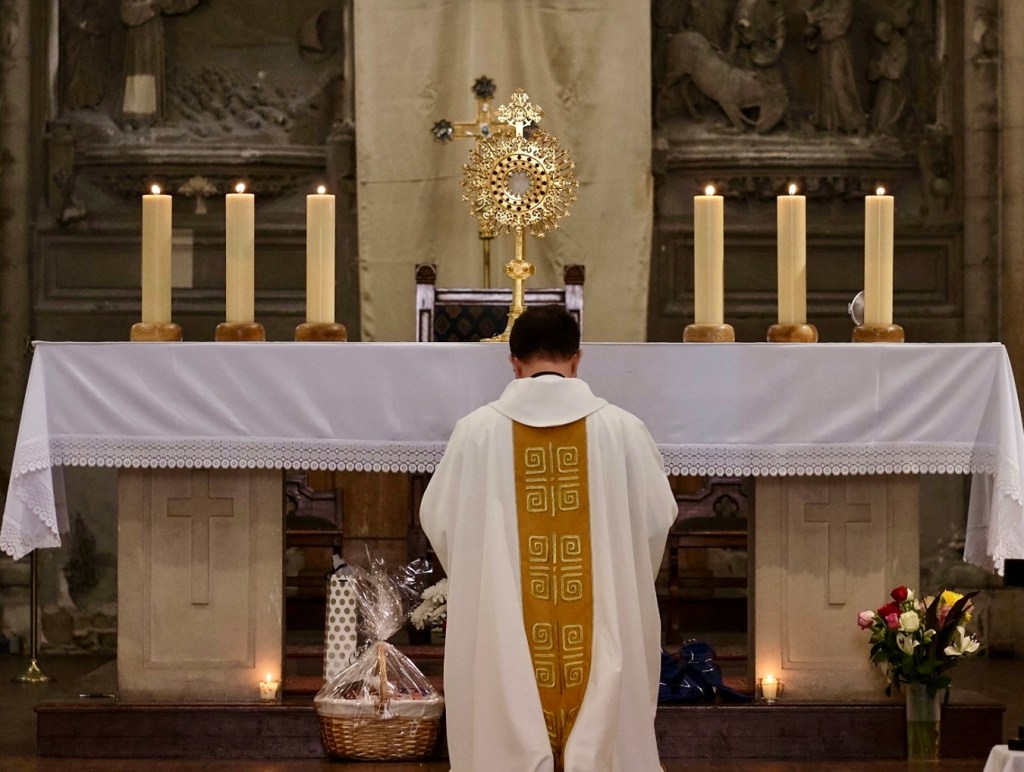
This Sunday we celebrate the Solemnity of the Most Holy Body and Blood of Christ, traditionally called in Latin as the feast of Corpus Christi (The Body of Christ). You may be wondering why our gospel today is on the feeding of the multitude with five loaves and two fish instead of a passage on the Last Supper where Jesus institutes the Eucharist. We shall get to that. For now, I invite you to listen and remember 3 “S”es. The Body of Christ as a Sacrifice, as Sustenance and as a Symbol of Love.
SACRIFICE. We know that at the last supper Jesus leaves His followers with a special gift. He institutes the Eucharist as a memorial of His offering up of His Body and Blood to save us from the consequence of sin. From that moment until today, every time we celebrate the Liturgy of the Eucharist and receive communion, our faith tells us we are receiving not just bread and wine but the Body and Blood of our Lord Jesus Christ. At every mass, we re-live the sacrifice of Jesus on the cross when we listen to the words of consecration… “This is my body which will be given up for you” and “This is the chalice of my blood…. which will be poured out for you and for many for the forgiveness of sins…”. Through the mystery of transubstantiation, the bread and wine are transformed into no less than our Lord, Jesus Himself. Not Jesus in His glory, but Jesus, who was beaten, bruised, crucified and sacrificed for us. Sometimes, we forget that and line up for communion, ready to receive just a host. When we line up for communion be prepared to receive our Saviour, who gave up His life for us, who took on the punishment for our sins. When possible, go to confession and receive Jesus in the state of grace. If it is not possible, simply make a perfect act of contrition and be sorry for your sins. I also still subscribe to the practice of fasting from food and drink one hour before receiving communion. It reminds me that “man does not live on bread alone…” (Luke 4:4) Stand up straight, approach with a grateful heart and receive the Lord with reverence and love.
SUSTENANCE. Our gospel talks about how Jesus provided food for a multitude with a few loaves and fish. He provided bodily sustenance for His followers who were getting hungry for the day. Through His sacred Body and Blood — the lasting gift of Himself made available to us, Jesus continues to sustain us to be true to what we all have become through Him — God’s beloved children. We acknowledge and honour the wonderful gift of the Eucharist as spiritual nourishment and its implication in our life as followers of Jesus. Through the Eucharist, we are also Jesus nourished to become a source of nourishment for others. “Give them some food yourselves.” (Luke 9:13) Through these words, Jesus wants His disciples to realise that His mission of shepherding over God’s people continues through them. Like Jesus, they are to look after the needs of others not only spiritually but physically as well. It is not enough to simply feel sorry for them. We are to endeavour to provide for the needs of those less fortunate among our brothers and sisters. St. Theresa of Calcutta once said: “I used to pray that God would feed the hungry, or do this or that, but now I pray that he will guide me to do whatever I’m supposed to do, what I can do.” Like the disciples, we might also find ourselves asking how we can possibly help feed these people. “Five loaves and two fish are all we have…” (Luke 9:16) The disciples felt they have too little to share. What they have is obviously not enough for so many people. Through the Feeding of the Multitude with five loaves and two fish, Jesus wanted to rectify this defeatist mentality of considering what is “meagre” as “nothing”.
SYMBOL OF LOVE. Let us be conscious that Jesus’ sacrifice that gives us a continuous source of spiritual sustenance are proof of God’s love for us. God allowed His only Son to become flesh, to live as one of us, to subject Himself to the difficulties of human life, to suffer and die a painful death so that He may draw us once more close to Him. By the sin of Adam and Eve, heaven was lost to humankind but through Jesus, the door to eternal life was opened again for us. What compels the Almighty to do this for His lowly creatures who consistently disappoint Him? LOVE. Jesus reveals to us, that if we accept Him as our brother, we become adopted sons and daughters of God. We can dare to call Him “Father” in the same way Jesus does as His only Son. Today is Father’s Day. Happy Father’s Day sa lahat ng mga tatay at father figures. We can not expect all fathers to be perfect because it is a tough job. It is said that fatherhood is not simply having children but it is about raising children, right? Hindi ka ama dahil nagkaanak ka. Ama ka kung ikaw ay nagpaka-tatay. If you are a father, remember that you are the first example of fatherhood whom your children will witness and live with. The concept of God as Father is likely based on these children’s experiences and understanding of what a fatherly role, responsibility, presence… and love is. Kaya sa mga tatay nawa’y pagsumikapan ninyong maging mabuti at mapagmahal na ama upang makilala ng inyong mga anak ang kabutihan at pag-ibig ng Diyos Ama.
SACRIFICE, SUSTENANCE AND SYMBOL OF LOVE. These are the things we need to remember about the Most Holy Body and Blood of Jesus Christ. Huwag ipagwalang bahala ang sakripisyo ni Hesus. He paid a high price for our salvation. He paid with His life. Let us not take for granted the gift of the Eucharist. Let us receive Jesus in communion as often as we can. He meets us at every mass. It is our hope that we become what we eat. Allow the Lord to sustain us, strengthen us, and transform us through His Body and Blood. Lastly, remember the greatness of God’s love. A love that has transformed the cross — a symbol of shame and punishment to a symbol of salvation and love. To all fathers out there, you have been blessed by God with children. Care for them and raise them with the model of God’s love. By your actions, witness to the goodness and mercy of God.
On this feast of Corpus Christi, we are called to witness to the generous love of God, in the very gift of Christ Himself broken and shared in the Eucharist. Nourished by Jesus through the Eucharist, we are challenged to become more and more a source of nourishment for others. We are impelled to live the Christ-life by going out in service to the needs of others so Christ can continually be vibrantly present and active among His people in our world.
 Sunday Gospel Reflections
Thanks so much Fr.
LikeLike