HOMILY: Solemnity of the Most Holy Trinity
John 16:12-15
12 June 2022
Fr. Ricky Cañet Montañez, AA
Did you know that in 2019, an organization released the results of a study on the learning capacity of students from around the world? The Philippines ranked the lowest in reading comprehension and second lowest in science and mathematics among 79 countries. That was in 2019. With the pandemic forcing students to do online learning in the 3 years following, do you think the capacity of our students for learning has improved or deteriorated even more?
Of course, there are many factors at play but inevitably, one reason for these dismal findings is the lack of interest in learning especially about topics that are not “fun”, or that which we think can’t help us earn more money. Even when we were students ourselves, we must have wondered why we need to learn Calculus, Biology, Chemistry, or Shakespeare if we want to be lawyers or businessmen or priests one day? Doesn’t this also translate to the equally unpopular topic of religion? If we go to a Catholic school, the subject is at least part of the curriculum and students must learn the faith (even if begrudgingly for some), but it is not the case in the public school system. If there are no catechists helping out, where do our young people learn the important aspects of our faith? Do we even care to ask questions? Can we teach our faith to our children and grandchildren?
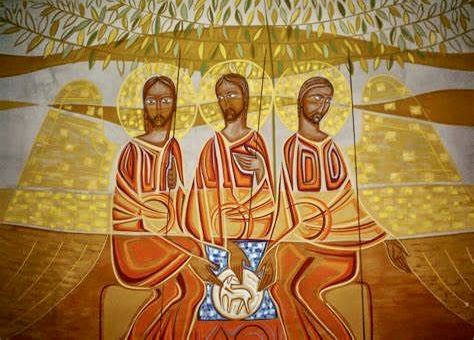
We don’t have to be Bible scholars or trained to be Catholic apologists but at least we need to understand our faith because we cannot say we love what we do not know and we cannot teach/share what we do not understand. Paano mo masasabing masarap para sa iyo ang pagkain kung di mo alam ang lasa o ang hitsura? Paano mo masasabing tunay mong mahal ang gusto mong maging girlfriend or boyfriend kung di pa kayo nagkakakilanlan? Isn’t it true that when we love someone, we want to spend as much time with them and truly get to know them? And isn’t it true that the more we know them, we are able to proudly introduce them to others? For example: Mabait, maganda, matalino, magaling magdamit, masarap magluto, etc. Today, we celebrate the Solemnity of the Holy Trinity. How is it that we claim to believe in one God and yet we say we have a Triune God? Three in one, just like coffee? How is it that three persons in one God do not equate to three Gods? How do you explain to a child that 1 + 1 + 1= 1? One of the most important dogmas of our church remains a mystery. Yes, we may not understand everything about the Trinity now but that simply means there is still much for us to learn.
Learning can come when we have a genuine interest in something or someone, as in our earlier example of the person in love. Learning can also come when we are overcome with doubt such as when people doubt the existence of God. May Diyos nga ba talaga? Paano siya naging Santatlo? Sometimes, doubt is a good starting point of knowledge because it can prod us to discover the truths of our faith. Someone said that “some of the world’s most devout believers have something in common: from time to time, they were plagued by doubt.” This brings to mind what the character of Father Brendan Flynn in the movie Doubt based on the multi-awarded stage play, Doubt: A Parable. Father Flynn said: “Doubt can be a bond as powerful and sustaining as certainty.” Dahil nagdududa ka, nagakakaroon ka ng mga katanungan, napapaisip ka at nauudyok na maghanap ng kasagutan.
The development of our church doctrines, although divinely inspired, are the product of a long process of human thought and learning. The Church has always encouraged critical thought in dealing with our faith beliefs. The tenets of our faith found in the CREED for example are products of thorough and tedious debates and discussions of many church thinkers throughout church history. Others challenged Catholic beliefs and our forefathers were forced to gather, pray, and learn together what they were able to pass on to us. So, when people tell us that we Catholics are not encouraged to think for ourselves in terms of the tenets of our faith, this we know is not true. We survived 2000 years because of the process of questioning and learning that we may understand better what we pass on to the next generations.
Finally, we have to acknowledge that God plays a huge role in what we know about Him. God revealed His power and might as Father and Creator through the prophets and great leaders in the Old Testament. In the New Testament, Jesus became man to further reveal God as merciful and loving to all of humanity. After Jesus’ Ascension, until this very day, the Holy Spirit continues to instruct us and helps us understand our faith and the will of God the Father. The dogma of the Holy Trinity is not a product of pure human reasoning but rather the result of reason’s collaboration with divine revelation. We can never come to know the God who is one in three, without God first revealing this to us. In the gospel passage, Jesus makes clear to His disciples: “I have much more to tell you but you cannot bear it now.” (John 16:12) And the Lord continues by assuring them that the Holy Spirit will lead them (and us) progressively to a deepening grasp of the truths that He Himself reveals in time. As it turns out, our maturity in the faith as well as growth in discipleship require the use of our intellect. The Church, through the power of the Holy Spirit endeavours to help us understand why we believe what we believe and do what we do so we can better understand, appreciate and live out the teachings of Jesus with meaning and purpose. The Holy Spirit continuously opens us more and more to the mysteries of our faith.
We may not know or grasp everything about our Triune God but we know that the Father, the Son, and the Holy Spirit for all times has continuously reached out to us in love and has desired to be known by His people as a loving God. The Trinity of God is definitely a mystery and we will continuously struggle in some attempts to understand it, but it is vital to TRY, if we are to adequately teach our faith to the youth and help them to understand it. The blessing of today’s solemnity is that Jesus in the gospel passage reminds us that He will always be with us through the Holy Spirit who continues to lead us to the Truth.
 Sunday Gospel Reflections